
Today, I'm doing something a little bit different. Previously, I have reviewed physical board games that I own. Some of them have been out of production, and some of them have been new; but they have all been good old-fashioned "card and plastic" board games. However, I recently picked up an iPad for work. Of course, I started downloading board game apps for it almost straight away. I should probably see someone about this little addiction I have...
Talisman: Prologue
For iPad and Android Tablets
For 1 player (yes, you read that right)
Sigh.
Is that a good way to start a review? I don't know. It probably gives the game away a bit. I'll start again.
Sigh.
Nope. Sorry. My immense disappointment with this app makes it entirely impossible for me to even attempt to go into this review with a more upbeat opening.
I suppose it's my own fault really. After all, this is a digital version of Talisman. You know, that game where you roll a dice, move left or right a bit, draw a card, roll some more dice, and then maybe die.
That's a pretty damning description of Talisman.
I know, I'll go back in time to when I was just a wee lad, and talk about my prized copy of Talisman: Second Edition. I absolutely adored that game. It had beautiful artwork, and for a young boy, it really was a great adventure that fired the imagination. You picked one of what seemed like dozens of different characters, who all had different strengths and weaknesses, and different special powers (man, I love special powers); then you found your starting place on the board, put down your playing piece (a cardboard standee in those days - none of this fancy plastic stuff), and then you started to roll dice...
So many dice.
The board was divided into an outer ring, a middle ring, and then the centre section. The aim of the game was to move around the outer ring, buff up a bit by killing monsters and finding treasure, and then advance to the middle section. Finally, you would go into the centre of the board (using the eponymous "talisman") to claim the crown of command.
To move, you rolled a dice, and then you got to make one of your only choices in the whole game: Left or right. The decision was rarely that difficult:
"If I go left, I land in the desert, lose one life, and don't get to draw an adventure card? If I go right, I land on the fountain of strength and gain a strength point. Hmm..."
Once you landed on a space, you followed the instructions printed on the board (like The Game of Life or something). The instructions would normally tell you to draw an adventure card. The card would be a monster, a treasure, an event, or a follower. Followers travelled with you, and gave you some kind of benefit, and you could carry a limited amount of treasure which would help in certain situations. Events happened immediately, and usually did something annoying like forcing you to lose a life, all your money, a follower, or an item. Monsters would immediately fight you.
Fighting involved rolling a dice, and then adding any bonuses from items and followers. To this total you would then add your strength (if fighting a physical monster) or craft (if fighting a spirit). The monster did the same. Highest score won, and the loser lost a life.
Once you had killed monsters totalling seven strength you could cash them in for a permanent bonus to your strength. Same for craft monsters, only you got a permanent craft bonus instead.
Eventually you had enough bonuses, items, and followers to brave the inner regions of the board, and someone would win.
Usually.
Other times the game would just go on so long that everyone would get thoroughly annoyed and give up.
The biggest problem with Talisman is that there were no real choices, and not very many ways in which to mitigate the swings of fate. You could be doing really well, and then you could get turned into a toad. You could be doing really badly, and then find a lance that allowed you to cut through dragons like they were goblins. Sometimes you would hit nothing but bad adventure cards, while all your opponents were constantly picking up treasure and followers. It was infuriating, it was random; but it was an experience.
I loved Talisman, but I hated it to. I loved the start of every game. I loved selecting a character, and then watching that character grow. I loved seeing my army of followers getting bigger and bigger. But it usually happened that, by the time I got about halfway through a game, I was beginning to get fed up with it.
Still, when a third edition of the game came out, with groovy plastic characters, or course I bought it. I bought it because the idea of Talisman was so much better than the game of Talisman. I never really felt like I was playing the game: I was just rolling dice and then seeing what happened. It was like an elaborate adventure story that I had no control over, and which usually had an unhappy ending.
Anyway, eventually I went to university, so I got rid of all my board games, including both editions of Talisman (with multiple expansions). It was a bad move, because most of the games I got rid of, I now hunt for on eBay, and end up paying silly amounts of money for.
I have often considered buying the current edition of Talisman, but I always stop myself. I always tell myself, "No, you really won't like it. You have other adventure games now. Good adventure games, that give you choices. Adventure games that give you characters that all feel really different from each other, and grow in interesting ways instead of just building up one of two statistics. You don't need Talisman."
You see, I love picking a hero character. I love watching that hero grow, gaining new skills and weapons. I love adventure, and the story that each game brings. I just don't think I love Talisman any more.
However, recently Talisman: Prologue was released for the iPad. An excellent excuse to pick up the game for £2.99 rather than £40.
Bearing in mind that I have always known that the game is a luck-fest, it is quite surprising just how disappointed I was with this app.
First of all, I have to say it looks beautiful. The artwork is taken from the game, and Talisman has always been a very attractive product. Unfortunately, that is pretty much where my positive comments run out.
You see, this app is for one player only. Yeah. That's right. One player.
Apparently they are rolling out a multi-player option later on. It really needs that option, because I honestly see no reason to play Talisman solo. This game has always been about the banter: Laughing as your friends turn into toads, and groaning when they find a talisman before you do. When you are sat on your own, watching random events knock you all around the (digital) board, it just doesn't seem that entertaining.
I expect the multi-player add-on will incur a fee. Frankly, I think that functionality should have been there from the start. Maybe I am just old fashioned.
The problem with being a solo experience is that the designers had to give you a reason to play. They chose to go along the lines of giving each character in the game a series of quests, which loosely hang together in a campaign that forms a story. For example, the warrior character starts off in his first quest learning how to fight with two weapons (you just pick up two weapons and fight a monster with them), in his next mission he tries to rescue a princess from bandits. Once you kill the bandits, you realise the princess has been taken by ogres, so in mission three you have to kill the ogres. This continues through all six missions.
In theory, it's a good idea. In practice, it's a problem.
It has always been the case that a game of Talisman will be as long or as short as the players want it to be. If everyone is cautious, the game will take an age. If one player really starts to race to level up, it forces everyone else to do the same thing. But if you don't have any opponents at all, you don't have any incentive to rush. You can just creep around the board, slowly building up your strength and craft until you are ready to wipe the floor with anything you meet.
The designers of the app realised this, and attempting to resolve it by making the challenges time trials. If you complete the mission in only a few turns, you get three talismans, if you take longer, you score less and less talismans. You can complete your mission and yet score no talismans at all.
Seems like a good solution, right? Wrong.
Wrong. Wrong. Wrong. Wrongity wrong wrong.
It's wrong, because the mechanics of Talisman do not allow you to win any of your missions through skill, and there is no way to skilfully complete a mission within a time limit. If you get three talismans on a mission it is because you got lucky.
As an example, consider the first mission for the troll character: He has to lose a life, use his special skill to regenerate that life, and then fight a strength nine monster. To get three talismans, you need to do all this within ten turns. Doesn't sound too hard, especially when you realise they have stacked the deck of adventure cards so that the first card you draw is always the pestilence event that forces you to lose one life.
The problem is that the troll's special regenerate ability can only be used if you roll a six for movement. On my first try at this mission, 13 turns had elapsed before I rolled the six I needed to regenerate my lost life point, by which time it was already too late to claim three talismans.
Where you land on the board each turn is determined by dice roll, so any mission that involves landing on a specific space will never be completed through skill; it will only ever be completed because you were lucky enough to roll the exact move you needed to land on that space. After bouncing backwards and forwards over the space where the two ogres were holding the princess captive for more than ten turns, I realised there was literally no fun to be had here.
Now some people will be saying, "What did you expect?" I guess that's a fair point. People have never won games of Talisman because of their tactical acumen. But for an app like this, the lack of any decision-making makes the whole thing seem so totally pointless.
There are other issues as well, but those are related to the way the app is designed. For example, rolling the dice involves touching a small dice on the screen. Using a special ability, or selecting to pick up an item, involves tapping a tiny symbol in the top corner of the screen (which is incredibly close to the button for NOT picking up the item). It's a bit clunky. Not anything that makes the game unplayable; but stuff that could have been better.
All told, I am not a happy bunny. I am sure that when the multi-player option becomes available, I will grab it, so that I can sit with my wife and play a few rounds; but I don't think even that will save this app for me. I certainly don't think it is a game that would be any fun to play remotely with people from all over the world, because you still miss out on the jokes and good humour that were such an integral part of my enjoyment of Talisman all those years ago.
Ultimately, what playing this app has made me realise is that Talisman really isn't an adventure when you don't have some friends to take the journey with you.
Wednesday, 8 May 2013

Wednesday, 17 April 2013
Review - The aMAZEing Labyrinth
Where does the time go? One minute you're promising to do more regular updates to your blog, and suddenly it's a month later and you haven't done a thing... To at least give the impression that some new content is appearing here, I have reproduced a review of The aMAZEing Labyrinth, which I first published on www.BoardGameGeek.com back in March 2010.

The aMAZEing Labyrinth
Published by Ravensburger
Designed by Max J. Kobbert.
For 2-4 players, aged 7 to 99 years (according to the box).
I used to play a lot of board games when I was young. As I didn't know too many people who liked board games, I tended to own most of the games I played; but there were exceptions, one of which was The aMAZEing Labyrinth. I only played this game once when I was young, and I remembered it being an absolute joy - simple to play, with a nice mix of randomness, "gotcha" elements, and planning.
So, now I'm in my 30s, and finally I own my own copy. It was given as a gift from my mother-in-law, who has a knack of finding games I used to love when I was young. Does the game stand the test of time? Let's see...
This is a game for 2-4 players, each of which will be controlling a neat little pawn that looks like a witch or a wizard. Each pawn is a different colour and sculpt. Having a different sculpt for each piece is totally pointless, but it is a nice touch that adds to the overall package.
The sturdy board for this game has certain tiles fixed to it (which don't move), and certain other tiles that are placed on it but which can move freely. This is the genius of the game: Every turn someone will add a tile to the board, which in turn will push one of the other tiles off of the board. On the following turn, the tile that was pushed off gets returned to the board, thereby removing a different piece. In this way, the board is constantly changing. Each tile has a picture of a tunnel on it (either a right angle turn, t-junction, or straight road), and as the pieces move around, paths will link up or break apart. When paths are linked, you can move along the tiles, but when the paths are broken, you have to try and move pieces around until a route opens up again and allows you to continue on your way.
But what's the point?
At the start of the game, you will be dealt a hand of (very flimsy, badly illustrated) cards. Each card has a symbol on it which matches a symbol on one of the tiles on the board. The aim of the game is to move around the board, stopping your pawn on the tile that has the symbol matching your first card. Once this is done, you reveal the card to your opponents and then look at your next card. You repeat the process until you have revealed all of your cards, and then you return to your starting space to win.
A turn consists of taking the single tile that is not on the board, and pushing it onto the board at one edge (thereby removing a tile from the other side of the board). You can then move your pawn, moving along as many tiles as you want until reaching a dead end OR the tile that has the symbol on it you require. Sometimes the paths on loads of tiles will link up, and you will be able to travel several tiles in a single turn, but sometimes you will not be able to move at all.
The game is very simple, and can be taught in just a few minutes, but it is absolutely loads of fun. It is not possible to plan too far ahead, especially in a 4-player game, because the board will change so much before you get to move each time, so people looking for a deep, thoughtful game will be disappointed. However, for a very light filler, this is absolutely perfect, and it plays fast. It plays really well with children who enjoy seeing the paths linking up, and get very excited when they can match a tile; but surprisingly, the game is also a hoot with adults.
For such a simple game, there is also quite a bit of variety. The board is generated randomly at the start of the game by simply drawing the tiles and placing them one after another, and there are enough different combinations of tiles that you can be sure no two games will ever be the same. You are also dealt random cards, so you will rarely, if ever, be looking for the same set of symbols from one game to the next. Even the number of symbols you are looking for varies depending on the number of players.
It is also worth noting that you can play different variants to tailor the game to the crowd you are with. In the standard game, you are secretly hunting the top symbol in your deck of cards, so you do not know what other symbols you will need, and no-one knows exactly what you are looking for. This can easily be changed so that, for example: you openly reveal the card you are looking for, enabling other players to try to block your path and creating more "gotcha" situations. You could also play so that you can look through your deck of cards and select the symbol to go after, rather than simply going for the top card in the deck - a variant that will make the game easier for children.
I love complicated, theme-heavy games, and I love deep, strategic games, but I still think there is a place in my collection for this little gem. It plays so smoothly and elegantly, so quickly and without fuss, that you cannot help but get involved in the fun. With a few drinks and a crowd of adults (even non-gamers) you can pass an hour or two laughing at the misfortunes of others and trash talking, or you can settle down with your kids for a game that is not too "mean," doesn't involve a lot of direct competition, teaches pattern recognition and decision making, and is just good fun.
I have never played this with a group of people (of any age) who didn't enjoy it. And several people I have introduced it to have gone away intending to buy a copy for children they know.
Highly recommended.

The aMAZEing Labyrinth
Published by Ravensburger
Designed by Max J. Kobbert.
For 2-4 players, aged 7 to 99 years (according to the box).
I used to play a lot of board games when I was young. As I didn't know too many people who liked board games, I tended to own most of the games I played; but there were exceptions, one of which was The aMAZEing Labyrinth. I only played this game once when I was young, and I remembered it being an absolute joy - simple to play, with a nice mix of randomness, "gotcha" elements, and planning.
So, now I'm in my 30s, and finally I own my own copy. It was given as a gift from my mother-in-law, who has a knack of finding games I used to love when I was young. Does the game stand the test of time? Let's see...
This is a game for 2-4 players, each of which will be controlling a neat little pawn that looks like a witch or a wizard. Each pawn is a different colour and sculpt. Having a different sculpt for each piece is totally pointless, but it is a nice touch that adds to the overall package.
 |
| I apologise for this bloody awful photograph... |
The sturdy board for this game has certain tiles fixed to it (which don't move), and certain other tiles that are placed on it but which can move freely. This is the genius of the game: Every turn someone will add a tile to the board, which in turn will push one of the other tiles off of the board. On the following turn, the tile that was pushed off gets returned to the board, thereby removing a different piece. In this way, the board is constantly changing. Each tile has a picture of a tunnel on it (either a right angle turn, t-junction, or straight road), and as the pieces move around, paths will link up or break apart. When paths are linked, you can move along the tiles, but when the paths are broken, you have to try and move pieces around until a route opens up again and allows you to continue on your way.
 |
| The board before being covered in movable tiles. |
 |
| The board during a game. |
But what's the point?
At the start of the game, you will be dealt a hand of (very flimsy, badly illustrated) cards. Each card has a symbol on it which matches a symbol on one of the tiles on the board. The aim of the game is to move around the board, stopping your pawn on the tile that has the symbol matching your first card. Once this is done, you reveal the card to your opponents and then look at your next card. You repeat the process until you have revealed all of your cards, and then you return to your starting space to win.
A turn consists of taking the single tile that is not on the board, and pushing it onto the board at one edge (thereby removing a tile from the other side of the board). You can then move your pawn, moving along as many tiles as you want until reaching a dead end OR the tile that has the symbol on it you require. Sometimes the paths on loads of tiles will link up, and you will be able to travel several tiles in a single turn, but sometimes you will not be able to move at all.
The game is very simple, and can be taught in just a few minutes, but it is absolutely loads of fun. It is not possible to plan too far ahead, especially in a 4-player game, because the board will change so much before you get to move each time, so people looking for a deep, thoughtful game will be disappointed. However, for a very light filler, this is absolutely perfect, and it plays fast. It plays really well with children who enjoy seeing the paths linking up, and get very excited when they can match a tile; but surprisingly, the game is also a hoot with adults.
For such a simple game, there is also quite a bit of variety. The board is generated randomly at the start of the game by simply drawing the tiles and placing them one after another, and there are enough different combinations of tiles that you can be sure no two games will ever be the same. You are also dealt random cards, so you will rarely, if ever, be looking for the same set of symbols from one game to the next. Even the number of symbols you are looking for varies depending on the number of players.
 |
| My cards - wrapped in Hugo's Amazing tape, of course. |
It is also worth noting that you can play different variants to tailor the game to the crowd you are with. In the standard game, you are secretly hunting the top symbol in your deck of cards, so you do not know what other symbols you will need, and no-one knows exactly what you are looking for. This can easily be changed so that, for example: you openly reveal the card you are looking for, enabling other players to try to block your path and creating more "gotcha" situations. You could also play so that you can look through your deck of cards and select the symbol to go after, rather than simply going for the top card in the deck - a variant that will make the game easier for children.
 |
| The rules booklet. |
I love complicated, theme-heavy games, and I love deep, strategic games, but I still think there is a place in my collection for this little gem. It plays so smoothly and elegantly, so quickly and without fuss, that you cannot help but get involved in the fun. With a few drinks and a crowd of adults (even non-gamers) you can pass an hour or two laughing at the misfortunes of others and trash talking, or you can settle down with your kids for a game that is not too "mean," doesn't involve a lot of direct competition, teaches pattern recognition and decision making, and is just good fun.
I have never played this with a group of people (of any age) who didn't enjoy it. And several people I have introduced it to have gone away intending to buy a copy for children they know.
Highly recommended.
Tuesday, 19 March 2013
Review - Cthulhu Dice
I was going to call this review "I ain't dead," because... well... I'm not. But it's been so long since I updated this blog, anyone who reads my stuff (do you exist? Let me know!) might think I had shuffled off this mortal coil. As it happens, I've just been spending a lot of time promoting my series of fantasy books, The Legend Riders, and time has gotten away from me a bit.
But I'm back now, so here's a little review about a game that isn't really much of a game at all: Cthulhu Dice.

Cthulhu Dice
Published by Steve Jackson Games
Designed by... Take a guess
For 2-6 players, aged 10 to adult
Okay, before I begin, I'm going to talk about the name Cthulhu Dice. In the UK, the word "dice" is both a singular and a plural. However, in America, "dice" is the plural of "die." That means, it may be surprising to an American audience that Cthulhu Dice contains just one dice (er, die... whatever). Apparently, the reason for this is because Steve Jackson didn't want the game to be called Cthulhu Die, on the grounds that Cthulhu can't die. Don't know who Cthulhu is? Then you haven't read enough of the works of H P Lovecraft.
Right, with that bit of silliness out of the way, let's talk about the game.
Cthulhu Dice does not have much in the way of components. It ships in a blister pack which is discarded after opening, and from then on all the components are stored in a small ziplock bag. At least it doesn't take up much space on the game shelf.
The components are 18 glass beads (the kind you can get pretty much anywhere, but which are quite nice to handle anyway), a crumpled rules sheet (honestly, it is folded up so small to fit in the blister pack, it looks like it has been mauled by a Hound of Tindalos), and a 12-sided dice (die... whatever). The dice, it has to be said, is really nice. You can get different colours, and it is really chunky with nicely embossed symbols. My wife bought this game for me because I am a fan of Lovecraft's writing, and she thought the dice was cool. She wasn't wrong.
The storyline behind the game is that the servants of Cthulhu (one of the characters from H P Lovecraft's pantheon of eldritch horrors) are trying to dive each other mad. Why? Don't know. Doesn't really matter.
Each player takes three green beads, which represent sanity. Going insane is such an important part of the works of Lovecraft that sanity, and keeping it, are pretty much staples of any game based on his writing. The owner of the game decides who will be the "Caster" first (and why wouldn't you pick yourself?), and then the Caster picks a "Victim" and rolls the dice. The dice has different symbols on it rather than numbers, and the symbol you roll determines what happens.
Roll the Yellow Sign: The Caster's Victim loses one sanity to Cthulhu (a pool of sanity in the middle of the table that starts empty).
Roll the Tentacle: The Caster TAKES one sanity from the Victim. This happens even if it was the Victim who rolled the dice.
Roll the Elder Sign: The Caster gains one sanity from Cthulhu (the pool in the middle of the table), if possible.
Roll the Cthulhu symbol. Everyone loses one sanity to Cthulhu.
Roll the Eye: The Caster chooses any result.
After applying the result of the roll, the Victim will roll in retaliation, and the result of the roll is applied. The player to the Caster's left then becomes the new Caster, and play continues. You can't choose to pass, and the only choices you will have to make are who will be your Victim, and what result to choose if you roll the Eye. These are really not choices at all.
If you loss all your sanity points, you are insane. You can still attack, but you cannot be attacked, and the only way to become sane again is by winning sanity from Cthulhu with the Elder sign (or by rolling an Eye, and then choosing the Elder Sign result).
The winner is the last person to remain sane. If everyone goes mad, then Cthulhu wins. Either way, no-one will care.
Yes, the game really is that simple; and yes, it really is that bland. There is no strategy, and there are no interesting choices to make. Of course, the game is clearly not trying to be the new Chess, but even as a silly filler game it is severely lacking.
Over on BoardGameGeek I gave this game two stars out of ten. That was reviewing the product as a game. However, the product does have merit as a way of choosing the first player for a real game. There are many games on the market that don't offer a real way to select the first player: They just say "choose at random" or they pick some silly method such as "the person who most recently went to an island is the first player." If you are about to play such a game, you can whip of the Cthulhu Dice and play a quick round. Cthulhu Dice is over in two or three minutes, and the winner gets to be the first player in the proper game you are about to play.
I suppose Cthulhu Dice could also be used as a drinking game, with shots replacing sanity tokens; but I'm a married man with a child, and my days of drinking games are far behind me. Besides, drinking games aren't good for you.
So, all told, I don't really think much of Cthulhu Dice. However, I am going to keep it. It is so small it hardly takes up any space, I like anything with a Cthulhu flavour, and the dice is really nicely made. If those sound like good enough reasons to own something, then you may want to pick up a copy; just don't expect much of a game.
But I'm back now, so here's a little review about a game that isn't really much of a game at all: Cthulhu Dice.

Cthulhu Dice
Published by Steve Jackson Games
Designed by... Take a guess
For 2-6 players, aged 10 to adult
Okay, before I begin, I'm going to talk about the name Cthulhu Dice. In the UK, the word "dice" is both a singular and a plural. However, in America, "dice" is the plural of "die." That means, it may be surprising to an American audience that Cthulhu Dice contains just one dice (er, die... whatever). Apparently, the reason for this is because Steve Jackson didn't want the game to be called Cthulhu Die, on the grounds that Cthulhu can't die. Don't know who Cthulhu is? Then you haven't read enough of the works of H P Lovecraft.
Right, with that bit of silliness out of the way, let's talk about the game.
Cthulhu Dice does not have much in the way of components. It ships in a blister pack which is discarded after opening, and from then on all the components are stored in a small ziplock bag. At least it doesn't take up much space on the game shelf.
The components are 18 glass beads (the kind you can get pretty much anywhere, but which are quite nice to handle anyway), a crumpled rules sheet (honestly, it is folded up so small to fit in the blister pack, it looks like it has been mauled by a Hound of Tindalos), and a 12-sided dice (die... whatever). The dice, it has to be said, is really nice. You can get different colours, and it is really chunky with nicely embossed symbols. My wife bought this game for me because I am a fan of Lovecraft's writing, and she thought the dice was cool. She wasn't wrong.
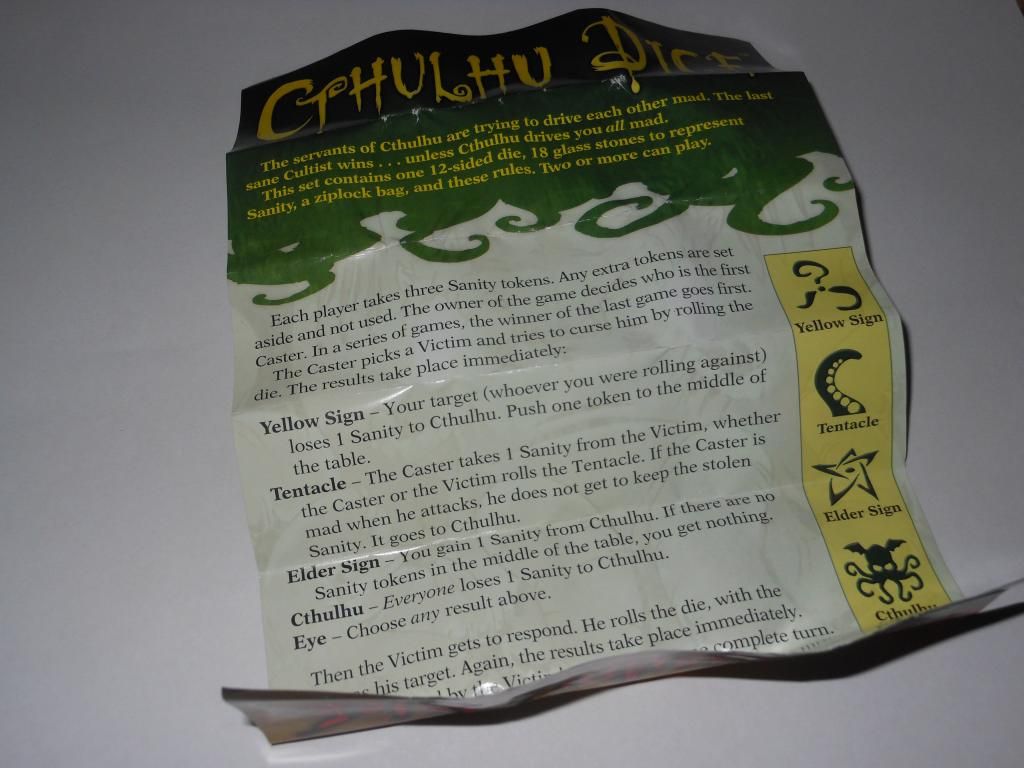 |
| The rules... No, I didn't screw them up in frustration. |
The storyline behind the game is that the servants of Cthulhu (one of the characters from H P Lovecraft's pantheon of eldritch horrors) are trying to dive each other mad. Why? Don't know. Doesn't really matter.
Each player takes three green beads, which represent sanity. Going insane is such an important part of the works of Lovecraft that sanity, and keeping it, are pretty much staples of any game based on his writing. The owner of the game decides who will be the "Caster" first (and why wouldn't you pick yourself?), and then the Caster picks a "Victim" and rolls the dice. The dice has different symbols on it rather than numbers, and the symbol you roll determines what happens.
Roll the Yellow Sign: The Caster's Victim loses one sanity to Cthulhu (a pool of sanity in the middle of the table that starts empty).
Roll the Tentacle: The Caster TAKES one sanity from the Victim. This happens even if it was the Victim who rolled the dice.
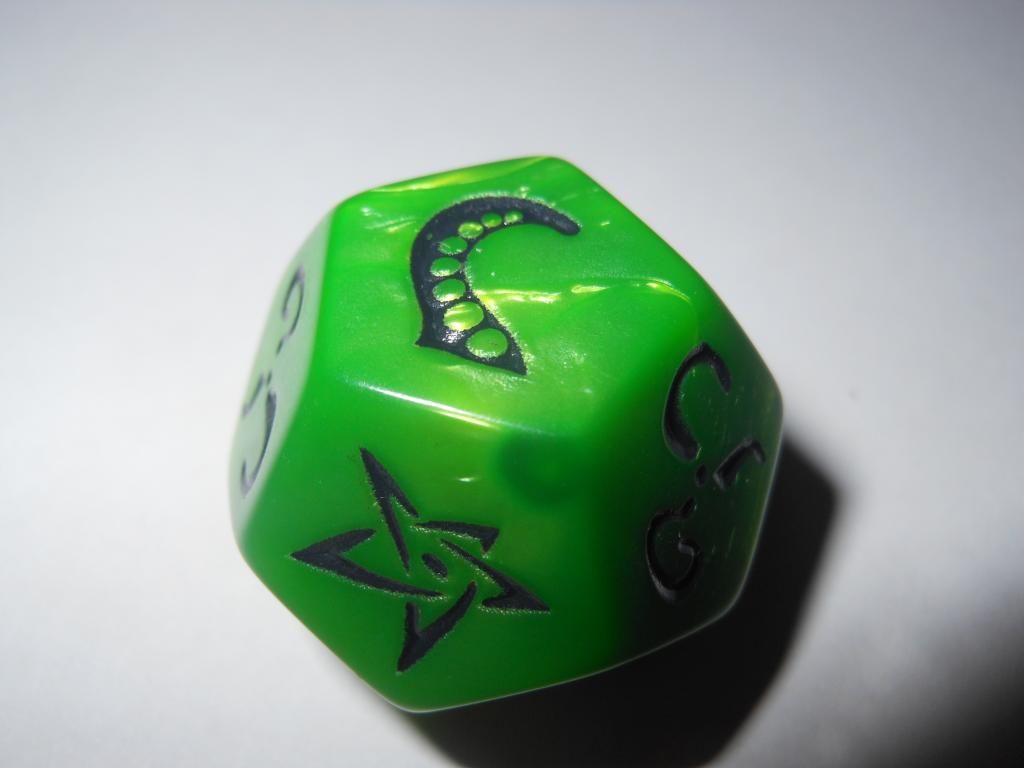 |
| The tentacle |
Roll the Elder Sign: The Caster gains one sanity from Cthulhu (the pool in the middle of the table), if possible.
 |
| The elder sign |
Roll the Cthulhu symbol. Everyone loses one sanity to Cthulhu.
Roll the Eye: The Caster chooses any result.
After applying the result of the roll, the Victim will roll in retaliation, and the result of the roll is applied. The player to the Caster's left then becomes the new Caster, and play continues. You can't choose to pass, and the only choices you will have to make are who will be your Victim, and what result to choose if you roll the Eye. These are really not choices at all.
If you loss all your sanity points, you are insane. You can still attack, but you cannot be attacked, and the only way to become sane again is by winning sanity from Cthulhu with the Elder sign (or by rolling an Eye, and then choosing the Elder Sign result).
The winner is the last person to remain sane. If everyone goes mad, then Cthulhu wins. Either way, no-one will care.
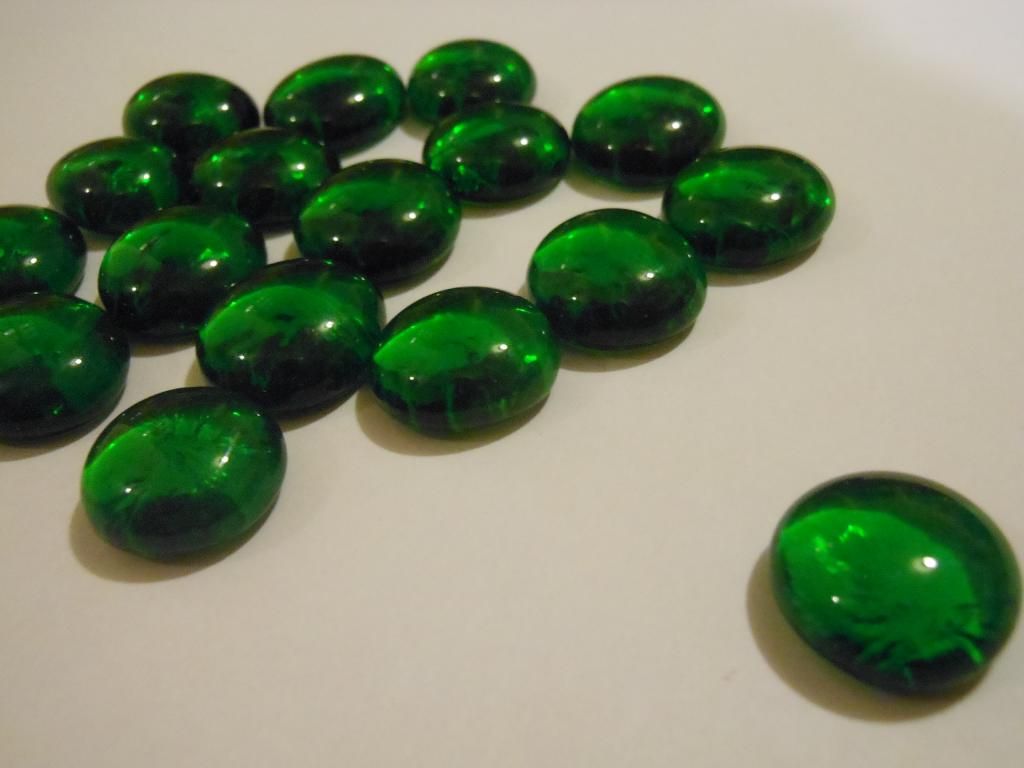 |
| Globules of sanity |
Yes, the game really is that simple; and yes, it really is that bland. There is no strategy, and there are no interesting choices to make. Of course, the game is clearly not trying to be the new Chess, but even as a silly filler game it is severely lacking.
Over on BoardGameGeek I gave this game two stars out of ten. That was reviewing the product as a game. However, the product does have merit as a way of choosing the first player for a real game. There are many games on the market that don't offer a real way to select the first player: They just say "choose at random" or they pick some silly method such as "the person who most recently went to an island is the first player." If you are about to play such a game, you can whip of the Cthulhu Dice and play a quick round. Cthulhu Dice is over in two or three minutes, and the winner gets to be the first player in the proper game you are about to play.
I suppose Cthulhu Dice could also be used as a drinking game, with shots replacing sanity tokens; but I'm a married man with a child, and my days of drinking games are far behind me. Besides, drinking games aren't good for you.
So, all told, I don't really think much of Cthulhu Dice. However, I am going to keep it. It is so small it hardly takes up any space, I like anything with a Cthulhu flavour, and the dice is really nicely made. If those sound like good enough reasons to own something, then you may want to pick up a copy; just don't expect much of a game.
Sunday, 10 February 2013
Review - A NinjaGO storage solution

Back in October 2012, I reviewed NinjaGo, a Lego game that I didn't rate particularly highly. While I didn't think much of the game, I didn't have the heart to get rid of it because... Well, you know... It's Lego. You can't get rid of Lego.
Anyway, I kept the game, and played it a few times with my 11-year-old brother-in-law. He really enjoyed it, so I guess Lego know what they're doing after all!
Fast-forward to February 2013: I discovered Amazon.co.uk were having a sale on some of their Lego products, including a NinjaGO Spinner Storage Box. These nifty little cases are normally £15 or so, but Amazon were selling them off for less than £5. I don't particularly need a storage solution for my epic collection of two NinjaGO spinners, but I know a bargain when I see one.
(Man, I am such a sucker.)
I purchased one of the cases, thinking it would be a bit tidier than the screwbox I had my spinners stored in; but I wasn't really expecting much. However, when the case actually arrived, I had to admit I was pretty impressed.
It came in a nice cardboard sleeve to keep it unmarked, and I was slightly amused to see this sleeve included a diagram showing how to put the Lego bits inside. Have we really reached the stage where we need instructions on how to put things in a box?
After I had removed the sleeve I was presented with a pretty cool piece of artwork featuring Lego ninjas and snake people. (I'm glad it was the snake people, as I think they are more interesting than the skeletons and stone people that comprise the other enemies in the NinjaGO line of products.)
 |
| The NinjaGO spinner storage case - Ninjas are so cool. |
The case itself is very sturdy, with a durable plastic handle and two straps that fix in place with poppers to hold the lid closed.
 |
| The case is actually well made and sturdy. |
Inside, there is a plastic flap to store cards in, and a moulded plastic section that can house plenty of spinners, figures, weapons, blocks, and instructions.
 |
| Moulded tray stores 10 spinners and accessories. |
It's a good little product: Certainly not worth £15, but well worth £5. And yes, it does look tidier on my shelf that that old screwbox I was using before.
Sunday, 3 February 2013
Review - Mighty Warriors
This review of Mighty Warriors originally appeared on www.BoardGameGeek.com in June 2011. This is a slightly edited version which I hope reads a little better than the first effort. And if you were wondering: yes, I do still own this game; and no, I haven't played it since.

Mighty Warriors
Published by Games Workshop
Designed by Andy Jones (he should be ashamed of himself!)
For 2 players, aged 8 to adult
 |
| You will note how the box art has bugger all to do with the game. |
Before I begin, it should be noted the only reason I have Mighty Warriors in my collection is because a few years ago I bought an incomplete copy of Advanced Heroquest on eBay for pennies. The game was missing all the hero pieces and about half the skaven and henchmen. A good friend of mine knew this, and gifted me his mint condition copy of Mighty Warriors. Why would he do that? Because Mighty Warriors is a game that appears to have been released (back in 1991) with the sole purpose of enabling Games Workshop to pack up and sell surplus stock of the figures that came with Advanced Heroquest.
So, let's start with a brief rundown of the miniatures you get: One elf, one dwarf, one knight, one wizard, 20 skaven (four with different coloured bases to denote champions), and 12 henchmen. These miniatures are great. I believe they are some of the finest GW ever produced for a game. They look good on the board, and they are also totally functional (they don't get all tangled together like those damned genestealers in first edition Space Hulk).
 |
| The bad guys. |
These miniatures actually drive the design of the game. Basically, it feels like the designer was given the miniatures and told to come up with a set of rules to match them.
DESIGN FAIL 1: Design miniatures for use with your game, do not design a game for use with your miniatures.
As an example of how the models define the rules of the game, consider there are 20 skaven with shields that can be removed. As a result, the rules for Mighty Warriors allow skaven to block hits with their shields (resulting in the shields being removed from the model).
DESIGN FAIL 2: Do not have fiddly little bits of plastic that need to be constantly taken on and off of other fiddly bits of plastic. (We used cardboard tokens pinched from Advanced Heroquest to show which skaven had lost their shields.)
More examples: The elf is the only character that can use a bow, because his model is the only one that has a bow. The skaven are led by a chaos wizard - this only makes sense because it enabled the game to use the wizard figure from Advanced Heroquest as the leader of the bad guys. Even the plastic shields for the dwarf and knight are used as "flags" to be captured (rather than being affixed to the models as you would expect). Bizarrely, the henchmen in the game do not have rules for using a shield, so the models do not come with shields, even though each model has a little peg where a shield should be attached!
 |
| The good guys (note the pegs where shields should go). |
Besides the models, you get a bunch of floor tiles showing different rooms inside a castle. They are all different designs with a nice, old-fashioned hand-drawn style of artwork. However, the rooms are all different sizes and have thick black borders (which often cut off parts of the spaces on the boards), and this makes it difficult to see how you are supposed to move around and between each room.
DESIGN FAIL 3: If you are going to have some spaces on the board that are cut in half, or only have a quarter of the total area visible with the rest taken up by a wiggly bit of wall, give some instructions in the rules for whether or not those spaces count as a real space.
To make matters worse, the card used for the boards is incredibly thin, and the boards do not "jig" together in any way. This means the boards will often slide around and move out of alignment, making it even more difficult to know which rooms are linked. Pieces tend to get knocked over, and you feel a bit like you are playing on sheets of paper rather than professionally produced game boards.
DESIGN FAIL 4: If you are going to have a board made up of separate card pieces, use card that is thick and durable.
 |
| The boards - nicely drawn, but thin. Also note the thick borders. |
There are also some cardboard doors for showing how rooms are linked together. These are cheap, folded cardboard that fall over a lot and make the doors in Heroquest look top-class.
DESIGN FAIL 5: If you are using doors to link separate boards, do not give the boards thick black borders that are so wide it is difficult to tell which two spaces the door is linking.
DESIGN FAIL 6: When an element of the rules is that models cannot move through a space containing another model, do not include doors that are only one space wide or you will end up with a game that consists of two neatly lined up armies fighting one on one fights through a single doorway.
Finally, you get four dice and the box. Why do I mention the box? Because the inside of the box lid is divided into nine squares labelled "hit" or "miss." Whenever you roll dice to attack or cast spells in the game, you drop the dice into the box lid. Dice that land in a "hit" are hits. This is truly as terrible as it sounds, and it is made worse by the fact that there are five "hits" forming a "+" sign, with four "miss" spaces in the corners. In my experience, it seems that when you throw dice into a box lid, they tend to bounce around and settle into corners rather than ending up in the middle, which means you tend to roll a lot more miss results than you really should. This is just plain annoying.
Okay, so I couldn't even get through the description of the playing pieces without bad-mouthing the game. I will try to be a bit more even-handed with the rest of the review of this terrible, terrible, terrible game. Promise.
 |
| A sample of the rulebook's awesome graphic design. |
The game says it plays 2-4 people, but really it is a two-player game, with one person playing the skaven and wizard and the other person playing the three heroes with the henchmen. You set up the board by taking it in turns to draw a room tile and placing it down adjacent to a board already in play. You then take it in turns to place doors. Then you take it in turns to place your figures in rooms. Finally you place your plastic shield in a room you control. If that sounds like fun, then read on...
The aim of the game is to "capture" your opponent's shield. However, the rules give you no instructions on how this "capture" takes place. There are no rules for carrying the shield. No rules for moving it. No rules for what qualifies a win. We decided that you captured the shield if you were standing on the same space as it and there were no conscious enemies in the same room. As it happens, I had completely wiped out my opponent by the time I reached his shield, so it didn't matter. (Oh - did I mention I only played this game once? I should have done - this is a review after one play. Why am I reviewing a game after one play? Because this is one of the worst games ever made. Haven't I made that clear enough yet?)
DESIGN FAIL 7: Don't forget to define the winning conditions.
The heroes move first, and then it goes in rounds, with both teams following the same steps.
First, if your wizard is still alive, you roll two dice into the box lid. If either lands on "hit" you have successfully cast a spell. Pick one dice that landed in "hit" and check the number rolled on your wizard's spell list, then implement the result.
 |
| The elf spell card. |
The spells vary wildly and range from useless (such as the elf's invisible spell, or most of the chaos wizard's spells) to stupidly overpowered (the elf's "attack EVERY SINGLE MODEL in an adjacent room" spell or his "STUN EVERY SINGLE MODEL in an adjacent room" spell). With the right spells, it is possible for the elf to almost single-handedly win the game.
DESIGN FAIL 8: Don't make spells that are stupidly powerful or pointlessly weak.
Interestingly, the chaos wizard has different spells to the elf. The wizard's are generally related to making the wizard stronger in combat, but one of his spells allows him to bring D6 skaven back to life. As skaven die easily, you will want to bring as many as you can back to life, and that means keeping the wizard safe and alive and OUT OF COMBAT. This makes about 2/3 of the wizard's spells pretty much useless. And of course, bringing D6 skaven back to life for several turns in a row is bloody annoying and makes the game go on and on and on and on...
DESIGN FAIL 9: Don't make wizard characters have spells that are only useful in close combat - the last place you want your wizard to be.
DESIGN FAIL 10: Don't make spells that are annoying and boring.
After spellcasting comes movement. Roll 1D6. Each of your models can move up to the number of spaces rolled. Yup - roll and move. In a tactical skirmish game. Really.
How can you form any kind of strategy when the number of spaces you can move EVERY MEMBER of your team is determined by a single dice roll? I lost count of the number of times I set up my team ready for a powerful attack and then rolled a 1 for movement and ended up "closing ranks" and facing an attack from my opponent instead. There really is no excuse for this kind of design. In a light skirmish game, each piece should have a defined movement allowance so you can actually make some plans and strategies. At least that way you would feel like you had some control over your fate.
DESIGN FAIL 11: Don't do roll and move. Especially in a skirmish game.
After movement you do shooting - well, the elf does, as he is the only one with a bow. He can shoot at any model in the same room. No line of sight. Stupid.
DESIGN FAIL 12: Don't have ranged combat if you aren't going to do proper line of sight and range rules.
After shooting you do close combat - yay, more dice go into the box lid for a bit more randomness. Your success in combat is down to how the dice bounce. If you hit a skaven they can lose a shield before taking the hit. Skaven without shields will be automatically stunned on a hit and killed outright on a 5 or 6. Strangely, the shields make the skavens harder to kill than anything else on the board as you need to attack them at least twice to be in with a chance of killing them, while any other model can be killed with a single attack (although admittedly, everything else only dies on the roll of a 6 and is often not even stunned).
If models are stunned they lie down, and if they are hit a second time they are instantly killed. Quite often you will find that to kill a skaven requires three hits - one to remove the shield, one to stun, and one to kill. Compare this to, for example, the heroic knight character, who has no shield and is stunned on the roll of a 5 and instantly killed on the roll of a 6.
Yes, that's right; it is IMPOSSIBLE to instantly kill a skaven with a shield, and yet the most powerful warrior - the knight - has a 1 in 6 chance of dying every single time even a weak skaven hits him.
DESIGN FAIL 13: Don't make "weak" units that can outlast hero characters.
Finally, after combat you roll for each of your stunned models, and recover them on a 4, 5, or 6.
 |
| The hero reference sheet. (You get one for the villains too.) |
That's it. There is no more. Play until one team captures the opponent's shield (however you decide that should happen) or everyone slips into a coma.
Honestly, I cannot stress how much I thoroughly disliked this game (although I have tried my best); but is there anything about this game that I do like?
Well - those models are really nice. I love the henchmen. They are nicely detailed, but they are not in action poses so they are very easy to handle and move around. The heroes are similarly well made. The skaven are really attractive pieces and look great in a "swarm."
I also like the almost childlike artwork on the boards (although the boards themselves are too thin for my liking). I am sure these boards would also be useful for anyone who plays Dungeons and Dragons or some other roleplaying game.
The game plays cleanly enough. There aren't many rules so you can learn in five minutes and start playing your first game. Unfortunately, your first game will also probably be your last as the game plays far too long for something so simple.
Rolling dice in the box lid is not a bad idea as such, but in a game that is already so random, it is all a bit much and removes any element of strategy that might have existed.
I am keeping the game for two reasons:
1/ I collect older and out of print games, particularly fantasy themed games.
2/ I can use all the figures in Advanced Heroquest.
As a game in its own right, Mighty Warriors fails completely, and I have no intentions of playing it again. If you find a copy cheap somewhere it might be worth picking up, but I wouldn't recommend actively searching it out or paying the prices I have seen copies advertised for on eBay.
That's all from me. Best of luck, and may all your dice land in a "hit" space.
Subscribe to:
Posts (Atom)