Showing posts with label The Vault. Show all posts

Wednesday, 31 October 2018

Review - Labyrinth: The Duel

Designed by Marco Teubner
Published by Ravensburger
For 2 players, aged 8 to 99 years, apparently


Labyrinth: The Duel


Is there anything more terrifying than being lost in a dark maze, where the walls are constantly shifting, and you never know which way to turn? Well... probably, yes. Probably lots of things. Spiders, clowns, spiders dressed as clowns. The list is almost endless. But the truth is, it's Halloween and I should be reviewing something suitably creepy such as Warhammer Underworlds: Nightvault right now. Unfortunately my photographs aren't ready, and that means you get stuck with a review of Labyrinth: The Duel which I'm ham-fistedly trying to cram into a spooky framework.

So, let's all just pretend this is a really creepy game and we'll say no more about it...

Good?

Great.

Here goes...

Wednesday, 28 June 2017

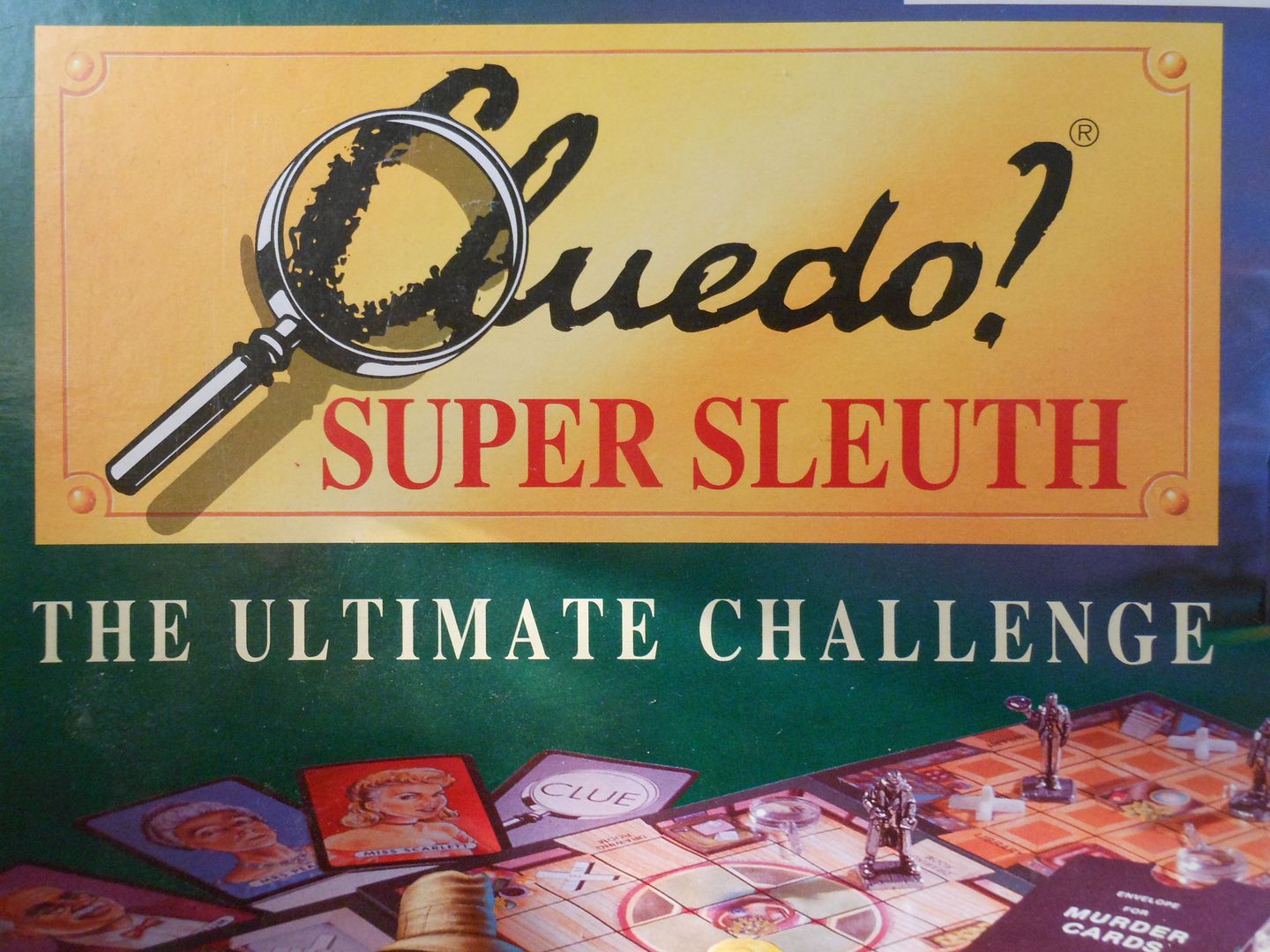
Review - Cluedo Super Sleuth

Designed by Anthony E. Pratt
Published by Waddingtons
For 2 to 6 players, aged 10 to adult


Cluedo Super Sleuth


"The rules of an intriguing and interesting game, must inevitably seem to be slightly boring..."

And so begins the rules book for Cluedo Super Sleuth. It's an... unusual... gambit, but let's ignore the growing sense of dread and press on.

Thursday, 16 February 2017

Review - Catacombs (First Edition)

Designed by Ryan Amos, Marc Kelsey, and Aron West
Published by Sands of Time Games
For 2-5 players, aged 12 to adult


Catacombs first edition box art


My hands are basically screwed.

Have I ever mentioned that?

They randomly betray me, flinging things across the room. Last month I had to remove electrical outlets from my wall to drain them because a full cup of tea escaped my fumbling grasp, and not long after that I bounced one of my best friends freshly painted space marines off the table. It wouldn't have been so bad, but it was his first go at painting miniatures for about two decades. Fortunately, those space marines are a lot more robust than some people give them credit for. I guess they have to be if they're going to survive in the grim-dark future of the Warhammer universe.

And this is my hands under normal conditions. If it starts to get cold, they straight up stop working altogether.

My rubbish hands take the full blame for my inability to learn to play the guitar (my lack of persistence is completely unrelated, I assure you), and also for my heavy reliance on ink washes and drybrushing to make my painted miniatures look even halfway decent.

They're also why I'm not overly keen on dexterity games.

Thursday, 24 November 2016

Review - Kingdom Death: Monster

Designed by Adam Poots
Published by Kingdom Death
For 1 to 4 players, aged 17 to adult

Kingdom Death: Monster


One Sunday afternoon, way back in my sepia-toned youth, I watched a film that changed my life.

The film was Clash of the Titans. And no, I don't mean that bloody awful travesty of a remake. I mean the original, which while not being an amazing film even by the standards of the day, was pure cinematic magic to me. The tale of gods and monsters, brought to life through Ray Harryhausen's incredible stop-motion animation, transfixed me. I was instantly transported to another world, and some people would argue I never really came back.

It's hardly surprising that my first trilogy of children's novels was an attempt to recapture that pure sense of wonder by creating a world populated by the same mythical beasts that had stolen my heart so many years before.

Friday, 4 November 2016

Review - Lost Patrol

Published by Games Workshop
For 2 players, aged 12 to adult


Lost Patrol


When did the world become so bitter?

When did we start finding it so much easier to mock than to admire? When did we start seeing the bad in every good, and making sure no good deed went unpunished?

I blame the Internet.

I blame the medium that gave everyone a voice while taking away their face.

Tuesday, 20 September 2016

Review - Warhammer Quest: The Adventure Card Game

Designed by Brady Sadler and Adam Sadler
Published by Fantasy Flight Games
For 1-4 players, aged 14 to adult

Warhammer Quest: The Adventure Card Game


Well, that escalated quickly.

I am, of course, talking about the split of Fantasy Flight Games (FFG) and Games Workshop (GW). You must have heard about it. It's the most news-worthy thing to have happened in the gaming world since that last Kickstarter campaign that everybody backed, which delivered slightly late and with slightly lower quality components than expected.

For the last few years, FFG has been using GW's intellectual property to pump out living card games (Conquest), strategy games (Forbidden Stars), adventure games (Talisman, Relic), and more. But recently, it has become increasingly apparent that the relationship couldn't last. FFG has been moving more into miniatures-based games, and GW has returned to producing board games for the first time since the '90s.

Friday, 5 August 2016

Review - Regency

Published by The Baronage Press
Designed by a fun sponge
For 2-4 players, aged 7 to 70 (apparently)


On occasion, I have been known to ramble.

This is an understatement.

I appreciate my reviews are often long, and sometimes come front-loaded with a preamble that is longer than the amble itself.

I would apologise, but my apology would be a lie.

I love words, and I love writing. I've been making what almost passes as a living based on my writing for a long time now. But I appreciate that not everybody wants to wade through a deluge of words to find out about some dusty old game they found in a charity shop. So, for the benefit of anyone who is in Oxfam or Scope right now, reading this review on a phone with a copy of Regency in one hand, I'll get to the point:

Regency gifted me with one the worst gaming experiences of my life. And I don't say that lightly, because I've played The Worst Case Scenario Survival Game.

Thursday, 5 May 2016

Review - Gears of War: The Board Game

Designed by Corey Konieczka
Published by Fantasy Flight Games
For 1 to 4 players, aged 13 to adult


Often, on sites such as BoardGameGeek, you hear boardgamers talking about games that "fired" other games.

"Hear about Thunderstone Advance? Totally fired Dominion."

"Tried Battles of Westeros? Fired BattleLore."

"Got a copy of Kingdom Death: Monster? Fired everything..."

Generally speaking, a game fires another game when it has a central mechanism, or a particular style of play, that it does better than an older game. These are the latest iterations in the constant evolution of games design, and they usually stand on the shoulders of giants, taking great games and giving them extra swagger.

Now, there are some people who see enough difference between two games to want them both, but I understand why a lot of people feel the need to fire older games from their collection. It's not necessarily a "cult of the new" thing; it's just practical. There is only so much time and space in the world, after all.

Recently, I reviewed a game called Fireteam Zero. If you read that review, you will know I am a huge fan. You will also know I mentioned it features a similar card system to the one found in another excellent game, Gears of War. (Or rather, Gears of War: The Board Game, to differentiate it from Gear of War: The Video Game, or Gears of War: The Action Figure, or Gears of War: The Meccano Set.)

Monday, 22 February 2016

Review - Dread Pirate: Buccaneer's Revenge

Dread Pirate: Buccaneer's Revenge


Dread Pirate: Buccaneer's Revenge
Published by Front Porch Classics
Designed by Dan Tibbles
For 2-4 players, aged 8 to adult.


Dread Pirate: Buccaneer's Revenge game box


Ahar, Me Hearties.

Uh, no. Wait...

Avast, ye scurvy landlubbers,

No, that doesn't work...

Ahoy, Mateys.

Maybe?

Batten down the hatches, splice the mainbrace, shiver me timbers, and... uh... Roger the Cabin Boy?

Nope. Screw it. Let's start again.

Friday, 30 October 2015

Review - Fury of Dracula (Second Edition)

Fury of Dracula


Fury of Dracula (Second Edition)
Designed by Stephen Hand and Kevin Wilson
Published by Fantasy Flight Games
2-5 players, aged 10 to adult


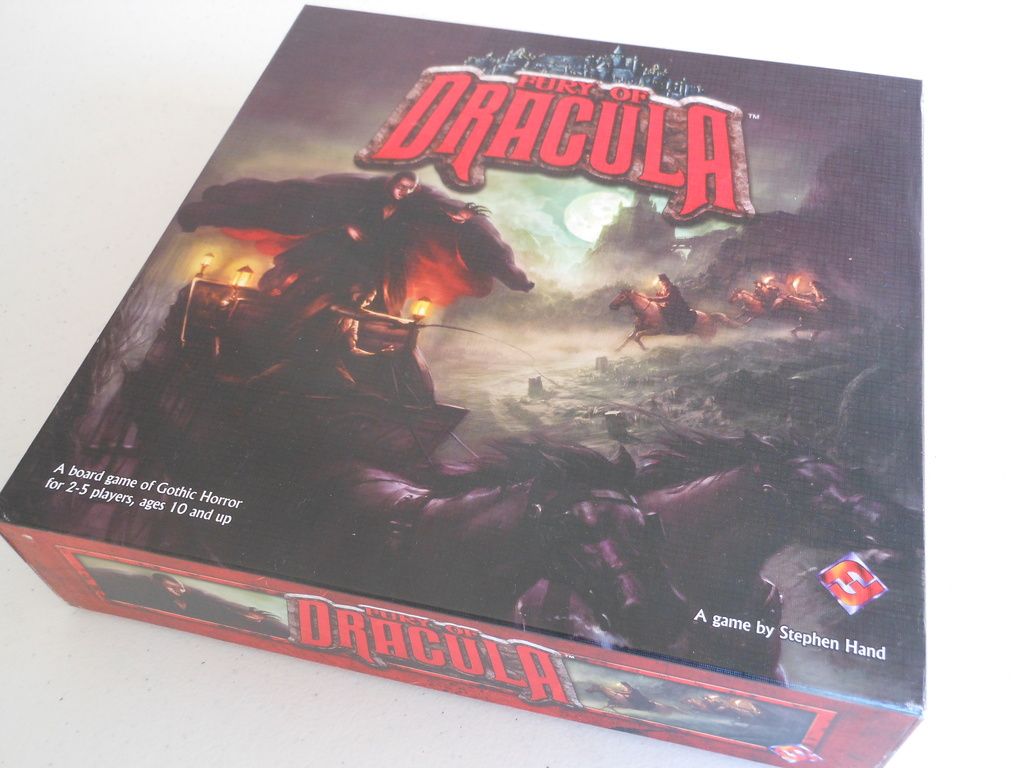
Fury of Dracula box
Dracula looks like he is in a spot of bother.


Ah, Halloween...

I love Halloween.

It's one of those times of the year when I wish I lived in America... The other times being all the other days surrounding Halloween.

Not that I dislike England, you understand. I just feel we don't really put our back into it when it comes to Halloween. Or theme parks. Or customer service.

Or dental care.

But I digress.

Monday, 29 June 2015

Review - Monsuno

Monsuno


Monsuno
Designed by... someone
Published by Topps
For 2 players, aged 6 to adult

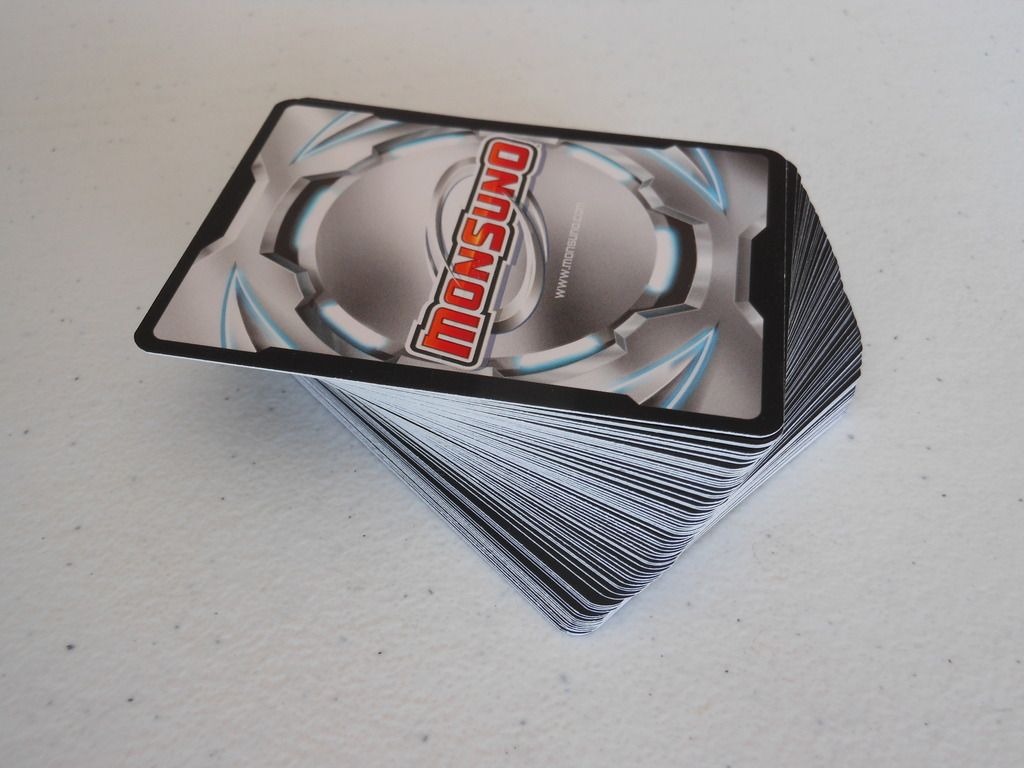
Monsuno Cards
The contents of the starter set... Enough cards to start a nice fire.


Hi.

You've been here before, right? You know about my "special" condition.

Course you do, I can see it in your eyes.

It's okay. Don't be afraid. Take a seat.

Go on, take a seat.

TAKE A SEAT!

Sunday, 21 June 2015

Review - Warball

Warball


Published by Duncan
Designed by Trish Bell, Richard C. Levy, Mike Selinker, Brian Tinsman, and Teeuwynn Woodruff
For 2-4 players, aged 8 to adult

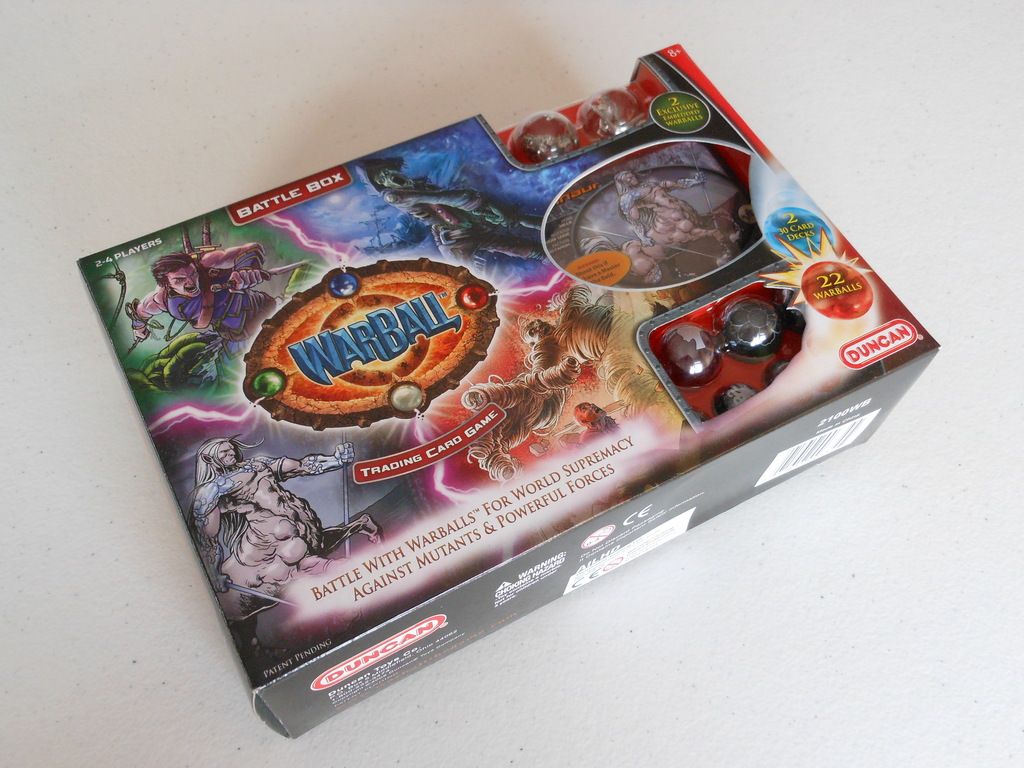
Warball Battle Box
The Battle Box in all its eye-catching glory.


Ah, Poundland...

What would I do without Poundland?*

I go in looking for some craft supplies for my daughter, some Halloween decorations, or some overstock batteries that have about 25% of their charge left, and sometimes... just sometimes... I find something interesting.

By which I mean weird.

The other day (a term I use here to define a specific date I no longer recall), I was strolling past the toys, chuckling at the action figures that look a bit like Power Rangers while being just different enough to avoid a lawsuit, when I saw a small box with an eye-catching design. It had some half-decent fantasy art, and little cutaway sections revealing... revealing?

I moved closer.

No. It couldn't be.

But it was.

Marbles!

It was a game with marbles.

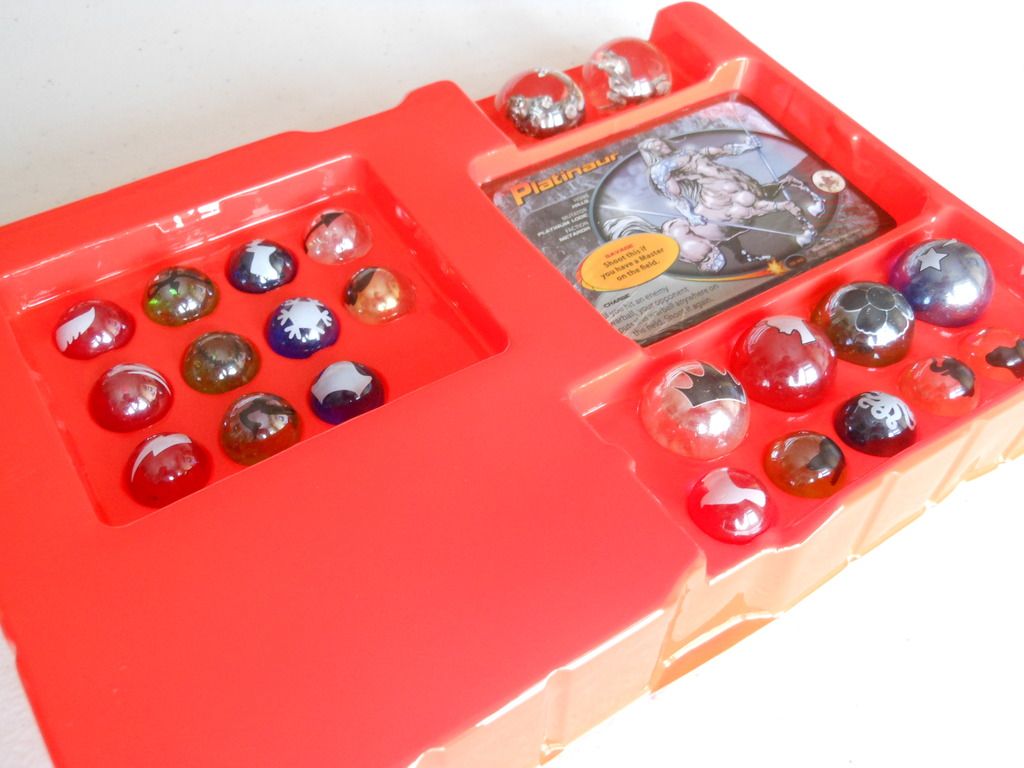
Warball contents
Battle Box contents. What a lot of balls.


I quickly checked the date on my watch.

I had driven to the store quite quickly that day, but I was absolutely certain I hadn't hit 88mph.

Sure enough, the date was correct.

A company called Duncan had actually made a new game using marbles.

A new game that Duncan hilariously (and apparently seriously) called "revolutionary and original."

A new game that Duncan hilariously (and apparently seriously) called a trading card game, even though it is quite clearly a game about marbles.

A new game that Duncan hilariously (and apparently seriously) called Warball.

Now, I don't know if Warball's name is supposed to sound like something certain birds do; but it does. Every time I say it, I feel like I am imitating an avian mating cry.

Warball...

Warball...

It's just awkward. And my friends don't like it.

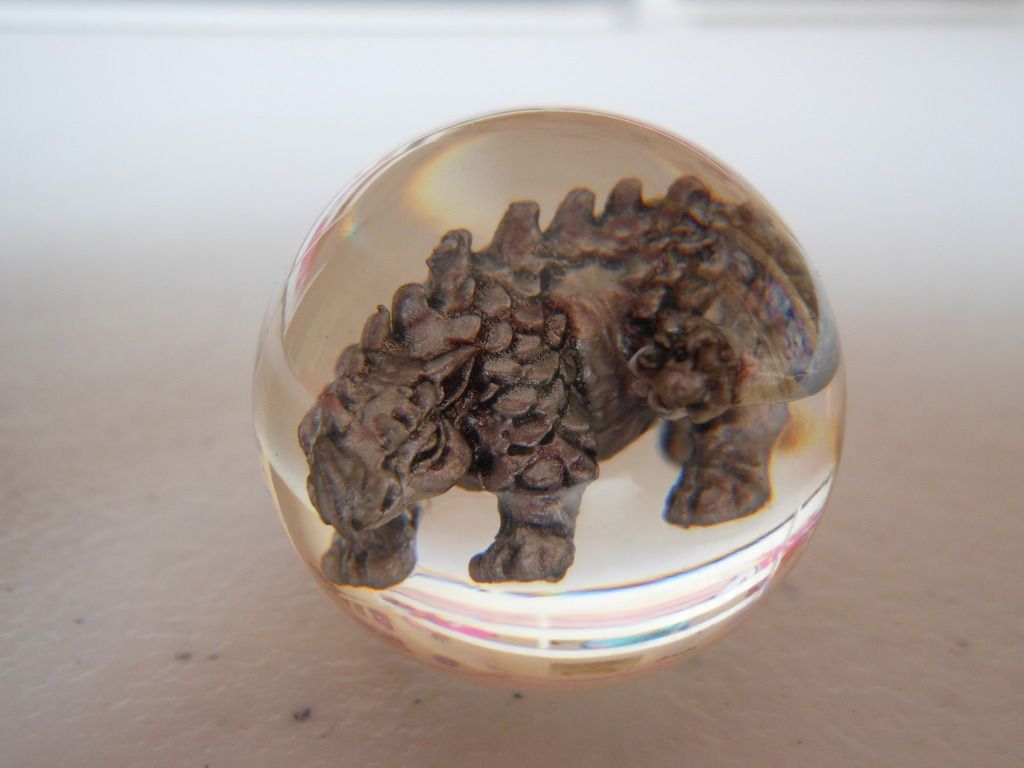
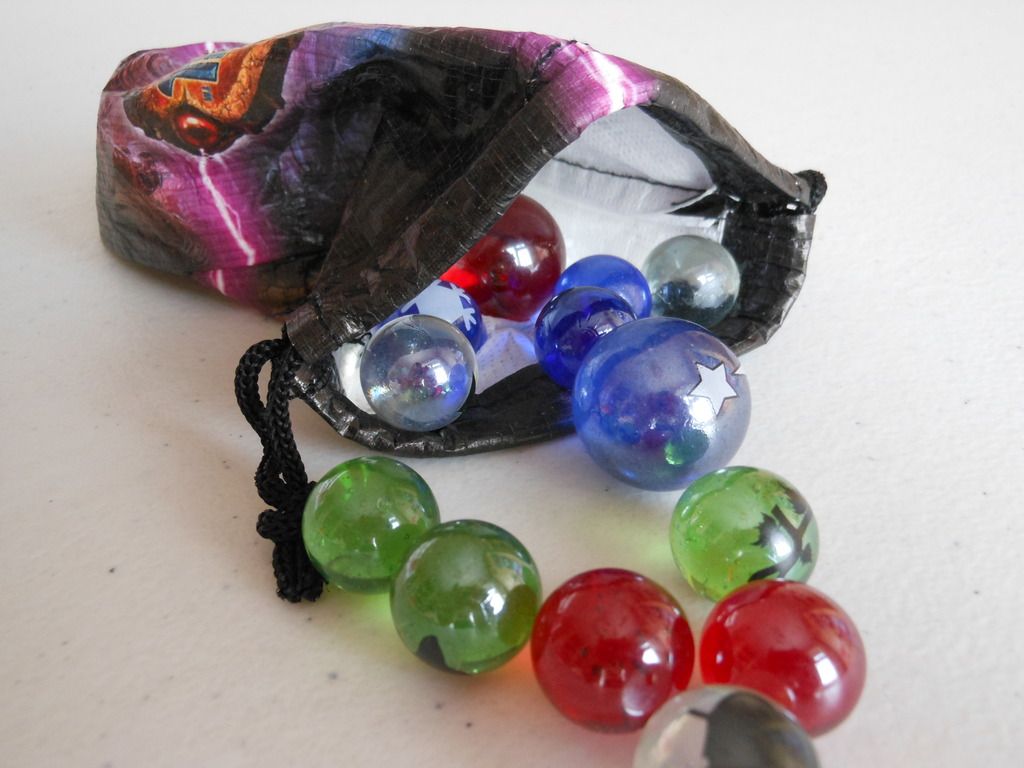
But I'll forgive the name, because Warball is quite an attractive game, and I'm quite shallow. The marbles... sorry, Warballs... are nicely made. Some even have little monsters trapped inside them like mosquitos in amber, or dreams encapsulated in one of those crystals David Bowie loved pretending to wave around.

Savage Warball
It's a crystal, nothing more...


These Warballs work in conjunction with a set of cards that have some pretty interesting artwork on them (this is supposed to be a trading card game, after all). The problem is, the cards have a thick glaze that has a tendency to chip on the edges. Futhermore, when the cards are brand new, they really stick together, making shuffling a bit of a bear.

Still, the whole package is quite appealing, and there is a cool drawstring bag included for storing your Warballs, which is a nice touch.

Warball marbles
Nice ball bag.


However, despite the good-looking components, and despite the wedge of 60 illustrated cards, and despite the range ruler, this is quite obviously a game of marbles. I mean, Duncan has dressed it up as a trading card game, suggesting that players need to collect different cards to build power decks that allow them to manipulate each battle and maximise the usefulness of the available Warballs. But you can't fool me.

This is just marbles.

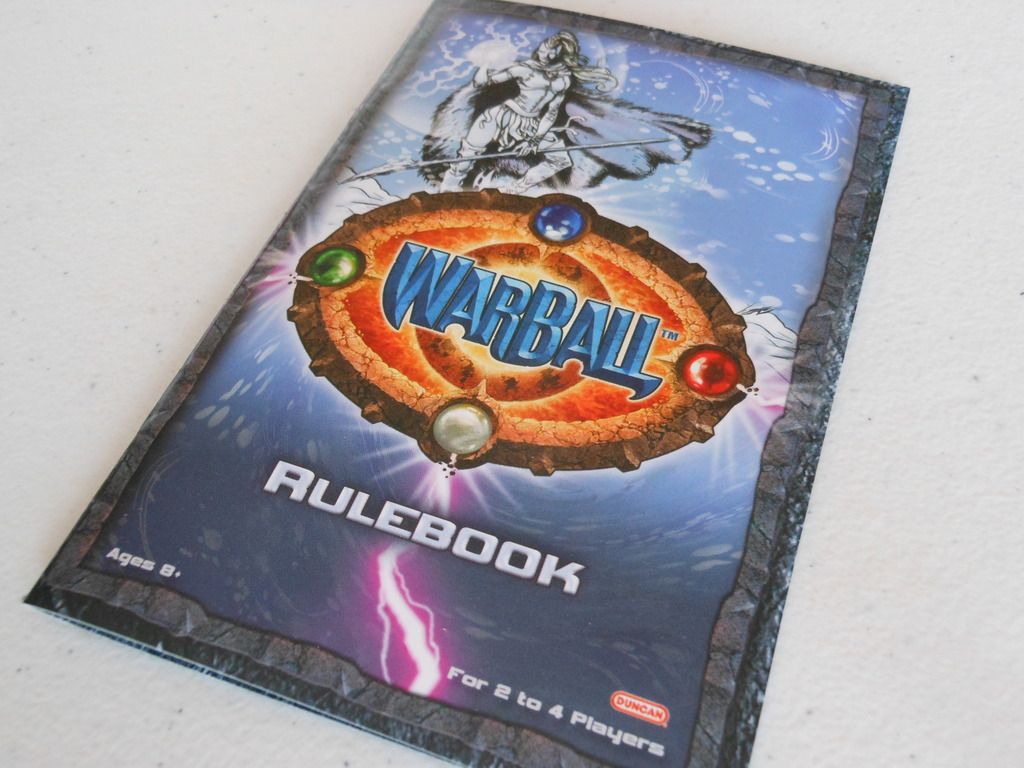
Warball rulebook
I don't remember marbles having so many rules...


At the start of the game, players line up their Core Warballs across the centre of an arena, keeping aside any of their larger Master or Savage Warballs, then they shuffle a deck of cards built around the Warballs they have brought to the battle. If you are playing with the contents of the Battle Box starter set, like I was, you don't get any choice in the Warballs and cards you have available; but it is possible to buy expansion packs containing more cards and Warballs, allowing for the possibility of custom decks.

On a turn, you draw four cards, and then you use any that you can to activate Warballs. To use a card to activate a Warball, it has to match the Warball design, and you have to check any special requirements. For example, you can only play cards that activate Savage Warballs if you have at least one of your Master Warballs on the battlefield.

Warball cards
The cards. (The artwork varies from nice to... not nice.)


When you activate a Warball, you simply flick it at enemy Warballs. If you knock any Warballs out of the arena, you capture those Warballs, and you win the game by...

Marbles.

It's bloody marbles.

Okay?

You flick your marble to knock your opponent's marbles, and you win by knocking all of your opponent's marbles out of play.

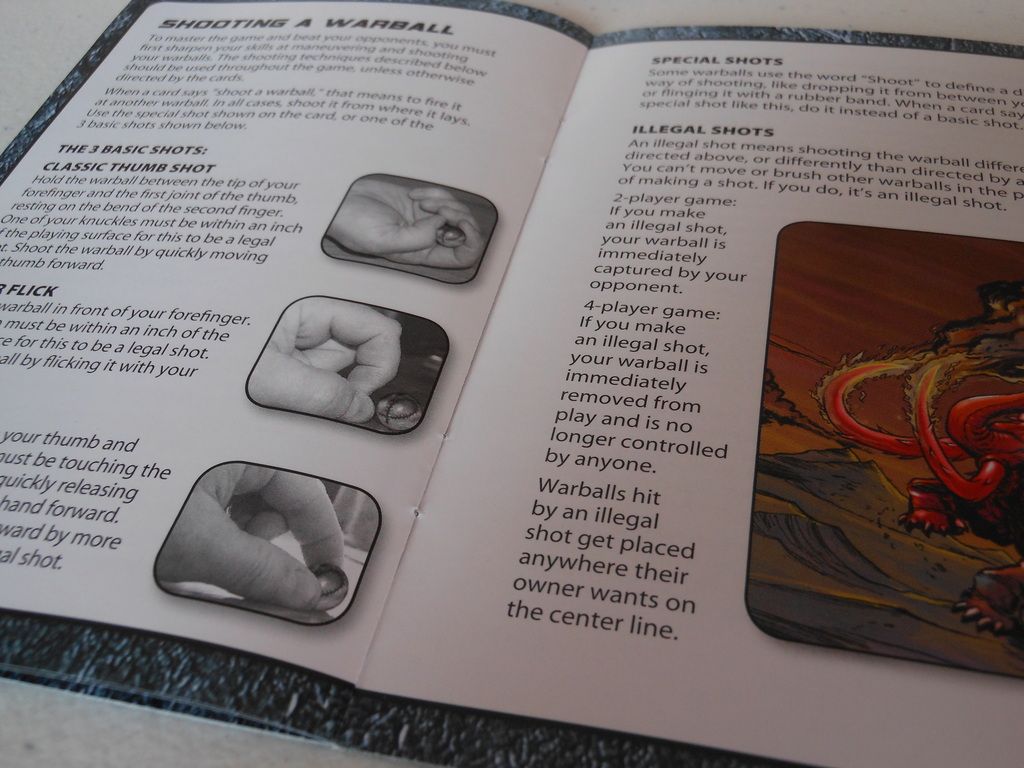
Warball flicking rules
Instructions on how to shoot marbles. Seriously?


They have added a few gimmicks, of course. This is a "revolutionary" game, after all. Some cards only allow you to activate a Warball with a trick shot, like using your feet or the edge of the range ruler; and your opponent can take control of your Savage Warballs if you don't have a Master in play to keep them under control.

Oh, and some cards don't activate a Warball, and instead "hex" an opponent's Warball. Being hexed is bad, not least because you have to fiddle around trying to slide the hex card under the Warball without displacing any of the Warballs in play, which is something of a dexterity game within a dexterity game.

But for all the gimmicks, this is just marbles.

Fortunately, marbles is a really cool dexterity game.

I grew up playing marbles over manhole covers, and had countless hours of fun. And yes, Warballs is fun too.

Best of all, one Battle Box (which, let us not forget, I bought for £1) contains enough content for two people to play, without having to worry about deck-building.

It isn't revolutionary. It isn't original. It isn't even a trading card game.

It isn't anything Duncan said it is.

But it's fun.

For £1, I can't really ask for more than that, can I?


*"Buy better games" seems like the obvious answer.

Wednesday, 18 March 2015

Review - Rail/Road

Rail/Road


Rail/Road
Designed by Frank Dyksterhuis and Mark Wood
Published by Dr Wood Challenge Centre
For 2 players, aged... Hell, I dunno. Doesn't even say on the box.

I don't find toilets particularly interesting...

...

Man. That's a weird way to start a review, even by my standards.

Ah well, here goes...

I don't find toilets particularly interesting. I appreciate how all the little bits and bobs inside them work together to make a functional device. I just don't find that device particularly exciting.

I mean, there are many ingenious ways in which a toilet could function, but in most cases, the designers of toilets go for a simple solution.

A bog-standard solution, if you will.

And if I'm being honest, that's for the best. Most functional items should be simple. They should have a defined purpose that they achieve with the minimum of fuss. Sure, it might be nice at first if your toilet summoned a magical unicorn-riding elf, but honestly, there are only so many times you can clean hoof prints out of the carpet before it gets tiresome.

However, there are many products in the world that could be likened to toilets, but which should really be aiming for something better. Things that, from a mechanical point of view, work as intended, but which ultimately are a bit boring. Fast food, for example... Food that is indeed fast, and which looks a bit like food, but which is almost always bland, uninspiring slop that no sane person would put in his or her mouth.

And then there is Rail/Road, a game that could be the poster child for board game toilets.

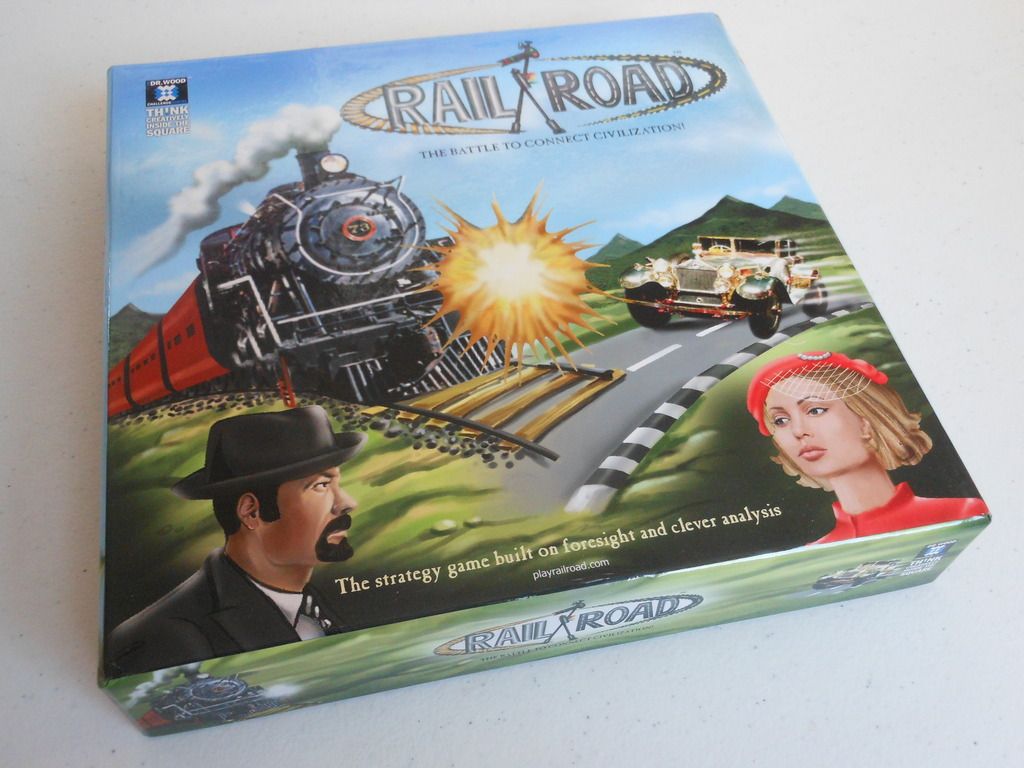
Rail/Road box
Witness the arrival of Metatron...


Frankly, I don't even know where to start trying to review this game, which seems to have done everything in its power to take the fun out of functional.

Actually, yes I do... I'll start with the box art.

Honestly.

It is the most unusual mishmash of clipart I've ever seen. It actually looks like a prototype mock-up. There is a man in a hat, and he is staring at a woman in a hat, and behind them a derailed train is crashing into a car, and... And I just made the art sound a lot more exciting than it really is.

It's just awful.

The back of the box says Rail/Road takes place in a land "far, far away," and I suspect that could be where the artist spends a good deal of his time.

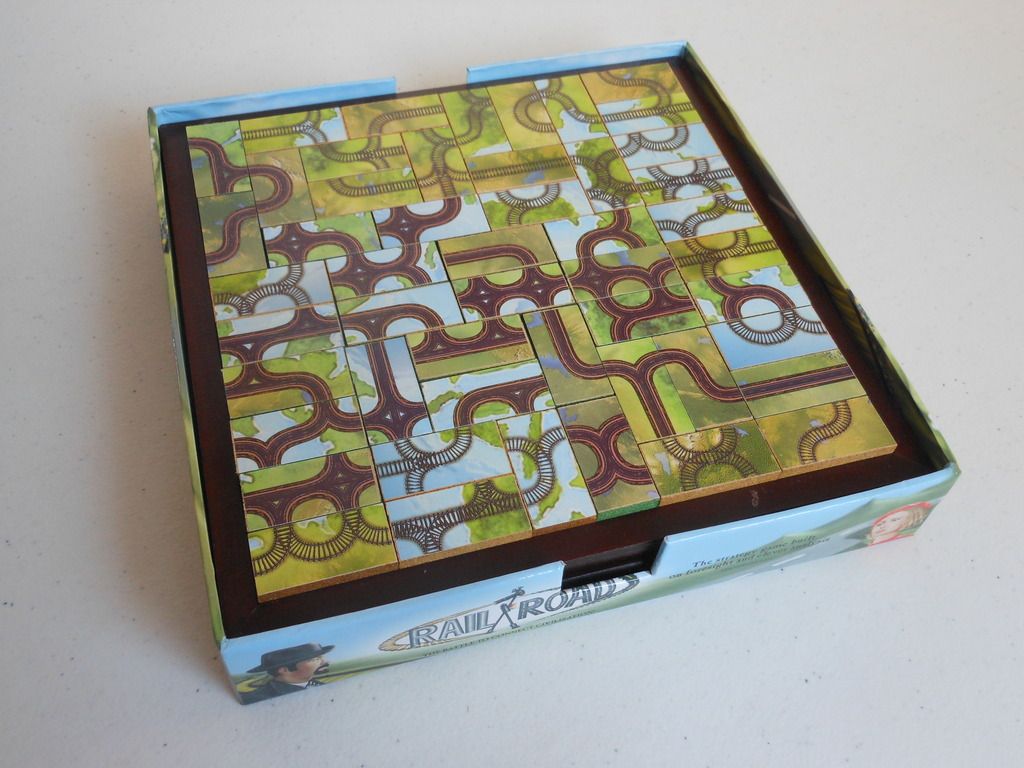
When you pick up the box, the first thing you will notice (after the hideous artwork) is how heavy it is despite the small size. That is because the game is entirely made of wood. You get 50 wooden tiles (25 railways and 25 roads) and a wooden board with a raised lip that holds the tiles in place.

Rail/Road components
Some motorists are about to have a very bad day...


Unfortunately, it is one of those rare products that is made with high-quality components yet still manages to look and feel cheap.

I have to assume the amount of wood in the game is the reason the publisher is called Dr Wood (which sounds like someone who should team up with Dr Hook to make a nice line in hat racks).

Anyway, the game itself is pretty simple, and yes... functional. The box claims it is a battle to connect civilisation, but really it's just a two-player abstract tile-laying game.

The aim is straight-forward enough. One player has the rail tiles, and the other has the road tiles, and they alternate turns placing one of their tiles on the board. Each tile shows a section of road or rail, with up to six connections, and when placing a tile, the only rule is that it must connect with a tile already in play. The weird bit? It doesn't matter if it connects to a road or a rail, and it doesn't matter if other connections lead to dead ends. As long as at least one connection joins up with a connection on any other tile, it's all good.

And that's pretty much it. Players take turns placing tiles, matching connections, and trying to close off sections of the board, which stops the other player from placing tiles there. When no further tiles can be placed, each player adds up all the connections on his or her unplayed tiles, and the person with the lowest total is the winner.

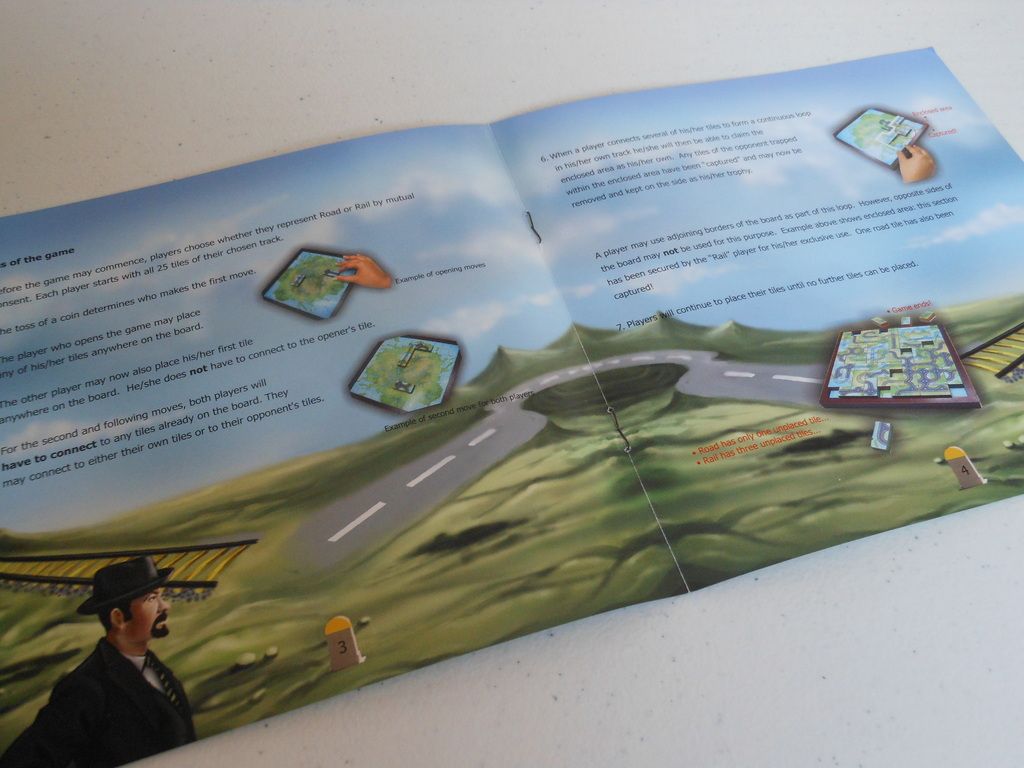
Rail/Road rules
Would you be surprised to find the rules are badly written?


Really, it couldn't be more bog-standard if it tried.

Everything works. It is a game.

It is functional.

But I honestly can't recommend this to anyone. There is nothing there that lifts it above the competition. There is nothing to breathe excitement into the game.

You just put down tiles until you can't put down tiles.

Rail/Road tiles
Dr Wood, with these tiles you are really spoiling us...


If you like artwork that is functional without being attractive, tiles that are serviceable without being high-quality, and mechanisms that allow you to do stuff on your turn without generating any kind of entertainment, well then... You might like Rail/Road.

You probably like fast food too.

And I bet you don't have a magic unicorn in your toilet.

Wednesday, 25 February 2015

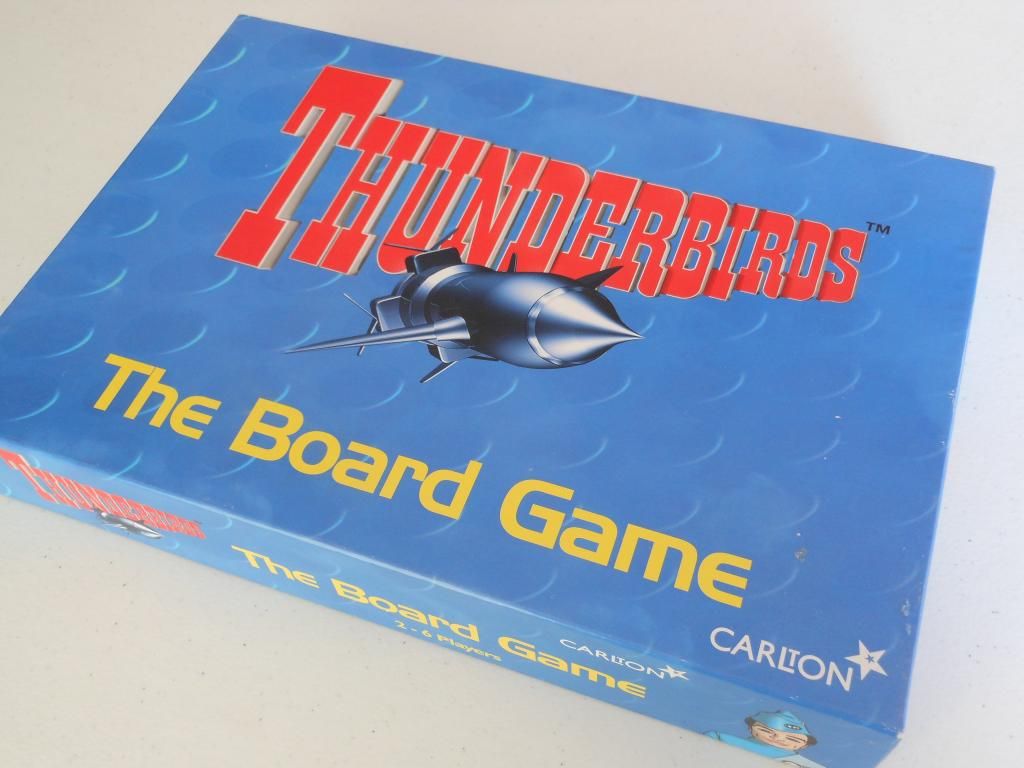
Review - Thunderbirds: The Board Game

Thunderbirds: The Board Game


Thunderbirds: The Board Game
Designed by Susan Prescott
Published by Susan Prescott Games
For 2 - 6 players, aged 8 to adult

Thunderbirds: The Board Game
Looks exciting!


You've all heard the news, right?

Thunderbirds Are Go!

Really. That's the name of the new show. With the exclamation mark and everything, if Wikipedia is to be believed.

(Which it isn't.)

Yes, after years of waiting, Thunderbirds is finally coming back on the air, and it intends to arrive in style. It's a blend of live-action and CGI, with music by Ben and Nick Foster (Doctor Who), miniatures by WETA Workshop (never heard of 'em), and a cast including Rosamund Pike, Angel Coulby, and Thomas Sangster.

That's pretty exciting, right?

Well, unless of course you're reading this article after the 2015 launch of the show, in which case you're probably over it by now.

But right now, as I'm typing this, it's pretty exciting.

A little bit less exciting is Thunderbirds: The Board Game, a game with a title that explicitly states it is game lest people mistake it for some kind of demonic entity and kill it with fire.

Sigh.

Where to start with this one?

Well, let's get the obvious thing out of the way: It looks like shite.

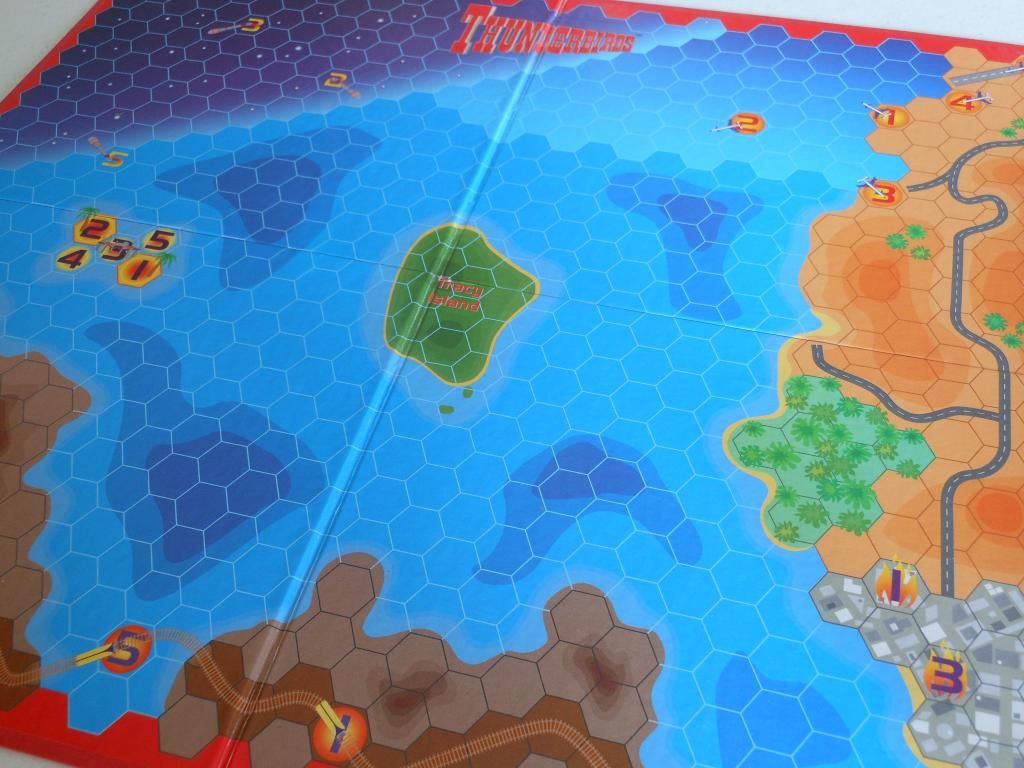
It looks like a game from the '70s, but it actually came out in 1999. It has bland box art, bland card art (or no card art at all in most cases), and a hex-based board that looks more like something you would use for a war game rather than the uninspiring roll and move piece of pap this game actually is.

Thunderbirds: The Board Game board
Everything is so far away.


So now, having set the bar suitably low, let's take a quick limbo through the rules.

Brace yourself.

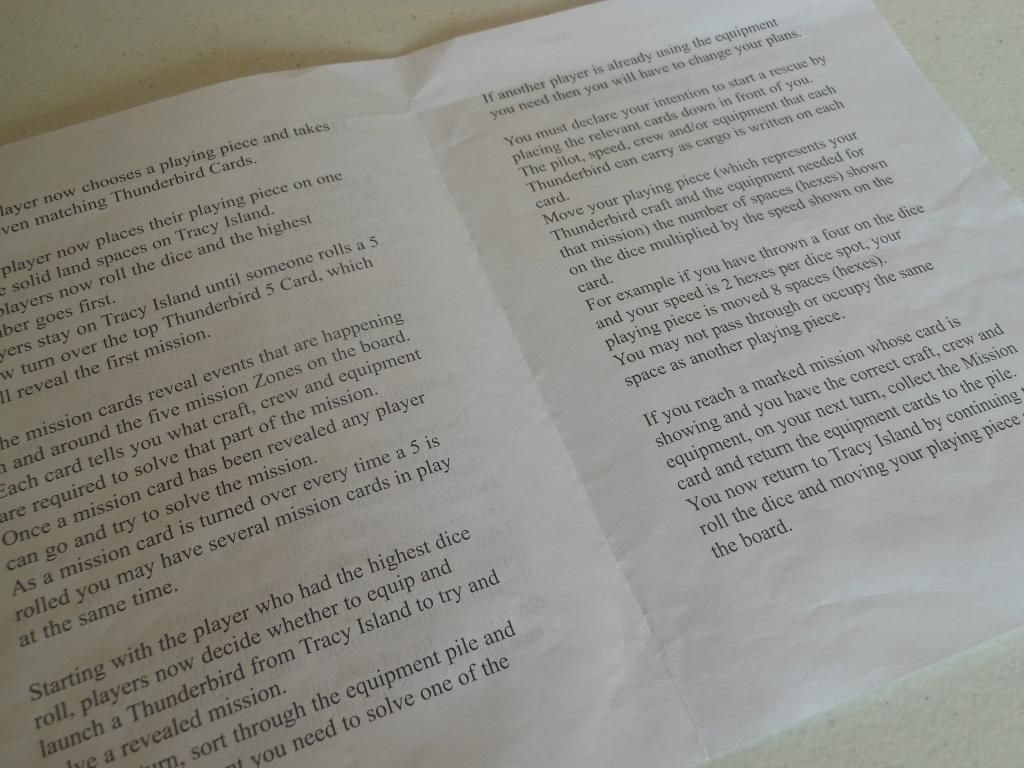
The rules are printed in large font on four sides of A5 paper, and look like something you would knock up for a prototype. They are badly worded, inconsistent, incomplete, and contradictory. I have read them a dozen times or more, and I still don't think I know exactly how the game is supposed to work. But if I concentrate really hard, and furrow my eyebrows in my very best "thinky" expression, a rough outline of the game seems to emerge, like an image from one of those Magic Eye paintings that I could never get to work.

Players start on Tracy Island, which is in the middle of a board comprising a series of hexagons, some of which are numbered. The aim of the game is to fly out to the numbered locations to avert disasters. Unfortunately, players are not allowed to leave Tracy Island until someone rolls a 5, because... Thunderbirds!

(Note: This does not mean that each player must roll a 5 to leave the island. It just means nobody is allowed to leave until someone rolls a 5, after which time everyone is allowed to leave freely, making the whole process entirely pointless.)

So, all the playing pieces are crammed together on Tracy Island, and players start to roll the D6, waiting for the number 5 to show up, accurately recreating the exciting world of Thunderbirds we all love so much.

When a 5 does turn up, it is time to reveal a mission from Thunderbird 5. This mission designates an area on the board where a disaster has occurred (maybe space, maybe underwater, maybe on a train, maybe at the office of Susan Prescott Games).

Each area of the board has its own deck of mission cards, and these cards give you a list of equipment and crew you need, plus a specific Thunderbird craft. To set off on the mission, you need to assemble a set of cards matching the list.

If you are thinking that collecting the cards is going to be an exciting element of gameplay, think again.

Starting with the player who rolled the highest number... Wait, what?

[Re-reads rules...]

Oh right, at the start of the game everyone rolled the dice. This is before the pointless bit where everyone was rolling the dice to get a 5. That first roll determines the order in which players choose whether or not to go on a mission. But wait... Hold on... That means the person who rolled the highest value at the start of the game always gets first option when a new mission card is revealed. That's a permanent, game-long advantage, based on a single dumb-luck dice roll. That can't be... But... You just... Ah, whatever.

So, a player who chooses to go on a mission takes the relevant equipment cards from a communal stack of equipment, thus preventing anyone else from going on the mission. This is one of my favourite bits of the rules as written, because it says, "If another player is already using the equipment you need then you will have to change your plans."

What plans would those be? Rolling the dice until you get another 5 to start another mission that the bastard who rolled a 6 at the start of the game is just going to nick off you before you get a chance to go on it?

Anyway, you grab the equipment.

Thunderbirds: The Board Game equipment
The cards really capture the essence of the show.


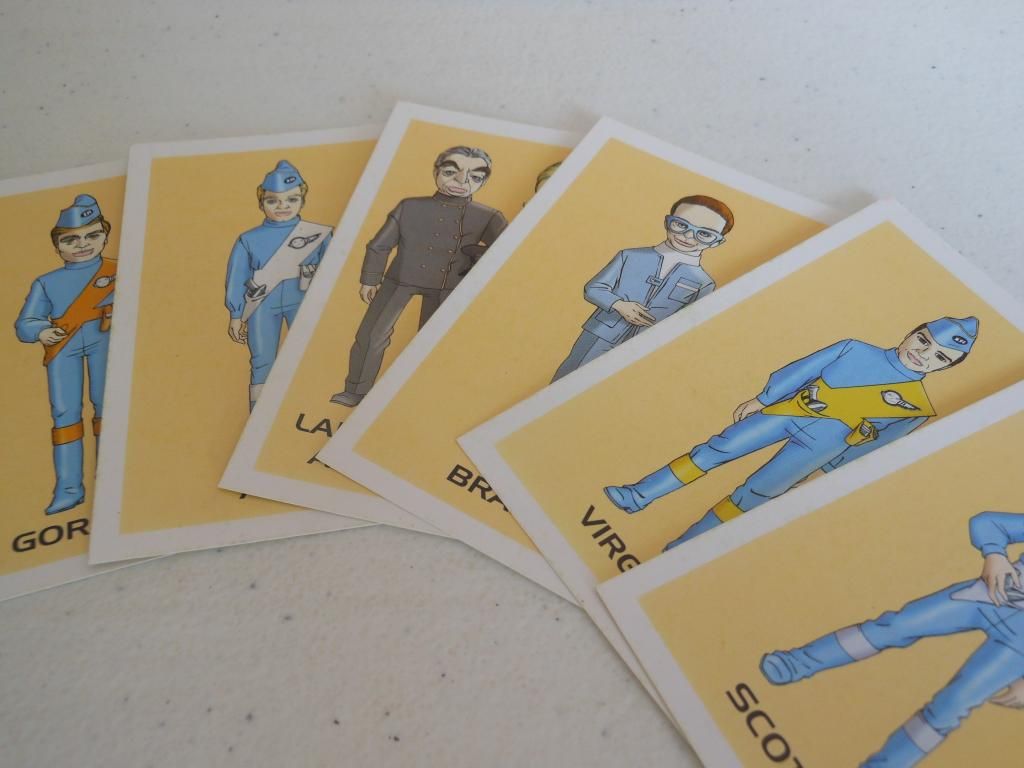
Each player also has an identical set of cards containing crew and ships, and you sift through those to find the other cards you need for your mission. Why these aren't communal like the equipment cards is beyond me, especially as there is nothing in the rules to suggest two players are forbidden from using the same ship or crew member at the same time, resulting in the situation where there are multiple Thunderbird 2s zipping around the board.

Anyway, you have your crew, your ship, and your equipment.

Thunderbirds: The Board Game crew
The gang's all here... trying to roll a 5.


What next?

Well, on your turn, you roll the dice and you... move. And you keep doing this until you reach the numbered space on the board where the mission is happening.

And then you instantly solve the mission.

And then you head all the way back to Tracy Island.

And this continues until all 25 missions on the board have been resolved.

25!

The winner, of course, is the player who doesn't put his head in the gas oven.

This is just an agonising slog of a game. A tedious, mind and butt-numbing horror show from beginning to end.

The rules are a mess, only vaguely describing the way the game should play, and the mechanisms are fundamentally flawed. There is no card play or set collection aspect. You just roll the dice, rummage through the available cards, and then move toward a mission if you can.

Thunderbirds: The Board Game rules
These are the rules. Seriously.


I think it would actually be pretty easy to rewrite the rules to make the game halfway decent, but that is just a testament to how shoddy the game is out of the box.

Frankly, someone needs to call International Rescue, because this game is a disaster. Let's hope the inevitable games released in conjunction with the new Thunderbirds Are Go! series offer something a little more entertaining.

I won't hold my breath.

Wednesday, 18 February 2015

Review - Drakon (Third Edition)

Drakon


Drakon (Third Edition)
Published by Fantasy Flight Games
Designed by Tom Jolly
For 2-6 players, aged 10 to adult

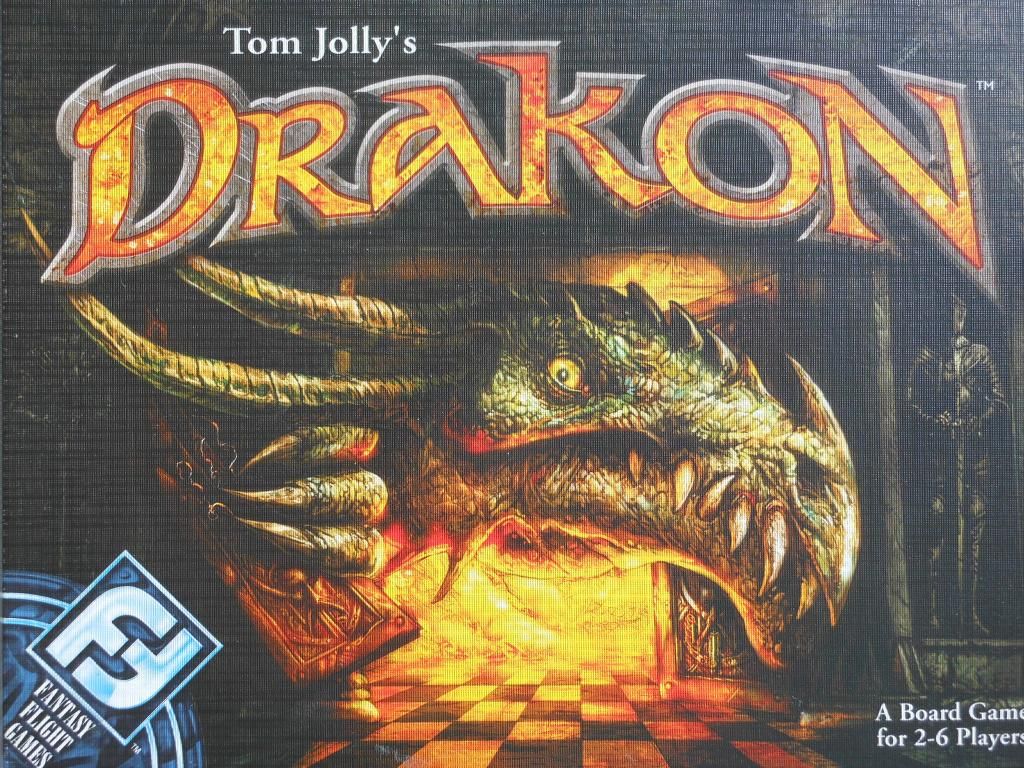
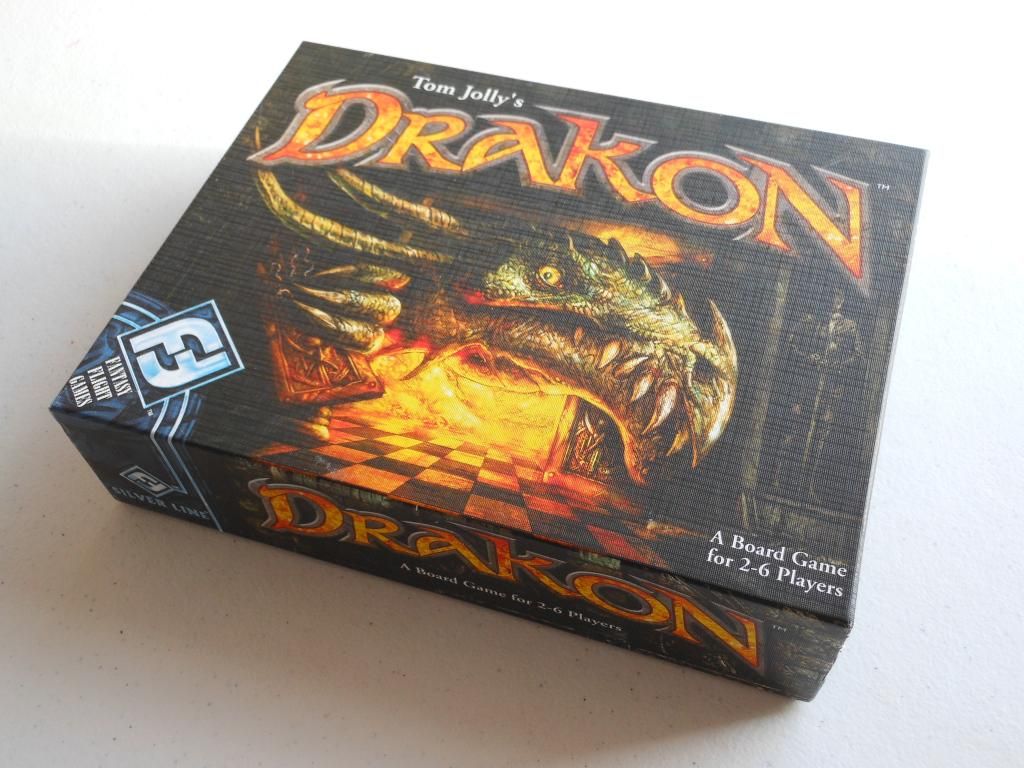
Drakon box
HEEEERRRREEE'S DRAKON!


I don't understand part-baked bread. You know, the bread you buy in a sealed bag that you have to sling in the oven to finish off before you can eat it.

It doesn't make any sense.

If you want store-bought bread, why buy stuff that you have to faff about baking?

If you want to bake your own bread, then... you know... bake your own damned bread.

Part-baked bread is this weird sort of halfway house food. Home-baked bread for people who can't be arsed.

It's a shortcut. A bite-sized step into the world of baking for people who aren't really sure if they like bread enough to buy a breadmaker. An easily digestible chunk of urban living.

It's the Tweet of the food industry.

And it's bloody nice.

And that's true for many things that straddle the boundary between two worlds.

Take Drakon (the third edition) for example.

Drakon looks like a dungeon crawler, but it isn't. It looks like the players get to take on the role of might warriors, but they don't. And it looks like it has artwork from the 1980s, but it doesn't.

It's all terribly confusing.

What at first may look like a stereotypical adventure game where you dash into the dungeon, kill the monsters, grab the money, and then head to the tavern, is actually something more streamlined. More refined.

And darker.

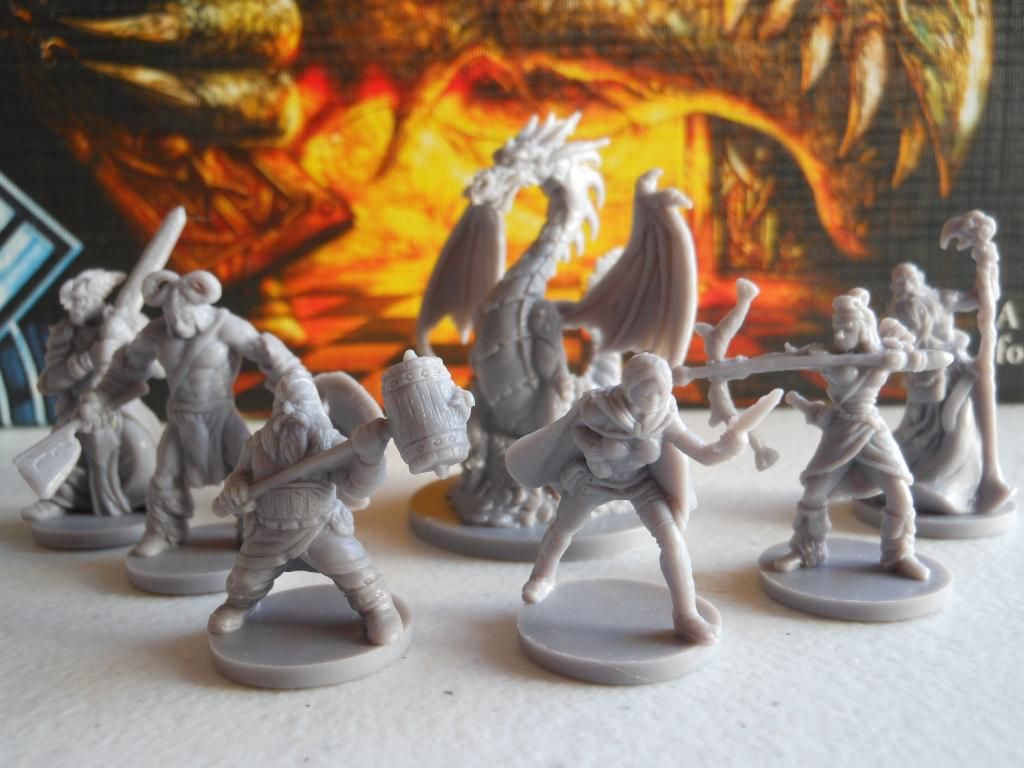
Drakon Heroes
The "heroes."


One to six players start the game by selecting a character. These characters look like your stereotypical heroes: Butch barbarians, surly dwarves, mystic wizards, and... er... stabby knights. But these aren't heroes, they're just luckless adventurers who have been caught with their fingers in the cash register.

Unfortunately, that cash register is owned by a dragon: the Drakon of the title.

Drakon, is one of those fun-loving dragons who likes to play with her food, so rather than straight up eating everyone, she has decided to let them scurry like rats through her magical maze. The first character to beg, steal, or borrow, but mainly steal, 10 gold coins gets to go home. Everyone else gets invited to dinner at Drakon's pad.

I'm sure you can figure out what's on the menu.

Clue: it isn't part-baked bread.

Drakon coins
The root of all evil.


So, our "heroes" do not spend their time in the dungeon fighting orcs, rescuing damsels, and looting treasure chests. Instead, they spend the time screwing each other over. And they achieve this through one of the most elegant rule sets I have ever seen for a game.

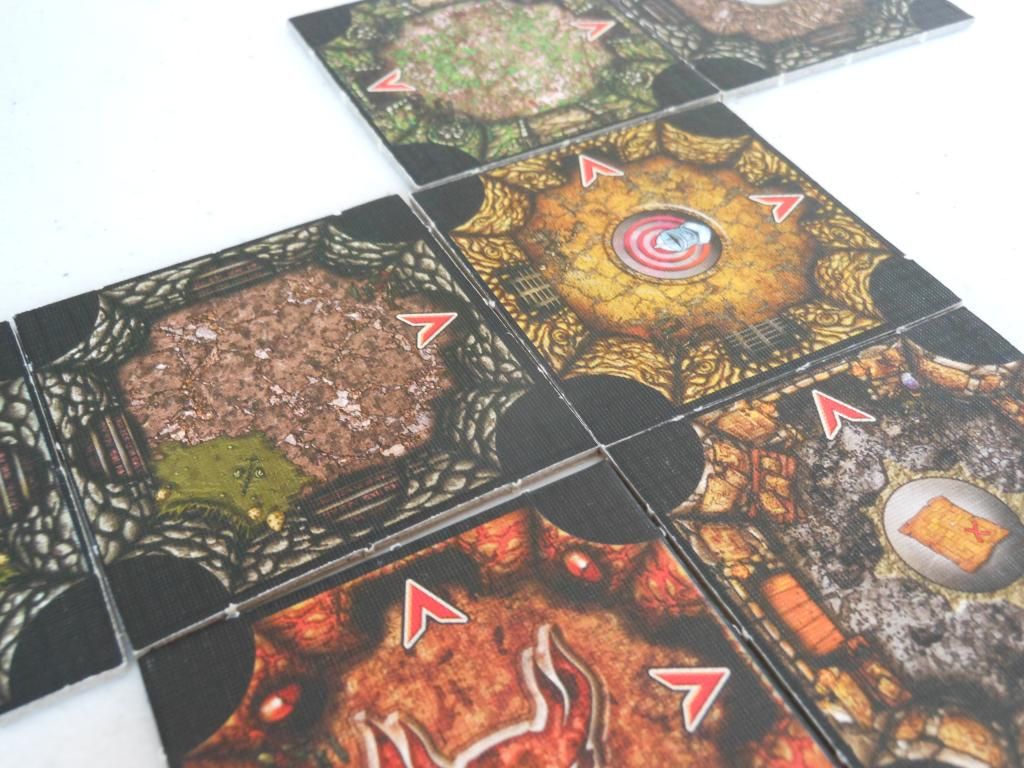
On a turn, a player can do one of two things: add a tile to the existing maze (following certain limitations based on the direction of the arrows on tiles already in play), or move his or her character onto an adjacent tile (following the direction of the aforementioned arrows).

That's it.

The rules for the game fit on two sides of A5 paper, and you can explain them to anyone in less time than it takes to prepare some part-baked bread.

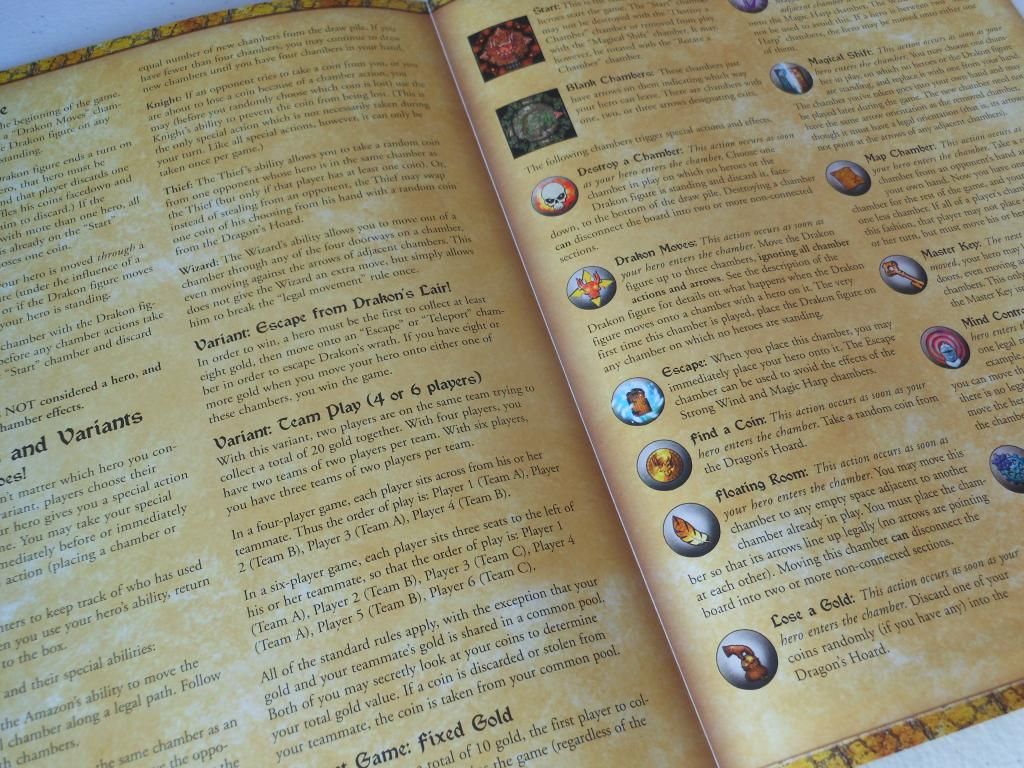
Of course, what really makes the game a blast is the special rules that work within that simple framework to create hilarious (and frustrating) situations. For a start, most of the rooms in the maze have special symbols. These range from a coin symbol that means a character gets to take a coin from the bank upon entering, to the deeply annoying magic harp, which forces characters in adjacent rooms to move towards it.

There are tiles that allow players to steal coins from other players, tiles that allow players to destroy other rooms, and tiles that allow players to activate the Drakon figure so that it stomps around the dungeon beating up everyone.

Drakon Maze
Characters can only move in directions marked by arrows.


The real joy comes from watching players create dungeons that benefit them while messing up the plans of everyone else at the table.

For example, as characters always have to follow the direction of one of the arrows on each map tile, it is possible for a player to create a closed loop of four or more coin-generating tiles. What follows is every other player at the table rapidly trying to break open that loop by blowing up tiles, sending in the dragon, floating tiles into new locations, or (ingeniously) making their own loops full of coin-stealing tiles.

Through clever positioning of tiles, players can rush around the dungeon, bypassing dangerous tiles to hit the coins they need to win. Nothing is more satisfying than a good shortcut that teleports you past a sequence of magic harps to land in the middle of a coin-rich area of the map. Nothing, except part-baked bread, I mean.

Finally, as an optional rule, it is possible for characters to get a one-shot special power. Each character has a different power, and if employed at exactly the right moment, it can make the difference between success and failure.

Drakon instructions
The rules couldn't be simpler.


It really is an incredibly simple game that offers a wealth of enjoyment from its streamlined rule set. It is hilarious to see players desperately clawing coins from each other, bickering and fighting as they do everything within their power to avoid becoming Drakon's dinner.

For that, I recommend Drakon highly; but there are two important provisos, which are actually the same.

1. This is not a dungeon-crawler.

You will not feel heroic playing it. You will feel like a complete sod. You will screw over your friends, again, and again, and again.

And then you'll do it again, just to make sure.

Every turn, every move, is fifty percent to aid you, and fifty percent to ruin the lives of every other player.

If you don't like that idea, then you won't like this game.

In other words, if you want to save the day, look elsewhere; because this is all about saving your own neck.

2. This is not a dungeon-crawler.

There are no dice, no magical weapons, no chests to loot, no monsters to fight. Nobody dies (until the end). You can't fight the dragon, you can't upgrade your skills, you can't gather experience points.

You can play a tile. Or you can move one space.

This is a tile-laying puzzle game, and it is surprisingly thinky.

But it's not a Euro game either.

There is lots of luck in the tiles you draw, and the coins you pull (which have secret values ranging from one to four). Good play will get you a long way, but it doesn't guarantee a win. There is too much interaction between players to perfectly map out your solution.

It's a little from column A, and a little from column B.

It is the part-baked bread of the gaming world.

And it is delicious.

Drakon
She looks hungry.


So, what have we learned today?

Mainly, we have learned that I probably shouldn't write reviews when I'm hungry.

Oh yeah, and Fantasy Flight Games have recently announced the fourth edition print of Drakon with new artwork and miniatures. It's well worth checking out.

Wednesday, 28 January 2015

Review - Cover-Up (aka Hepta)

Cover-Up


Cover-Up
Designed by Alex Randolph
Published by Ideal
For 1 or 2 players, aged 6 to adult

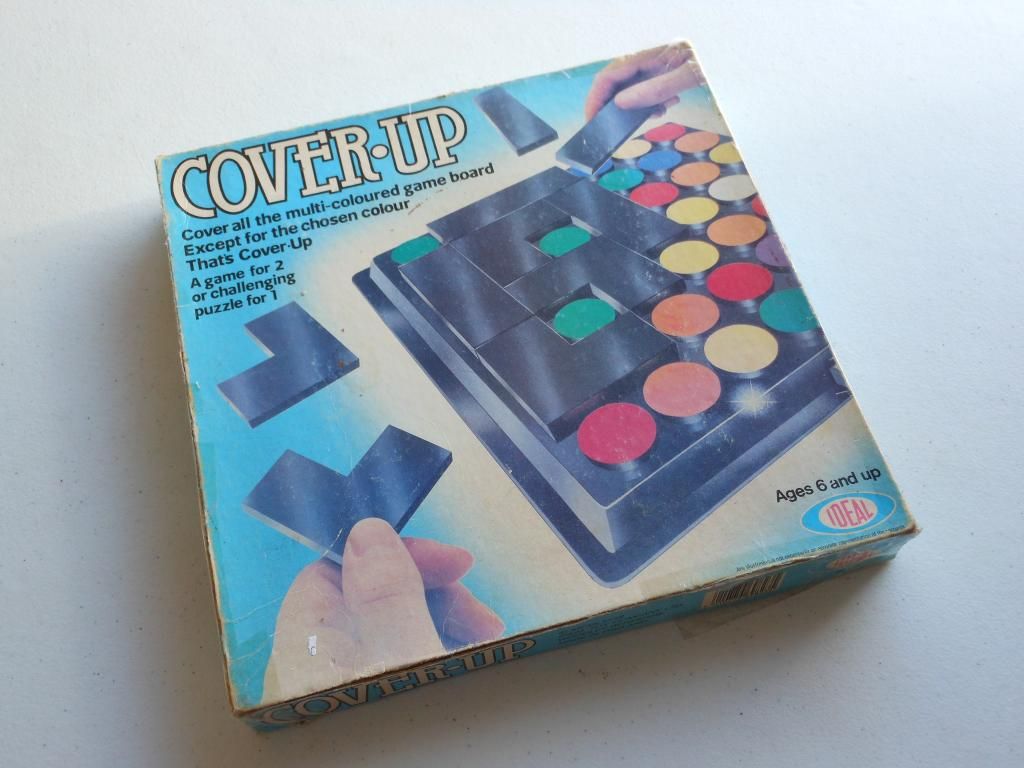
Cover-Up Game
My charity shop copy, complete with free stains.


Life is full of little embarrassments. At least, my life is.

And that's not a euphemism.

I manage to embarrass myself with such unnerving regularity, if I thought about it too much I would never leave the house.

And I'm not talking about major faux-pas here.

I mean the little stuff.

Like being a writer, but still having to double-check if the plural form of "faux pas" is actually "faux pas."

Like getting into a taxi and forgetting your house number at the exact moment the driver asks where you want to go.

Like finding an old picture of you when you looked slightly different. *

But recently I was subjected to one of the most humiliating things ever: getting beaten in a two-player abstract game by my four-year-old daughter.
And I don't mean I threw the match to make her feel good.

I mean I lost.

I lost in a "best of five" contest.

So, I actually lost three times.

Three times.

All joking aside, I am actually very proud of my daughter for genuinely beating her old man. It's nice to see her developing as a games player, and as a little person in general. And, you know, I'm getting used to embarrassment.

But seriously...

THREE TIMES.

The game in question is Cover-Up, a curious little game that my wife found for me in a charity shop, and which I honestly expected to be a bit shit.

Turns out, I was actually wrong.

So, what does Cover-Up bring to the table, other than a name that sounds like something Mary Whitehouse would shout at a Page 3 girl?

Let me explain...

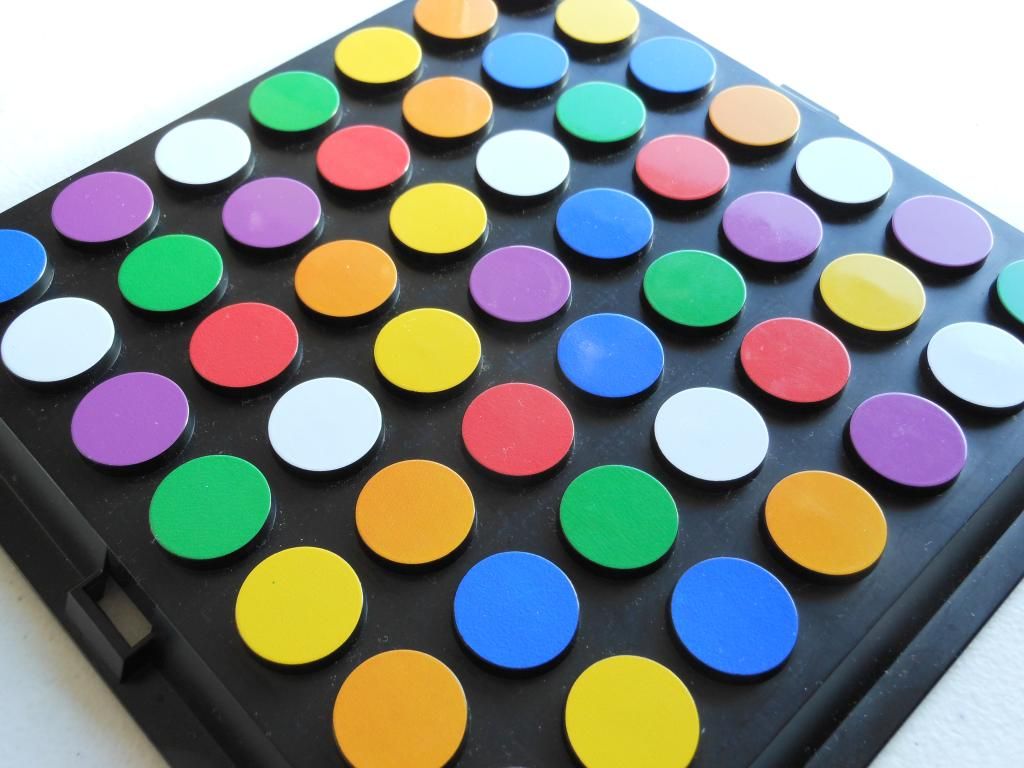
Also known as Hepta, this is a tight little two-player game that involves tile laying and spatial awareness. The board is moulded plastic, and features a pattern of raised dots in different colours that looks like something Damien Hirst might make. There are exactly seven dots of each colour, in what at first appears to be a random configuration.

Cover-Up Board
It's a work of art.


One player gets seven straight tiles, and the other player gets seven "L" shaped tiles. All of the tiles cover exactly three dots.

Now, here's the science bit:

One player picks a colour. For the duration of the game, neither player is allowed to place a tile so that it would cover up a dot of that colour. Players then take it in turns to place a tile. The first person who cannot legally place a tile (i.e., me) loses the game.

It is really that simple.

In fact, it is so simple, the "advanced rules" for the game are, "play the best of five games."

Not even kidding.

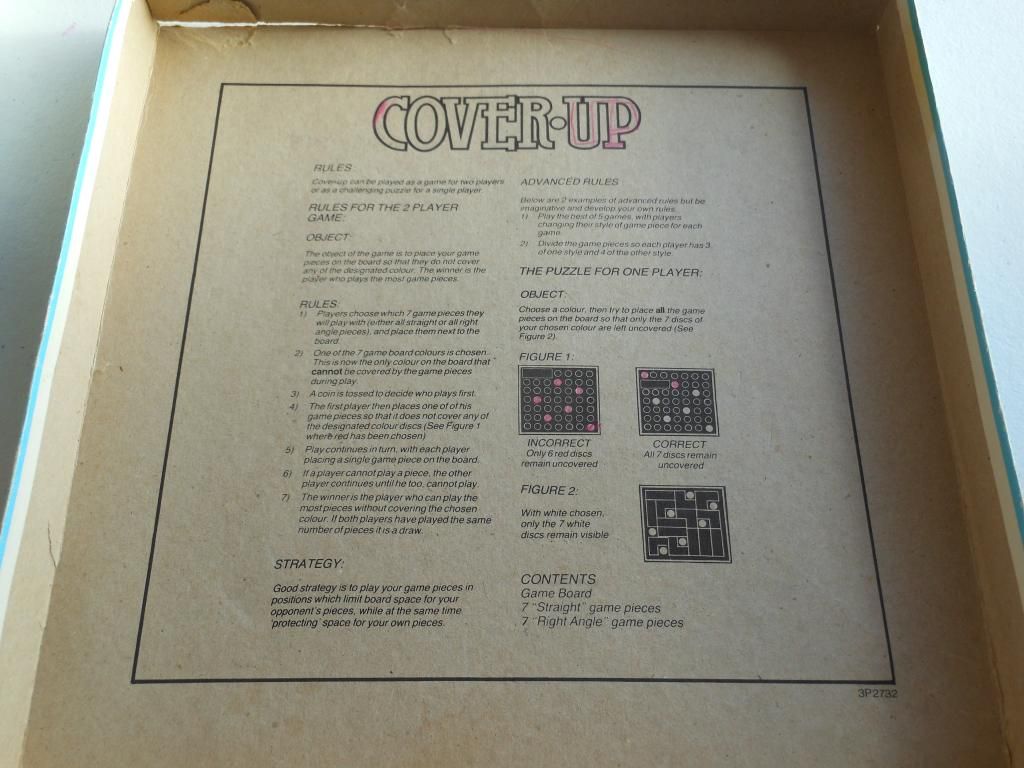
Cover-Up Rules
Rules in the box lid. That's old school.


But, in an age when games are increasingly complicated, it is refreshing to play something you can explain to a four-year-old in under a minute, but which still actually quite good fun, and even a little bit "thinky."

I taught the game to my daughter by letting her choose a tile shape, then letting her choose a colour. Then I told her we had to take turns placing tiles, without covering up her chosen colour. And that was all it took.

She now requests to play the game daily, and considering a single match lasts no more than five minutes, it is easy to play "best of five" no matter how busy your day is.

Cover-Up game in progress
I'm already losing.


As a little bonus, the game also has a solo variant. The aim is to select one colour, and then place every single tile on the board so that only the seven dots of that colour are showing.

No. I haven't managed to do it.

Yes. I suspect my daughter could.

Little show off.

So, what have we learned today?

We've learned that it is possible to find good stuff in charity shops sometimes; we've learned that I embarrass myself more than seems humanly feasible; and we've learned my daughter is cleverer than me.

Oh yeah, and we've learned that Cover-Up is an okay game. It is quick, simple, and suitable for all ages. Certainly worth a look, but not something that is ever going to be considered a real "gem" in a games collection. The only major downside is that it is a colour-based game, and that means people who are colour blind are going to have a hard time of it.

Now, if you'll excuse me, I have to go to arm wrestle my daughter.


* And like putting an asterisk next to jokes you have stolen from Reeves and Mortimer, just in case someone notices that you stole them.

Sunday, 11 January 2015

Review - The Weather Game

The Weather Game


The Weather Game
Published by Waddingtons
"Devised" by Wincey Willis
For 2-4 players, aged 6 to adult

The Weather Game box
Check out Wincey on the cover. She looks pleased with herself.


Old people say some funny things.

And by funny, I don't mean "ha ha" funny. I mean "slowly back out of the room without breaking eye contact" funny.

Sometimes they say things that are blatantly obvious, such as, "I'm not as young as I used to be."

Sometimes they say things that suggests some kind of ownership over things that were clearly never theirs, such as, "In my day..."

And sometimes, they say positive things while implying a negative connotation, such as, "They don't make 'em like they used to."

"They don't make 'em like they used to," is clearly intended to suggest things were better in "the good old days" (a sepia-toned period in time so steeped in nostalgia that even the bone-aching winters, outside toilets, and lack of television are remembered as being joyous). Of course, not making things "like they used to" is actually a really good thing. After all, if they were, we'd all still be living in caves staring slack-jawed at a stick while wondering why it is so bloody cold.

Worse still, they might still be making board games like The Weather Game, devised by Wincey Willis.

Now, I'm not exactly old (although I'm not as young as I used to be), but I do vaguely remember Wincey. She rose to prominence in the 1980s as a weather presenter, cheerily lying to the Great British public by sticking little suns on a map of the UK and proclaiming this would lead to the now-mythical "dry spells."

What I never knew is that Wincey also dabbled in board game design, and is credited with "devising" The Weather Game, which my wife found in a charity shop for the princely sum of 99p.

As far as I know, this was Wincey's only foray into the hobby, and that's something we can all be thankful for, because if this game was a map of the UK, there would be a lot of black clouds stuck all over it.

Here, let me explain:

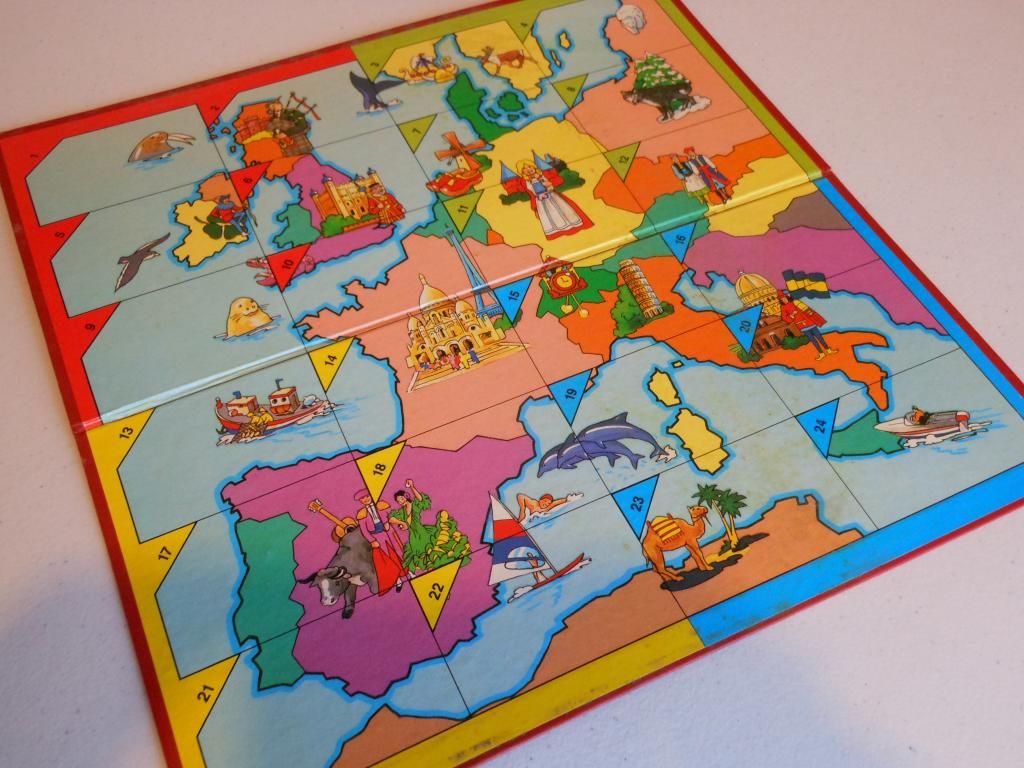
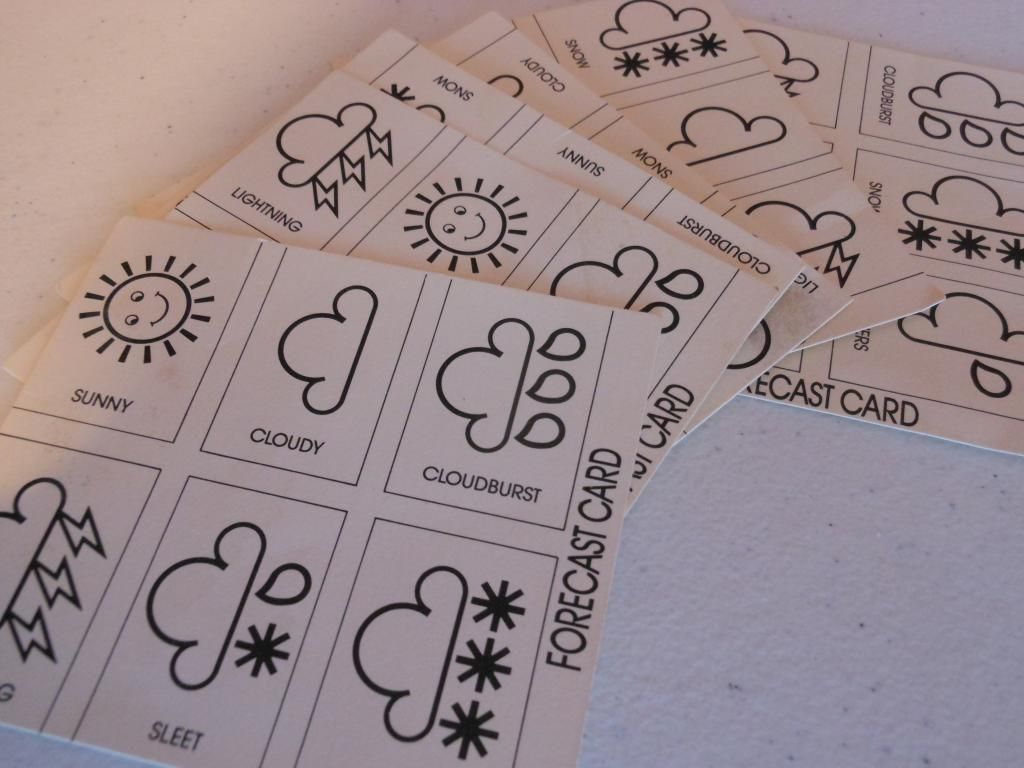
The board is divided into four sections, which are further divided into six spaces, and each player is allocated one section. Each player also gets a unique forecast card, showing six types of weather. The aim is for a player to fill all six spaces in his or her section with pairs of cards matching the icons on the forecast card.

The Weather Game board
It's a small world after all.


This Herculean task is achieved through the age-old mechanism of the memory game.

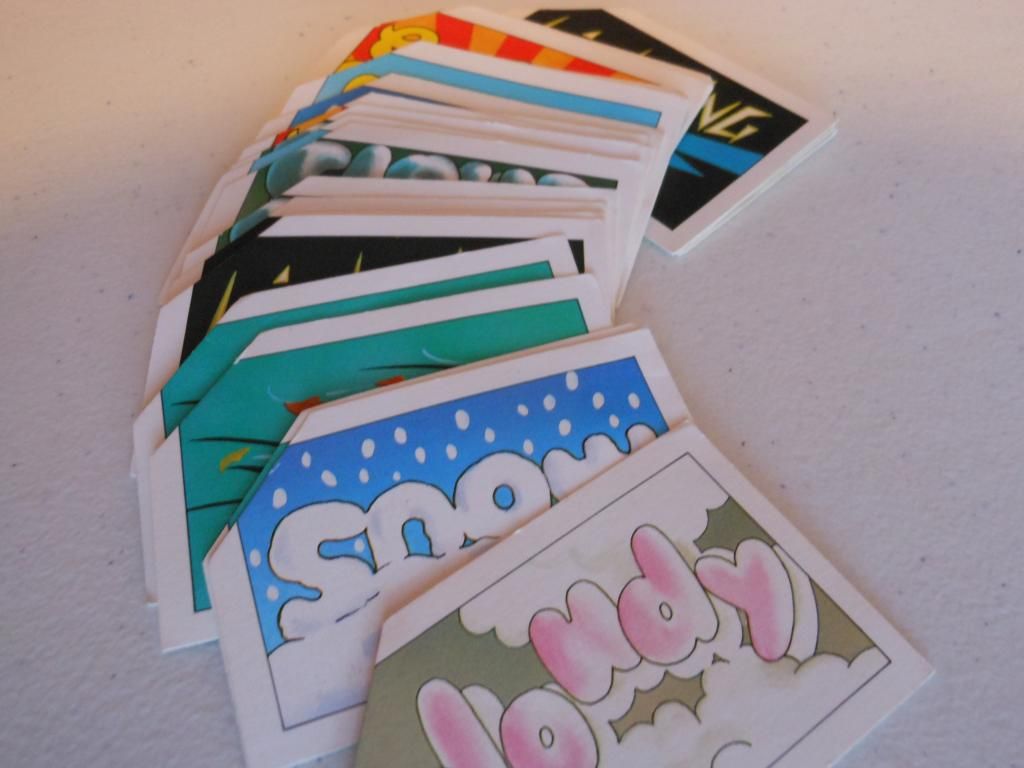
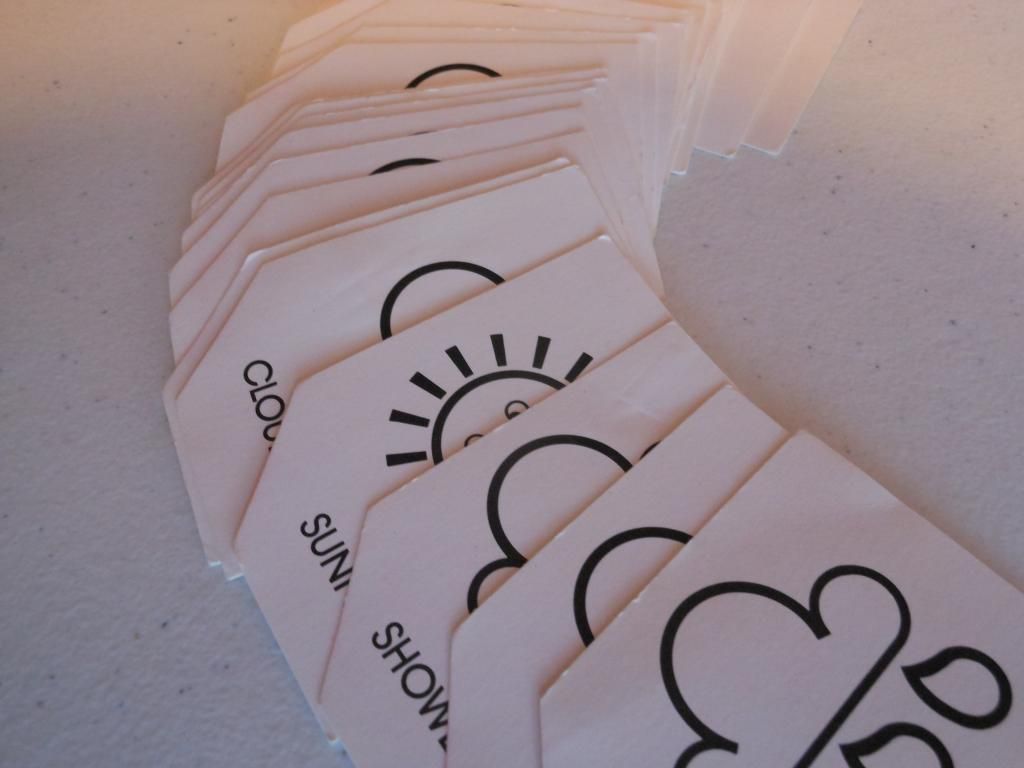
There is a set of blue-backed cards, and a set of pink-backed cards. On your turn, you flip one card of each type. If you get a match, and the match is also on your forecast card, you can take both cards and drop them onto your board space. If you fail to make a match, you turn the cards face down again, and play proceeds to the next player.

The Weather Game cards
You have to match one of these coloured cards...


The Weather Game cards
...with one of these black and white cards.


That's basically it. It's Memory. Only, it's an agonisingly long version of Memory that requires you not only find matching pairs, but also find the correct matching pairs that appear on your forecast card.

I don't have a problem with Memory, I play it with my daughter quite often; but it's a filler game. It's nice and quick, and you can play it a few times and then do something else before the players start to grind their teeth in boredom and frustration. But in The Weather Game, even finding pairs isn't good enough. It makes the game drag on longer than it has any right to.

This issue is compounded by "Windy" cards. Every player is allocated two "Windy" cards, and a player has to have used both before he or she is allowed to win the game.

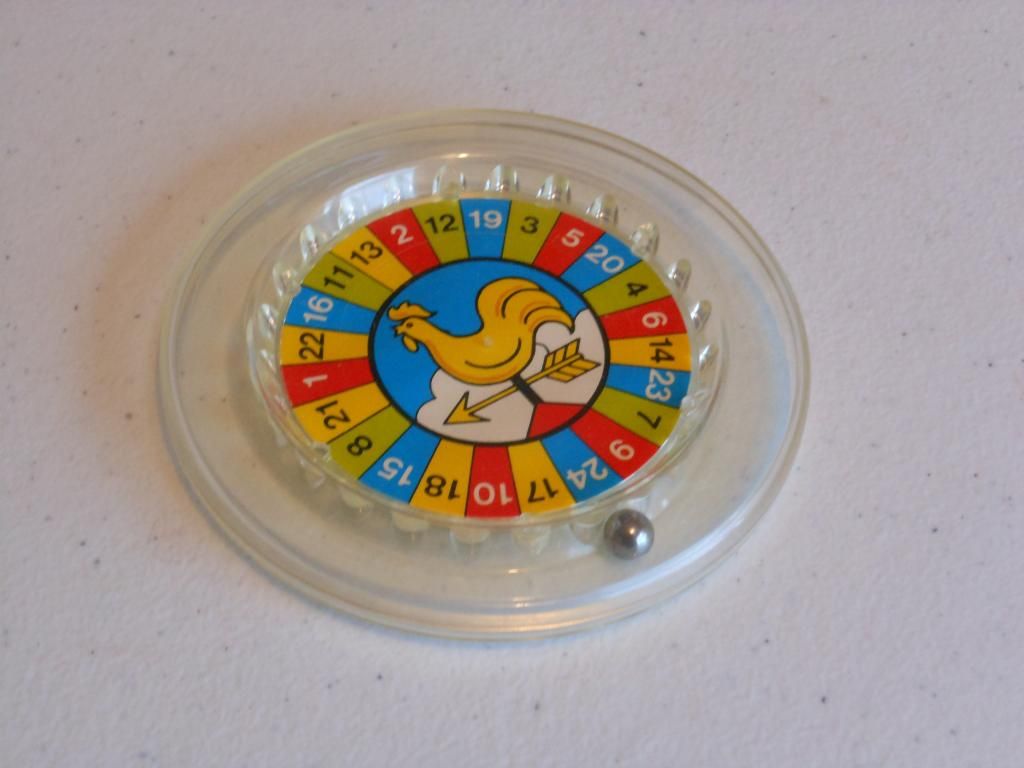
Playing a "Windy" card involves spinning a spinner, and then removing any cards from the board section indicated on the spinner. These cards are returned to their respective card sets, and then all the cards are shuffled.

The Weather Game spinner
The spinner of doom. Fear it.


Think about that for a minute...

Go on, I'll wait...

Let's go through the issues with this game mechanism together:

You have to play the "Windy" cards in order to win. So, right there you are forcing players to use a mechanism to extend the length of the game. But it isn't like the cards are a catch-up mechanism. You have just as much chance of knocking out some of your own cards, and because you then shuffle all the face down cards, you are effectively resetting the game. There is nothing more frustrating than finally learning where a pair of cards is that you need, only for someone to then shuffle all the cards so you have to start again.

The chance of removing your own cards, and the annoyance of shuffling all the face down cards, means wise people will use their "Windy" cards in the first turn (there is nothing in the rules to stop you doing this). Playing the cards immediately prevents the risk of losing your own cards, and dramatically shortens the length of the game.

Even wiser people will simply not use the "Windy" cards at all.

The wisest people of all will simply not play.

I honestly don't have anything positive to say about this game. The graphics are ugly, the gameplay is bland and monotonous, it goes on too long, and the "Windy" cards mechanism is deeply flawed. Even the theme is a dud. Children aren't going to get excited about turning up pictures of clouds when they could be playing a themed version of Memory with Marvel superheroes, Disney princesses, or popular television characters.

The Weather Game forecast cards
The forecast looks bleak.


Maybe I am getting too old and grumpy. Or maybe I am not old enough to sink into the honey-dipped nostalgia this game exudes. Either way, t's true what they say: they don't make them like they used to.

That's something we can all be grateful for.