Showing posts with label games for Halloween. Show all posts

Monday, 30 October 2017

Review - Goosebumps: Terror in the Graveyard

Designed by Craig Van Ness
Published by Waddingtons
For 2-4 players, aged 7 to beyond the grave


Goosebumps Terror in the Graveyard board game box art, showing the headless ghost preparing to strike.


Recently I've been spending a lot of time trying to get a new YouTube channel off the ground. I'd never really intended to start doing videos, but it just sort of happened, and now I'm just another victim of the machine: A disembodied voice in the vast expanse of the Internet, wailing, "Look at me!"

If I'm honest, I'm not good with cameras. I don't like having my picture taken, I don't like being the centre of attention, and even just recording my voice fills me with anxiety. I've always been more comfortable writing. It's no wonder I became a novelist; even less of a wonder I became a freelance content provider so I could lock myself away at home and project myself onto the world from the comparative safety of my computer.

Friday, 30 October 2015

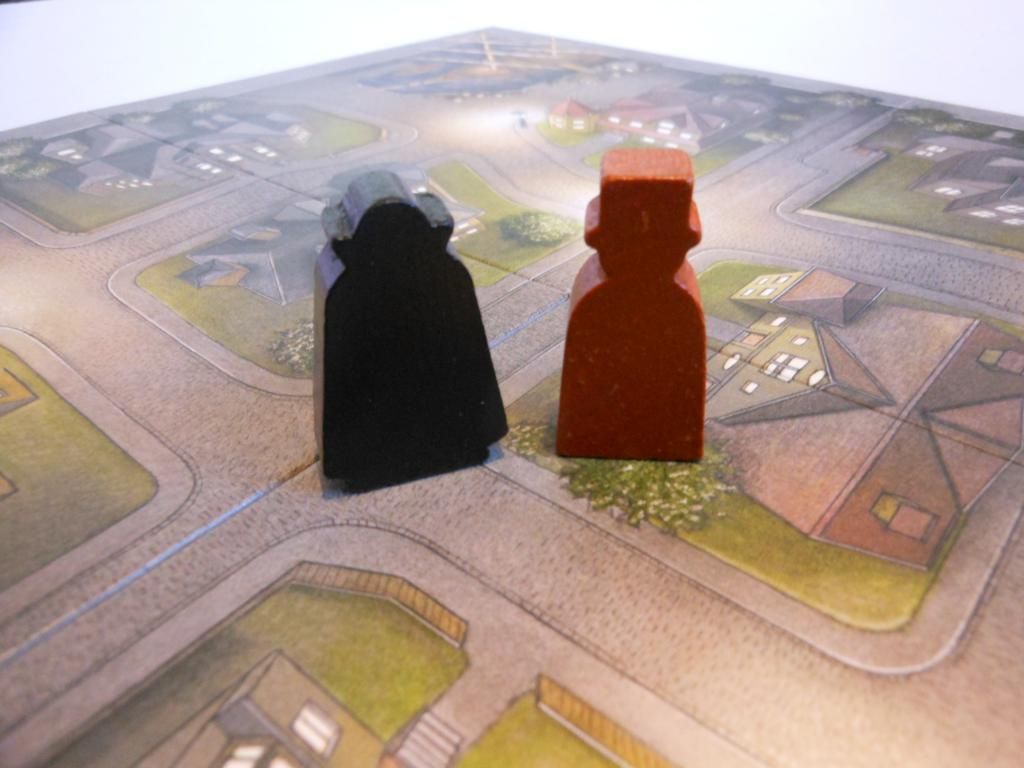
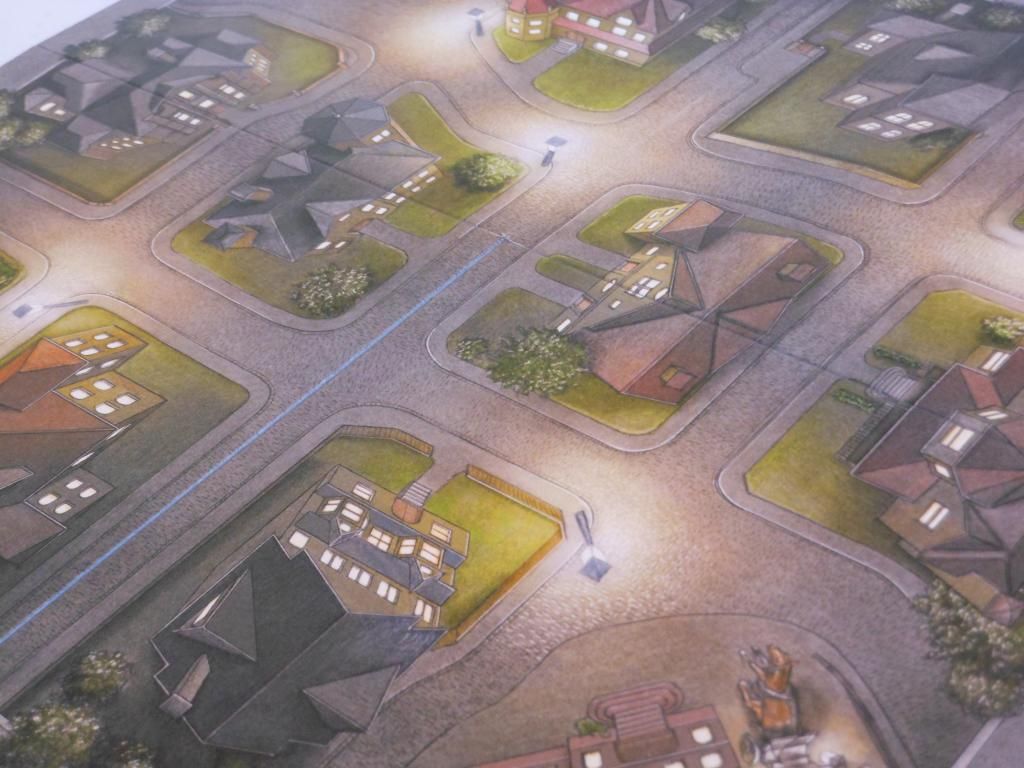
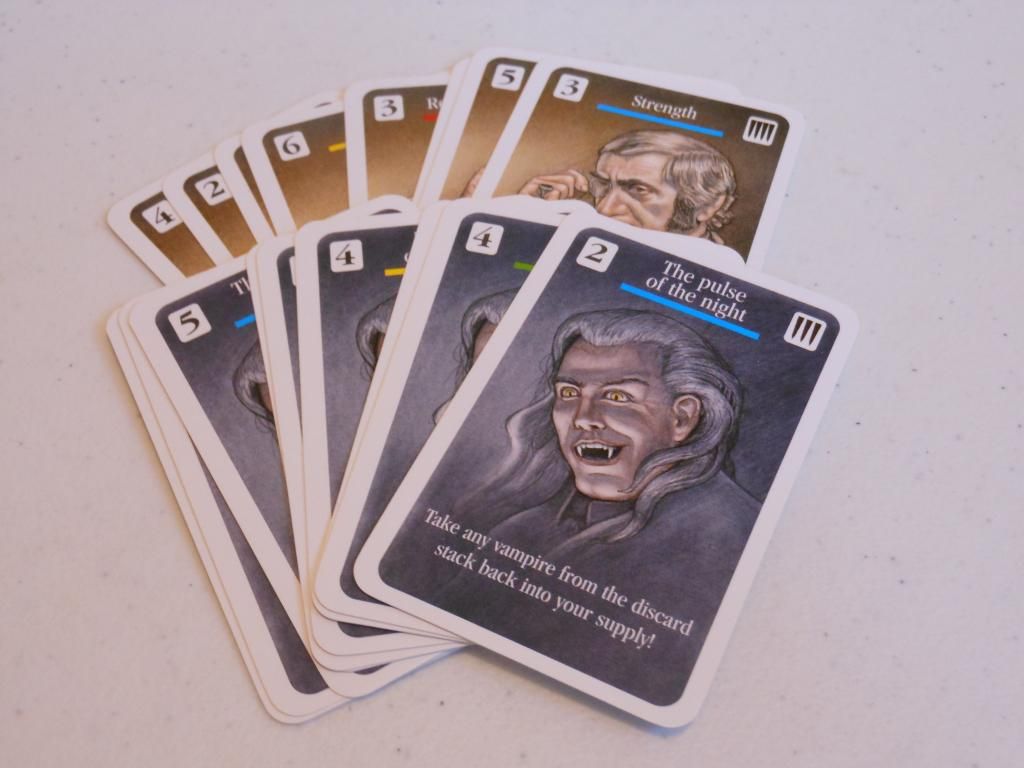
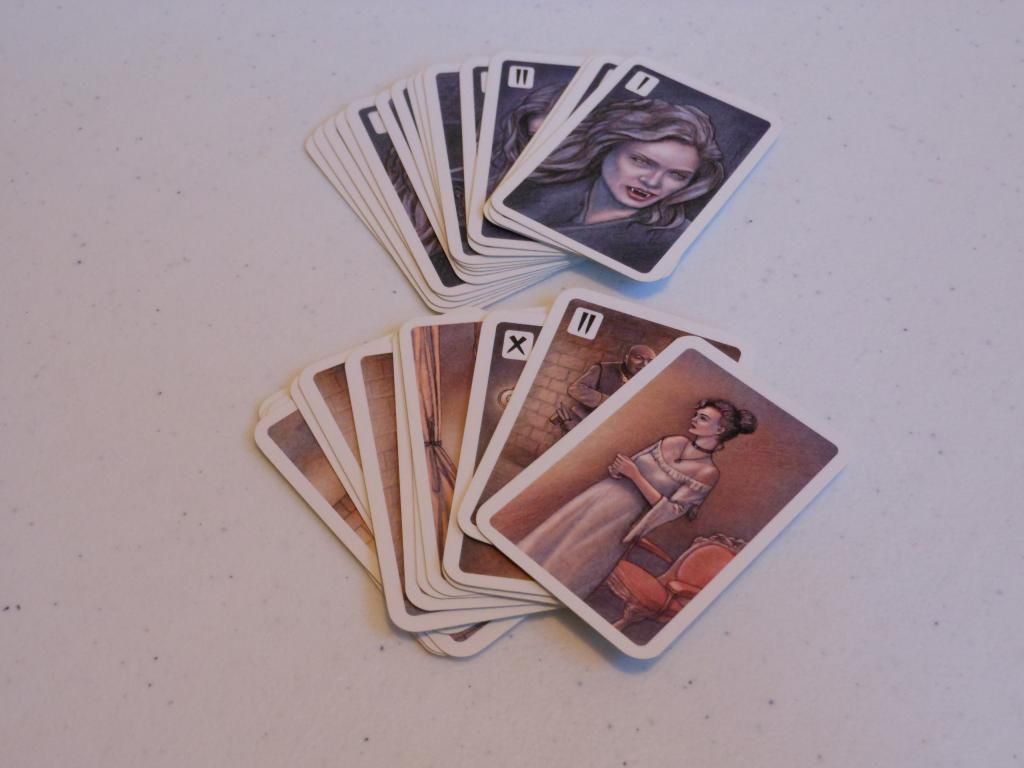
Review - Fury of Dracula (Second Edition)

Fury of Dracula


Fury of Dracula (Second Edition)
Designed by Stephen Hand and Kevin Wilson
Published by Fantasy Flight Games
2-5 players, aged 10 to adult


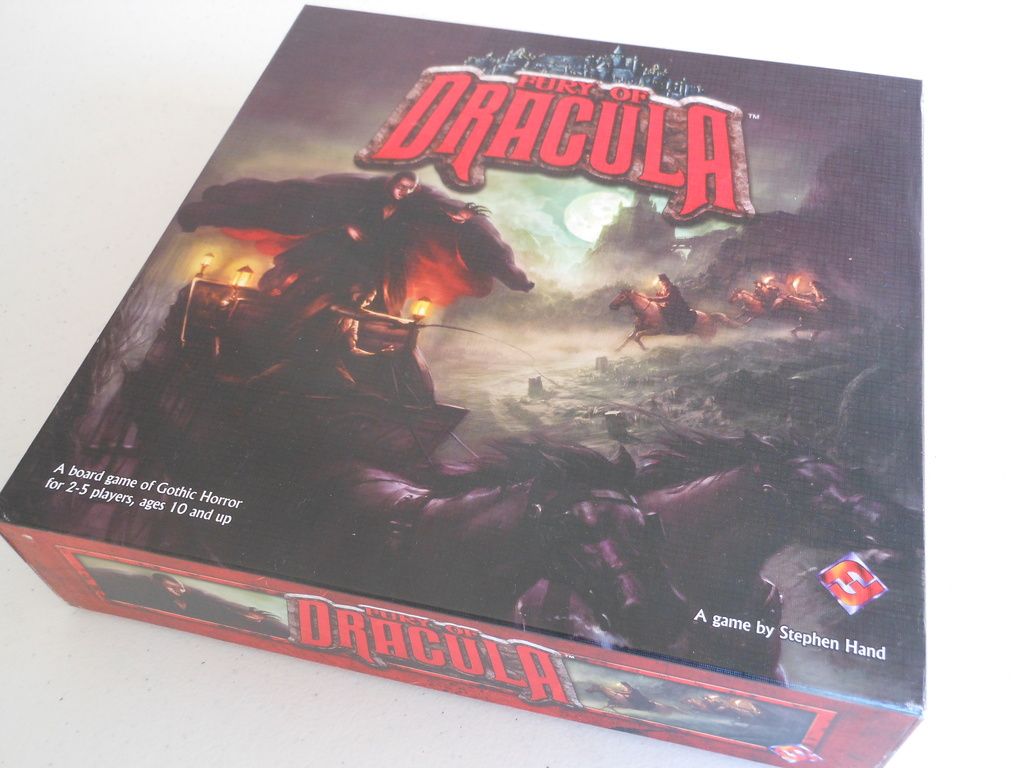
Fury of Dracula box
Dracula looks like he is in a spot of bother.


Ah, Halloween...

I love Halloween.

It's one of those times of the year when I wish I lived in America... The other times being all the other days surrounding Halloween.

Not that I dislike England, you understand. I just feel we don't really put our back into it when it comes to Halloween. Or theme parks. Or customer service.

Or dental care.

But I digress.

Wednesday, 30 October 2013

Review - Dracula

Dracula teeth


Dracula
Designed by Michael Rieneck
Published by Rio Grande Games (Kosmos Line)
For 2 players, aged 12 to adult


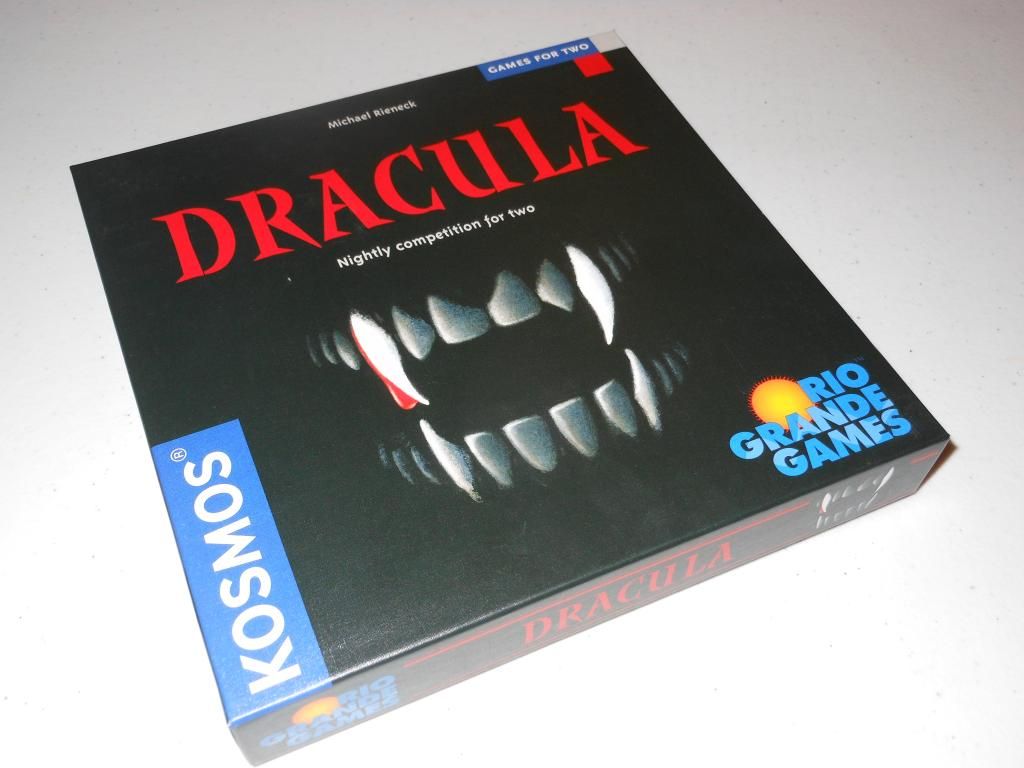
Dracula board game
The eye-catching box.


Halloween is fast approaching, so I thought it was time to tell a scary story...

Once upon a time there was a young man who lived in a small flat all by himself. The flat was part of a converted inn, and was home to more than one ghost. Doors would bang at night, lights would come on, and dark phantasms swirled through the young man's dreams.

One day, the young man met a young woman. They quickly became friends, and soon after became something more... Within three months of their first date, they had rented a huge house together, and the young man was finally free of his haunted flat. Unfortunately, renting a large house did not leave the young couple with very much money, so they spent a lot of evenings at home.

Neither the young man, nor the young woman, were particularly fond of television, so they were always looking for other things to pass the time.

One day, the young man said, 'Hey. When I was younger I used to really like board games. Maybe we should get some board games.'

The young woman agreed that it sounded like a good idea, and a few days later a suspicious brown box arrived in the post. Inside: a two-player game called Dracula.

Dracula is a beautifully produced, and beautifully designed, game of deduction, bluffing, and hand management. The concept is simple. One player is Van Helsing, and the other player is the titular night-time menace. Drac has arrived by ship in London, and has begun hiding his coffins in various locations; Van the Man is on the hunt, but at the same time, he is trying to protect the citizens Drac wants to bite.


Dracula board game - Dracula and Van Helsin meeples
Guess who...


So, what you have is an incredibly tense game of cat and mouse, played out over a simple 4x3 grid. In each space will be a face down card (either a card from Van Helsing's hand, or a card from Dracula's hand). On a turn, a player can choose how many spaces to move his cute little wooden meeple on the board, and as he does, he can look at the cards he lands on. If the card is one of his, he can swap it (or pretend to swap it) with a card from his hand. If it isn't one of his cards, he encounters it, which often means having a fight.


Dracula board game - the board
The board - you don't need it, but it's lovely.


Each player has three types of cards: Five objectives (Van Helsing has victim cards, Drac has coffin cards), one special object (if revealed by your opponent, your opponent loses a life instantly), and nine allies. Allies are obviously the most likely sort of card you will encounter, and they represent vampire hunters or vampires. They each have a strength value, and when they are revealed, you have to play a card from a second hand of cards to defeat them...

Wait... What? Didn't I mention the second hand of cards?


Dracula - action cards
Action cards.


Okay. You see, in this game, you have to carefully manage two hands of cards. The first hand comprises the encounter cards that get played on the board (as already mentioned). You also get a deck of ten larger action cards. At the start of the game you draw five, and then once you have used all five, you get the other five. After that, you shuffle them together and draw a new hand of five, and so on...

These larger cards add real meat of the game. Each one has four elements: A movement value, an attack strength, a barrier, and (usually) a special power. On your turn, once you have stopped moving, or have been forced to stop moving by encountering one of your opponent's allies, you need to play one of the larger cards from your hand. You need to play a card with a movement value that matches the number of spaces you moved (otherwise you take damage), you also need to play a card with a strength value that will enable you to defeat the ally. Of course, the cards with the highest movement value tend to have the lowest attack strength, so you have to balance speed with strength. Nice, clever stuff.

Most of the cards will also show a barrier colour, and this allows you to place (or move) a barrier on the board. These barriers are impassable, and can be used to block your opponent from reaching certain locations.

Finally, most cards have a cool power, allowing you to take extra turns, or move your piece, or regain health.

So, going in turns, players will move to one or more locations, revealing and swapping cards, moving barriers, and generally trying to create as much confusion for their opponent as possible. But what's the point? The point is those objective cards I mentioned before. If at any point you have found all five of your opponent's objective cards, or you can prove that the only objectives left are in your opponent's hand rather than on the board (achieved by landing on your opponent's space and showing each other your hands of cards), you win.

Dracula is a very clever little game. It plays out in around half an hour, on a tiny grid, and has a very limited set of rules; and yet it offers some surprisingly deep gameplay. Bluffing and deduction play a big part of it: You need to keep swapping cards on the board, forcing your opponent to return to locations over and over again. You need to know when to place an objective on the board, and when to keep it in hand (where it is slightly safer). But there is also a second game layered over the deduction game, and in that game you are managing a limited amount of resources: Action cards. You have to carefully plan when you want to move a large number of spaces, and when you want to move cautiously. You need to keep in mind which allies you have killed, and hold on to a strong enough action card to kill any that are left.


Dracula - encounter cards
Encounter cards.


What is great about this second layer of gaming goodness, which is drizzled all over the deduction game like cream on pumpkin pie, is the fact it helps to level the playing field. I am not good at deduction games, but I am pretty good at resource management and card games. If you can kill an opponent's ally, you get to replace it with a card of your own. This makes it more dangerous for your opponent to move around, forcing more fights that might end with your opponent taking damage. If your opponent takes four lots of damage, you win. In other words, if you are confronted with a master of bluffing, you can just beat the snot out of him or her instead.

After the young man had played several games of Dracula with the young woman, he packed it up and put it on the book shelf. 'That was good fun,' he said.

'Yeah,' the young woman said. And then it was as if a dark spirit crept into the room, possessing the young couple.

The young man shivered, as if a window in his soul had been opened, allowing him a brief glimpse of his future. 'We should get more games,' he said.

Nine years later, the young man is no longer so young. He lives in a slightly smaller house that he owns rather than rents. The bookcase with a single board game on it has become three bookcases, crammed with over 150 games and expansions. And board games have become an integral part of his character.

He even writes a blog about them.

And the young woman? She is now his wife, and the mother of his daughter.

And sometimes, just sometimes, they still play Dracula.

Spooky, huh?

Tuesday, 17 September 2013

Review - Vampire Hunter

Vampire Hunter


Vampire Hunter
Published by Milton Bradley (Hasbro)
Designed by someone with really good eyesight
For 2-4 players, aged 9 to adult

If you know me at all (and let's be honest, you probably don't) you will know that I like games with a bit of theme. I enjoy abstract games, and I can enjoy cube-pushing games that have a pasted on theme for colour; but what I really want is a game that oozes theme (not in a gross kind of way). I want a game that makes me feel completely involved in what is happening, and totally invested in the success of my character.

Creating theme in a game is more than just suitable artwork and playing pieces (although, of course, that is a major element). It also takes game mechanisms that make sense. If what you are doing makes sense (without having to perform mental backflips to link everything together), then the battle is already won. And if you have a game with a novelty element or gimmick that reinforces the theme in some way... Well... Sign me up.

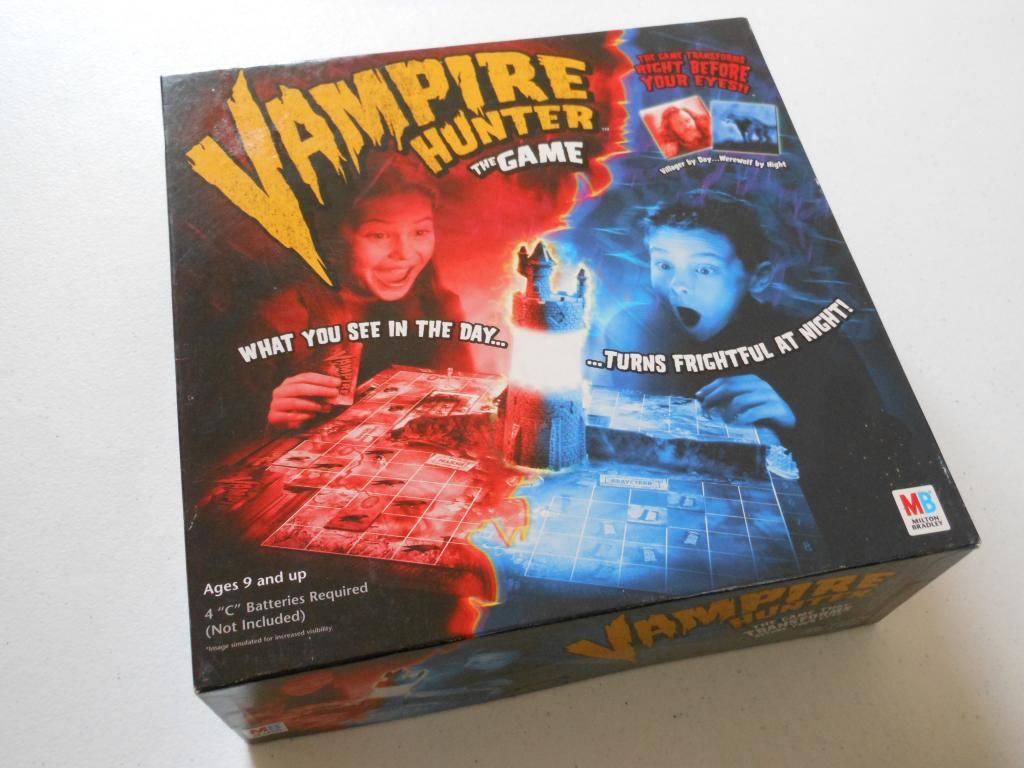
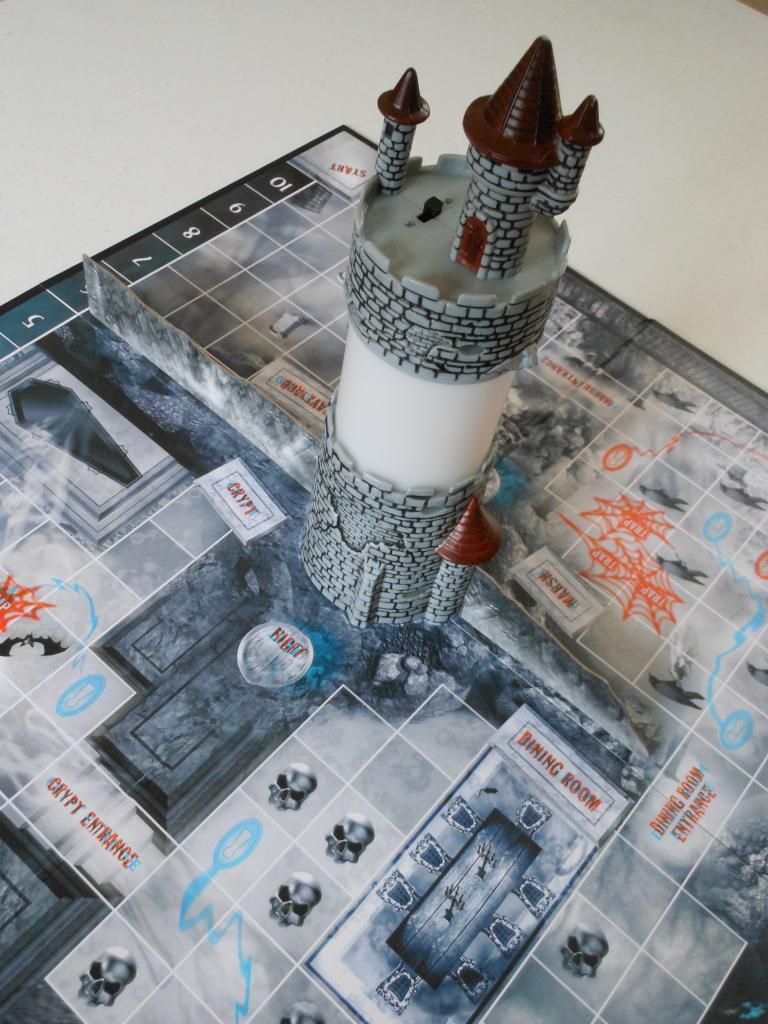
On first blush, Vampire Hunter is a perfect fit. It has suitably moody artwork, plastic miniatures for playing pieces, and a cool 3D tower in the middle of the board. But it is the novelty element of this game that really sells the theme.


Vampire Hunter Tower
The tower.


You see, in that cool 3D tower is a light. Switch it on, and the light glows blue. Press the top of the tower, and the light changes to red. Why? Simple really. Everything in this game is printed twice. Every card, every token, every dice, and even the board, has been printed once in red, and once in blue. When the light is blue, certain elements on the game components are washed out to reveal particular images; but when the light changes to red, different elements are washed out, and the images change.

This is more than just a gimmick: It is the central conceit of the game's mechanisms, and the beating heart of the game's theme. Without the tower, the theme is virtually non-existent; and without the theme, the game is virtually non-existent.

When the red light is on, it is the daytime. The movement dice show higher numbers, graveyard tokens show harmless tombstones, and in the village you will bump into amiable farmers. But when the light goes blue, night has fallen over the land: the movement dice shows lower numbers (because it is harder to travel at night), zombies claw out of the ground beneath the tombstones, and those farmers transform into slavering wolves.

It is incredibly clever, and a beautiful example of how to integrate theme with game mechanisms. The two are literally inseparable.

Unfortunately, beyond this wonderful piece of ingenuity the game is rather sub-standard. Your glasses would need to be as rose-tinted as the board during daylight turns in order to see the game as anything more than a minor distraction.

You may already have noticed I mentioned a movement dice. That should have been the first warning sign: The game is roll and move. The game is also rather boring.


Vampire Hunter
The rules.


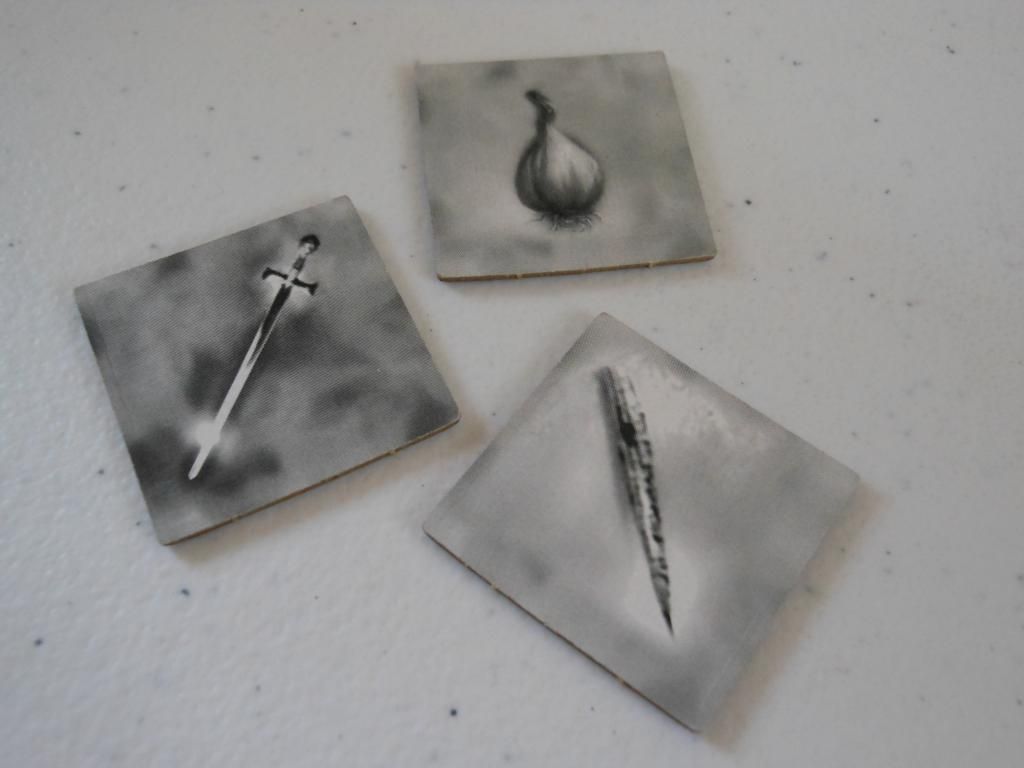
Two to four adventurers are racing to the vampire's tower in order to kill him before he can escape in his ship. To do this they need to move through a graveyard, a marsh, the castle dining hall, and finally the vampire's crypt. On the way, they will flip tokens, which may contain bad things, but may also contain good things. The heroes need to collect garlic, a stake, and a sword, and then defeat the vampire in combat three times (once with each weapon). If they do this before the vampire's ship arrives, they win. If the ship arrives, the vampire escapes, and everyone loses.

You may think this sounds like a co-operative game, but it isn't. Realistically, the vampire will never escape; and really it is just a race between all the hunters to see who can land the killing blow. And yes, it is possible for someone to defeat the vampire twice, and then for a third hunter to turn up and win the third battle, thus claiming total victory for doing only a third of the actual work.


Vampire Hunter Weapons
The weapons.


One of the biggest problems is that it is all incredibly pedestrian. Yes, the changing light mechanism is clever and inventive; but it has been used to disguise a boring game system that is older than Dracula himself. You roll to move, flip a token, take the token if it is good or fight a monster if it is bad, and then... Then you wait until your next turn. Oh, and if you lose a fight? You get pushed back to the entrance space. Like in Mario. Because that's really fun. And thematic.

This is just a bog-standard race game in which you charge around the map gathering up the tools you need to fight the vampire. And of course, whether or not you gather those items is entirely down to luck of the dice (rolling high enough to reach tokens), and luck of the draw (randomly flipping a useful token rather than a harmful one). It may be a children's game, but that's no excuse for this kind of lazy design.

But the biggest problem is also the biggest draw: that tower.

The tower just isn't bright enough. You are supposed to play the game in a darkened room, using only the light of the tower to see what you are doing. But the light is so dim, it is incredibly difficult to see what you are doing. And after 15 minutes, you will have a headache.


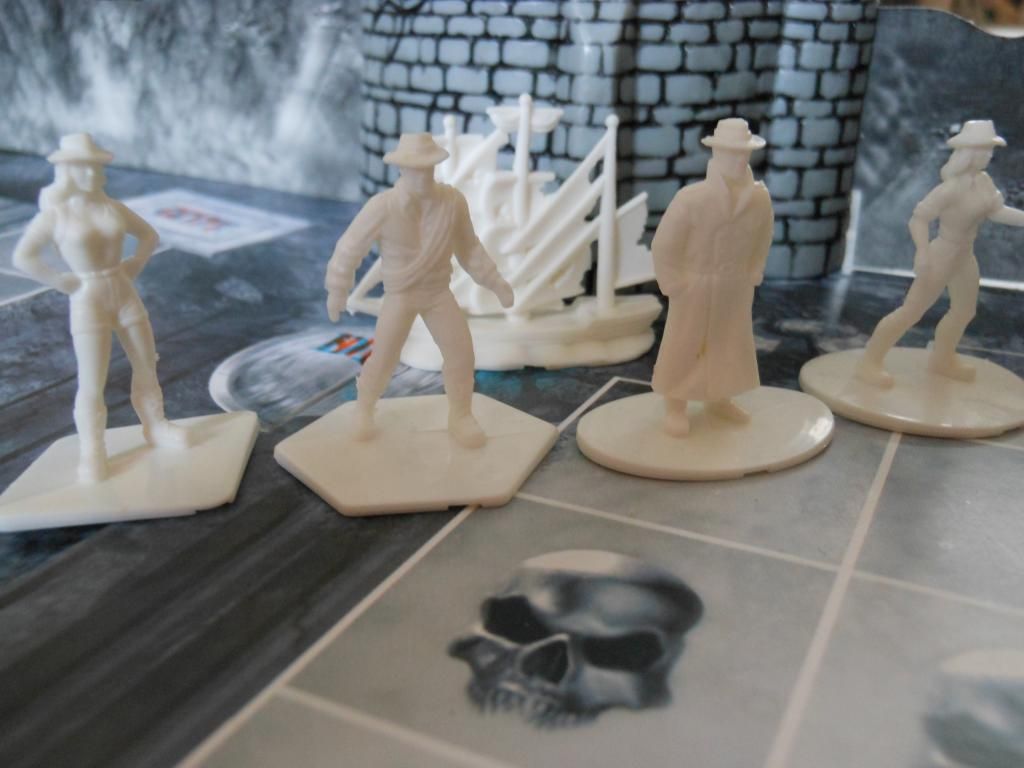
Vampire Hunter playing pieces
Is it just me, or do these guys not look like vampire hunters?


I have had this game for a few years now, and I have made a habit of rolling it out at Halloween. But this is a bad habit, and one I don't intend to continue.

Besides, I have Fury of Dracula in my game collection, which happens to be the most thematic vampire game ever made. And it manages that without a silly light-up tower.

Wednesday, 31 October 2012

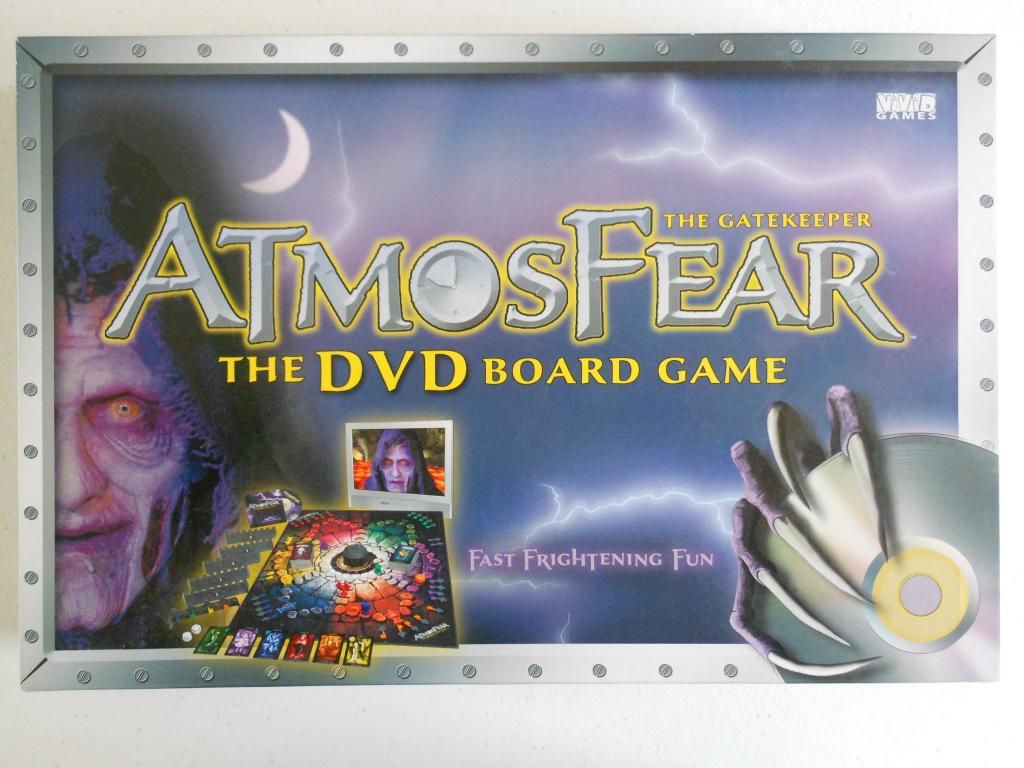
Review - Atmosfear: The DVD Board Game

Atmosfear the DVD board game

Atmosfear
Published by Vivid Games
Designed by The Gatekeeper as a means to torture his victims
For 3-6 players, aged 12 to adult


It's that time of year again... Halloween. The time of year when Poundland brings out its rubber bats and dead-eyed skeleton masks, every radio station seems to be playing Michael Jackson's Thriller, and tiny little demons threaten you with eggs in exchange for sweets and chocolates.

I'm not a huge fan of Halloween; I mean, I don't dislike it, I just don't go out of my way to celebrate it in any meaningful way. However, there are a few traditions I have:

(a) I always watch Tim Burton's The Nightmare Before Christmas;
(b) I always play a game of Atmosfear.

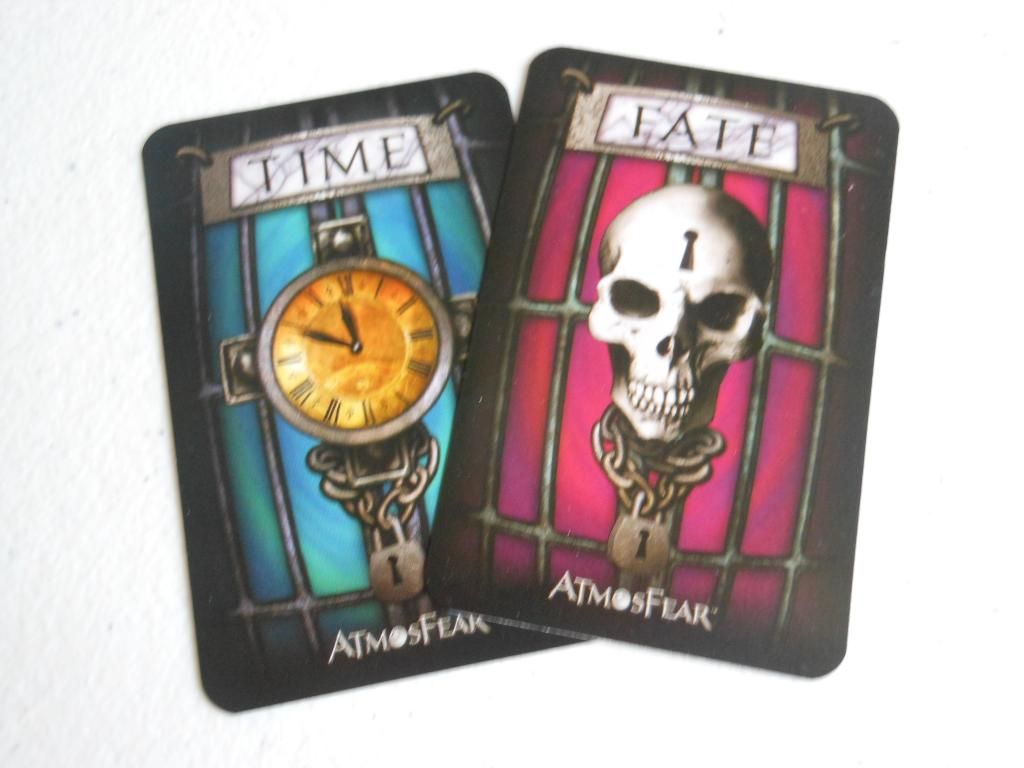
Atmosfear is, let's be honest, not a great game. It is basically a roll and move game in which you try to collect a set of keys that will "unlock" the "well of fears." On your turn, you roll a dice (or two dice - your choice) and then move the indicated number of spaces; and on most turns you don't even get to decide in which direction you move, giving you the same number of options you get in a luck-fest such as Snakes and Ladders. But there is something that lifts Atmosfear far above other roll and move games: Speed. No, I don't mean a hefty dose of illegal substances is required to make the game playable; I mean the game is played at speed. You have only 49 minutes to win the game, and the clock is always ticking. The pressure of passing the dice around, rolling, moving quickly while the next player scrabbles for the dice creates a frantic, fun way to spend an evening. Just don't expect any hidden depths or strategic choices.

But I'm getting ahead of myself. Time to back up...

Whenever I am out in town, I always hit the charity shops in the hope that I will find some old board games (I usually have my fingers crossed for something by Waddingtons or Milton Bradley). Almost every time, I will find at least one copy of Atmosfear - the old VHS version in the long coffin box. Honestly, I know people from other countries who think this game is rare; but I must see one every other week, almost as often as I see those Carol Vorderman's Sudoku games. Thing is, I don't have a video player, so I have always passed up the opportunity to acquire this old classic (I only have games in my collection that I intend to play). Of course, when I eventually found a mint condition copy of the DVD version of the game in a charity shop I had to have it, even though it was a little pricey.

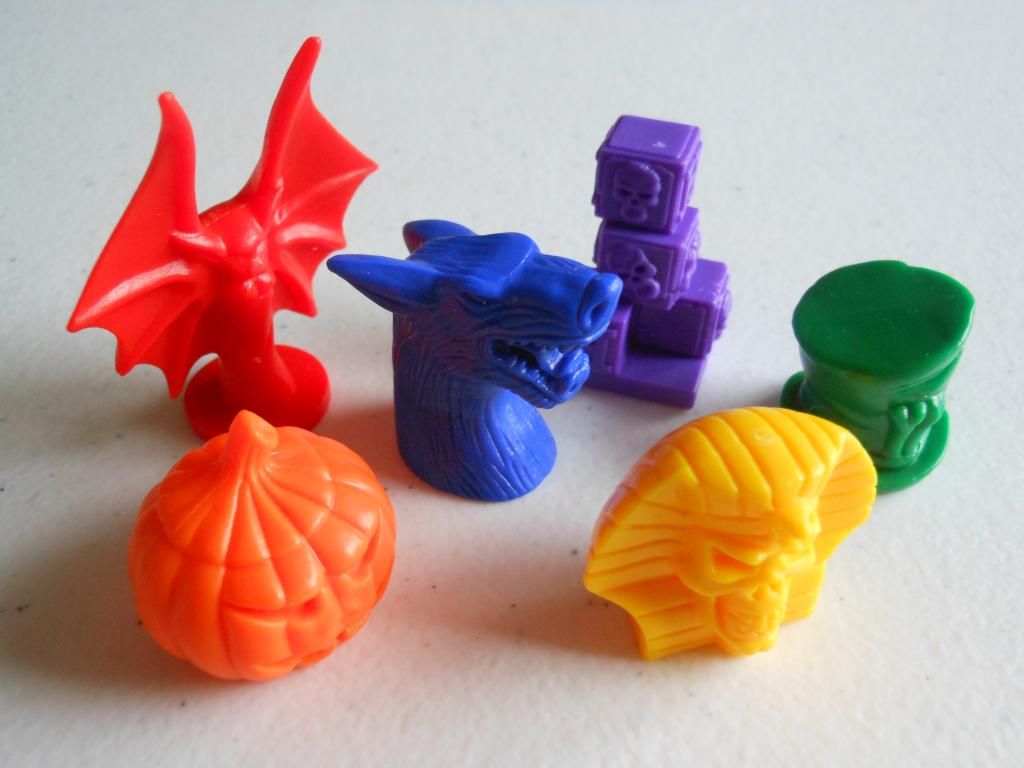
The DVD version is a very nicely produced package, with plenty of plastic bits. The six player pawns stand out as being particularly good; they are like plastic Halloween-themed versions of Monopoly pieces. Some of them are pretty straight-forward (a bat representing the vampire), some are a little unusual (a hat representing a zombie), and one is just plain creepy (a stack of building blocks representing the ghost of a dead infant - thanks for that!). Of course, as my last name is Outlaw, I always play as the werewolf, who is represented by a wolf's head.


Atmosfear playing pieces
The Atmosfear playing pieces.


These pieces are moved around a board which is like a spoked wheel, with an outer circular path, and then several paths that lead to a much smaller inner circle. When a piece is on the outer circle it can only be moved clockwise, so on your turn you just roll the dice and move your piece. The board is divided into coloured sections, and several spaces on the outer ring have special symbols. If you land on one of these spaces, you do the related action (for example, if you land on the clock face, you can take a time card).


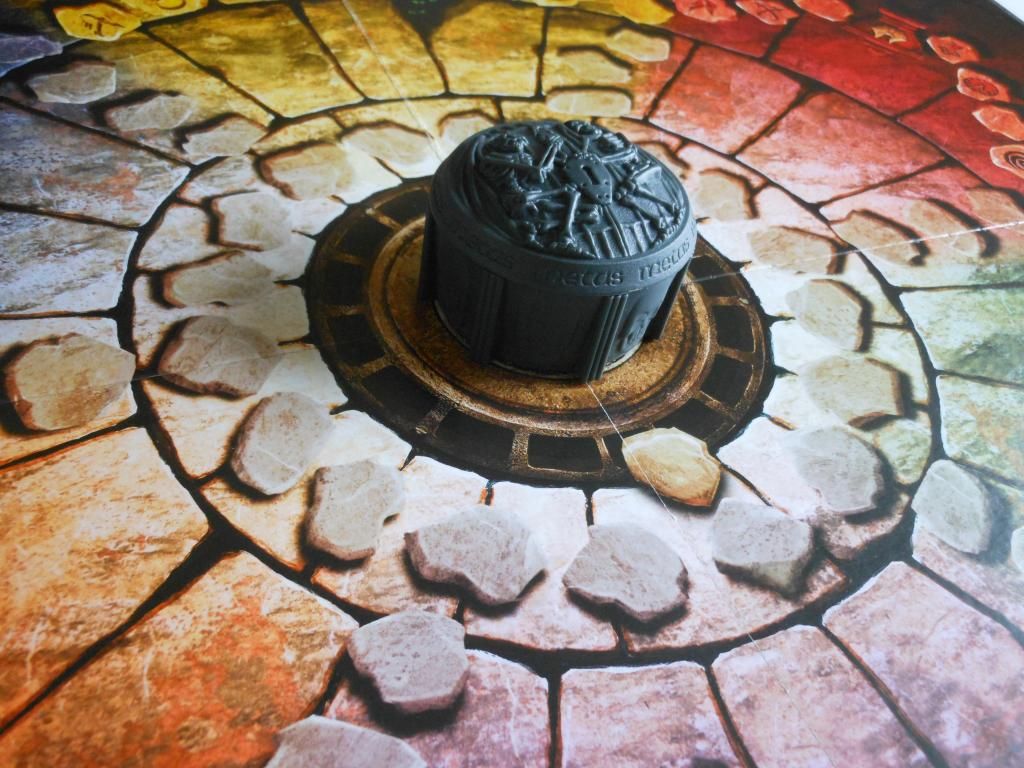
Atmosfear board detail
The "Well of Fears" at the centre of the board.


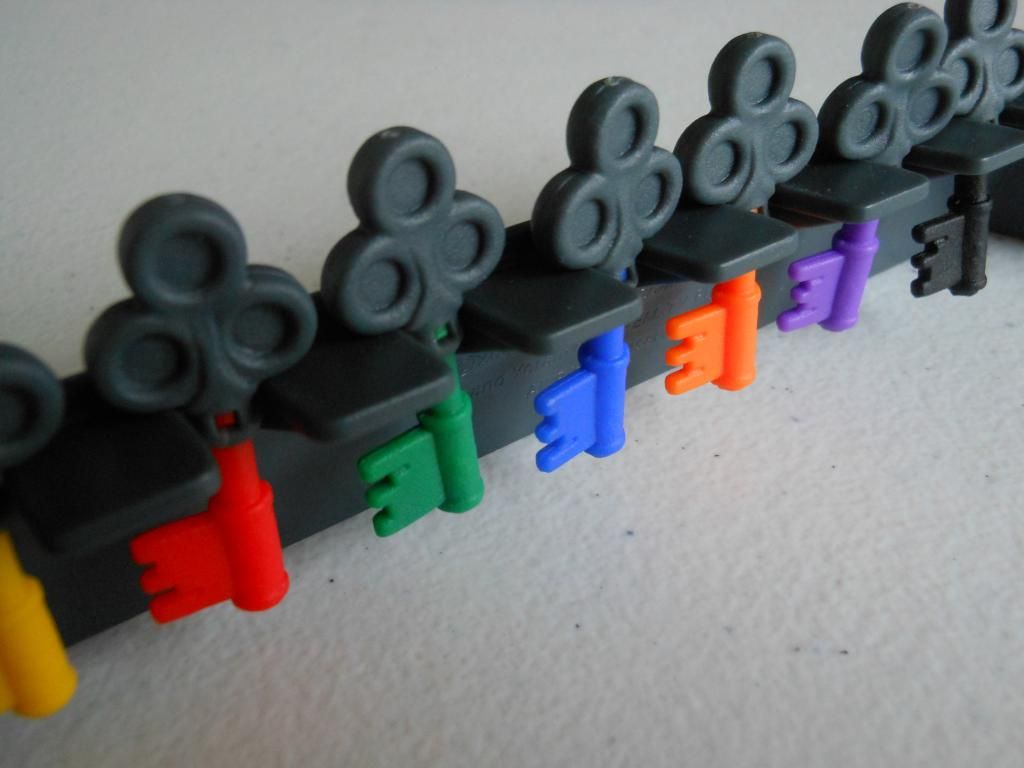
As already mentioned the aim of the game is to collect a complete set of six keys (one each in six different colours), and in the DVD version of the game, these are nicely moulded in plastic. You also get little plastic racks which hold the keys in such a way that your opponents can see how many keys you have, but not what colour those keys are (very important for when an opponent has the chance to steal one or more keys from you). A player can take one of the keys that matches the colour of the board section his piece is in every time he lands on a key space.


Atmosfear keys
The keys hanging in their special rack - that black key is a "bad" one.


If at any point a player has one key from each of the six coloured sections of the board, he can move to the inner ring and attempt to "face his fear" by randomly drawing a fear from the cool plastic pot that sits right in the middle of the board. These fears have been written on scraps of paper and put in the pot by the players at the start of the game, and if the fear drawn matches the fear the player added to the pot then that player wins.

It all sounds very pedestrian and dull, doesn't it? And it really is until you add the DVD element.

The DVD does several different things. The first thing it does is add the time limit. The DVD will run for 49 minutes, and after that time, if nobody has won, then the game wins. The time limit forces everyone to rush, and people will often find dice being snatched out of their hands as opponents try to hurry the game along.

The timer also indicates when special time cards can be used. These cards are picked up by landing on certain spaces on the board, and they are held to be played exactly at the time specified on the card. When the timer on the DVD matches the time on the card, you play the card (even if it is not your turn). These cards will ask you to scream at an opponent to make them jump, or steal keys, or swap places with other players, and lots of other screwy stuff. Of course, if you miss your chance to play the card, too bad! You snooze, you lose.


Atmosfear game cards
Atmosfear game cards.


The other thing the DVD does is provide your host for the evening: The Gatekeeper. This is a wonderful addition to the game. The Gatekeeper will pop up on your television screen from time to time and basically call you an asshole. Yes, this is a game that provides its own trash talk. The gatekeeper will insult you, and then he will probably do something horrible to you as well. He works as a randomiser in a similar way to the electronic memory in the dungeon-crawler game Legend of Zagor, picking a player and then asking them to perform a task or suffer the consequences. He even insists you respond to all his questions with "Yes, My Gatekeeper." Failure to say this also results in a penalty of some kind.

The intervention of The Gatekeeper can turn the whole game on its head, and a person with a full set of six keys can suddenly find themselves with no keys and no chance to win. This may sound awful, and like it would totally ruin the game; and it might, if it wasn't so much damn fun. Atmosfear really isn't a game you should be playing to win. You should just be playing to shout at the television, scream at your friends, and try to roll dice as quickly and frequently as you possibly can. If you are the kind of person who will get angry to have victory stolen away by a bit of bad luck in the last few seconds of the game, then you should probably look for some other way to spend 49 minutes of your life.

So basically, the game comprises a group of flustered people rushing about while an old guy shouts insults at them. It's a bit like a normal day at work, really.

There is no strategy, and no skill; you can have all your hard work undone in seconds just because of stupid luck. There are no real decisions to make (which player to steal a key from is probably the trickiest thing you will have to do), and there is no way to prepare for the intervention of The Gatekeeper. But it doesn't matter. This game is an absolute blast. Not for every night of the week; but for Halloween... Perfect.

Thursday, 18 October 2012

Review - Tomb of Doom

As Halloween is fast approaching, I thought it was time to review a couple of the "spooky" games in my collection. First up is this piece of sh*t:

Tomb of Doom - nothing to do with Indiana Jones


Tomb of Doom
Published by Drummond Park
Designed by David Mair
For 2-4 players, ages 5 to adult

I picked up Tomb of Doom in a charity shop for £2 expecting it to be junk, and I am pleased to say I was not disappointed. Yes, I knew before I paid my £2 I was buying something that was going to be awful; but I couldn't pass up the opportunity to buy something that looks so utterly ridiculous. You see, Tomb of Doom isn't really a board game; it's actually just a Halloween decoration that someone then tried to turn into a fun family game. It certainly isn't a fun family game, but as a gimmick to put on the shelf during Halloween it does have some value. Let's find out more...

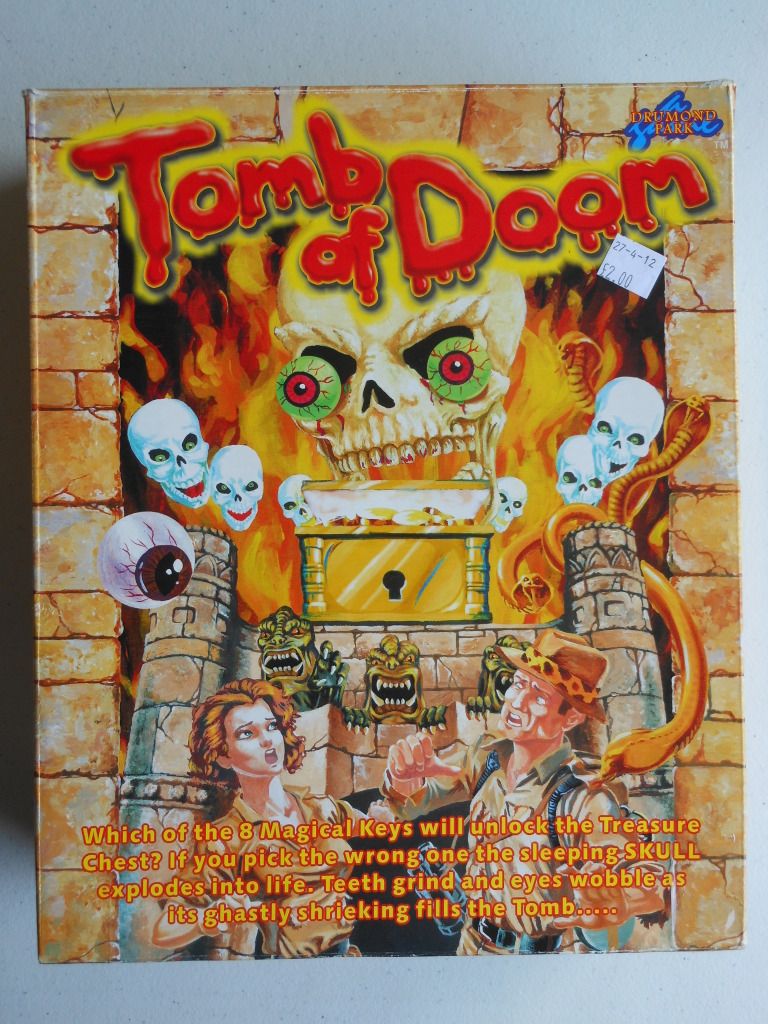
Before I start, I have to say the box art for this "game" is great. I love it. It's a bit retro, and massively over-the-top, with a male and a female adventurer being terrorised by a giant skull, snakes, gargoyles, and a giant eyeball. Top marks.


Toom of Doom box art
Awesome box art; sub-standard game.


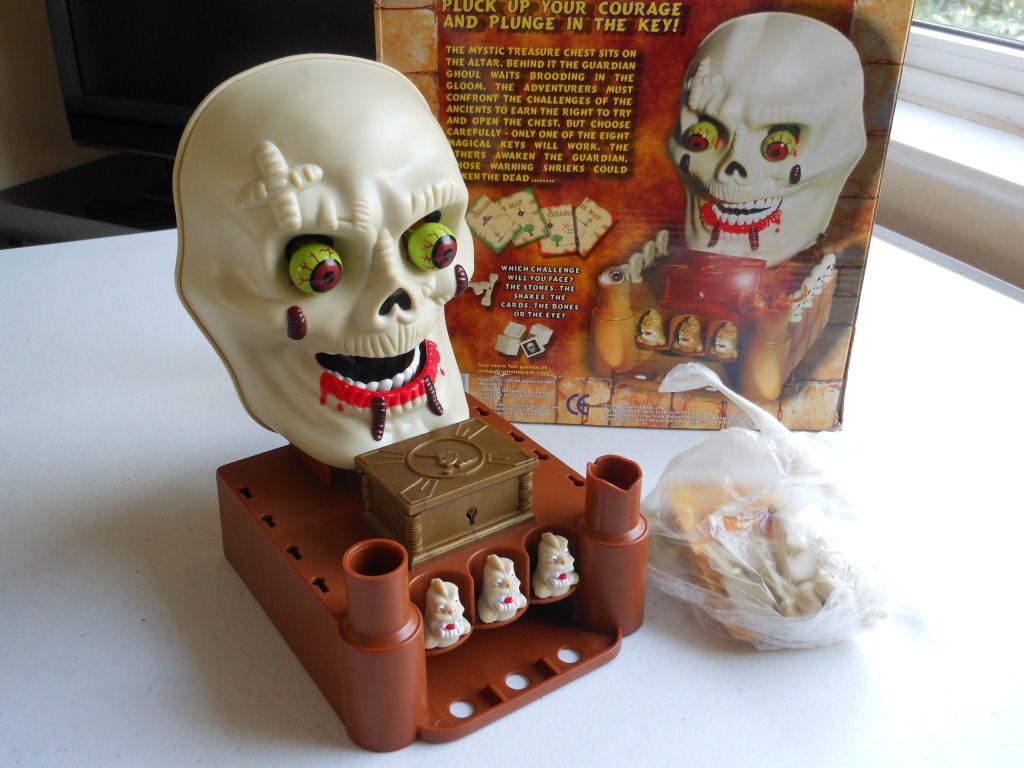
Inside the box there is a large unit that consists of a base and a battery-powered 3D skull. There is no board, no dice... just that weird unit, and some random accessories such as plastic keys, plastic bones and that creepy eyeball from the box art.


Tomb of Doom skull
The "game" is as ridiculous as it looks.


The reason there is no board or dice, is because there isn't really much of a game. The basic premise is that there are lots of plastic keys. One of them opens the treasure chest that is situated on the base in front of the giant skull, while the other keys will cause the skull to laugh, chatter its teeth, and roll its eyes. You get a chance to select a key by winning a challenge on your turn, which will be determined by drawing the top card from a challenge deck. These challenges are only challenging because they are entirely luck based, and they are not even any fun.

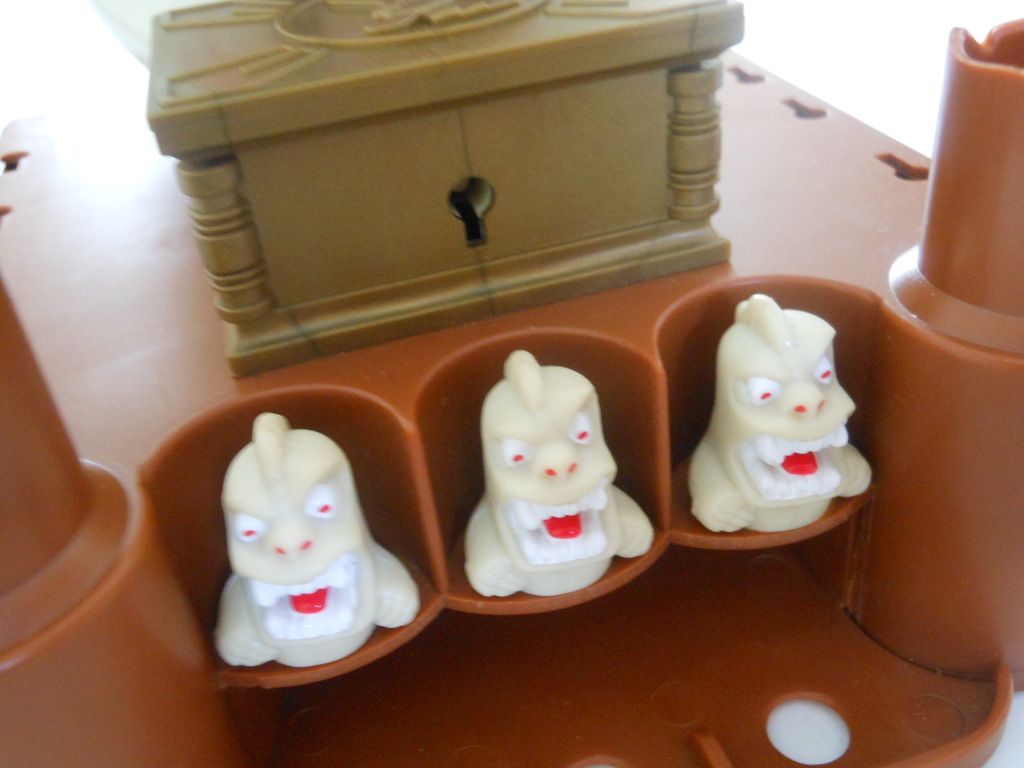
One challenge involves selecting one of the three gargoyles on the front of the base and then rolling the eyeball down a ramp. If the eyeball rolls into the slot beneath the gargoyle you picked, then you get to pick a key (and of course, picking the correct key from those available is also entirely luck-based). The only interesting thing about the gargoyle challenge is that the gargoyles were made with the same mould used to make the monster from another board game: Gonna Get Yer! (from Chad Valley).

Tomb of Doom gargoyles
The gargoyles... Ooh, scary.


Another challenge involves picking a snake from a pot of snakes. If the snake is the one with a red tail, you get to pick a key.

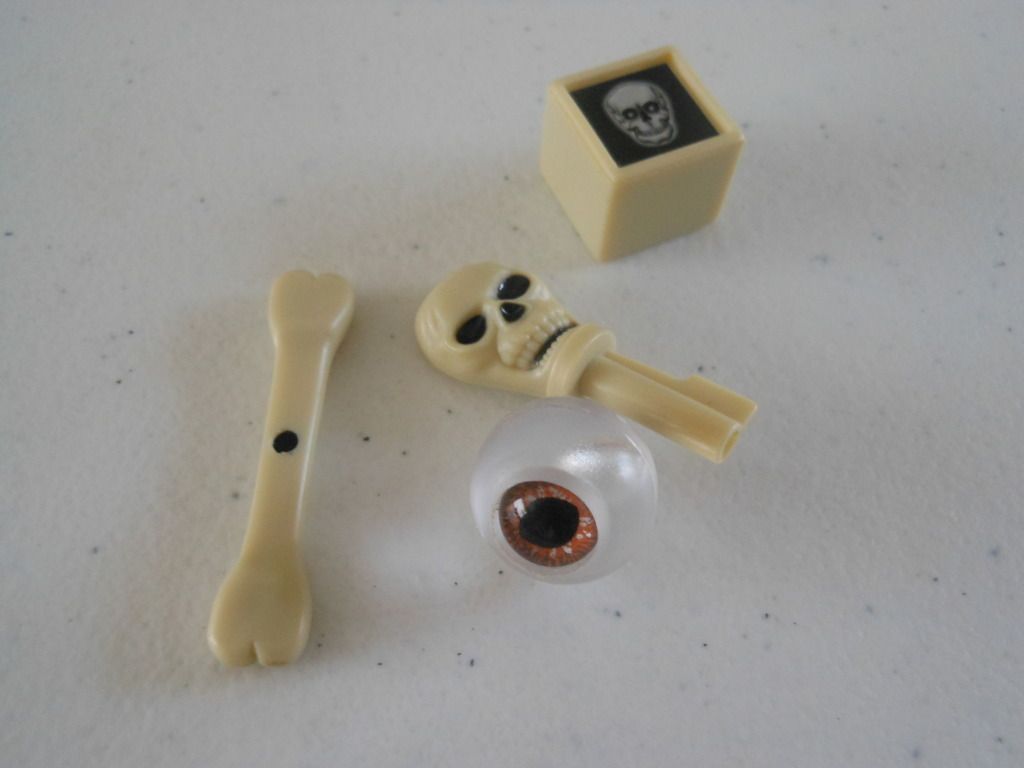
Yet another challenge involves picking one of several face-down cubes. If you pick the one with a skull on it, you get to pick a key.

Yes. The games are that simple, that uninspired, that random, that boring...

Sigh.


Tomb of Doom pieces
Bone, eyeball, key, and skull cube.


But of course, this is a game for children, and the "challenges" are really only there to create a semblance of a game before you get to the cool bit where you pick a key. There is a reason most of the keys will cause the giant skull to wake up: That's the only reason to play with this thing! When the skull activates, it is incredibly noisy, and actually pretty funny. I can certainly see it causing young children to squeal (with excitement or fear, depending on the child), and while this is not going to be the sort of game that will keep anybody interested for long, it should provide a suitably noisy distraction for a brief Halloween treat.

I certainly have no intention of playing Tomb of Doom as designed, but I will be keeping hold of the game and using it as a Halloween decoration. Bringing it out once a year to scare my daughter and her little friends will make it worth keeping.