Showing posts with label roll and move. Show all posts

Friday, 31 October 2014

Review - Ghost Castle (a.k.a Which Witch?)

Ghost Castle


Ghost Castle
Published by MB Games
Designed by Marvin Glass
For 2-4 ghosts and goblins, aged 6-12 years

Ghost Castle box
Those kids on the box are having a great time.


Sometimes in life, you are presented with a very narrow window of opportunity.

Sometimes, that window is so narrow, you're really only going to be able to take advantage of it if you are Tooms from The X-Files.

Sometimes, that window is so incredibly narrow, you wonder if it is really a window at all, or just a crack in the plasterboard, or maybe one of those squiggly lines you sometimes get in the corner of your eye.

Take, for example, the game of Ghost Castle (or Which Witch? if you ain't from round these here parts), a roll-and-move horror-themed board game with an age range so focused it could burn a hole through the box: 6 to 12 years.

I'm not sure why MB Games felt the need to make the age range so specific. It really doesn't need to be. Sure, the game has a spooky theme and small parts (most noticeably a glow in the dark plastic skull), but my three year old daughter loves this game. And sure, it is effectively a skill-free game of luck with nothing to keep older children particularly interested, but I still enjoy watching the misfortunes that befall my character as I move around the haunted castle as long as my daughter is there to enjoy those misfortunes with me.

So, yeah... I'm taking a sledgehammer to this window and busting it right open to allow all the ghosts and goblins to spill out. This is a family game.

Age restrictions be damned.

Having said all that, what is Ghost Castle actually about, and is it any good?

Ghost Castle board game
The board in all its glorious gloriousness.


Well, I was first introduced to this game when I was a wee lad, and it immediately gripped my imagination like a skeletal hand and refused to let go. It charts the misadventures of a group of young children who foolishly seek refuge in a haunted castle. Over the course of the game, they move around the gloriously illustrated, three-dimensional board, seeking to close the coffin at the top of the tower to lay the malevolent spirit to rest.

It is a great idea for a game, made greater still, of course, by that three-dimensional board loaded with awesome traps.

On each turn, players roll the dice to move along a fixed path. They then spin the spinner. They may get frozen with fear (in which case they get a groovy fear mask that clips over the top of the playing piece and they cannot move again until spinning a foot result on the spinner), or they may get to drop the spooky skull into the coffin at the top of the castle, activating one of four traps.

Ghost Castle frightened child
You've got something on your face, Dude.


In the first part of the board, there is a suit of armour with a battleaxe, and if the skull lands here, the axe falls, squashing anyone who is about to enter the castle.

In the second part of the board, there is a wobbly floor. If the skull lands here, players get shaken off their feet.

In the third section, there is a magic mirror behind a hanging skeleton. If the skull lands here, anyone in front of the mirror teleports through to the other side. Anyone already on the other side gets booted up the bum by the skeleton.

In the fourth section, there is a long staircase. If the skull lands here, it bounces down the stairs knocking everyone over.

In each case, falling foul of a trap sends you back along the path to a designated checkpoint. Just like in an old-school platform video game.

It's all very silly, and great fun.

And frustrating.

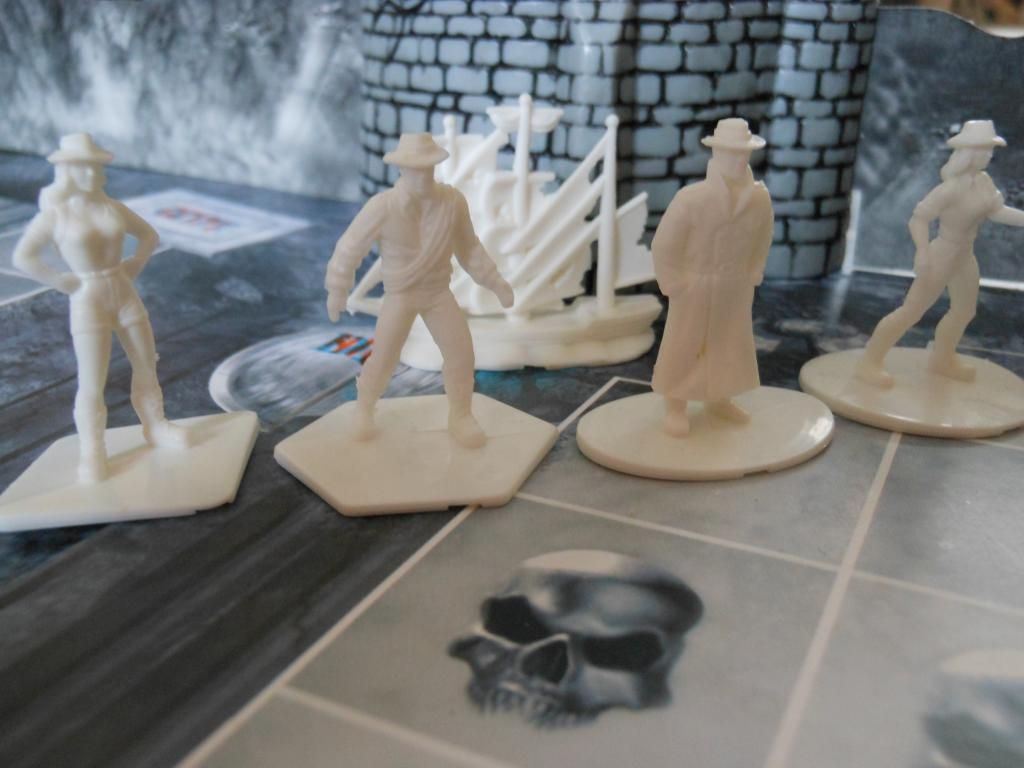
Ghost Castle pawns
Mom! We found something in the garden!


You see, there is absolutely nothing you can do to avoid any of those tricks and traps. You roll and hope, spin and hope.

And you lose hope.

Games can be brutally quick, or agonisingly slow. There is no way to tell.

Honestly, as games go, it really isn't very good.

But it is so cool.

When I was a child, I spent hours playing this game, studying the fantastic artwork in each of the four zones.

At the start of the game, you are outside, in a haunted forest. There is a stream trickling into the distance beneath a baleful moon. The trees have faces. Wolves howl. Bats flutter.

Ghost Castle board
Have I ever told you trees creep me out?


So the children run, terrified, entering the haunted hallway beyond the portcullis, where ghosts swirl like mist, and the corridor seems to go on forever.

Ghost Castle board
That isn't Casper.


If they make it through there, they descend into the store room, where vampire bats swoop and chitter among the shelves of rotting books and poisons.

Ghost Castle board
I like big bats, and I can't deny.


Then finally, they reach the basement with the staircase leading to the roof. Here, giant rats gnaw on bones, and a phantasmal hand gropes in the dark.

Ghost Castle board
Dem bones.


The art is creative, inventive, spooky, and an absolute joy.

It is just a shame it is tagged on a basic roll-and-move game, because the theme, and those skull-activated traps, deserve better.

Ghost Castle spinner
It looks like a spiders web!


As it happens, Ghost Castle is not the only game to make use of the haunted, three-dimensional, trap-filled board. There are at least a couple of Scooby Doo games that work on the same principle, and Waddingtons made a nice Goosebumps game called Terror in the Graveyard; but they aren't quite the same.

Possibly because I never got to play them in that oh-so-narrow window of opportunity when I was an impressionable young child aged 6 to 12.

Possibly because I never got to play them when I sat in my darkening bedroom, rolled dice, and wished that the phantasmal hand reaching out of the crack in my plasterboard wall was nothing more than a squiggly line in the peripheral of my vision.

Tuesday, 22 July 2014

Review - Dragonology: The Game

Dragonology


Dragonology
Published by Paul Lamond Games
Designed by Anne Nonimous
For 2-6 players, aged 8 to adult

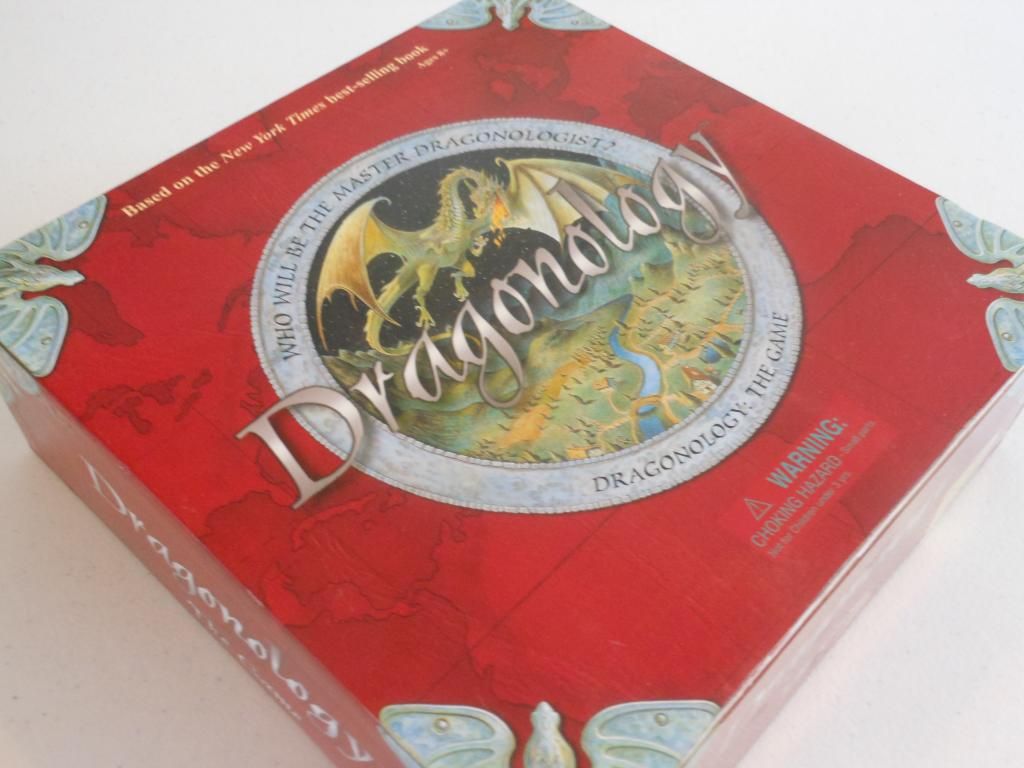
Dragonology game box
Pretty, pretty box.


Anyone who knows me, and knows what I do for a living, is aware that I am a huge fan of mythology. I love Greek mythology, and anything involving werewolves and vampires (not the sparkly kind) is going to catch my interest; but if I had to pick one type of mythological creature that I love more than any other, it would be dragons.

Why am I telling you all this? Because it should help to explain why I went out of my way to pick up a copy of Dragonology: The Game.

Way back in the mists of time, when my wife was still my girlfriend, I purchased her a copy of the Dragonology book. It is a very special book, full of humour and magic. My wife loves it, I love it, and my daughter (who is rapidly approaching her fourth birthday) loves it too. It was only natural that I wanted to see what a game based on that book was all about.

Of course (rather depressingly), it is about rolling dice.

And moving.

Okay, to be fair, I knew it was a roll and move game before I purchased it; but it has an enjoyable theme, and the box is packed with cool plastic dragon pieces, so I thought it was worth a look. Unfortunately, those lovely pieces are the epitome of what is wrong with this game: It is all style, at the expense of function and fun.


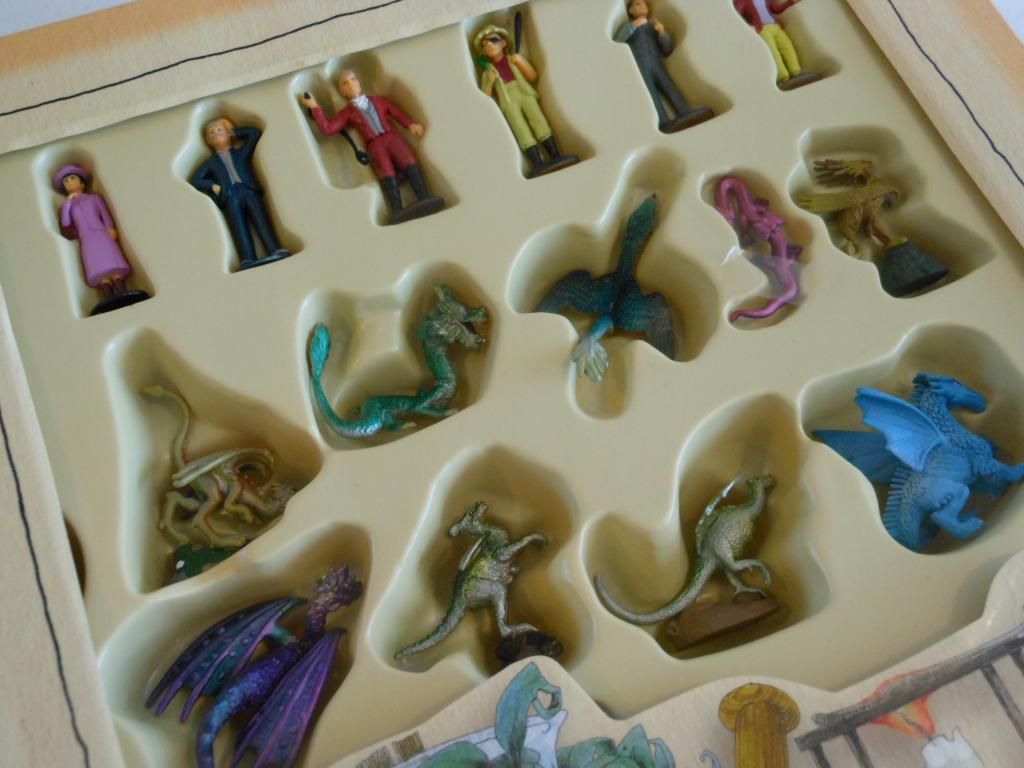
Dragonology playing pieces
The playing pieces.


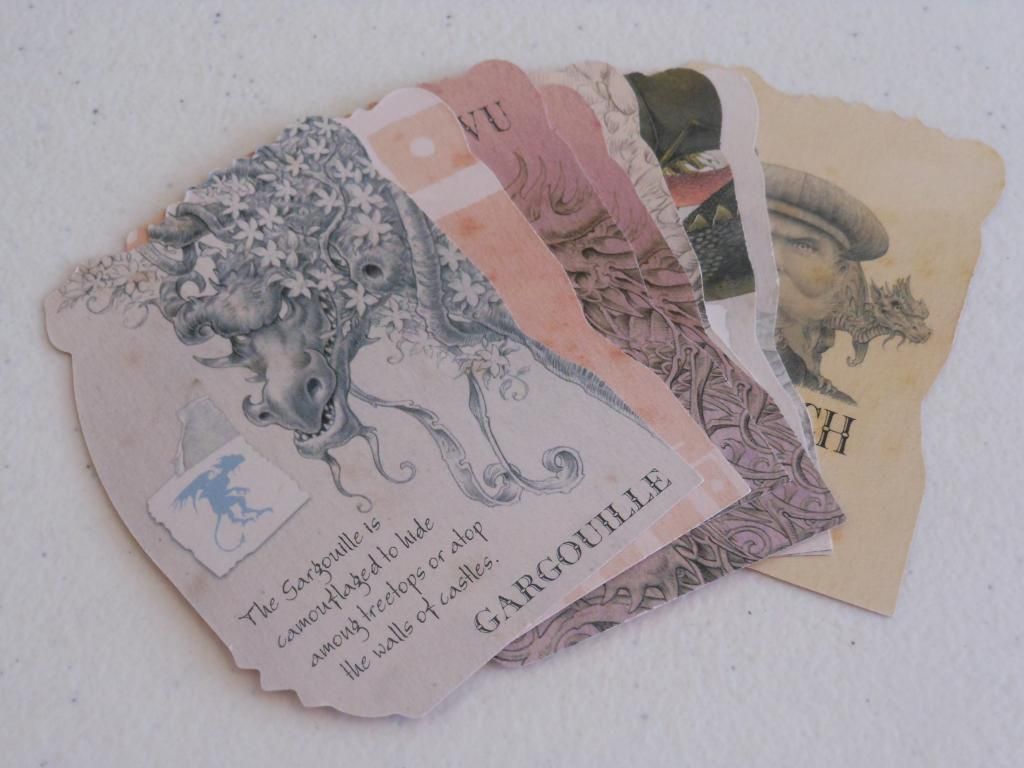
The problem is immediately apparent as soon as you open the box. For a start, the cards are shaped like dragons. Seriously. Have you ever tried to shuffle a dragon? It isn't easy. And they really don't like it.

And then there are those playing pieces, representing the characters that are jet-setting around the world looking for dragons, and the dragons themselves. They look fantastic, but most of them don't stand up due to the stupidly small bases. Of course, the bases have to be stupidly small because of the stupidly small spaces on the (rather beautifully illustrated) board.

But at the end of the day, it is the game that is important, right? As long as the game is good, you can overlook the frustration of constantly picking up the pieces, or the annoyance of trying to shuffle cards that seem to be designed specifically to prevent you from doing so.

Of course, the game isn't good.

The aim is simple. You move around the map (usually by rolling a dice), trying to land on spaces that give you the option to draw one of those stupid dragon cards. These cards are called, rather unimaginatively, "Bit of Knowledge" cards. They are called this because they contain bits of... Yeah, okay, I think you can figure it out.

Some cards have your standard "take that" spells that allow you to screw other players by stealing their cards, or even stealing their dragons, while other cards allow you to take extra turns, or defend yourself. However, most of the cards contain a bit of a description about a specific kind of dragon. If you ever have three cards from a set, and you land on the "home" space for the related dragon, you can claim that dragon as your own. If you successfully collect three dragons, and then land on the "dragon's eye" space on the board, you win the game.


Dragonology cards
Stupid-shaped cards


In theory, it doesn't sound so bad. It's just set collection, with a bit of "take that" and dice rolling.

In practice, it is an agonisingly long exercise in tedium.

The biggest problem is that movement is primarily by dice rolling, and you always have to move exactly the number of spaces rolled. This results in that classic, laugh-inducing situation where a player is desperately trying to land on a dragon space in order to claim a dragon, but keeps rolling the wrong number. Now, everyone knows how annoying that is when you are rolling a six-sided dice. Well... Now imagine that with a 12-sided dice.

That sounds fun, right?

Okay, to be fair, the game tries to do several things to mitigate the dice-rolling. First of all, one face on the dice is a dragon's eye logo, which allows you to teleport to any dragon space you want. Additionally, certain spaces on the board allow players to take a transportation ticket card. Players use these to move by air, sea, or road, without using the dice.

Even so, most of the time, movement is going to come down to dice rolling; and the possibility of having to move up to 12 spaces out of your way means that landing on anything you specifically want to land on is a real chore.

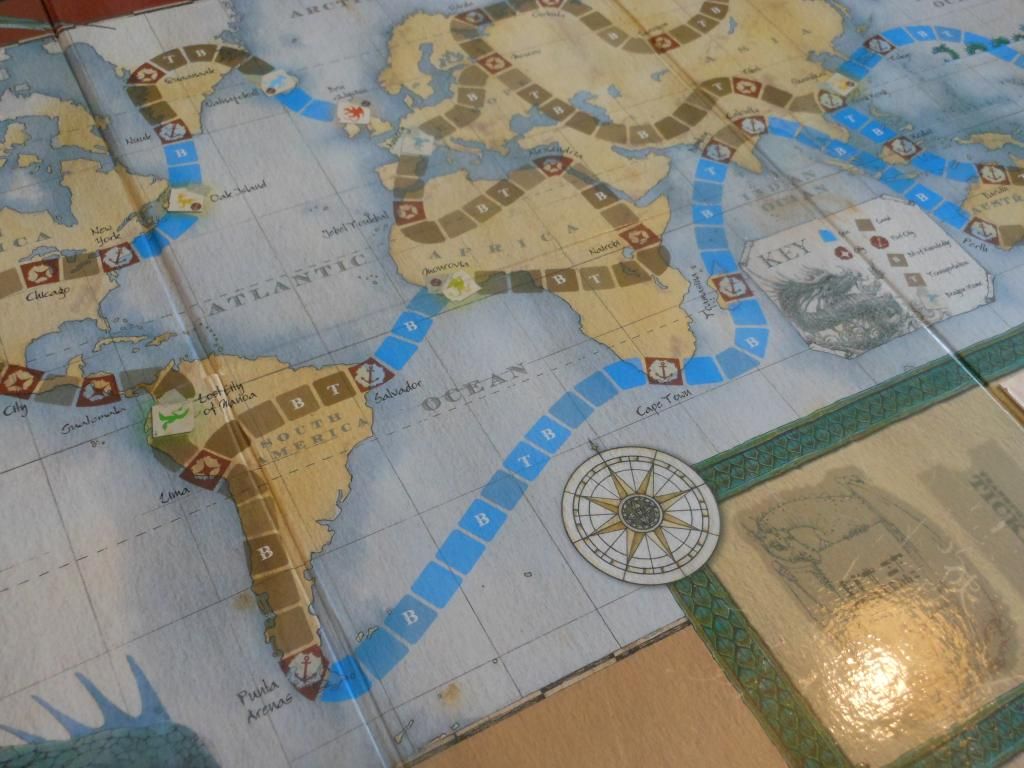
Things are made even worse thanks to the layout of the board. In most cases, a player will end up with a choice of three or four routes, so every turn comprises  rolling the dice, and then painstakingly counting the number of spaces along multiple routes to determine the best space to land on.


Dragonology board
Choices. So many choices...


And then there is my favourite thing in any game ever: Blank spaces. There is nothing better than rolling the dice, checking all your possible routes, and then realising you are going to end up on a space that allows you to do... absolutely nothing.

And finally, as if it wasn't already tedious enough trying to win the game, there are the "take that" cards. There are 81 cards in the deck, and 36 of them are special cards. Of those special cards, there are 10 cards that allow you to take cards from other players, and two "master claw" cards that allow you to take one of their dragons. The real kicker? The "master claw" cards cannot be blocked by any of the "shield" cards in the deck, so that hard-won dragon you have in your possession is getting taken away, and there is absolutely nothing you can do about it.

That sounds fun, right?

The sum total of rolling the dice, counting all the spaces, gradually accumulating the cards you need, claiming dragons, then losing dragons, and then trying to get to the "dragon's eye" space to win, takes almost forever. The nightmares will last even longer.

Really, this game just wasn't well thought-out. The board needs a complete redesign, with less spaces, for a start. I would also go for rolling two six-sided dice and then having the choice of using one value, or adding the two values together. But honestly, the game isn't worth tinkering with. I bought my copy for a couple of quid in a charity shop, and I think that might have been just about worth it for the dragon pieces. Other than that, there is nothing to see here.


Dragonology dragon piece
So pretty.


Anyone reading this is probably thinking, "What did you expect from a children's game that was churned out to the mass-market to take advantage of a related book's status as a New York Times Bestseller?"

The answer is simple: I wasn't expecting much at all.

But it's always nice to be surprised sometimes, isn't it?

Unless, of course, that surprise is someone playing an unblockable "master claw" card when you are one space away from winning the game.

Tuesday, 17 September 2013

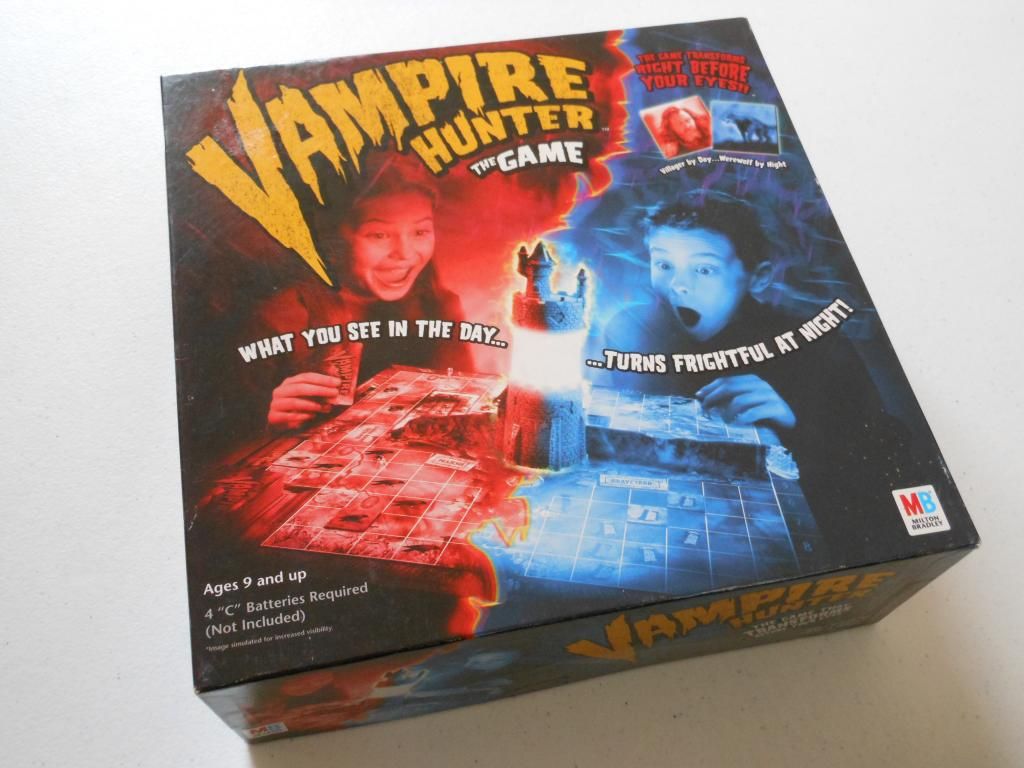
Review - Vampire Hunter

Vampire Hunter


Vampire Hunter
Published by Milton Bradley (Hasbro)
Designed by someone with really good eyesight
For 2-4 players, aged 9 to adult

If you know me at all (and let's be honest, you probably don't) you will know that I like games with a bit of theme. I enjoy abstract games, and I can enjoy cube-pushing games that have a pasted on theme for colour; but what I really want is a game that oozes theme (not in a gross kind of way). I want a game that makes me feel completely involved in what is happening, and totally invested in the success of my character.

Creating theme in a game is more than just suitable artwork and playing pieces (although, of course, that is a major element). It also takes game mechanisms that make sense. If what you are doing makes sense (without having to perform mental backflips to link everything together), then the battle is already won. And if you have a game with a novelty element or gimmick that reinforces the theme in some way... Well... Sign me up.

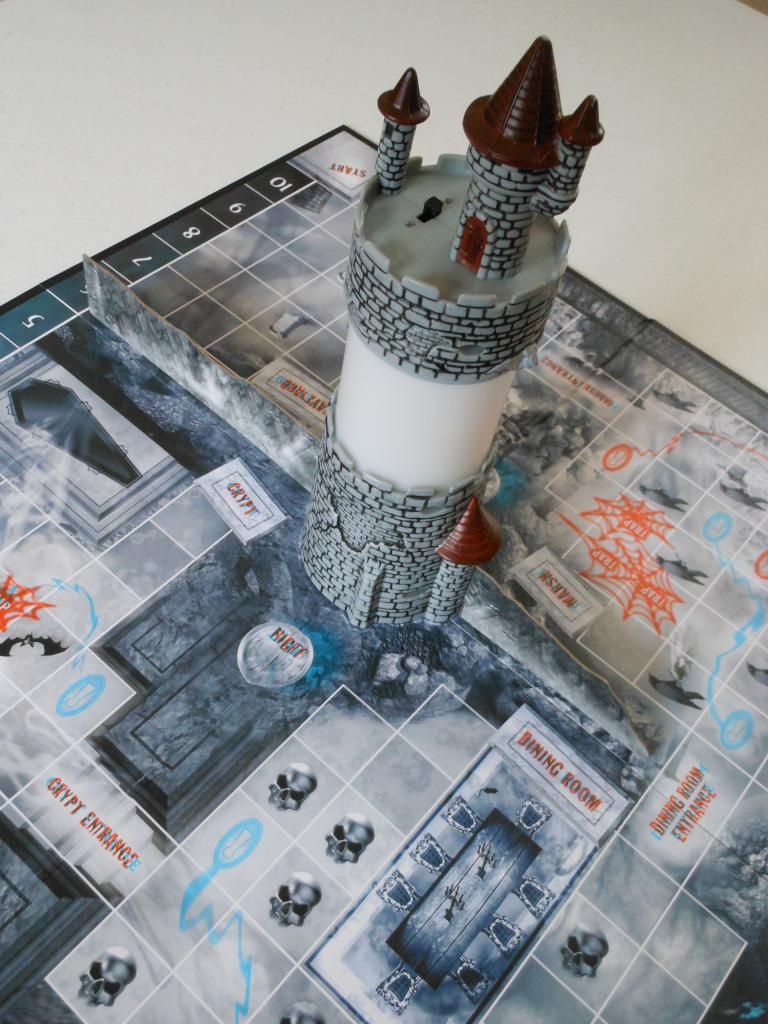
On first blush, Vampire Hunter is a perfect fit. It has suitably moody artwork, plastic miniatures for playing pieces, and a cool 3D tower in the middle of the board. But it is the novelty element of this game that really sells the theme.


Vampire Hunter Tower
The tower.


You see, in that cool 3D tower is a light. Switch it on, and the light glows blue. Press the top of the tower, and the light changes to red. Why? Simple really. Everything in this game is printed twice. Every card, every token, every dice, and even the board, has been printed once in red, and once in blue. When the light is blue, certain elements on the game components are washed out to reveal particular images; but when the light changes to red, different elements are washed out, and the images change.

This is more than just a gimmick: It is the central conceit of the game's mechanisms, and the beating heart of the game's theme. Without the tower, the theme is virtually non-existent; and without the theme, the game is virtually non-existent.

When the red light is on, it is the daytime. The movement dice show higher numbers, graveyard tokens show harmless tombstones, and in the village you will bump into amiable farmers. But when the light goes blue, night has fallen over the land: the movement dice shows lower numbers (because it is harder to travel at night), zombies claw out of the ground beneath the tombstones, and those farmers transform into slavering wolves.

It is incredibly clever, and a beautiful example of how to integrate theme with game mechanisms. The two are literally inseparable.

Unfortunately, beyond this wonderful piece of ingenuity the game is rather sub-standard. Your glasses would need to be as rose-tinted as the board during daylight turns in order to see the game as anything more than a minor distraction.

You may already have noticed I mentioned a movement dice. That should have been the first warning sign: The game is roll and move. The game is also rather boring.


Vampire Hunter
The rules.


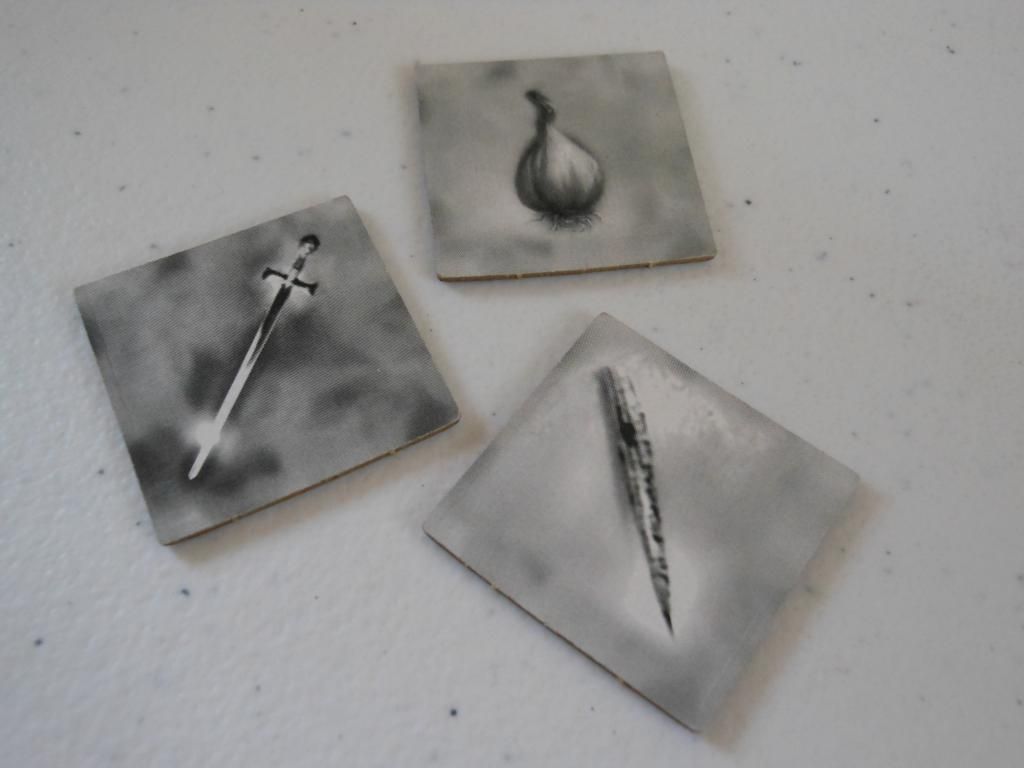
Two to four adventurers are racing to the vampire's tower in order to kill him before he can escape in his ship. To do this they need to move through a graveyard, a marsh, the castle dining hall, and finally the vampire's crypt. On the way, they will flip tokens, which may contain bad things, but may also contain good things. The heroes need to collect garlic, a stake, and a sword, and then defeat the vampire in combat three times (once with each weapon). If they do this before the vampire's ship arrives, they win. If the ship arrives, the vampire escapes, and everyone loses.

You may think this sounds like a co-operative game, but it isn't. Realistically, the vampire will never escape; and really it is just a race between all the hunters to see who can land the killing blow. And yes, it is possible for someone to defeat the vampire twice, and then for a third hunter to turn up and win the third battle, thus claiming total victory for doing only a third of the actual work.


Vampire Hunter Weapons
The weapons.


One of the biggest problems is that it is all incredibly pedestrian. Yes, the changing light mechanism is clever and inventive; but it has been used to disguise a boring game system that is older than Dracula himself. You roll to move, flip a token, take the token if it is good or fight a monster if it is bad, and then... Then you wait until your next turn. Oh, and if you lose a fight? You get pushed back to the entrance space. Like in Mario. Because that's really fun. And thematic.

This is just a bog-standard race game in which you charge around the map gathering up the tools you need to fight the vampire. And of course, whether or not you gather those items is entirely down to luck of the dice (rolling high enough to reach tokens), and luck of the draw (randomly flipping a useful token rather than a harmful one). It may be a children's game, but that's no excuse for this kind of lazy design.

But the biggest problem is also the biggest draw: that tower.

The tower just isn't bright enough. You are supposed to play the game in a darkened room, using only the light of the tower to see what you are doing. But the light is so dim, it is incredibly difficult to see what you are doing. And after 15 minutes, you will have a headache.


Vampire Hunter playing pieces
Is it just me, or do these guys not look like vampire hunters?


I have had this game for a few years now, and I have made a habit of rolling it out at Halloween. But this is a bad habit, and one I don't intend to continue.

Besides, I have Fury of Dracula in my game collection, which happens to be the most thematic vampire game ever made. And it manages that without a silly light-up tower.

Friday, 28 December 2012

Review - Tim Burton's The Nightmare Before Christmas

The Nightmare Before Christmas


Tim Burton's The Nightmare Before Christmas
Published by NECA
Designed by Santa's elves... or Satan's elves
For 2-6 players, aged 8 to adult


NBX Box
The box is oh so pretty...


I have to be honest, I intended to publish this review before Christmas (it would have made more sense), but better late than never... Right?

Right.

Good, that's settled then.

Tim Burton's The Nightmare Before Christmas is a typical NECA board game - rather beautiful, but not really much of a game. It's one of those games that is aimed squarely at the fans, who will buy a copy even if it's absolute crap. And yes, I am one of those fans.

NBX (which is what I understand all the cool kids are calling it) is one of my favourite movies, and as I also collect out of production board games, it is no surprise that I have a copy of this game in my collection. What is surprising, is I didn't even know the game existed until it was already out of production and rare as hen's teeth in the UK. I spent a long time hunting down a copy, and eventually picked one up (mint condition) from eBay for a lot more than I would have really liked to spend. Was it worth all the effort? Let's find out...


The Nightmare Before Christmas inside the box
The board has an NBX label on the bottom, which is a nice touch.


As already mentioned, NECA really went to town to make this game look nice so that it would appeal to fans who are not necessarily interested in board games, but who want this for their collection of movie merchandise. It ships in a sturdy box with a high gloss finish (hence the terrible photographs on this page with light glare all over the place), and plenty of great artwork to keep the fans happy. Inside the box is a thick board that features scenes from the movie, a spinner, two chunky dice, and six really nice pewter playing pieces.

The board (I would have preferred illustrations to movie stills).


Before I go on, I have to say, for a fan of NBX, these pewter pieces are going to be a big draw. They are miniature busts of Jack, Sally, Dr Finklestein, Lock, Shock, and Barrel. Very heavy, very nicely sculpted, and worth the price of admission alone. Mine end up on the shelf at Christmas time as extra little decorations, I like them that much.

In fact, everything in the box is of a very high standard except for the deck of playing cards, which are well-illustrated, but a little thin.


The Nightmare Before Christmas playing pieces
Pewter playing pieces.


However, while the components are excellent, the game is something of a disappointment. The aim of the game loosely follows the plot of the film. First you need to "kidnap" Santa Claus, then you need to collect 100 points (okay, that bit's not like the film), and then you need to "defeat" Oogie Boogie. Sounds great - but what does it mean?

(Here comes the science bit...)


The Nightmare Before Christmas rules
Instructions... A truly epic tome.


Each player is initially dealt four cards. These cards will either show a red picture of Santa Claus, or a white picture of a character from the story along with a numerical value. The character pictures on these cards, match pictures on certain spaces on the board (well, sort of - some of the artwork doesn't match exactly, which is a bit confusing). Your cards are kept secret.

The first player is the "biggest, scariest, most intimidating person" according to the rules, but as these things are not mutually inclusive, I just let the wife go first. On your turn, if you have a Santa Claus card in your hand, you just play it out in front of you for everyone to see. Once you have done this, you have "kidnapped" Santa and can begin accumulating points. It is not possible to accumulate points until you have played your Santa card.

If you don't have a Santa card, instead, take a random card from any other player and then roll the dice and move your playing piece the exact number shown (oh yes - roll and move. Did you expect anything else?)

If you land on a blank space, your turn ends. If you land on a location space, you can draw one card (if available) from that location's draw pile. If you land on another player, you steal one card from that player and then send him or her to Oogie Boogie's lair. If you land on a space that shows a picture of a character, and you already have a Santa card in play, you can play one card from your hand that matches the character you landed on. You then score the points on that card. Once you get to 100 points, you can go for the end game.

Players in Oogie Boogie's lair don't get a normal turn, instead they must spin the spinner and try to get an "escape" result. Any other result means they miss a turn and must try again next time. That's
about as much fun as it sounds.


NBX board game spinner
Spinner AND dice - you can never be too random, it seems.


Once you have 100 points, you have to land on Lock, Shock, and Barrel's tree house location (by exact dice roll, of course, because that's always fun), which immediately teleports you to Oogie Boogie's lair for the final showdown in which you... spin the spinner. In the ultimate insult to gamers everywhere, when you spin the spinner, if you get a "win" result you have won the game, but if you get the EQUALLY LIKELY "lose" result, you are dead and out of the game.

Yup, not even kidding. Dead. Gone. You kidnapped Santa, got 100 points, you were first to Oogie Boogie's lair, but you span the "lose" result and therefore lost completely. And yes, that does mean it is possible that at the end of the game, nobody has won.

As you read this brief overview of the game (which isn't much shorter than the actual rules as printed inside the box), you will have noticed that there's quite a lot of randomness, and this randomness will entirely determine the winner of the game.

It is possible to get lucky and to be dealt a Santa card as one of your four starting cards, giving you a massive head start on everyone else; but then again, you might not see Santa in the whole game and never even start to score points.


The Nightmare Before Christmas cards
Santa Claus was rubbish at blending into the crowd.


Once you start trying to score points, you have to land on certain spaces, and you can only do that by exact dice roll, so you could spend the whole game trying to land on spaces that match cards you own, but constantly missing.

If you get sent to Oogie Boogie's lair, on each turn you have a 50% chance of escaping, so you could spend an age in there trying to get out and back into the game.

And then if you do endure all that randomness and get 100 points, when you face Oogie Boogie in the showdown, you have a 25% chance of dying anyway and being eliminated from the game completely. What kind of reward structure is that?

The game is infuriating, and just not that much fun. So that means I'm getting rid of it, right? After all, I have that rule where I only keep games I'm going to play... Well, here's the thing. I do play this game. Only at Christmas, and never more than once a year; but I do play it. It helps me get into the Christmas spirit, and isn't the worst way to spend half an hour with friends while having a few festive drinks.

And beside, it's The Nightmare Before Christmas... Of course I'm not getting rid of it.

Wednesday, 31 October 2012

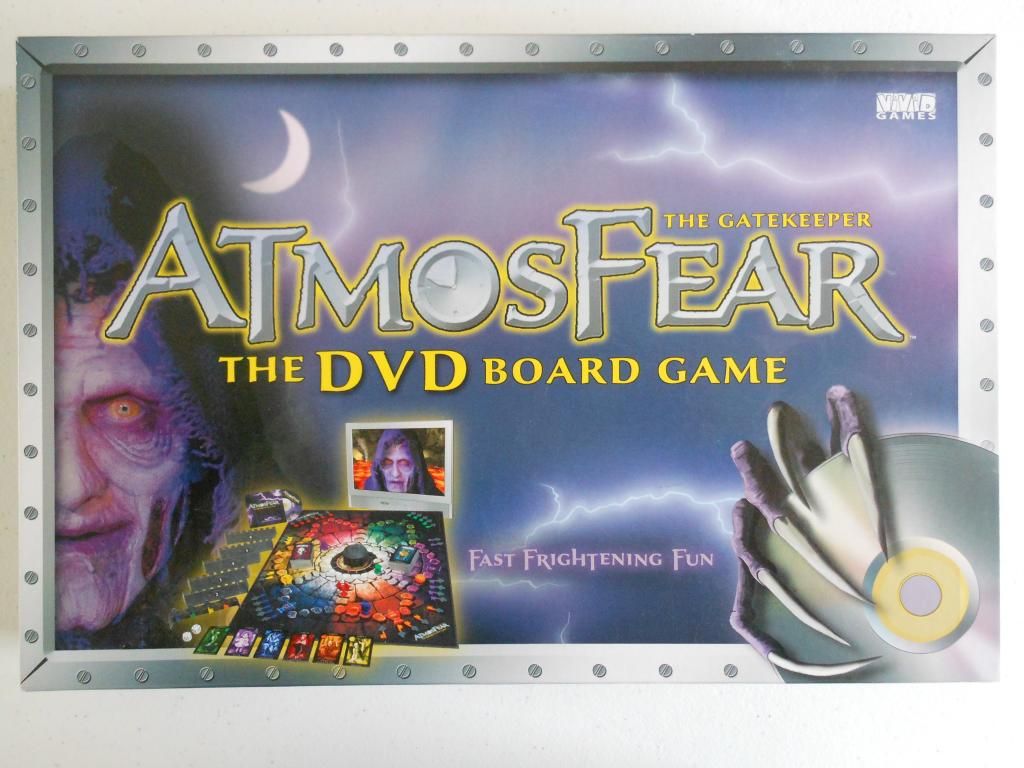
Review - Atmosfear: The DVD Board Game

Atmosfear the DVD board game

Atmosfear
Published by Vivid Games
Designed by The Gatekeeper as a means to torture his victims
For 3-6 players, aged 12 to adult


It's that time of year again... Halloween. The time of year when Poundland brings out its rubber bats and dead-eyed skeleton masks, every radio station seems to be playing Michael Jackson's Thriller, and tiny little demons threaten you with eggs in exchange for sweets and chocolates.

I'm not a huge fan of Halloween; I mean, I don't dislike it, I just don't go out of my way to celebrate it in any meaningful way. However, there are a few traditions I have:

(a) I always watch Tim Burton's The Nightmare Before Christmas;
(b) I always play a game of Atmosfear.

Atmosfear is, let's be honest, not a great game. It is basically a roll and move game in which you try to collect a set of keys that will "unlock" the "well of fears." On your turn, you roll a dice (or two dice - your choice) and then move the indicated number of spaces; and on most turns you don't even get to decide in which direction you move, giving you the same number of options you get in a luck-fest such as Snakes and Ladders. But there is something that lifts Atmosfear far above other roll and move games: Speed. No, I don't mean a hefty dose of illegal substances is required to make the game playable; I mean the game is played at speed. You have only 49 minutes to win the game, and the clock is always ticking. The pressure of passing the dice around, rolling, moving quickly while the next player scrabbles for the dice creates a frantic, fun way to spend an evening. Just don't expect any hidden depths or strategic choices.

But I'm getting ahead of myself. Time to back up...

Whenever I am out in town, I always hit the charity shops in the hope that I will find some old board games (I usually have my fingers crossed for something by Waddingtons or Milton Bradley). Almost every time, I will find at least one copy of Atmosfear - the old VHS version in the long coffin box. Honestly, I know people from other countries who think this game is rare; but I must see one every other week, almost as often as I see those Carol Vorderman's Sudoku games. Thing is, I don't have a video player, so I have always passed up the opportunity to acquire this old classic (I only have games in my collection that I intend to play). Of course, when I eventually found a mint condition copy of the DVD version of the game in a charity shop I had to have it, even though it was a little pricey.

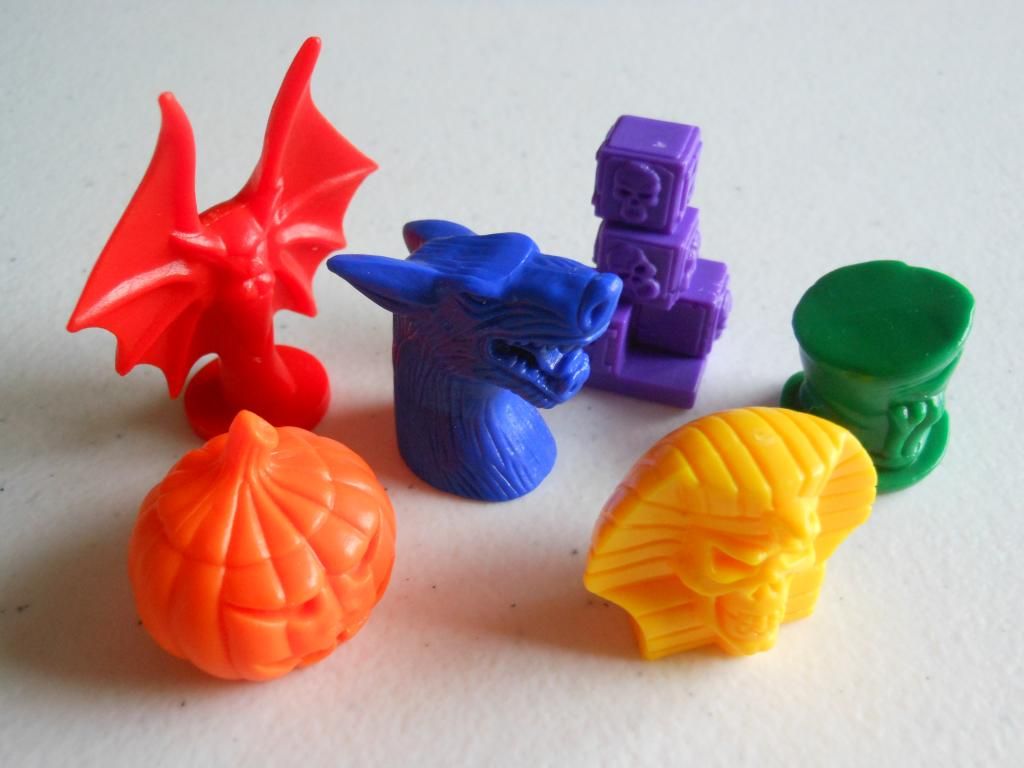
The DVD version is a very nicely produced package, with plenty of plastic bits. The six player pawns stand out as being particularly good; they are like plastic Halloween-themed versions of Monopoly pieces. Some of them are pretty straight-forward (a bat representing the vampire), some are a little unusual (a hat representing a zombie), and one is just plain creepy (a stack of building blocks representing the ghost of a dead infant - thanks for that!). Of course, as my last name is Outlaw, I always play as the werewolf, who is represented by a wolf's head.


Atmosfear playing pieces
The Atmosfear playing pieces.


These pieces are moved around a board which is like a spoked wheel, with an outer circular path, and then several paths that lead to a much smaller inner circle. When a piece is on the outer circle it can only be moved clockwise, so on your turn you just roll the dice and move your piece. The board is divided into coloured sections, and several spaces on the outer ring have special symbols. If you land on one of these spaces, you do the related action (for example, if you land on the clock face, you can take a time card).


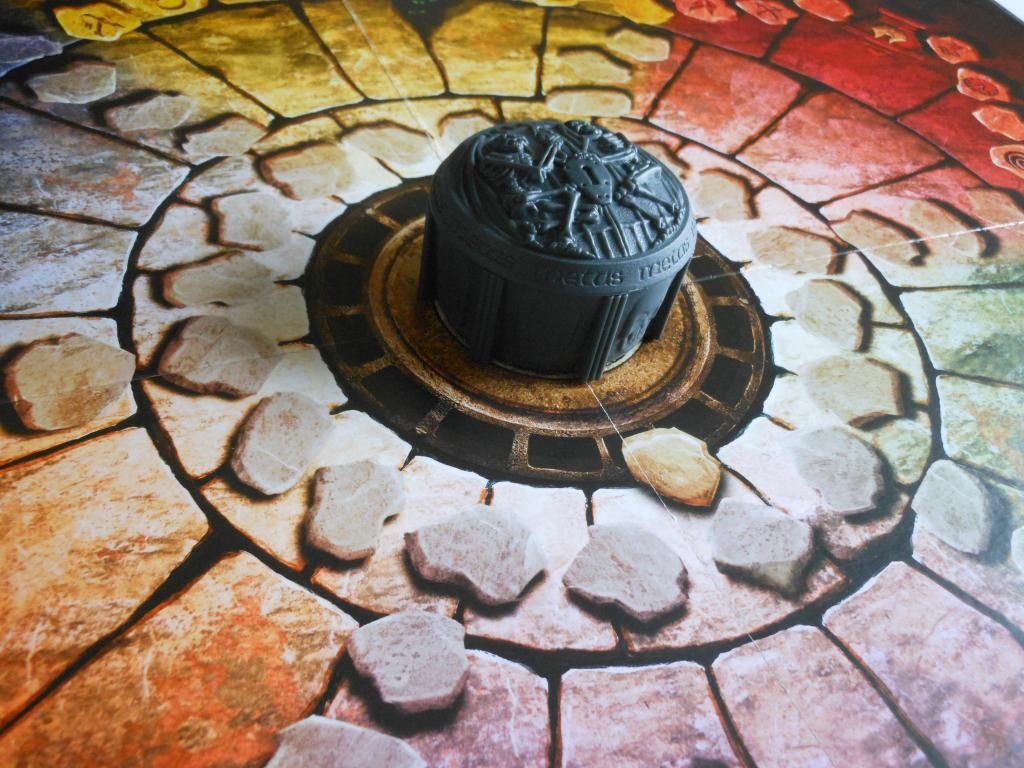
Atmosfear board detail
The "Well of Fears" at the centre of the board.


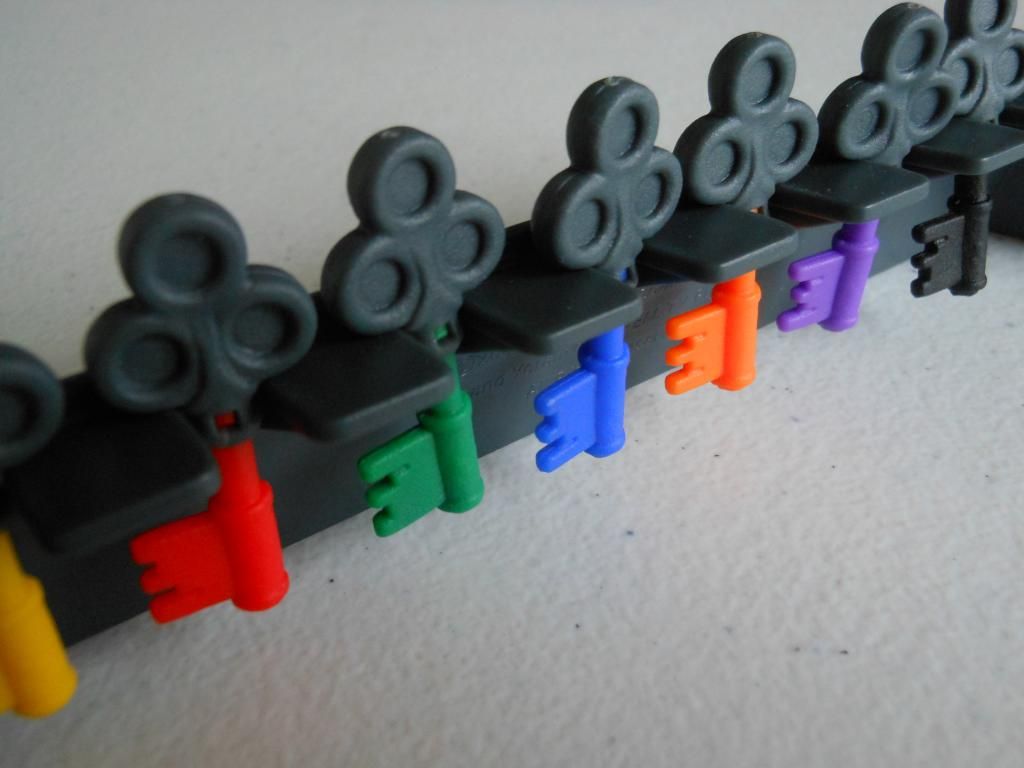
As already mentioned the aim of the game is to collect a complete set of six keys (one each in six different colours), and in the DVD version of the game, these are nicely moulded in plastic. You also get little plastic racks which hold the keys in such a way that your opponents can see how many keys you have, but not what colour those keys are (very important for when an opponent has the chance to steal one or more keys from you). A player can take one of the keys that matches the colour of the board section his piece is in every time he lands on a key space.


Atmosfear keys
The keys hanging in their special rack - that black key is a "bad" one.


If at any point a player has one key from each of the six coloured sections of the board, he can move to the inner ring and attempt to "face his fear" by randomly drawing a fear from the cool plastic pot that sits right in the middle of the board. These fears have been written on scraps of paper and put in the pot by the players at the start of the game, and if the fear drawn matches the fear the player added to the pot then that player wins.

It all sounds very pedestrian and dull, doesn't it? And it really is until you add the DVD element.

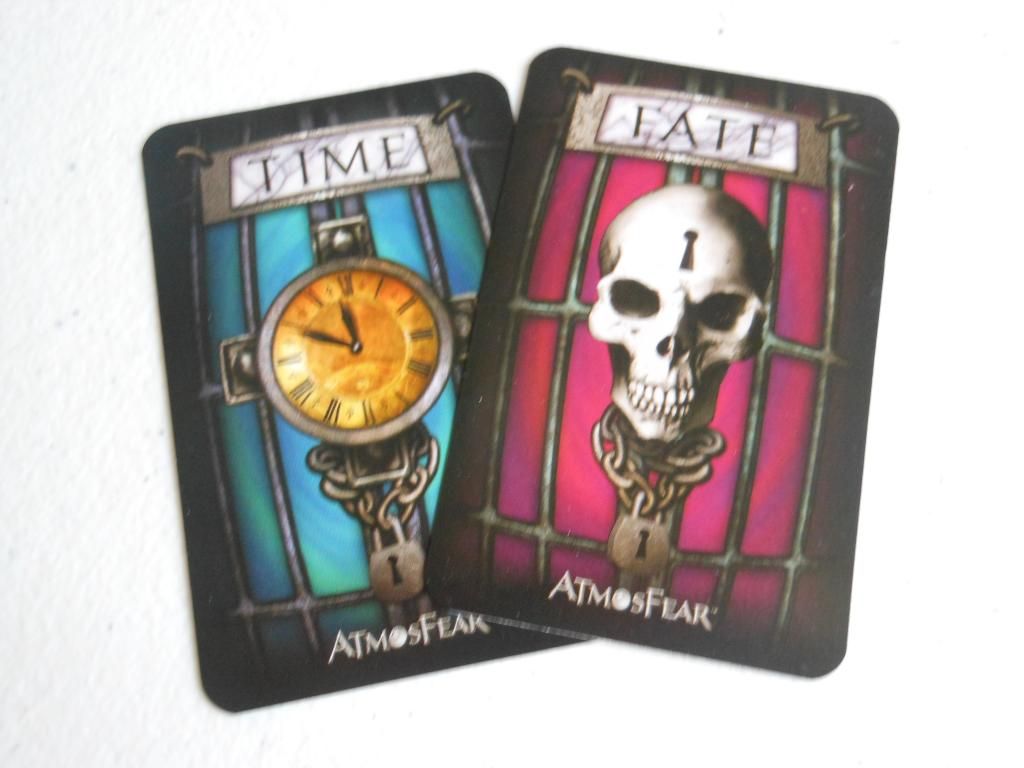
The DVD does several different things. The first thing it does is add the time limit. The DVD will run for 49 minutes, and after that time, if nobody has won, then the game wins. The time limit forces everyone to rush, and people will often find dice being snatched out of their hands as opponents try to hurry the game along.

The timer also indicates when special time cards can be used. These cards are picked up by landing on certain spaces on the board, and they are held to be played exactly at the time specified on the card. When the timer on the DVD matches the time on the card, you play the card (even if it is not your turn). These cards will ask you to scream at an opponent to make them jump, or steal keys, or swap places with other players, and lots of other screwy stuff. Of course, if you miss your chance to play the card, too bad! You snooze, you lose.


Atmosfear game cards
Atmosfear game cards.


The other thing the DVD does is provide your host for the evening: The Gatekeeper. This is a wonderful addition to the game. The Gatekeeper will pop up on your television screen from time to time and basically call you an asshole. Yes, this is a game that provides its own trash talk. The gatekeeper will insult you, and then he will probably do something horrible to you as well. He works as a randomiser in a similar way to the electronic memory in the dungeon-crawler game Legend of Zagor, picking a player and then asking them to perform a task or suffer the consequences. He even insists you respond to all his questions with "Yes, My Gatekeeper." Failure to say this also results in a penalty of some kind.

The intervention of The Gatekeeper can turn the whole game on its head, and a person with a full set of six keys can suddenly find themselves with no keys and no chance to win. This may sound awful, and like it would totally ruin the game; and it might, if it wasn't so much damn fun. Atmosfear really isn't a game you should be playing to win. You should just be playing to shout at the television, scream at your friends, and try to roll dice as quickly and frequently as you possibly can. If you are the kind of person who will get angry to have victory stolen away by a bit of bad luck in the last few seconds of the game, then you should probably look for some other way to spend 49 minutes of your life.

So basically, the game comprises a group of flustered people rushing about while an old guy shouts insults at them. It's a bit like a normal day at work, really.

There is no strategy, and no skill; you can have all your hard work undone in seconds just because of stupid luck. There are no real decisions to make (which player to steal a key from is probably the trickiest thing you will have to do), and there is no way to prepare for the intervention of The Gatekeeper. But it doesn't matter. This game is an absolute blast. Not for every night of the week; but for Halloween... Perfect.

Tuesday, 26 June 2012

Review - The Worst-Case Scenario Survival Game

The Worst-Case Scenario Surviva Game

The Worst-Case Scenario Survival Game
Published by University Games
Designed by people who do not understand the concepts of "fun," "game," and "worst-case"
For 2 or more players (read, "victims"), aged 8 to adult


I own a lot of games. Lots of them are little curiosities that my wife has found in charity shops and picked up because she thought I might like them. That's why I own a copy of The Worst-Case Scenario Survival Game, possibly one of the most awful games to have ever graced my tabletop.

This is a game based on a book that proves that games based on books are generally not much better than games based on movies, which as we all know, are generally crap (you can see my reviews of Small Soldiers: Big Battle Game, The Princess Bride: Storming the Castle, or Eragon if you would like proof).

However, The Worst-Case Scenario Survival Game could well be the worst of the lot. You could say the worst-case scenario for me would be playing it (ha ha) and its chances of survival in my collection are rather slim (he he).

Man, I need better jokes.

Anyway, this is one of those good old-fashioned roll and move trivia games. I really hate those games. It ships in a big box that contains a small deck of cards, some player pieces, a dice, and the board. With the exception of the board, the rest of the game could fit in your pocket, meaning this game has possibly the smallest game-to-box ratio of any game I have ever seen. It also has the smallest fun-to-game ratio, but more on that in a minute.

The Worst-Case Scenario Survival Game - inside the box
Did the box really need to be this big?


The aim of the game is simple. Players each control one of four coloured playing pieces (if you feel the urge to involve lots of people - for example, you are part of a large suicide cult - then you can play in teams). On your turn you roll the dice, and then you get asked a question by the player/team on your right. If you get the question right, you move your piece forward on the track by the number you rolled; if you get the question wrong, the peson who asked you the question moves his or her piece by the number rolled instead.

The Worst-Case Scenario Survival Game rules
The rules - Yes, there genuinely is a warning message on the front cover.
Don't try this at home kids (playing the game, I mean).


The first person to get to the finish space on the board wins the game, thereby earning the eternal gratitude of anyone who was unfortunate enough to be involved.

The Worst-Case Scenario Survival Game - board details
Blue and White hunt for Bigfoot.


Okay, so the game is very simple; but the same can be said for many trivia games. Such games will rise or fall based on the strength of the questions provided. Unfortunately, the questions in The Worst-Case Scenario Survival Game are crap.

Each question is framed in the same manner. You are given a scenario, and then three possible solutions for resolving that situation without ending up dead or severely injured. For example, you might be asked how to fend off a shark, or you might be asked how to escape from killer bees.

It sounds like that might be really interesting, but it isn't. With the more outlandish questions, all three possible answers seem feasible; and because they purposefully do not include the most obvious solution, you will probably end up having to guess. However, the biggest problem is the weird mix of questions in the deck. One person might get asked how to find land while lost at sea, while someone else gets asked how to do CPR.

There are also some questions which hardly seem in-keeping with the "worst-case" theme.

One of the questions asks, "how to treat skin that has been in contact with bleach." Seriously? Is this a game about survival or misplacing your marigolds?

The Worst-Case Scenario Survival Game question card
Spoiler: The answer in bold is the right one (no shit, Sherlock)


My absolute favourite question, and the one that made me realise this game had been rushed out as quickly as possible with as little thought as possible, was "how to fix a leaking radiator."

There is even one question that asks you the correct way to punch someone, and for a game that can be played with young children, that really made me uncomfortable.

Yeah, this game is bad.

I thought it might be okay to play with my mates over a few drinks; but it isn't. The questions aren't funny enough to be entertaining, and most of them are too outlandish to be educational for younger players. Its a strange mix that leaves the game feeling completely soulless and boring.

In fact, this game is so bad it... Actually, you know what? I can't be bothered. Screw it. It's not worth the effort.

I'm gonna go play Lords of Waterdeep.

Thursday, 31 May 2012

Review - Eragon


Eragon: The Official Motion Picture Board Game
Published by Mega Brands
Designed by Jim Bousman
For 2-4 players, aged 8 to adult


Having already reviewed Star Wars Episode I Customizable Card Game, Indiana Jones Akator Temple Race Game, and Operation: Aliens, I thought I would continue the theme by reviewing another game based on a movie: Eragon.

To be more exact, this is a game based on a movie based on a book. I love a good franchise. Unfortunately, Eragon is not a good franchise. The film is a tragic waste of human endeavour, managing to suck all the fun out of an adventure story involving knights, monsters, and dragons. I didn't even think that was possible.

It's not entirely the film's fault. The CGI is ropey, the acting is bad, the action sequences are boring, and some of the casting is way off (Rachel Weisz is not the person who springs to mind when I am asked to think up a good actor to voice a dragon); but the biggest problem is it's based on a book that simply isn't very good. The theme is a rehash of Star Wars, the plotting and characterisation is severely lacking, and it's all just a bit dull. I actually have a lot of respect for the author, Christopher Paolini. Not because he is good; but because he has managed to be so incredibly successful without actually being any good. However, he hasn't had everything his own way, and he has taken a lot of abuse for his writing "style" over the years (just like he is right now).

I am sure he sits in his mansion, surrounded by his piles of money, and cries himself to sleep.

But we aren't here to talk about the merits of the book or the film. We are here to talk about the merits of the shameless board game cash-in that came out off the back of the movie. With such great source material to work with, I am sure you can imagine how this is going to go...

At first glance, the production quality seems really rather good; but it very quickly becomes apparent that things haven't been thought through very well. The box is good enough: It's nice and glossy,  with a cover featuring all the actors from the movie looking suitably surly (but no picture of the dragon, which is clearly because this game was made using promotional artwork from before the movie's special effects had been completed); but once you remove the box lid, you start to realise what sort of game this is.

Eragon board
The board for Eragon. The squiggly writing isn't much easier to read close up.


The game board is big, and features  a series of paths overlaid on a map of Alagayseewhatsit (the fantastically not Middle Earth world in which the story unfolds). It seems very nice until you look closely, and you notice:
  • All the text is written in spidery italics and is almost impossible to read without pressing your nose against the board.
  • The bit of the board used for the game could actually fit on a board one-third the size, meaning that the rest of it is just for show.
  • It's covered in stupid words from the book, which have ridiculous umlauts and apostrophes scattered over them like fairy dust.
The other interesting thing about the board is that there are little punch out sections in the four corners, so that when the board is laid on a table, there are little "wells." The aim of the game is to collect cute little plastic crystals, and the "wells" on the board are where you place the crystals. The need for the "wells" becomes apparent as soon as you place one of the crystals on a flat surface. The crystals look impressive enough, but they are rounded, and they roll. Fast. You can't just pile them up beside the game board, not unless you want to spend most of the evening rummaging under the sofa for them.

Eragon dragon crystals
You wouldn't believe how difficult it was to take this picture.


The problem is, the "wells" are only big enough to hold about six crystals. Not nearly enough. I would say that's a massive design fault. But it isn't. The massive design fault was including crystals that were so difficult to control that it became necessary to cut "wells" in the bloody board in the first place. Seriously... Why not just cubes? Or cardboard chits? They probably would have been cheaper, and the publisher wouldn't have needed to pay for diecut game boards.

The game also ships with a deck of cards. Despite having a gloss finish, they still manage to be cheaper and flimsier than most of the other cards I have seen (including the ones in Hasbro games). Furthermore, the printing is terrible. All the character images are grainy; it's actually difficult to figure out who some of the people on the cards are supposed to be.

Eragon cards
The word "action" on a card is the closest thing to action you will find in this game.


However, the components are not a complete bust. The game includes three good quality dice (six-sided, 10-sided, and 20-sided), and four really nice player pieces designed to look like the hilt of a sword. Each playing piece has a translucent plastic "gem" in the pommel with a matching colour base. They are sturdy, and look great. Makes you wish they had used them in a better game.

Eragon playing pieces
The playing pieces. There must be a better use for them!


Ah yes... the game. The game isn't much of anything really. It's a simple roll-and-move game where you interact with the spaces you land on, occasionally get to draw a card, and need to roll the exact number to land on the final space of the path. (Really? Why do people still design games that require you to roll an exact number to win?)

As already mentioned, the aim of the game is to collect the horrible, rolling crystals. On your turn you roll the dice, and move that number of spaces (unless you land on a "stop" space, in which case you... er... stop). Occasionally you may have a choice of two directions to chose from, but all roads lead to Rome, so it doesn't matter which way you go.

If you land on a "challenge" space you get to challenge an opponent to a contest of magic or strength. It doesn't matter which you pick, it just determines if you roll the red dice (strength), or the green dice (magic). Both players will roll the same dice, so there is no real advantage to picking one ability over the other.

Before rolling the dice, you both wager some crystals, then the person who rolls the highest gets to keep the crystals. Re-roll ties.

I'm not kidding.

Sometimes you will land on a "draw a card" space. Guess what happens then?

There are three types of card:

Battle cards: Drawing one of these means you are involved in a bit of a scrap. You will either lose or gain dragon crystals (with no chance to do anything about it), and you may also get moved a few spaces forwards or backwards.

Action cards: Do pretty much the same as battle cards, except sometimes they ask the players to do mental things like "pass this card over your forehead three times." Oh yeah... and they say "action" on them.

Protection cards: You keep hold of these cards, and use them to block challenges. Some block strength challenges and some block magic challenges. The existence of these cards seems to be the only reason there are two types of challenge at all; and as you will never know if an opponent has a protection card against your selected challenge, it all seems rather random and pointless.

And that, my friends, is the game.

Roll the dice. Move. Do what it says on the space you land on (unless you got lucky and landed on a blank space). Apart from the blank spaces, "challenge" spaces, and "draw a card" spaces, you may have the good fortune to land on the thrilling "take another turn" space, or the earth-shattering "raid" space that allows you to roll a dice(!) and take crystals equal to the number rolled from one of your opponents (assuming you found anyone willing to play the game with you in the first place).

The game ends when someone reaches the end space on the board. That player collects five bonus crystals. Then everyone counts up their crystals (while trying to stop them rolling off the table), and the person with the most crystals wins. Although they don't, because everybody who has taken part in this sorry waste of time loses something (precious moments of life, a piece of their soul, their minds, whatever).

I think one of my favourite things about the game is the small section entitled "strategy hints" in the rules. The hints include gems like: "When playing with more than two players, it might be important to keep one player from getting too many Dragon Crystals in his or her possession." Surely, that is also the case in the a two-player game?!

Anyway, enough of this nonsense. This game has drained more of my life than it has any right to: First, because I played it; and now because I've written this review. This game is one of those typical movie tie-ins, quickly thrown together without due care and attention. It was designed to sell while the movie was popular (which it never was) before being relegated to the bin.

Having reviewed this game, I am now getting rid of it. It doesn't deserve a space in The Vault. It barely deserves a space at the local land fill.