Showing posts with label H P Lovecraft. Show all posts

Thursday, 4 February 2016

Review - Mansions of Madness

Mansions of Madness


Mansions of Madness
Published by Fantasy Flight Games
Designed by Corey Konieczka
For 2 to 5 players, aged 13 to adult


Mansions of Madness box


Way back in the mists of time - and I mean way, way back - I was a young man. Naive, adventurous, and a bit geeky.

Back then, I met a girl, and if you asked me at the time, I would have told you I loved her. Remember, I said I was naive?

She seemed to like me, and we began a "whirlwind romance." We made a special effort to make space in our schedules to spend time together. And it was all exciting and new.

But over time, and actually rather swiftly, we started to realise that we didn't really have very much in common. Remember, I said I was a bit geeky?

It became more and more obvious that we weren't really enjoying our time together.

So it ended.

Now, I know what you're thinking. You're thinking this is a very familiar-sounding story.

And it is.

It's familiar to the point of cliche.

And it's familiar, because it happens all the time.

It even happens with board games.

That's why I'm writing this review of Mansions of Madness, a game I actually reviewed years ago, but which I felt the need to revisit.

After all, sometimes (like with a childhood romance), it's hard to let go...

Saturday, 16 August 2014

Review - Cthulhu Gloom

Cthulhu Gloom


Cthulhu Gloom
Designed by Keith Baker
Published by Atlas Games

For 2-5 players, aged 13 to adult

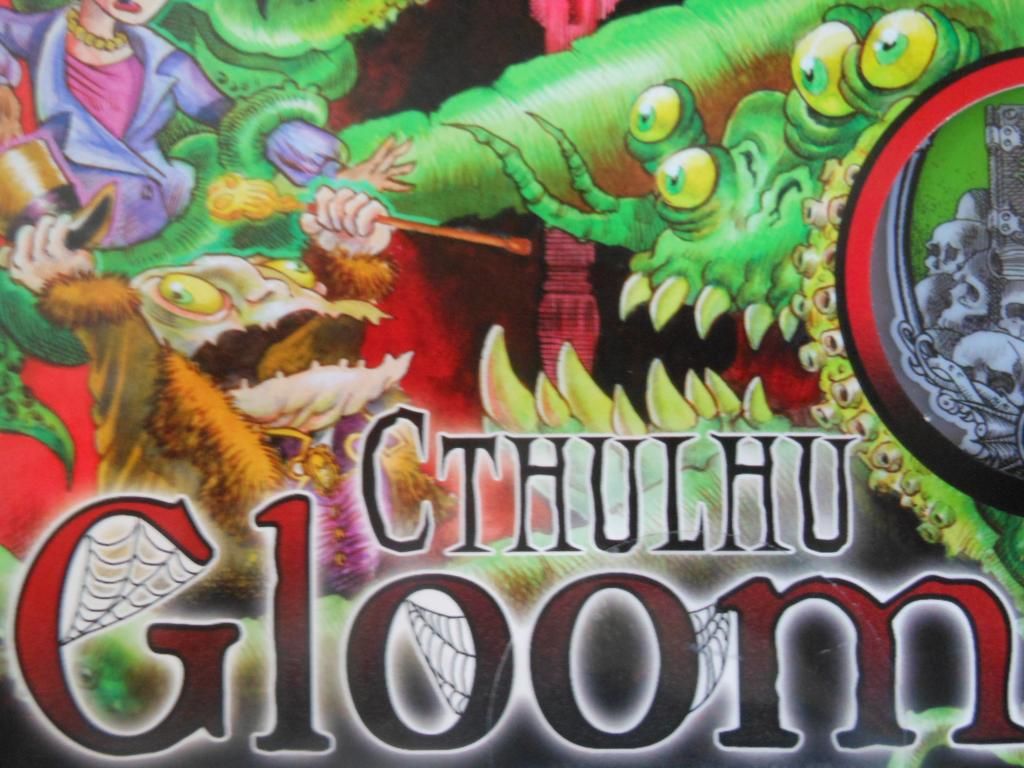
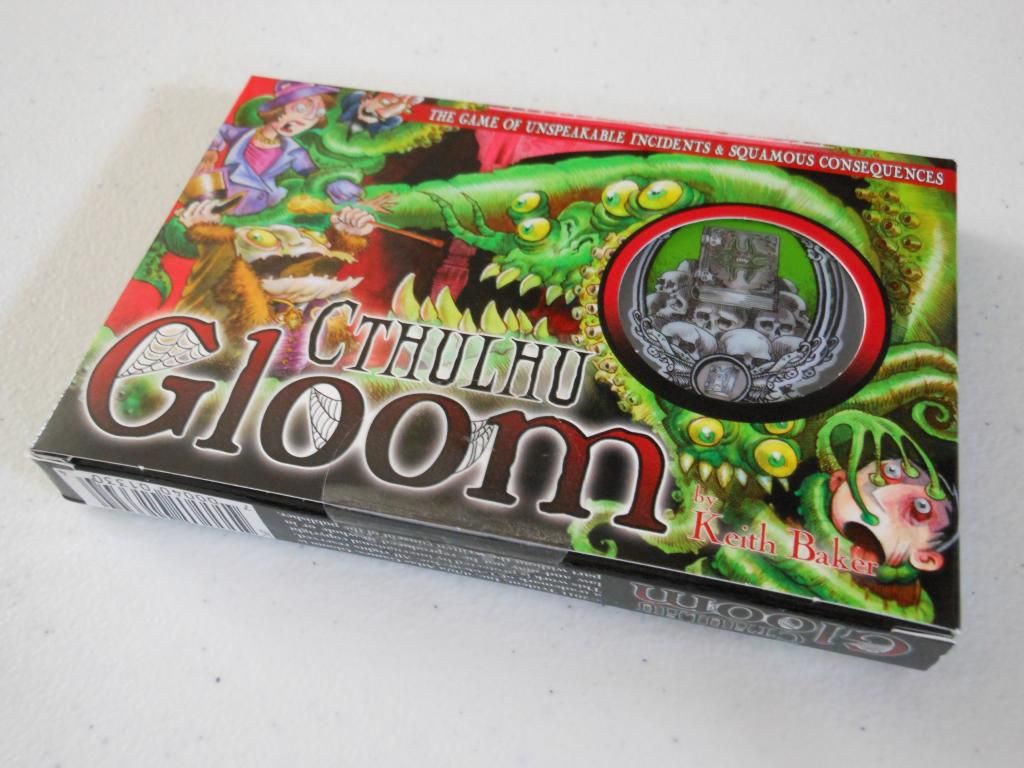
Cthulhu Gloom box
Looks inviting...

Recently, I was in Swindon, which as we all know is a place that terraformers are expressly forbidden from recreating. I was in the lift (or the elevator, depending on where you come from) at the car park, with an elderly woman, and a couple of guys and a woman around my age. We were squashed uncomfortably into the lift with our bags, and that awkward silence descended. You know the kind of silence I mean. The kind that makes you want to break wind.

Anyway, we were all shuffling our feet, and trying not to make eye contact in case anyone thought we were weird. All very British.

Then the woman who was about my age chirped up with, "You ever get that awkward moment where you're in the lift and realise you can't remember what floor your car is on?"

One of the guys smiled, and said, "I was literally just thinking the same thing."

By the time the lift stopped on my floor, everyone was laughing and chatting. I left them to it, with a cheerful, "Good luck" as I headed for my car.

So, why am I telling you this?

Mainly because I don't have any interesting anecdotes to tell you. But also, it reminded me how much better life is when you reach out to the people around you; when you stop and speak to someone rather than casting your eyes down or pretending to check messages on your iPhone. In our lives, we spend so much time being insular, and shutting people out, and putting on a front, and pretending we know where our car is.

When you stop doing that, the world gets a little brighter.

And that is what I love about board games. I love getting people together to talk and interact; to laugh and have fun.

Recently, I found and fell in love with a game called Winter Tales. It is a storytelling game, and it creates the most wonderful setting for a group of friends to craft a fantastical adventure. However, it is a game where the story is more important than winning. That's great; but sometimes people want to laugh and have fun and WIN.

Cthulhu Gloom fits the bill perfectly.

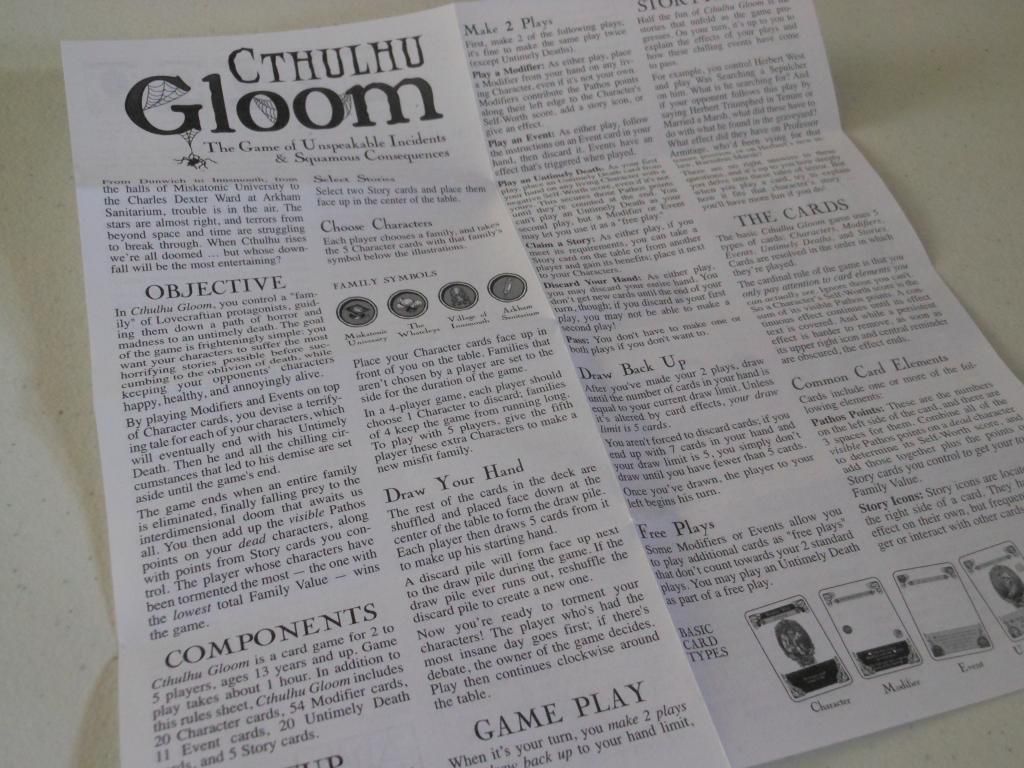
Cthulhu Gloom rules
The rules could be nicer.

Cthulhu Gloom is the inevitable Lovecraftian retheme of the game Gloom. It is a simple card game with a fiendishly entertaining goal: Players have five family members under their control, and must make them as miserable as possible before killing them off. At the point any one family is wiped out, everyone adds up how miserable their dead family members are, and the person who generated the most misery wins.

It sounds macabre, and it is.

It sounds miserable, but it most certainly isn't.

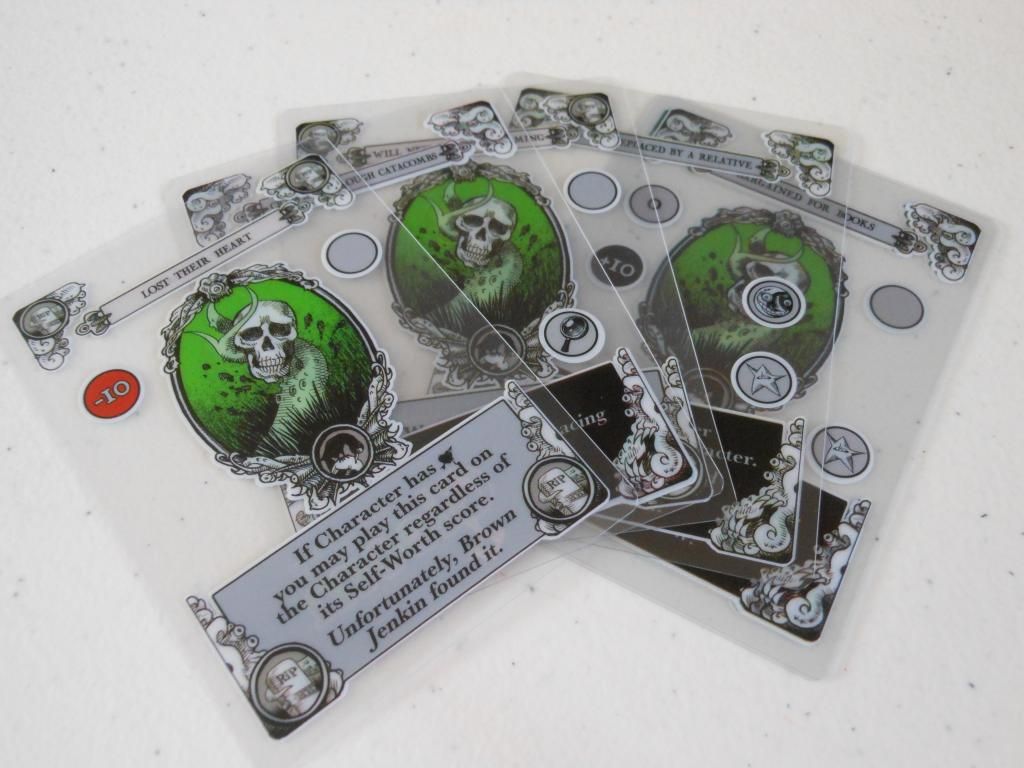
The game is actually exceptionally simple. Players have a hand of events, modifiers, and untimely death cards, and on each turn players take two actions, which normally involves playing two of those cards. Modifiers are played directly over the top of family members, making them happier or sadder, and also giving them other characteristics called "story icons," which other cards key off. This unique method of applying modifiers to the characters is achieved through the use of transparent cards. As the cards are stacked, certain elements show through from the card below, while other elements are blocked out.

Cthulhu Gloom cards
The transparent cards are cool.


It sounds a bit gimmicky, and I suppose it is. But it also works beautifully.

Over the course of the game, characters may transform into monstrous apparitions, gain special abilities, become more miserable, die, come back from the dead...

It's just great.

But it is also, at the very heart of it, just a "screw you" card game with limited strategies. You usually play bad cards (er, good cards, I mean) on other players, and good cards (I mean, bad cards) on yourself. You try to mutate your characters so they have the correct combinations of "story icons" to trigger events, make them unhappy, and then kill them, while trying to ensure your opponents stay happy and very much alive.

What really lifts the game, giving it the boost it needs to become truly entertaining, is the optional storytelling rule. Every card has a title, and maybe a funny piece of flavour text and a picture, but ultimately, each one is a blank canvas. A blank canvas for the players to fill with their own brand of storytelling.

For example, one of the untimely death cards is titled, "Will never stop screaming." But why? What does it mean? What did the unfortunate victim see?

Was it Swindon?

The rules encourage players to create a backstory for every card they play, to flesh out these tales of woe. And that, for me, makes this game an absolute joy.

At its core, it is a simple card game with a very basic rules set, but like the layers you make with the transparent cards, it is possible to layer the basic game with a layer of storytelling that really brings the game to life... er...death. Whatever.

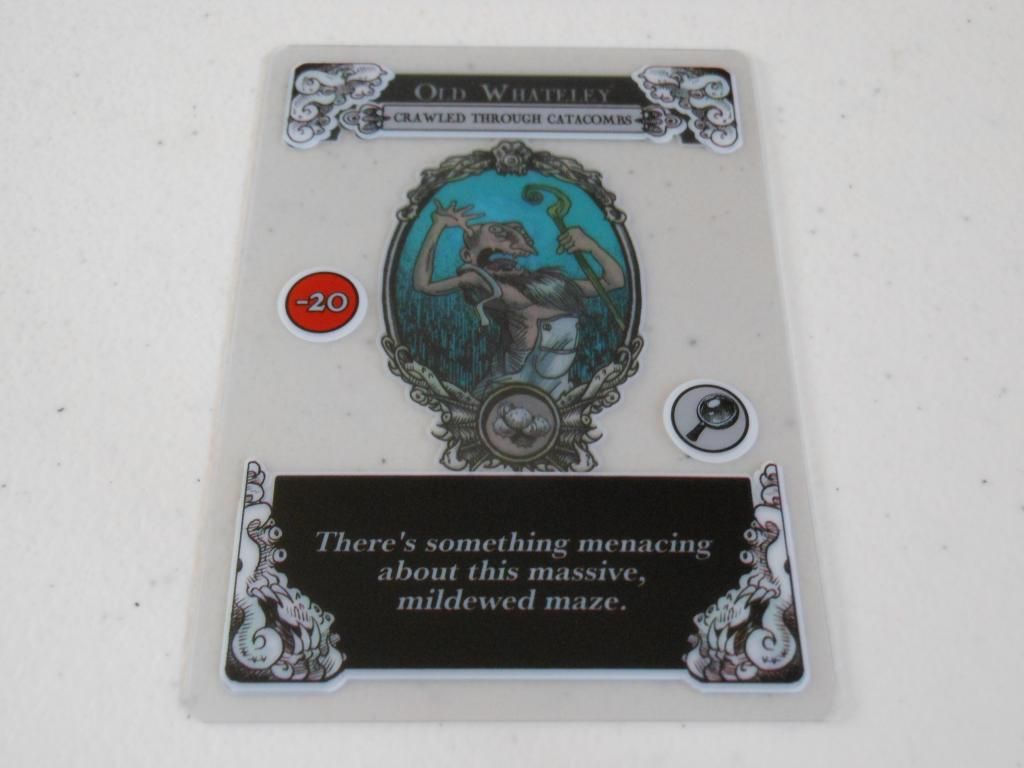
Cthulhu Gloom card in play
Old Whateley didn't enjoy crawling through catacombs.


Now, there are some down sides. Isn't there always?

First of all, the deck of cards is relatively small. In one game, you will probably see most of the modifiers and untimely deaths. Some variance is added by the random addition of two story cards for players to fight over, but there are only five of those. After a couple of games, you have seen everything the game has to offer, and that does hamper the storytelling aspect slightly. Basically, if players get this to the table often, then they are going to start regurgitating the same old stories as they see the same old cards time and time again.

It is also worth noting that storytelling games are not for everyone. Some people are too shy, and some people are not very good at making things up on the fly. If you have a gaming group like that, you can still play Cthulhu Gloom, but you are missing out on one of the best aspects, and you may find the game a little too light and repetitive to have staying power. I really wouldn't recommend the game to groups who do not intend to embrace the storytelling concept.

Finally, and it has to be mentioned... Cthulhu.

H P Lovecraft is one of my favourite authors, and his writing has had a huge influence on me; but even I begin to tire of all the Lovecraftian board games on the market. It is almost as tiresome as the number of zombie games. Furthermore, for people who do not know the works of Lovecraft, many of the jokes and characters in the game are going to go right over their heads. For those people, I would recommend good old regular Gloom instead, which has the same macabre vibe, but without the Cthulhu theme.

And that's it really. I don't have anything else negative to say about the game. The plastic, transparent cards shuffle well, and work perfectly; the art is excellent; the jokes are genuinely funny; and the game is solid without the storytelling, and truly joyous with the storytelling.

Cthulhu Gloom family members
The Whateley family are a fun bunch.


It may be a game about making people miserable, yet it has the potential to create such mirth. But it is important to do it with the right group of people. Which is a good rule of thumb for riding on the lifts in Swindon too.

Thursday, 8 May 2014

Review - Unspeakable Words

Unspeakable Words


Unspeakable Words
Published by Playroom Entertainment
Designed by James Ernest and Mike Selinker
For 2-6 players, aged 10 to adult

Being a writer has its downside. Sure, you get to spend all day crafting worlds, inventing characters, and generally doing what you love.

But...

First of all, people have a tendency to buy you pens. Usually pens with your name on them.

I know my name, thanks. And, apart from writing shopping lists, I haven't used a pen since about 2005.

And when it comes to games, people always seem to think a writer is going to like word games. Scrabble, Boggle, Upwords...

No.

No, no, no.

Words are tools. I don't play with tools.

Except my friend, James.

As a writer, I want board games that create stories. Games where I get to rearrange letters into words couldn't interest me less.

So, I tend to have quite a few word games in my collection, but there is only one that I actually bought myself. That one game is Unspeakable Words.

I picked it up years ago, when I saw it going cheap. I knew it was just a word game, but there was a little twist that appealed to me: A Cthulhu theme. Of course, this was back in the days when the Cthulhu theme was not quite so prevalent. Nowadays, Cthulhu is overused almost as much as ellipses in blog posts.

But anyway...

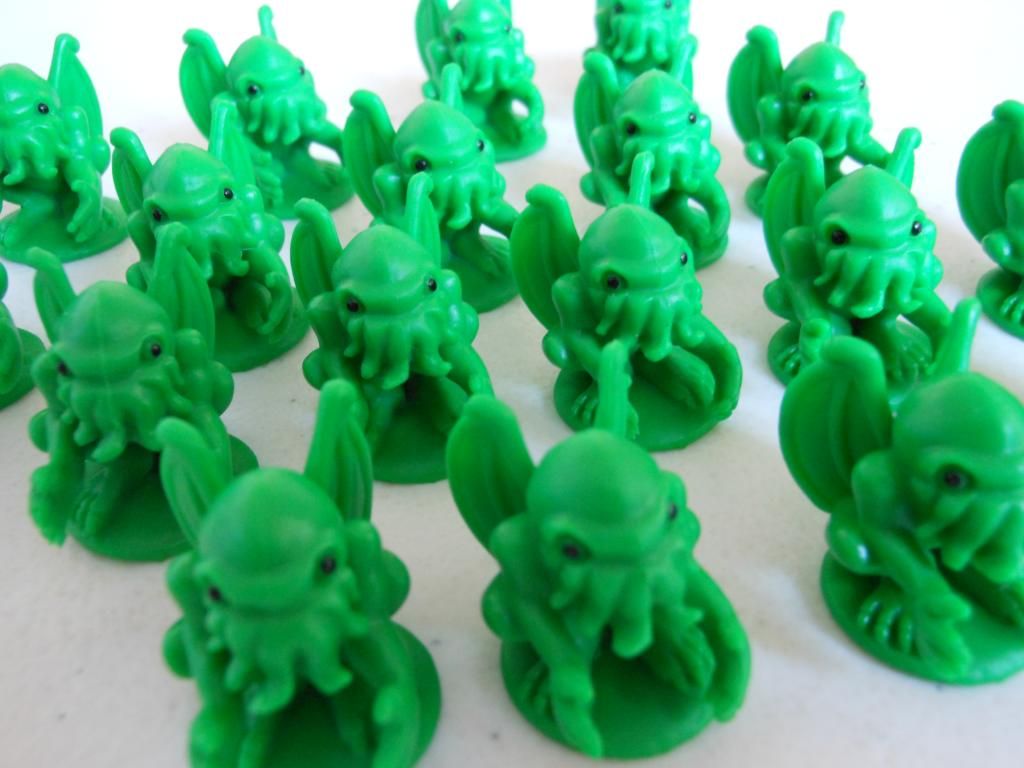
I was intrigued by the comical art, the fun spin on a theme I enjoy, and (of course) the promise of 30 cute Cthulhu pawns.

Frankly, those pawns are worth the price of admission alone.

Unspeakable Words Cthulhu pawns
We could be in trouble.


In fact, the presentation for the entire game is lovely. You get 96 cards depicting letters of the alphabet, the 30 pawns, and a 20-sided dice, which I am sure is a little nod to the Call of Cthulhu roleplaying game.

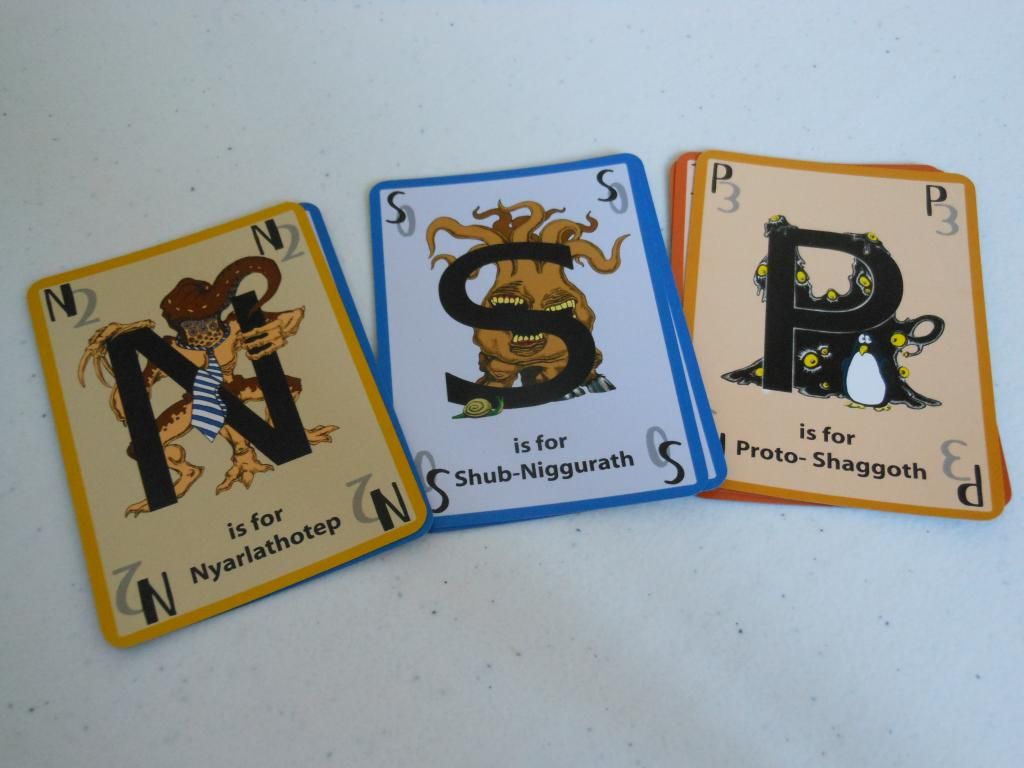
What is so nice about the cards is the way the theme is incorporated. For example, on cards depicting "C", you get the legend "C is for Cthulhu" and a nice picture of Cthulhu taking a nap with his teddy bear. If you don't know why that is funny, you clearly aren't a H.P. Lovecraft fan.

Additionally, each card incorporates a piece of art that is more typically associated with the letter in question. Seeing Azathoth eating an apple is guaranteed to bring a smile to your face.

Unspeakable Words cards
That penguin looks mighty nervous.


So the presentation is great. What about the game?

Sadly, the game is not really much to write home about (with a personalised pen, no doubt). The concept is that players are researching arcane lore, revealing words that no person was ever meant to spell out. Each player starts the game with five pawns, representing sanity (this is a Cthulhu game, after all), and seven cards.

Taking it in turns, players create words from the cards they have. The cards used to spell the word are placed on the table for everyone to see. The word is then scored based on the number of angles in the letters, which is another nice nod to the weird fiction that inspired the game. For example, the letter "Z" scores two points, while the letter "C" scores none.

At first, this might seem unusual. After all, the commonly used letter "A" scores five points, but the letter "Z" only scores two points. However, this is a surprisingly clever system when you realise that, after scoring your points, you have to roll a sanity check. To do this, you roll the 20-sided dice, and you must get equal to or greater than the total value of the word you just scored. If you don't, you lose a sanity point.

This means people who score high-value words are at greater risk of going insane. Thematically, this makes sense, and it also levels the playing field. Those players who are experts at creating high-scoring words run the risk of going insane, giving those people who have been scoring low-value words a chance to make a comeback.

The winner is the first player to score 100 points, or the last player with any sanity.

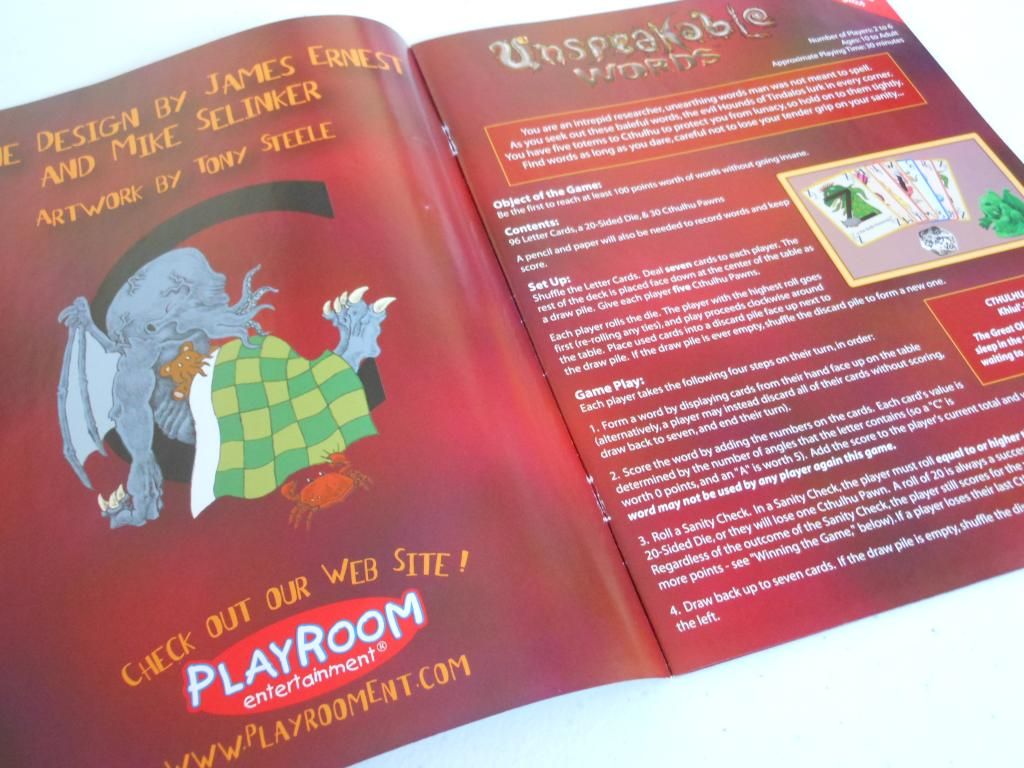
Unspeakable Words rules
Cthulhu's taking a nap. He does that.


So, yeah. it's just a word game. However, it has just enough going on to make it a little more interesting for me. The theme, the comedy elements in the art, the cute pawns, the push-your-luck element associated with creating high-value words, and the fact that people who are not great at word games still have a fighting chance, all adds up to make something that is just a little bit more than the sum of its parts. There are even some optional rules to spice things up a bit more, by giving people a chance to recover sanity, or to make up gibberish words if they are close to going insane.

This game may not be a Deep One, but if I have to play a word game I want to play one where I am not completely bored by the time Mi-Go comes around, and that means the only choice Hastur be Unspeakable Words.

...

...

I'll get my coat.

Tuesday, 19 March 2013

Review - Cthulhu Dice

I was going to call this review "I ain't dead," because... well... I'm not. But it's been so long since I updated this blog, anyone who reads my stuff (do you exist? Let me know!) might think I had shuffled off this mortal coil. As it happens, I've just been spending a lot of time promoting my series of fantasy books, The Legend Riders, and time has gotten away from me a bit.

But I'm back now, so here's a little review about a game that isn't really much of a game at all: Cthulhu Dice.

Cthulhu Dice


Cthulhu Dice
Published by Steve Jackson Games
Designed by... Take a guess
For 2-6 players, aged 10 to adult

Okay, before I begin, I'm going to talk about the name Cthulhu Dice. In the UK, the word "dice" is both a singular and a plural. However, in America, "dice" is the plural of "die." That means, it may be surprising to an American audience that Cthulhu Dice contains just one dice (er, die... whatever). Apparently, the reason for this is because Steve Jackson didn't want the game to be called Cthulhu Die, on the grounds that Cthulhu can't die. Don't know who Cthulhu is? Then you haven't read enough of the works of H P Lovecraft.

Right, with that bit of silliness out of the way, let's talk about the game.

Cthulhu Dice does not have much in the way of components. It ships in a blister pack which is discarded after opening, and from then on all the components are stored in a small ziplock bag. At least it doesn't take up much space on the game shelf.

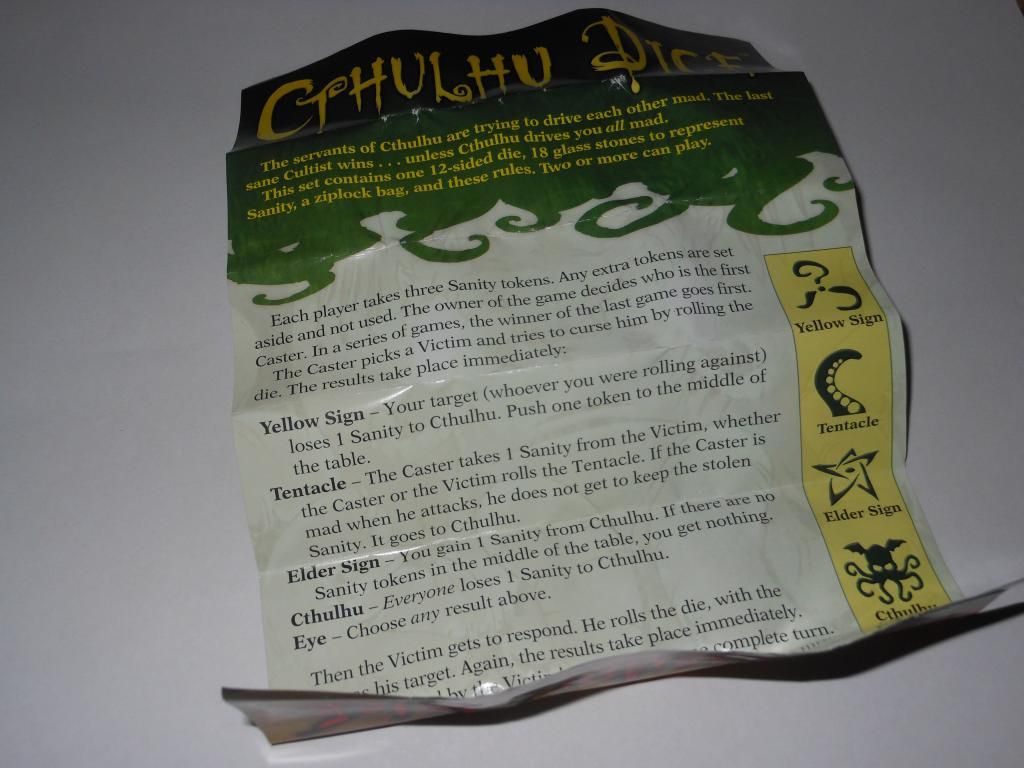
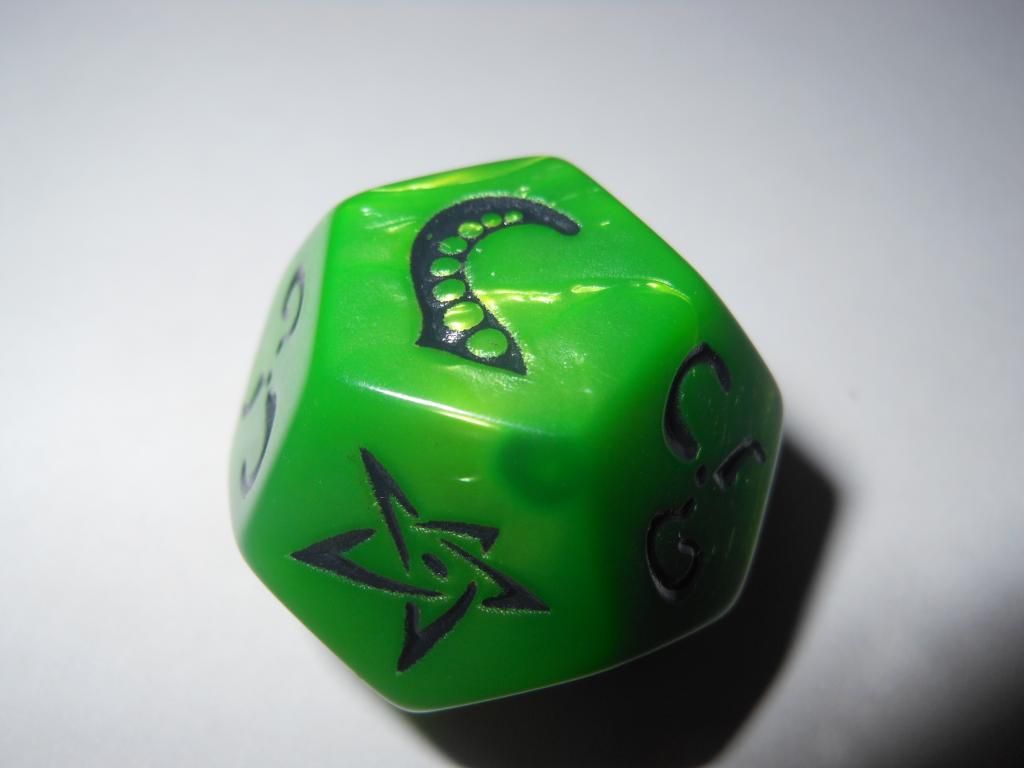
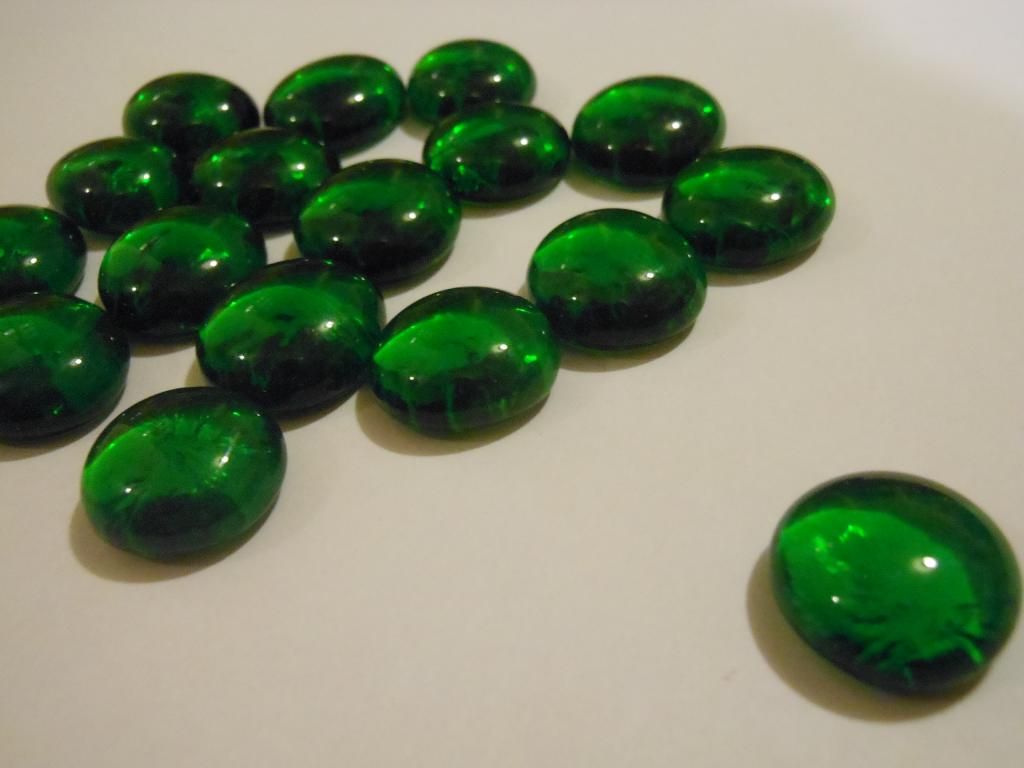
The components are 18 glass beads (the kind you can get pretty much anywhere, but which are quite nice to handle anyway), a crumpled rules sheet (honestly, it is folded up so small to fit in the blister pack, it looks like it has been mauled by a Hound of Tindalos), and a 12-sided dice (die... whatever). The dice, it has to be said, is really nice. You can get different colours, and it is really chunky with nicely embossed symbols. My wife bought this game for me because I am a fan of Lovecraft's writing, and she thought the dice was cool. She wasn't wrong.

Cthulhu Dice Instructions
The rules... No, I didn't screw them up in frustration.


The storyline behind the game is that the servants of Cthulhu (one of the characters from H P Lovecraft's pantheon of eldritch horrors) are trying to dive each other mad. Why? Don't know. Doesn't really matter.

Each player takes three green beads, which represent sanity. Going insane is such an important part of the works of Lovecraft that sanity, and keeping it, are pretty much staples of any game based on his writing. The owner of the game decides who will be the "Caster" first (and why wouldn't you pick yourself?), and then the Caster picks a "Victim" and rolls the dice. The dice has different symbols on it rather than numbers, and the symbol you roll determines what happens.

Roll the Yellow Sign: The Caster's Victim loses one sanity to Cthulhu (a pool of sanity in the middle of the table that starts empty).

Roll the Tentacle: The Caster TAKES one sanity from the Victim. This happens even if it was the Victim who rolled the dice.


Cthulhu Dice
The tentacle


Roll the Elder Sign: The Caster gains one sanity from Cthulhu (the pool in the middle of the table), if possible.


Cthulhu Dice
The elder sign


Roll the Cthulhu symbol. Everyone loses one sanity to Cthulhu.

Roll the Eye: The Caster chooses any result.

After applying the result of the roll, the Victim will roll in retaliation, and the result of the roll is applied. The player to the Caster's left then becomes the new Caster, and play continues. You can't choose to pass, and the only choices you will have to make are who will be your Victim, and what result to choose if you roll the Eye. These are really not choices at all.

If you loss all your sanity points, you are insane. You can still attack, but you cannot be attacked, and the only way to become sane again is by winning sanity from Cthulhu with the Elder sign (or by rolling an Eye, and then choosing the Elder Sign result).

The winner is the last person to remain sane. If everyone goes mad, then Cthulhu wins. Either way, no-one will care.


Cthulhu Dice sanity tokens
Globules of sanity


Yes, the game really is that simple; and yes, it really is that bland. There is no strategy, and there are no interesting choices to make. Of course, the game is clearly not trying to be the new Chess, but even as a silly filler game it is severely lacking.

Over on BoardGameGeek I gave this game two stars out of ten. That was reviewing the product as a game. However, the product does have merit as a way of choosing the first player for a real game. There are many games on the market that don't offer a real way to select the first player: They just say "choose at random" or they pick some silly method such as "the person who most recently went to an island is the first player." If you are about to play such a game, you can whip of the Cthulhu Dice and play a quick round. Cthulhu Dice is over in two or three minutes, and the winner gets to be the first player in the proper game you are about to play.

I suppose Cthulhu Dice could also be used as a drinking game, with shots replacing sanity tokens; but I'm a married man with a child, and my days of drinking games are far behind me. Besides, drinking games aren't good for you.

So, all told, I don't really think much of Cthulhu Dice. However, I am going to keep it. It is so small it hardly takes up any space, I like anything with a Cthulhu flavour, and the dice is really nicely made. If those sound like good enough reasons to own something, then you may want to pick up a copy; just don't expect much of a game.