Tuesday, 25 February 2014

Review - Tash-Kalar: Arena of Legends

Tash-Kalar: Arena of Legends


Tash-Kalar: Arena of Legends
Published by Z Man Games
Designed by Vlaada Chvatil
For 2 - 4 players, aged 13 to adult


I'm a storyteller by trade, and that's one of the reasons I like board games so much. A board game is just a story in a box, waiting to be told. Board games with a strong theme are my favourites, of course; but theme is a funny old beast (like a platypus), and it can be difficult to nail down (like a platypus).

Theme is more than having a bit of backstory to describe what is going to happen in the game, because a game can abstract that story to the point where the story is almost inconsequential. The wonderful Ghost Stories is a fine example, where a very strong story of monks defending a village from ghosts is abstracted into a nine-square grid surrounded by different coloured dots that require dots of the same colour to remove. Wow... I just made one of the my favourite games sound awful... Never mind, moving on...

Theme is also more than having little plastic miniatures to push around on a board. Sure, it helps if the minotaur you are fighting looks like a minotaur, rather than a red wooden cube, but that isn't the same as theme. That's just window dressing.

And theme is more than having a bit of florid text on the cards in your hand, because let's face it, after the first game you are never going to read those few lines of italicized text ever again. It will just fade away into the background, lurking behind the mechanisms of the game.

Theme is basically a bit of all the above, plus a set of mechanisms that make sense within the confines of the story being told. It is really tricky to do. Take Arkham Horror for example. Last time I played, I was a hardened detective who had seen too much horror. For my starting item I drew a bottle of whiskey, and that was it for me: I was "there." That randomly allocated starting item made the theme work, and it was amazing. Now, in the Arkham Horror game before that, where a nun was deputized, drove through the streets in a police car, and mowed down Lovecraftian monsters with a tommy gun... Yeah. The theme wasn't working so well for us in that game. That's the nature of randomness. Sometimes the stars align. Sometimes good nuns go bad.

But then there are games like Tash-Kalar (see, you knew there had to be a point in all this, right?). Tash-Kalar is one of those rare beasts (like a platypus) where the mechanisms ARE the theme. Every move you make is derived from the theme. The two things are inseparable. And that is one of the reasons why Tash-Kalar has become one of my favourite games ever in the world ever, ever, ever.


Tash Kalar board game box
Tash-Kalar: A game about punching horses. Or making glue. Or something.


You see, the theme of Tash-Kalar is simple. You are a wizard, and you are engaging in a bit of magical fisticuffs with other wizards. You have the ability to create and manipulate casting stones within an arena, and when those stones are formed into certain patterns, they channel the essence of a great warrior or monster, which momentarily manifests itself, does something cool, and then disappears, leaving behind only the stones that were used to create it. You basically have to think of it like those chess pieces in Harry Potter, where they move, suddenly come to life to make an attack, and then return to an inanimate state.

And that's the theme.

The gameplay for Tash-Kalar is simple. You are playing a wizard, and you are engaging in a bit of cerebral fisticuffs with other people playing wizards. On your turn, you can do two actions, one of which is placing a token onto the board. If the tokens you have in play match a pattern on one of the creature cards you have in your hand of five cards, you can use one of your actions to summon the essence of that creature. You play the card, perform the cool action specified on the card, and then discard the card from play, leaving behind only the tokens that were used to play the card in the first place.

And that's the game.

(Do you see what I did there?)


Tash Kalar cards - green deck
The game has stunning artwork. See the cute little tree thing? Aww...


Literally, what you are doing in real life - placing tokens on the board to make shapes, and then playing cards based on those shapes - is exactly the same as what the wizard character you are playing would be doing in the game world - creating stones in the arena to make shapes, and then summoning creatures based on those shapes.

It is pure genius.

It is also incredibly simple. The game is as a smooth as a platypus' bill. You have two actions: Play a token onto the board, or play a card. Other than flare cards, which are a catch-up mechanism that allows a losing player to take advantage of his opponent's strength to gain a magical boost and pull off some cool special moves, there is hardly anything else you need to know. You can learn how to play in about five minutes.

But that simplicity is part of the games joy. It is so quick and accessible. There is no fiddliness, and no tricky rules to get your head around; and yet the scope of the challenge the game presents is huge. When you start the game you will find it hard to summon any creatures, and you will cautiously place tokens to set up future turns; and then when those turns arrive... Boy. There is nothing quite like being able to string together multiple summons to lay waste to your opponent's forces. It is incredibly exciting, and the tension when you realise you can summon one of the powerful legendary creatures as long as no-one destroys an important piece before your turn rolls around is excruciating.

The game is also surprisingly versatile. Like a... platypus? There are two forms of play: High Form, in which you attempt to make patterns on the board to score points; and Deathmatch, in which you... Yeah, you can probably guess.

Additionally, the game plays with two, three, or four players, and includes team-play rules.

The game has incredible longevity.

And the stories you will have to tell... Honestly. Every game ends with the participants excitedly talking about what happened, where they went wrong, what they did right, and why oh why oh why couldn't they get that one last heroic piece on the board needed to summon the dreaded Bone Catapult or Time Elemental. And yes, you will probably be having this conversation while you reset the board for another match.

Okay, okay. I love the game. I think everyone should try this game at least once. But...

Man, there is always a but.

First of all, the game contains four decks of cards for the different factions you can play. Only, it is not really four, because two of the decks are exactly the same, they are just different colours. Now, I understand the concept of including two identical decks. It means you can play two-player games that are not asymmetrical, and that's a good idea. However, there should have been a fifth deck, so it was still possible to play a four-player game where everyone had a unique faction to work with.

The other problem is that the game is expensive for what you get in terms of components. All of the cards are beautifully illustrated, but the tokens you use to form the patterns are cardboard, and the board is thin and bland, with a tendency to warp a bit.


Tash-Kalar game pieces
The game in play really isn't much to look at.


However, the component thing doesn't really bother me, because the game is so much fun and gets so much play in my house that the price is justified. Besides, my wife bought it for me, so I didn't feel the punch to the wallet.

And there you have it.

I am not a Vlaada Chvatil fan boy. I am not even sure what a fan boy is, and I am probably far too old to be one anyway. However, this is the second game of his that I own (Mage Knight Board Game being the other), and both games sit squarely in my top 10 list of bestest besty best games in the world right now, while also being completely different.

Now, you'll have to excuse me. I have enemy wizards to crush.

Sunday, 2 February 2014

Review - Impact: The Battle for Wolf Ridge

Impact: the Battle for Wolf Ridge


Impact: The Battle for Wolf Ridge
Published by Drummond Park Ltd.
Designed by Captain Awesome and the Theme Juice Brigade
For 2 players, aged 6 to adult


Dinosaurs are cool. I have always loved dinosaurs.

I mean, the day Jurassic Park was released was one of the best days of my childhood, and I still think it is one of the greatest films ever made (no matter how many people try to convince me it's Citizen Kane).

So, if you are going to make a game about dinosaurs, and then put those dinosaurs in a futuristic war with humans, and give them guns, and make those guns really fire, then you, Sir, have my attention.


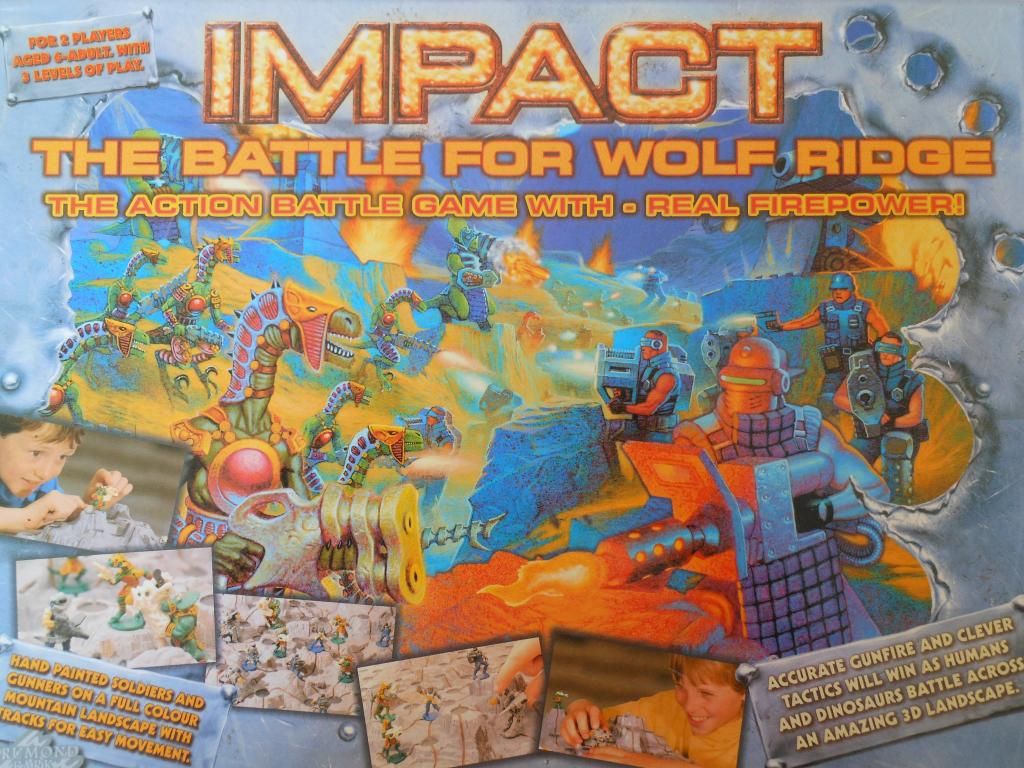
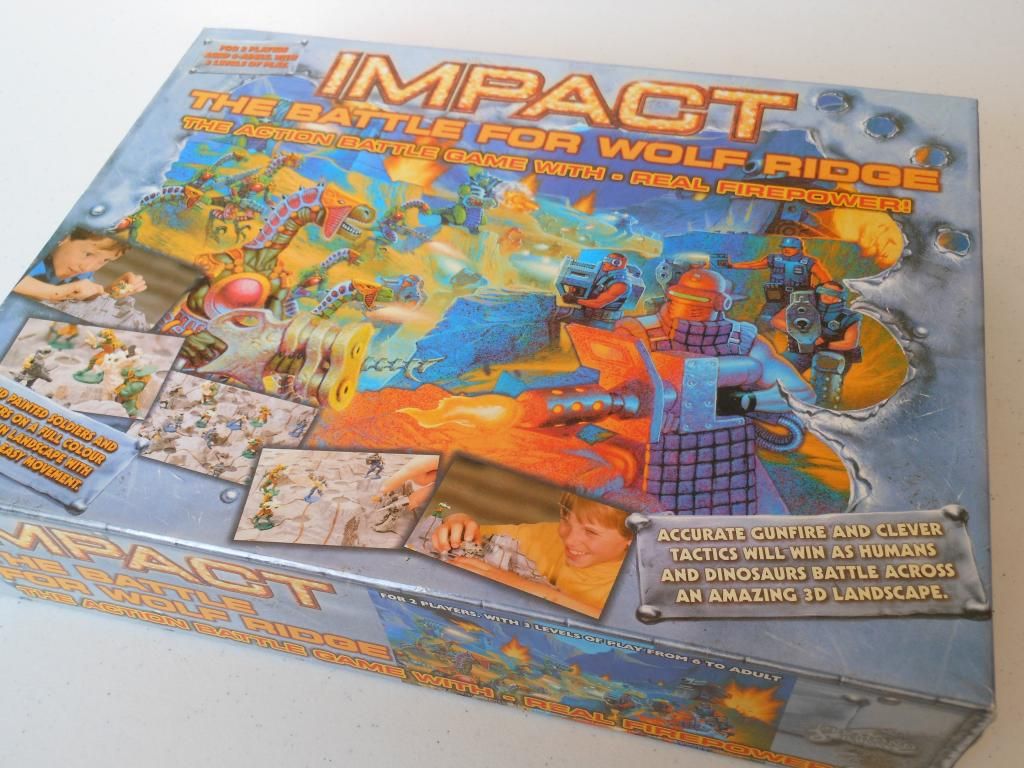
Impact: the Battle for Wolf Ride box
Dinosaurs! Guns! Ned Kelly with a flame thrower!


Oh, yes. Impact: The Battle for Wolf Ridge is probably the most thematically awesome game that has ever been devised. Even the name is awesome.

Really. I'm not kidding here. Listen to this:

An army of dinosaurs with high-tech weaponry is invading Earth. They have sent out a scouting party, which has found an oil-rig in a location called Wolf Ridge. The humans operating the rig hastily fashion weaponry from their drilling apparatus, and prepare to defend themselves from their cold-blooded assailants.

If you don't think that's the best set-up for a game ever, then you just don't appreciate awesomeness. Either that, or you're dead.

I want to see this being made into a film.

As you may have noticed, this game had me hooked on the theme the moment I saw it in my local charity shop, and I had to buy it, even though I suspected the gameplay itself would be dire. I am that sort of a guy.

Luckily, I was pleasantly surprised. While the game does not live up to the awesomeness of the theme (what could?), it is actually well designed. And, of course, it has dinosaurs with guns that really fire.

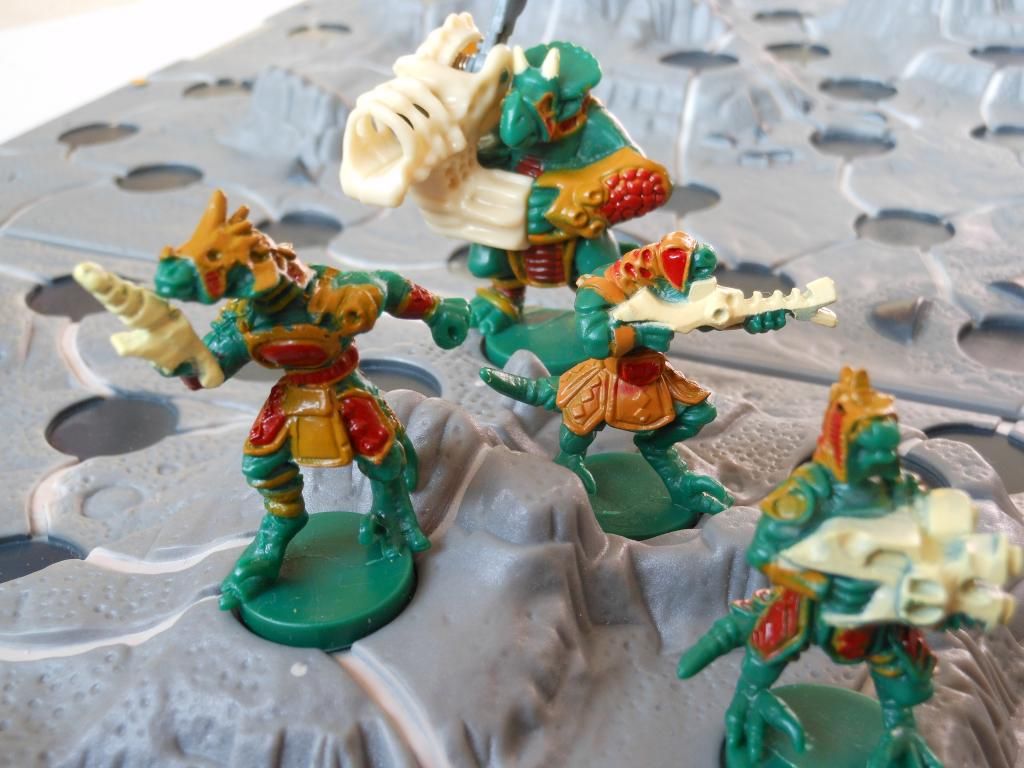
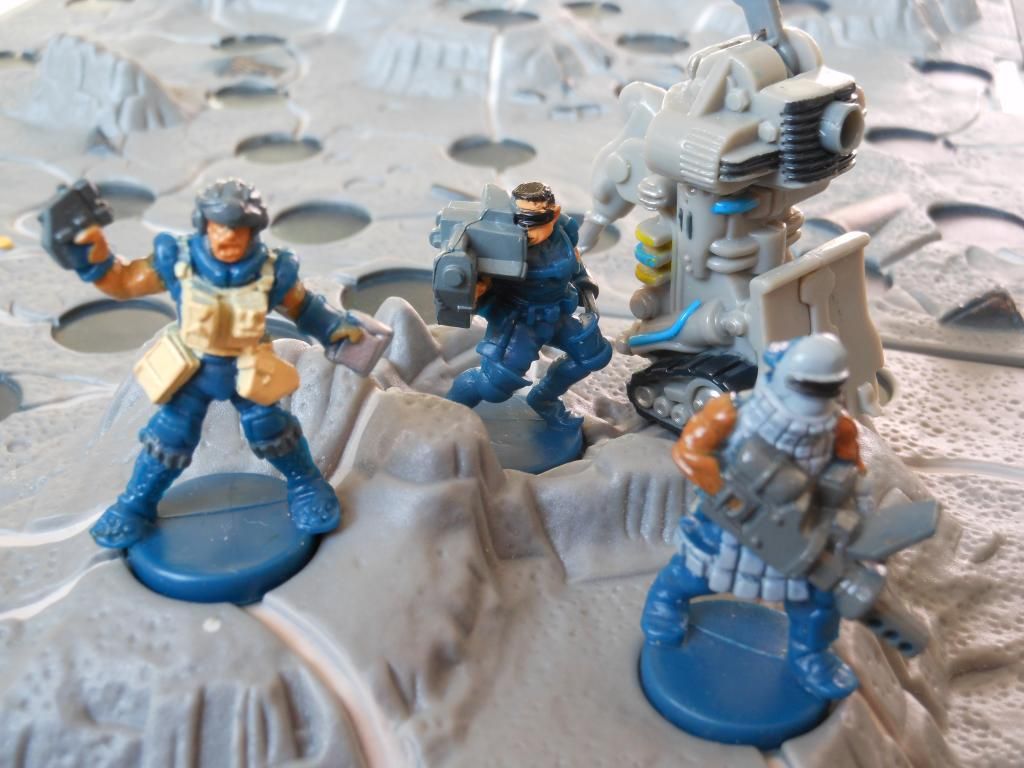
The game is basically a light two-player strategy war game, with the humans fighting the dinosaurs over a three-dimensional board. Each army has a leader, an NCO, four troopers, one large mobile gun, and one medium mobile gun. Each of the models is pre-painted, and the mobile gun units have guns that really fire! (Did I mention that, yet?)

Each model is well-sculpted, easily identifiable, and the paint jobs are surprisingly good. I particularly like the human gun units, which really look like they have been made from spare bits of the drilling rig.

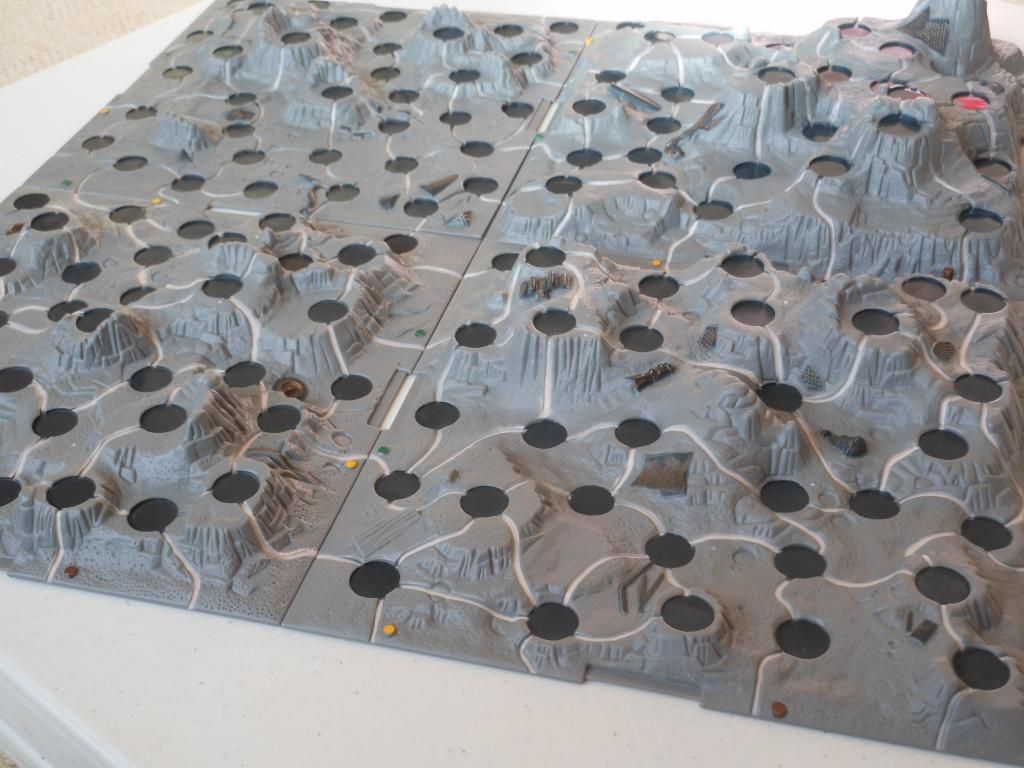
Apart the models, the only other game component is the board, which comprises four pieces of moulded plastic with circular indents to indicate spaces where units can stand, linked by routes those units can travel. It looks great when it is set up, and is just the right size for the skirmish-level battles you will be fighting.


Impact three-dimensional board
The three-dimensional board.


Okay, so in terms of "stuff in the box" you do not really get a lot: 18 figures and four board pieces. However, there is a decent amount of game crammed in there, including three levels of play that range from starter rules so basic you might fall asleep through to rules that are surprisingly involved.


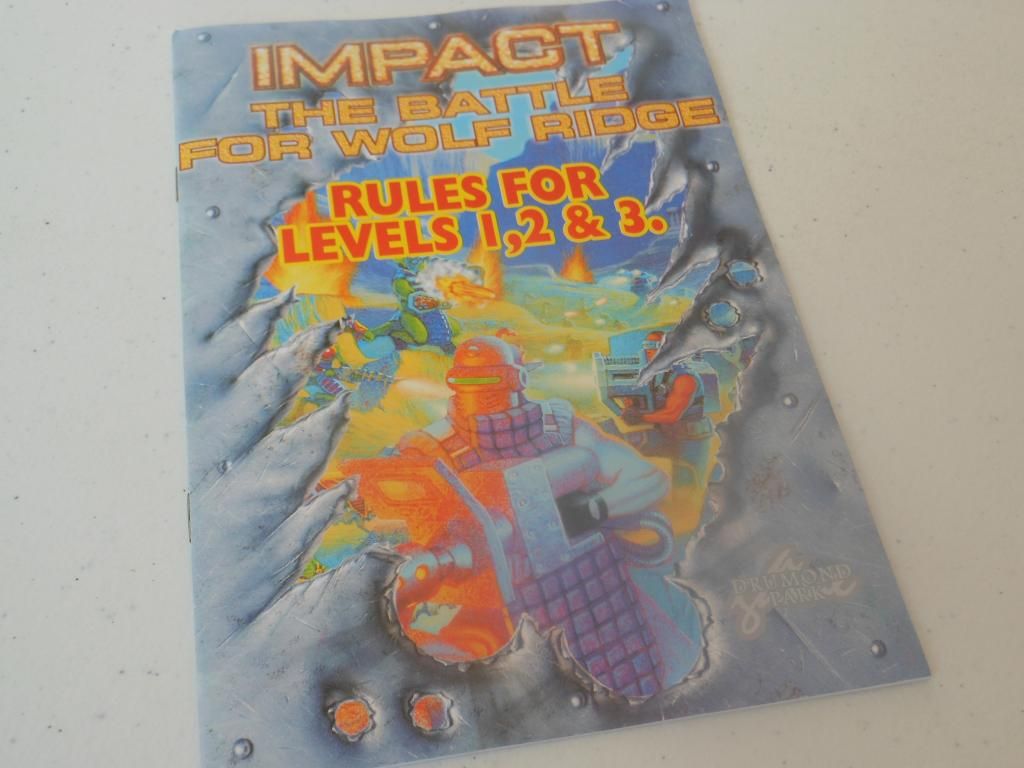
Impact rules book
The rules book, with three levels of play.


In the basic rules, you line up your troops, and then the players take turns firing one of their guns. First person to knock over all of his or her opponent's pieces wins. Sounds boring. It is. Moving on...

The intermediate rules add movement into the game. In turn, players move all their units, following the routes embossed on the board. You get to make twice the number of moves as the number of troops you started the game with (excluding your two gun units). If two of your units move adjacent to an enemy unit, the enemy is captured and removed from the board.

After movement, players take turns to fire their guns. Any units knocked over are removed from the game.

The first player to lose all six troops, or both gun units, loses the game.

This is actually a really fun set of rules. You get the enjoyment of shooting the guns, but strategically moving your pieces to capture enemy units is even more important, and surprisingly thinky. (Okay, that isn't a word. But neither is shpadoinkle. That's just the way life is.)

These intermediate rules are perfect for younger children, and offer enough options so that adult players can tolerate playing.

However, to get the most out of this game, you need to use the advanced rules. These introduce leaders and NCOs. (Yes, dinosaurs have a regimented army structure, and also have NCOs. Go figure.)

Leaders can capture enemy troops single-handedly (but still need assistance to capture NCOs and leaders), and at least one leader or NCO must be present with any other unit in order to capture a gun.


Impact pre-painted dinosaur figures
Question: What do dinosaurs have for lunch?


These two additional troop types, and a few other minor rules tweaks, offer the most engaging experience, and actually make the game pretty entertaining. Notably, winning comes down to skill rather than luck, as there are no dice. If you aim well with your guns, position your troops to effectively use cover, and spring attacks at the right time to surround and capture enemy units, you will win.


Impact pre-painted human figures
Answer: Whatever they want.


Of course, Impact: The Battle for Wolf Ridge is not without its faults.

For a start, the game is definitely designed with younger gamers in mind. It is on the light side for a strategy game, and it has a rather limited scope. You can only have a maximum of four troops, two special units, and two guns on the field, because that is all you get in the box. Furthermore, the small size of the board would prevent you fielding larger armies anyway. After a while, the game will start to feel a bit samey.

Another problem relates to the gun mechanisms. They are a little fragile, and if you are not careful, the wires can snap or come loose.

The biggest problem is that the game lacks a certain amount of focus, and therefore does several things moderately well without ever doing one thing that is amazing. The strategy element is good, but there are only limited options available due to the small number of troops and special abilities. Meanwhile, the dexterity bit where you get to fire the guns is cool, but with only two guns per side, it pales in comparison to something like Crossbows and Catapults. What we have here is a game that tries to be all things to all people, and ends up being less than the sum of its parts.

So, at the end of the day, is it a good game?

I don't know. I guess not really. But then again, it sort of is.

I'll admit. I'm surprised. When I purchased the game, I expected it to be really dumb. However, the ridiculous (but awesome) theme, is a bit of a smoke screen, disguising a game that has more depth than you might imagine. Okay, it isn't chess; but you aren't just rolling dice and firing missiles. You really need to plan your moves carefully, take your time, capture enemy pieces when they are exposed, and watch out for counter-attacks. Which actually does sound a bit like chess, I suppose.

But chess with dinosaurs. With guns. That really fire!

Tuesday, 7 January 2014

Review - Anima Tactics: Saga I & II: Awakening & Rise

Anima Tactics: Saga I & II


Anima Tactics
Published by Cipher Studios

Deisgned by Carlos B. Garcia Aparicio
For 2 players, aged... Hell, I still don't know


Regular visitors to this blog may recall that back in July I wrote a review about a miniatures skirmish-level war game called Anima Tactics. In that review I talked about the "light" and "dark" starter sets that you can purchase, and how they do not provide the best possible introduction to what is actually a rather splendid little game.

If you don't recall the review, go check it out now. Go on. I'll wait here.

Right. You all up to date?

Good.

You will have noticed that in the review I mentioned how my wife had sourced a copy of the hardback rule book for Anima Tactics, and how she ruthlessly refused to give it to me until Christmas. Well Christmas has come and gone, and I am now in possession of said book. (Funny story, my wife bought it so long ago she actually forgot she had it and I had to ask her for it... Bit awkward, that.)

So, this is just a little update review to get down my opinions on the book.

Now, the first thing to note is that the book is stunning. It is full of glorious artwork, most of it in full-colour, depicting the various characters from the game. Admittedly, a lot of the artwork is the same stuff that appears on the character cards used when playing, but now you get to see the artwork at full size.


Anima Tactics art
Some of the artwork will make your jaw hurt.


Most of the art is truly exceptional, and people who like that Eastern-Western fusion style, with demons, knights with ridiculously oversized swords, and schoolgirls with scythes, may be tempted to pick up the book just for the pictures. However, it should be noted (and this sort of comes with the territory), some of the artwork is a little... erm... you know... Fruity.

The front cover is a bit of a giveaway, as it features a blonde female warrior in a fetish outfit. She looks like she wants to kiss you, and kill you; and not necessarily in that order. Not every female character is portrayed this way, but there are certainly several pictures that some people might object to.

Surprisingly, very little of the actual book contains rules; but the rules that are there completely change up the game. The stripped down rules from the starter sets are enough to get going with, but you will not be able to experience the full tactical and strategic elements of the game without using the rules from the book. For example, the book contains complete rules for building warbands (and the advantages associated with building faction-specific warbands), and there are new rules such as "critical mastery" (which allows you to always hit when you roll a natural "10" on the dice) and "gnosis points" (a type of resource that allows you to roll more than one dice in order to get a better result).

There are also many new actions included in the book, such as attacking an enemy by dropping on him or her from an elevated position.

The whole rules section only covers about 30 pages, but those pages are crammed with good stuff that really opens up the game.


Anima Tactics rules
Well-illustrated, well-written rules.


The book also contains some basic scenarios, and complete rules for playing the game in the style of a board game (using a grid rather than terrain and a tape measure).

There is also an extensive section that gives details of all the characters from "Saga I" and "Saga II" (basically, every character released up to the point the book was published). This section includes all the rules for those characters, which isn't strictly necessary as every character comes with a character card that has all the rules on it anyway, and also a brief amount of history, which many people refer to as "fluff."

It is the fluff that I have the biggest issue with.

It's bum fluff.

There is not nearly enough information on the characters, and reading their biographies is often a bit confusing and creates a lot more questions than it answers. This is the same for the very brief world history, which condenses hundreds of years of war into a few short paragraphs, glossing over a lot of stuff that feels like it was way too important to be glossy. Even the short story that runs throughout the book does next to nothing to explain what the hell is going on. It doesn't help that the translation is not always great, and there are quite a lot of spelling mistakes and grammatical errors.

The lack of really good quality fluff is a bit of a shame, especially as one of my main complaints when I reviewed the starters was the difficulty I had becoming invested in the characters because I didn't know anything about them.

But still, you can't have everything; and I guess it takes a long time to create a world that is as fully fleshed out and convincing as (for example) the Warhammer world.


Anima Tactics mechs
Yeah, there are mechs too. Obviously.


Overall, I think the book is a success. It's beautifully made, and beautifully illustrated; and the additional rules add a layer of depth that was sorely lacking from the rules available in the starter sets. I am happy to have a copy, I just have to remember not to leave it out on the coffee table when the vicar comes round for tea.

After all, I wouldn't want the neighbours to talk... Not any more than they already do, I mean...

Tuesday, 31 December 2013

Review - Race Around Britain!

Race Around Britain!


Race Around Britain!
Designed by Bertram Kaes
Published by Ravensburger
For 2-6 players, aged 8 to adult


Race Around Britain! game box
Those kids are totally faking it...


So, as you might know, I have this... condition. I like to collect old board games. It's actually quite a fun way to spend the time. I enjoy hunting down the games, and then cataloguing the components, trying to find space for them on the shelf.

Sometimes, when I'm lucky, I even get to play the games I own.

Surprisingly, my wife seems to condone this kind of silly behaviour; and when she goes off shopping without me, she will always check out the charity shops to see if there is anything I might like. She once asked me what she should look out for, and I gave her one simple rule: "Never leave a Ravensburger on the shelf."

This simple rule has yielded some pretty positive results. She scored a complete Enchanted Forest (1982 edition), which is in lovely condition, and one of my Christmas presents this year was an unpunched, unplayed copy of Scotland Yard, which I was so excited about I nearly did a little wee.

However, there are exceptions that break any rule, and I was unable to disguise my horror the day my wife brought home Race Around Britain!

I mean, seriously; you know this game is going to be awful. It has an exclamation mark in the title, and it's about travelling around Britain. If I want to travel around Britain I'll buy a train ticket, not a board game.

And that front cover? Showing two smiling kids, with their dad, playing the game... Yeah. That ain't fooling anyone. They look like they've just buried Mum under the patio and are trying to act natural for when the cops show up.

Now, you may be wondering why I think this game is so bad. I'm glad you asked...

Race Around Britain! basically combines a whole bunch of game mechanisms I hate.


Race Around Britain game board
They really took the time to make Britain look as dull as possible.


The concept is simple: A starting city is chosen, and then 12 other cities are selected at random (four cards each from three stacks of location cards). The top card is turned over, and the "race" begins. On each turn, a player rolls the dice (roll and move, hurrah!) and then moves the number of spaces indicated, heading for the currently revealed location. If a player lands on the location (and of course, this requires an exact roll of the dice), he or she wins two points. Furthermore, that player then gets to answer a trivia question about that location (hurrah!), for the chance to win an additional point.


Lovely Plymouth
I went to university in Plymouth... The more you know...


After all that excitement, the next location is revealed. This continues until all 12 locations have been visited.

And then all the players have to race back to the starting city. The player who reaches the starting location (by exact roll of the dice, of course), wins a bonus three points, and then everyone adds up their points to determine a winner. Not that anyone will care by then.


Race Around Britain tokens
Plastic tokens for keeping score.


So there you have it; a game that combines everything wrong with board games: roll and move, requiring an exact roll to land on spaces, and trivia.

The trivia element is actually the least egregious aspect of the game. It almost makes sense. Most of the points are allocated to people who are lucky enough to roll the numbers needed to land on certain spaces, and the trivia element allows people who are not so lucky a chance to catch up. Of course, you only get asked a question if you land on the right location in the first place, so normally the questions just help the luckier people get even further ahead.


Race Around Britain rules
The rules sheet - great job by the graphic designer, there.


I can't even recommend this game as an educational tool. A game can last for a painfully long time, as each location needs to be reached by exact roll of the dice; and yet only 12 trivia questions will be asked. This is just as well, as there are only four questions for each city. If you played with any kind of regularity (which you wouldn't), you would quickly get through all the questions available.

You could say that the game will help children learn geography, but the terminally dull gameplay, and the terminally dull artwork on the board, is hardly going to keep anyone interested long enough for any kind of learning to take place.


Race Around Britain game components
Capture the flag... Or... You know... Don't bother... Whatever.


So, no; I'm not keeping Race Around Britain! in my collection. And maybe it's time I gave my wife a more definitive set of board game-hunting rules to follow...

Monday, 23 December 2013

Review - Dr Seuss's How the Grinch Stole Christmas! Game

How the Grinch Stole Christmas


Dr Seuss's How the Grinch Stole Christmas! Game
Published by University Games
Designed by someone who chose (or was forced) to remain uncredited.
For 2 - 4 players, aged 4 to adult


How the Grinch Stole Christmas board game
It looks like a present! Cute!


My daughter turned three this December. She has been quite interested in board games for a little while, and we have been playing Parcheesi and the like over the last few months. It is truly wonderful to watch how her ability to play games is developing, and how much fun she has spending time with me, my wife (and sometimes our friends) playing board games. And yes, I admit, I was proud when I found out her most wanted birthday present was a board game she had seen on the television called Go Piggy Go (a game I will be reviewing another time, and which is surprisingly tactical and fun).

Anyway, as a result of my daughter's increased interest in games, I have started looking for more games I can play with her. And so, I picked up How the Grinch Stole Christmas in a little charity shop ready for the festive season. I didn't expect it to be very good, but I will play anything when my little girl is at the table: Snakes and Ladders, Junior Monopoly, Candyland, it really doesn't matter. The important thing is spending time with her, and...

What? Why are you looking at me like that?

Okay, okay, I'll confess: I love the Dr Seuss books. I think they are wonderfully inventive, and excellent for teaching children to read; and one of my favourite Christmas stories is How the Grinch Stole Christmas, so if I am being honest, I would have purchased this game no matter what. Besides, it gives me something interesting to write about.

Now, where was I?

Oh yeah. How the Grinch Stole Christmas is published by University Games as part of their Beginner Games series. Games in this series are exceptionally easy to learn, quick to play, and feature elements that help children to read and learn social skills. The focus here is on learning, and encouraging children to play well, and that means you can't really expect much from the game itself. Hardcore gamers need not apply.

Inside the box, you get a nicely illustrated mounted board, four cardboard player pieces in plastic stands, a spinner, and some lovely three-dimensional cardboard "Christmas presents." The quality is okay, but not in the same league as many modern games from companies such as Queen Games and Days of Wonder.


How the Grinch Stole Christmas game board
Forks in the path encourage decision-making for young children.


The game itself is simple. On your turn, you spin the spinner, and then move your playing piece that number of spaces.

Yeah. It's roll and move. What did you expect?


How the Grinch Stole Christmas player pieces
Roll and move? Hurrah!


Anyway, after moving, you look at the space you have landed on. If you land on a space with a letter on it, you get to pick up one of the presents and look at the bottom. If the bottom of the present shows a picture of a toy that contains the same letter as the letter your playing piece is on, you get to keep the present. If you don't get a match, you show everyone what you got, and then you return the present to the pile.


How the Grinch Stole Christmas presents
Merry Christmas!


As you can see, this is teaching a number of core skills. Counting (moving the piece), reading (matching an item to the letter you are on), and memory (remembering which presents have already been looked at, and what they contain). Forks in the path on the board also encourage simple decision-making and strategies.

This is basically the whole game. There are a few other special spaces, like Grinch spaces that make you return a present to the pile, and Cindy-Lou Who spaces that allow you to take and keep any present you want, but generally, you just try to match letters, and remember where the presents you need are. At the end of the game (one circuit of the board, which only takes a few minutes), the player with the most presents wins, but everyone gets to hold hands and sing "Welcome Christmas, Ba-hoo Bo-ray."

Yeah. Really. That's actually in the rules.


How the Grinch Stole Christmas rules
Who decided to print green ink on white paper?


The description in this review should tell you everything you need to know about the game, and whether you would actually enjoy it.

It's quick, it's simple, it's about the Grinch, and it's designed to be educational. For me, that makes it a perfect game to play with my daughter on Christmas Eve. And I guess that makes it one of the best games in the world. For now, at least.