Tuesday, 12 June 2012

Review - The Princess Bride: Storming the Castle

Recently, I have been reviewing games that are based on movies, so in the continuation of that theme, I thought I would reproduce a review for The Princess Bride: Storming the Castle, which I originalled pubished on BoardGameGeek back in 2009.

Before I go any further, I would like to point out that this is a negative review, and I feel bad about that. The game's designer, Aaron Watson, is a genuinely nice guy and I wish I could have been nicer about his game than I have been. It must be tough to read a negative review about your "baby," and even tougher if some douchbag reproduces the same negative review years later to bad-mouth the game all over again.

However, I am committed to gradually porting across all of my reviews from BoardGameGeek to this blog, and that includes the negative ones.

Sorry, Mr Watson.
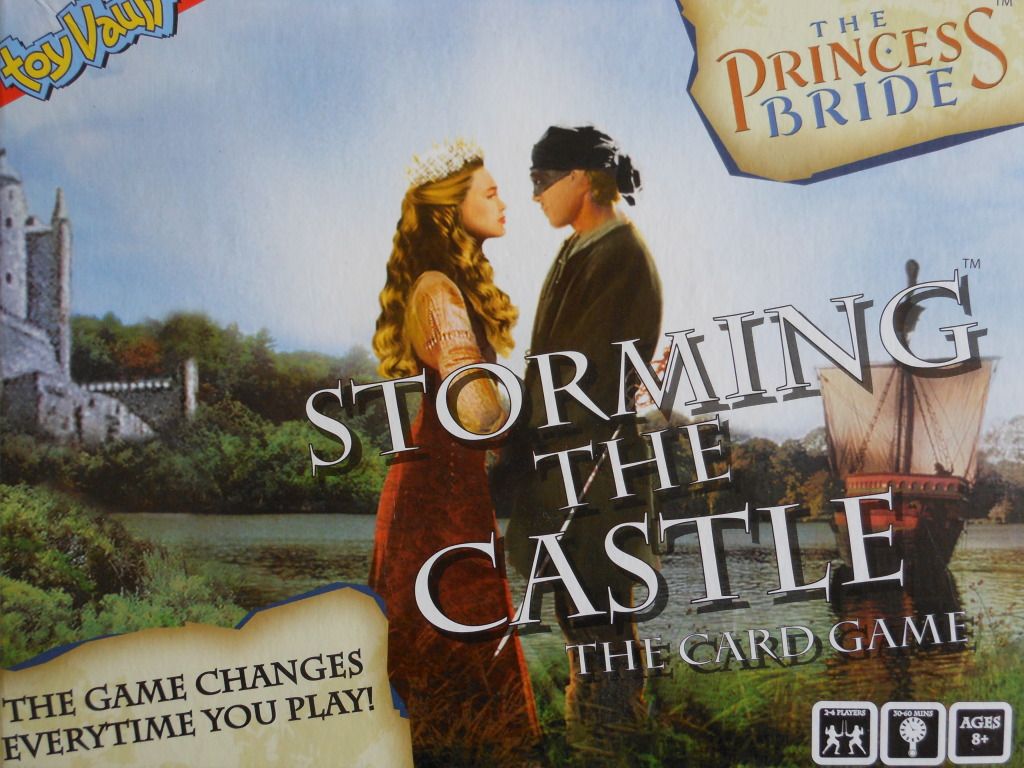
The Princess Bride: Storming the Castle


The Princess Bride: Storming the Castle
Published by Toy Vault, Inc.
Designed by Aaron Watson
For 2-4 players, aged 8 to adult.


There are two questions you should never ask my wife...

Actually, that's not strictly true.

There are two questions you should never ask my wife unless the answer she is 100% guaranteed to give is the answer you want to hear.

1. What boardgame would you like to play?
2. What film would you like to watch?

The answer to question one will be Odin's Ravens. I love Odin's Ravens: I think it's an elegant, thoughtful game with a perfect balance of luck offset by clever forward planning. My wife loves it even more than I do, and it rates as her favourite game. I never turn down a game of Odin's Ravens (even if my wife does insist on using the raven pieces upside down because it makes them look like bunnies), but I don't want to play it all the time.

The answer to question two will be The Princess Bride. I love The Princess Bride. I love the book, and I love the film. It has the perfect balance of humour, adventure, and romance. My wife loves it even more than I do. She prefers Bram Stoker's Dracula, but you have to be in a certain kind of mood for that film, whereas The Princess Bride can be watched any time you feel like it.

Okay, okay, I think you can see where this is going: I saw a game that had mechanics similar to those found in my wife's favourite game, that was also based on one of her favourite movies. What was I supposed to do? I bought the damned thing for her.

Should have stuck with Odin's Ravens...
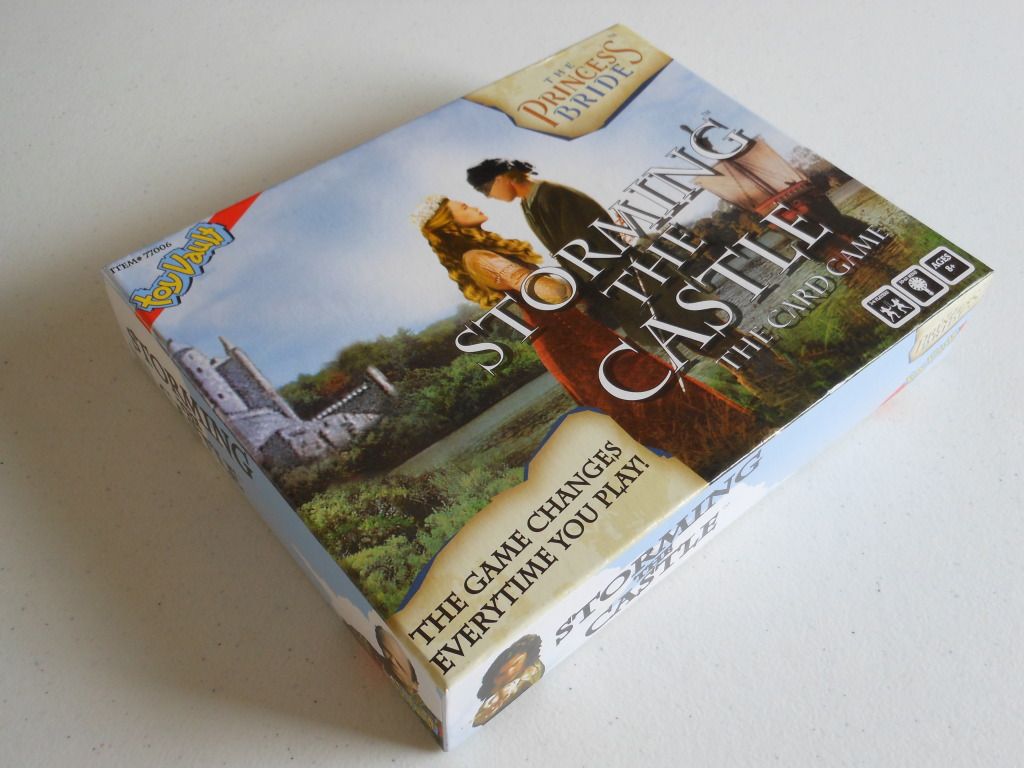
The Princess Bride: Storming the Castle box
The quality box.


So, what is this game?

The short answer: It's a shoddily made cash-in.

The slightly longer answer follows:

The Princess Bride: Storming the Castle The Card Game comes in a box about the same size as the Cave Troll / Drakon boxes (have I told you how much I love those games? Perhaps I can talk about them instead?) and on the cover of this stupidly oversized box it says "The game changes everytime you play." I should have known this game was going to suck. First of all, I'm pretty sure "everytime" isn't a word. Second of all, what kind of a tagline is that? "The game changes everytime you play." What does it mean? Even Snakes and Ladders changes every time you play, otherwise what would be the point?

(Okay, I do know what the tagline is getting at. The board is never the same, you have to change your "tactics" each time you play. But really, it just sounds silly.)

Inside this rather sturdy but poorly designed box there is a flimsy card insert which is an insult to card inserts the world over. This insert is so flimsy, the cards in the box had squashed it flat. The insert is entirely without function, and just increased my sense of uneasiness as my wife excitedly opened the box. This was beginning to look like a very poorly-produced game.
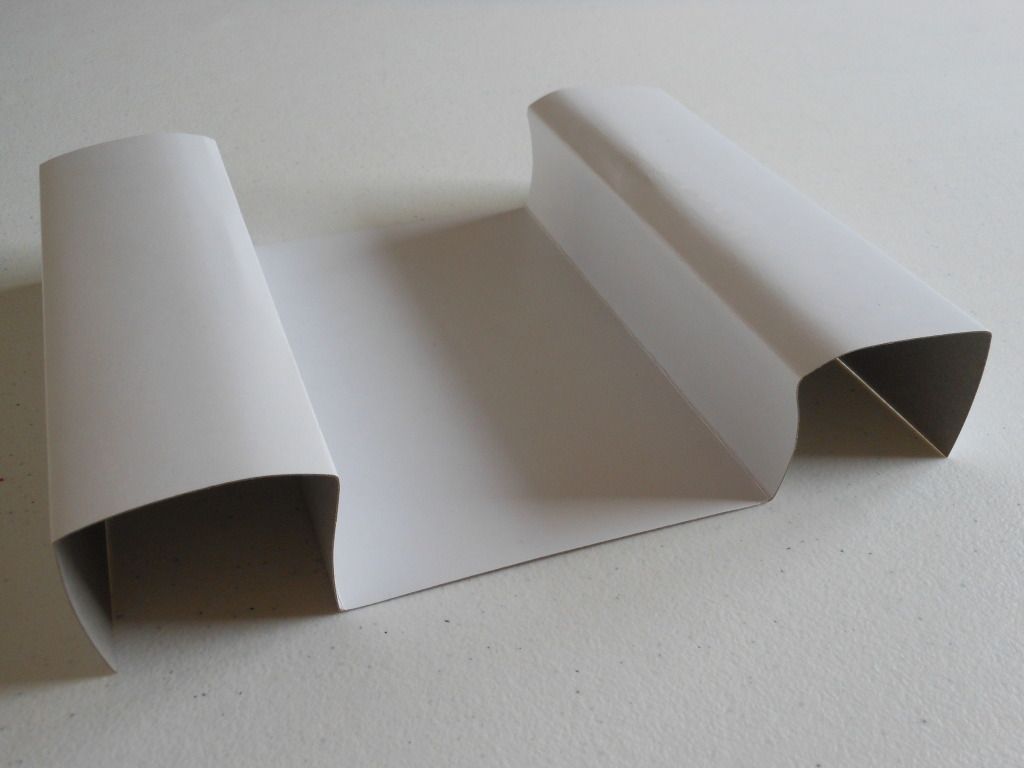
The Princess Bride: Storming the Castle box insert
The quality insert.


But maybe the cards would be good...

Maybe not.

There are three different types of card, each with a screen grab from the film. There is one large castle card, representing the card you are journeying towards, 54 path tiles, and 54 tactic cards (split into actions and equipment). All of the cards have a linen finish that obviously caused problems at the print yard, because a good two thirds of the cards have streaks and flakes where the print has not adhered correctly. This makes the cards ugly, but not unusable. (It's the rules that make the ugly cards unusable, but I'll get to that in a minute.)
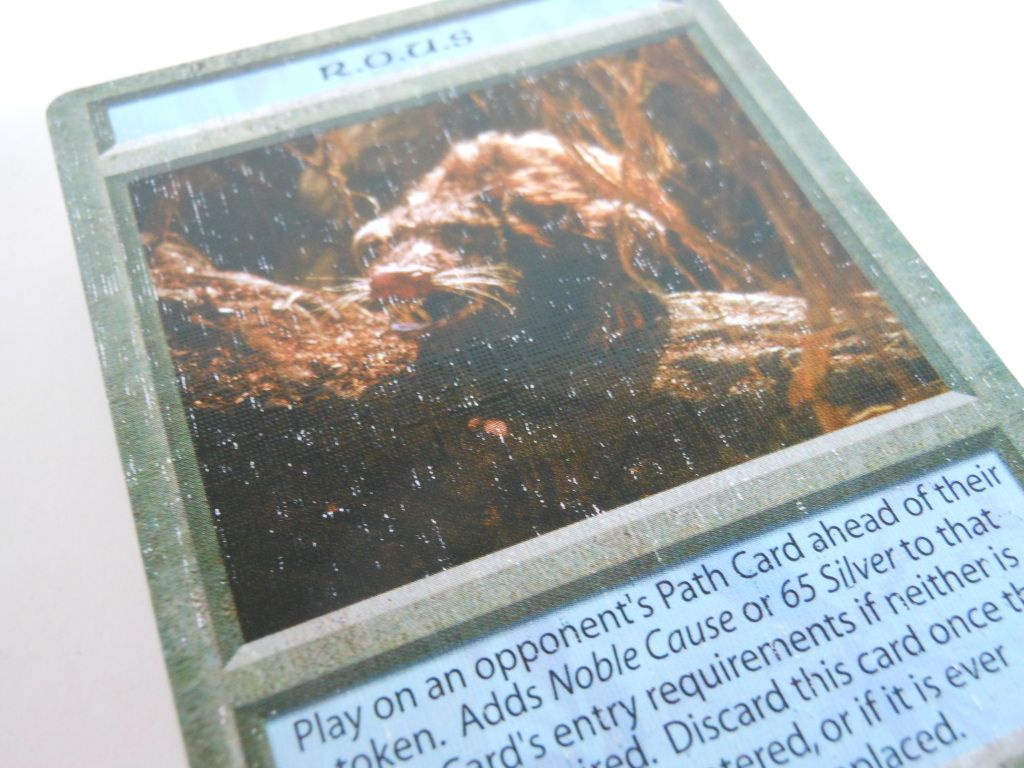
The Princess Bride: Storming the Castle sample card
The quality cards.


The game also comes with four playing pieces. These are nasty cardboard stand-ups which fall apart every time you try to move them, making them a real pain to use. Thematically, they also make little sense, as the characters are Inigo, Westley, Fezzik, and... Princess Buttercup. Hold on, why is Buttercup storming the castle? Surely the guys are storming the castle to rescue her? Surely there's been some kind of misunderstanding here, especially as each player is trying to prevent the others from getting to the castle rather than helping each other like they did in the film.

(By the way, I should note that this game was rethemed. It wasn't originally a Princess Bride game, so this is not the fault of the game designer. Doesn't stop it being rubbish though.)
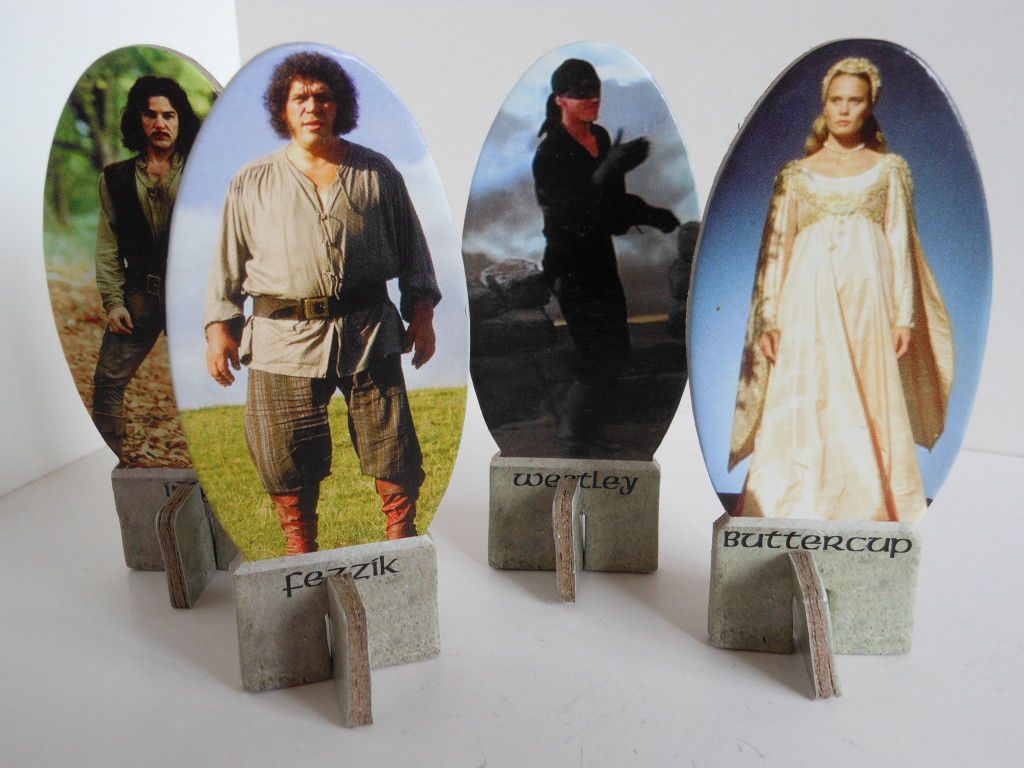
The Princess Bride: Storming the Castle playing pieces
The quality playing pieces.


Now, where was I... Ugly cards, ugly playing pieces... Ah yes, ugly rules. One folded up piece of paper that looks like its been run off on a black and white photocopier. However, I did think the rules were (for the most part) well-written. The game is about as simple as it is possible for a game to get, so there was little chance this could be fouled up, but even so, credit where credit's due.

The rules only take up two of the four pages, the other two pages give extra explanation for some of the more complicated cards.
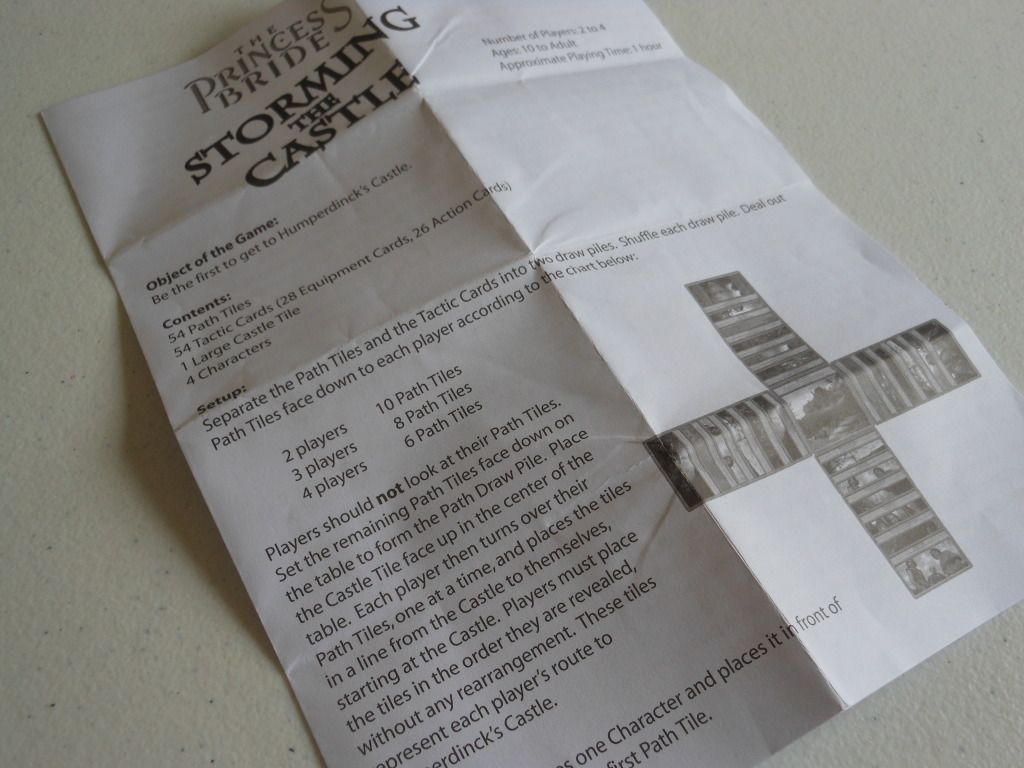
The Princess Bride: Storming the Castle rules
The quality rules.


As I've said, the game is nice and simple to learn. Each player lays out a series of path tiles, and this represents his or her route to the castle. Each tile represents a specific challenge to overcome. There are ten different types of location, all representing places from the movie such as Miracle Max's place or the Fire Swamp, and each type of tile has different entry requirements. You enter a tile by playing the correct type of tactic card. For example, to enter the Fire Swamp, you need to play a sword card.

On your turn, you get to do any combination of three actions: Playing action cards, moving forward on the path tiles (done by discarding the correct type of tactic card where possible), or drawing tactic cards.

You will notice that tactic cards are split into equipment and actions. That's because equipment is played to allow you to move along the path, but actions can be played to do other things. A lot of these things will slow down another player, so there is a strong "gotcha" element to the game which can really make a two-player game drag on. The problem is, there are plenty of action cards, and at the beginning of each turn you can discard as many cards as you want and draw again, so very rarely will a turn go by when you are not able to do something nasty to the other player. Of course, the same is true on your opponents turn, and you are set up for a revenge hit. In this situation, the winner of the game will come down to who is lucky enough to get the cards that are needed at the right time.

Oh yes... luck. This game is all about luck. There are no clever mechanics for saving up cards, and only a few cards that allow you to enter path tiles without needing the exact piece of equipment specified on that card. That means if you are sat by the sea needing a boat, your turn will begin by discarding a bunch of cards and then drawing back up to five. If you don't have a boat, you are stuck using your actions to draw more cards, or to play "gotcha" cards on someone else. Eventually you may get the boat you need, but then the other player will just play a card that moves you back on the path and you have to do the whole thing again.
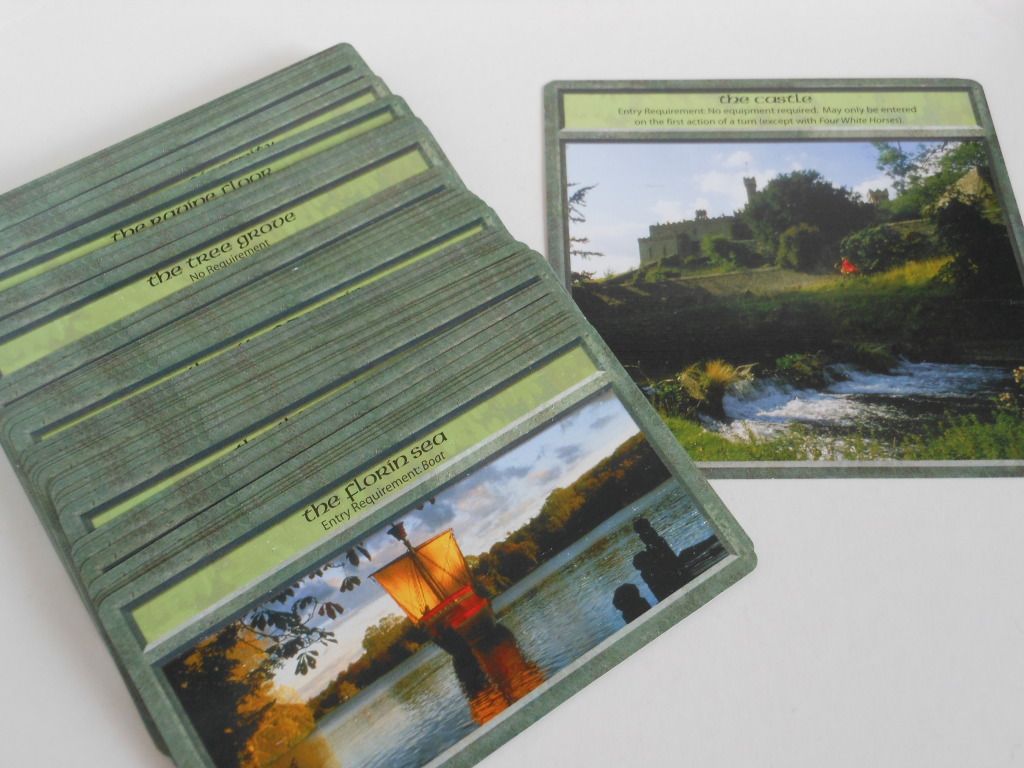
The Princess Bride: Storming the Castle location cards
More of the quality cards.


This game just doesn't have the same level of style and elegance as Odin's Ravens, and the theme is so pasted on it doesn't do anything to make a poor game more fun. There are no tactics to speak of, and what you do on your turn is obvious based on what cards you were lucky enough to get. I never once felt like I had a choice of options and had to decide which would be better for me.

Even worse, the section of notes clarifying certain cards made me more confused than before I read them. The worst case example is the Ravine Floor tile which says:

"No entry requirement, only sword if entering from Fire Swamp."

I read that to mean you can move into the Ravine Floor for "free" unless you are currently on the Fire Swamp space, in which case you need to play a sword. However, the extra explanation in the rules says this:

"The Ravine Floor may only be entered normally if the player uses a sword AND is entering from the Fire Swamp. Otherwise, the player will have to use Four White Horses, use the sword from a cliff top, use a rope to enter the Fire Swamp on the other side of the Ravine Floor, or use the Six Fingered Man on themselves in order to remove the Ravine Floor."

Phew. Glad we got that cleared up!

I wish I could be more positive, but I'm afraid I can't. I really thought this might be a fun little filler with a theme that my wife would love; but at no point does it feel like you are doing anything remotely related to the events in the movie. The grainy images don't inspire me, and there is only one card in the whole deck that has a quote from the film - what a waste!

Anyway, I should sum up because I've gone on way too long. I don't like to post reviews that are entirely negative, so I'll try to give as much balance as I can.

The game is relatively simple to learn apart from some confusing extra rules, and it is branded with The Princess Bride, which counts for something. The cards are relatively sturdy and shuffle well, but the print quality is awful, and the rest of the pieces are shoddy. The game is driven by luck, and there are only limited options available at any one time. As a two-player game there seems to be little entertainment. I suspect it would be more fun when played as a four-player game (and in that respect it gets a point over Odin's Ravens which is strictly a two-player game). As a game that requires little thought it's okay, but it tends to run a little long to be a quick filler.

All told, a disappointment, and not a game I suspect we will play much, if at all.

As you wish? Not even close.

Friday, 8 June 2012

Review - Navia Dratp


Navia Dratp
Published by Ban-Dai
Designed by Koichi Yamazaki
For 2 players, aged 8 to adult

Navia Dratp (apparently the "t" is silent), is one of those games that I was bound to love. It is a Chess variant that features cool miniatures and multiple paths to victory. What's not to like? Well, there is one major thing not to like. The game is collectable. That means, after you have bought the base set, you need to buy packs of additional figures if you want to explore everything that the game has to offer. Of course, the additional figures are blind packaged, promoting the necessity to spend lots of money to get lots of figures you don't actually need.

Luckily, Navia Dratp managed to avoid some of the pitfalls that most collectable games suffer from, by providing starter sets that provide a full game experience right out of the box. Yes, it is true that if you don't own all the different pieces you can't take full advantage of the rules for drafting your own armies to play with, and you will be missing out on certain elements of the game. And yes, it is true that sometimes you will want to play a certain powerful character but can't because you don't own the right playing piece. However, the two starter set armies are well balanced and lots of fun. Playing with just those pieces will provide endless hours of entertainment, and as long as you aren't playing against someone with the full range of characters to select from, you won't really feel like you are at any particular disadvantage.

For the sake of full disclosure: This game was bought for me by my wonderful wife for a Christmas present years ago. She bought the two separate starter packs, which each contained a Navia (king piece), seven Maseitai (powerful warrior pieces), nine Gulled pieces (like the pawns from Chess, but more powerful), a bunch of plastic crystals (called Gyullas), rules, reference cards, and a board. The game was also available as a two-player set featuring all the contents of the two starters in a single box, and that is definitely the recommended why to pick up a copy.

Although I loved Navia Dratp from the start, I found it difficult to find anyone to play with, and it languished in the back of the games cupboard for years. I recently dusted it off to play against a friend who I have gradually been introducing to board games, and playing it again reminded me what a truly exceptional game it is. This is a game that definitely deserved to be far more successful than it actually was.

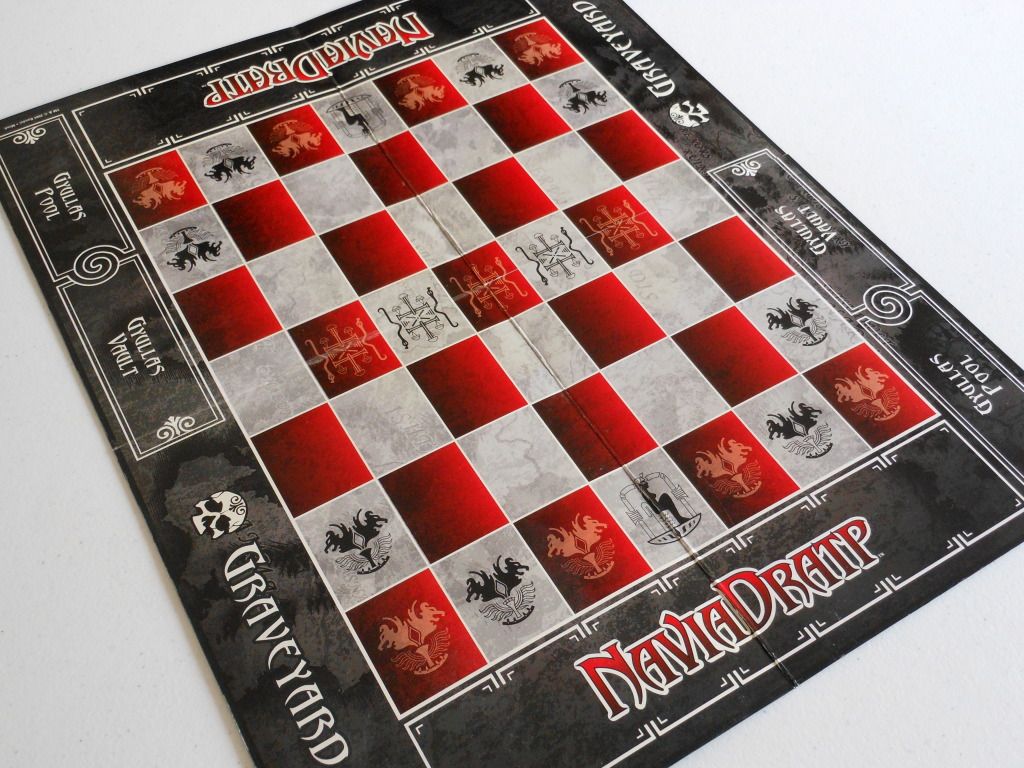
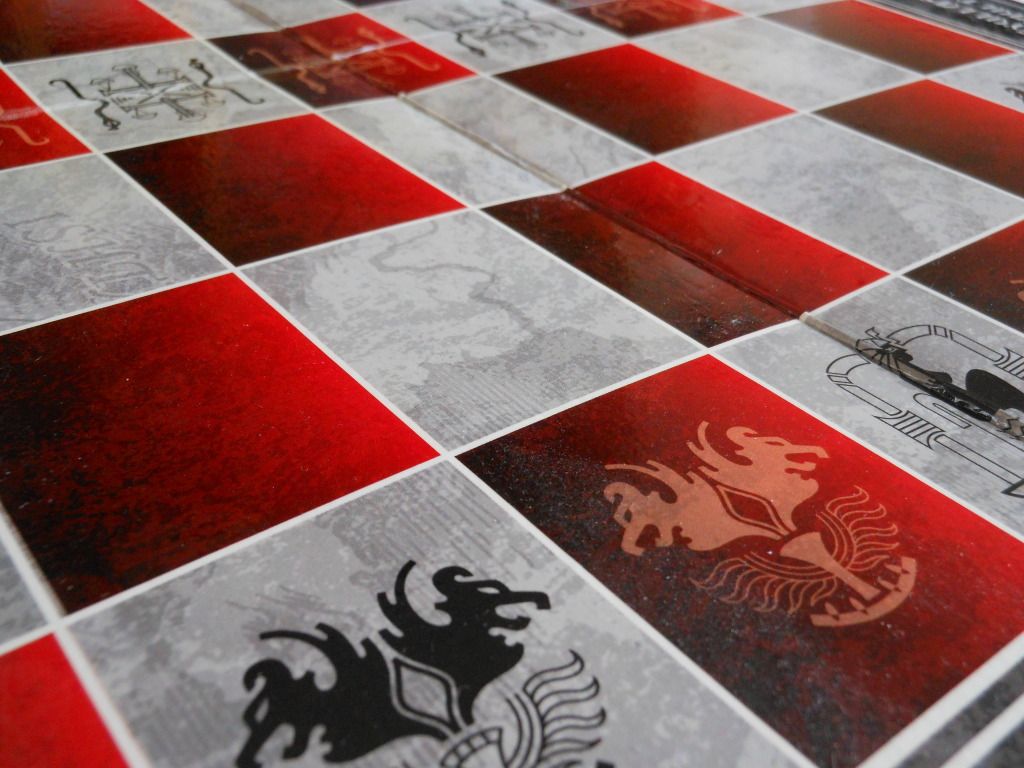
Navia Dratp board
The Navia Dratp board. Subject to a bit of warping, unfortunately.


If the game is so good, you might be wondering why it didn't do better. I think that comes down to several things. First, it's a collectable game, and that will immediately put people off. Second, it's a Chess variant with simple rules but very deep strategy. The use of the "toys" (plastic miniatures) might have put off serious gamers looking for a deeply strategic game, while the complex strategies and multiple paths to victory might have put off younger players who might otherwise have purchased the game for the cool playing pieces. A third reason is likely to have been all the stupid in-game terms such as "Maseitai," and "Gyullas." People want to play games; they don't want to have to learn a new language just to know what's going on.

However, the biggest reason for the game's failure is probably down to a lack of decent advertising. I never even knew the game existed until it was already out of print, yet as soon as I discovered it, I badgered my wife until she bought it for me.

Anyway, that's enough about why the game didn't succeed; let's talk about why it should have.

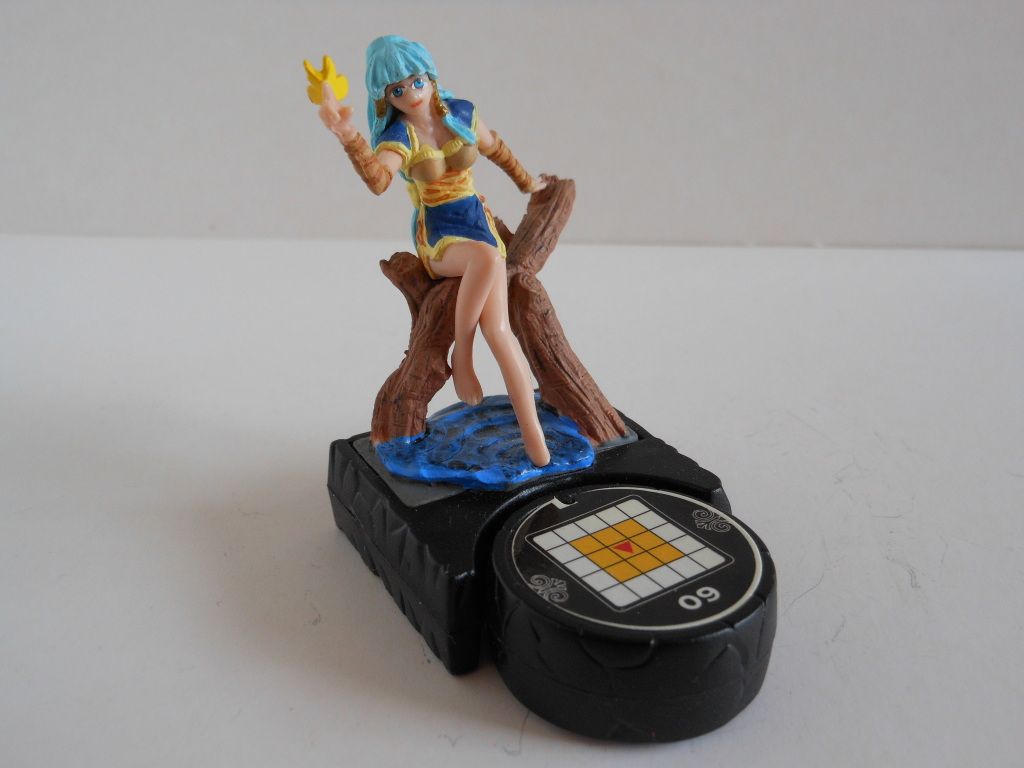
The game is framed around Chess, so pieces will move around a grid based on their unique movement styles, and will take enemy pieces by landing on them; but for every similarity to Chess there is a host of really interesting mechanics that make this game fresh and exciting. Each player has a Navia piece (a nicely painted female character who has the power to control the Maseitai), who will start on the board surrounded by Gulled pieces.

The Navia is the most important piece, and if she is ever in a Check Mate position, then you immediately lose. Killing a Navia is one of three unique ways to win the game.

Navia Dratp Navia Estelle miniature
Navia Estelle. Don't look into her eyes.


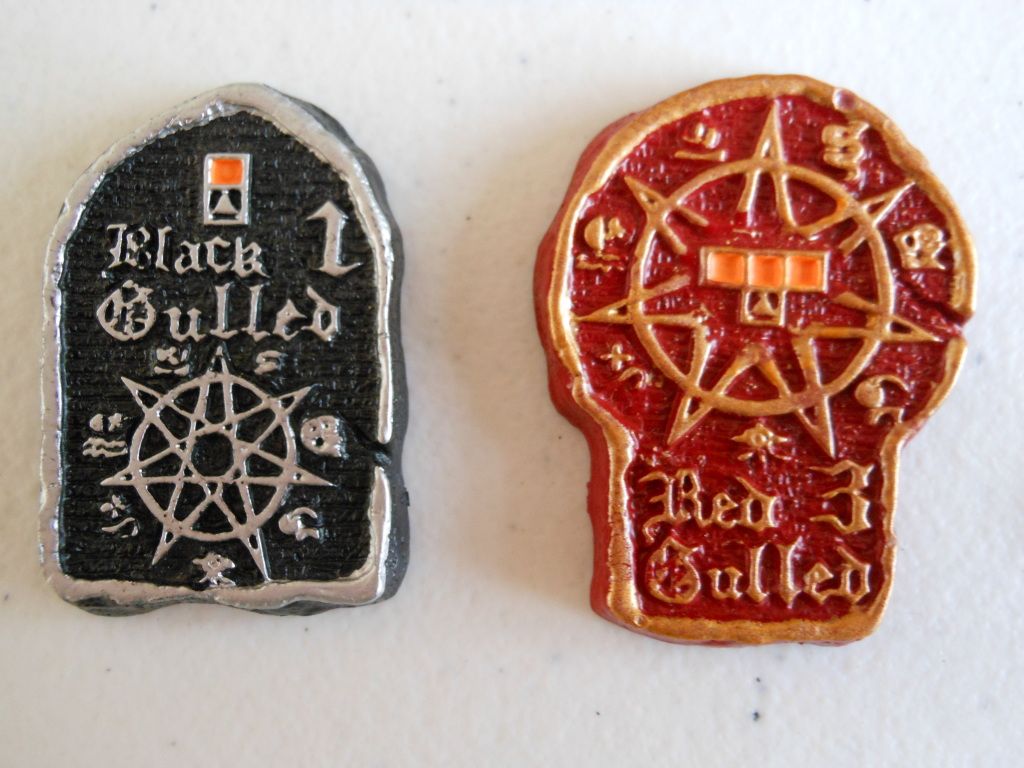
The Gulled pieces come in two flavours. Black Gulled can only move forward one space, and each time they do they earn one Gyullas, which the owner of the Gulled piece will store for later use. Red Gulled can move into any of the three spaces directly in front, and each movement earns three Gyullas. Obviously, the red Gulled are much more powerful, but you only get two of them compared to seven of the black Gulled.

Navia Dratp Gulled pieces
I see Gulled.


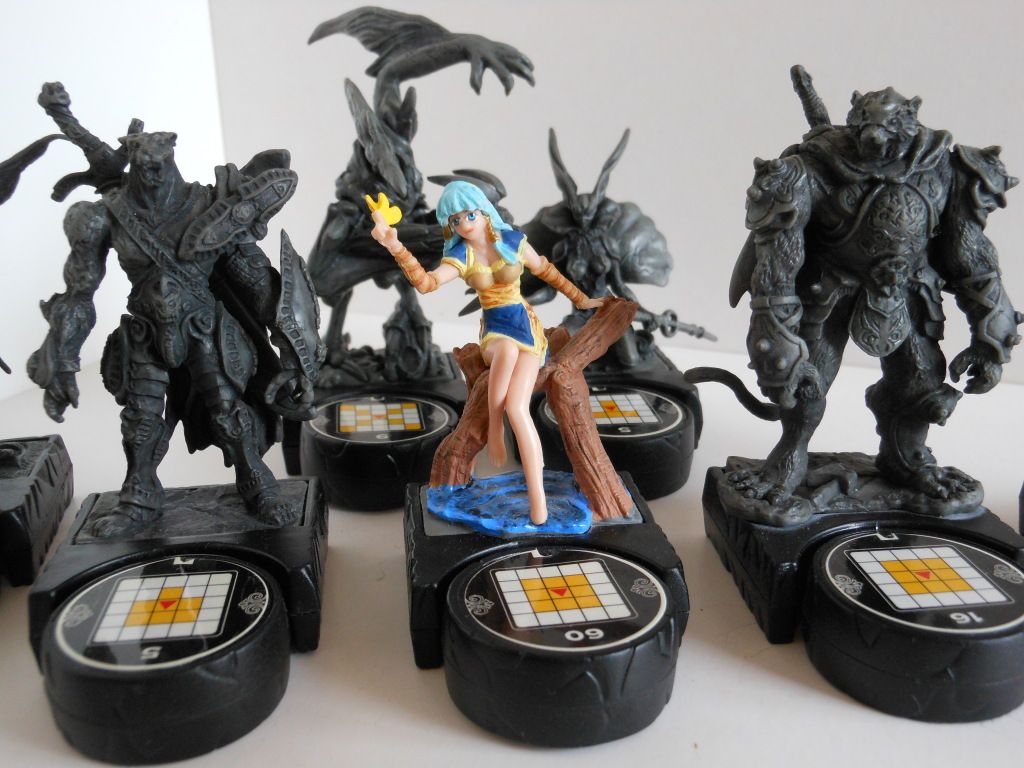
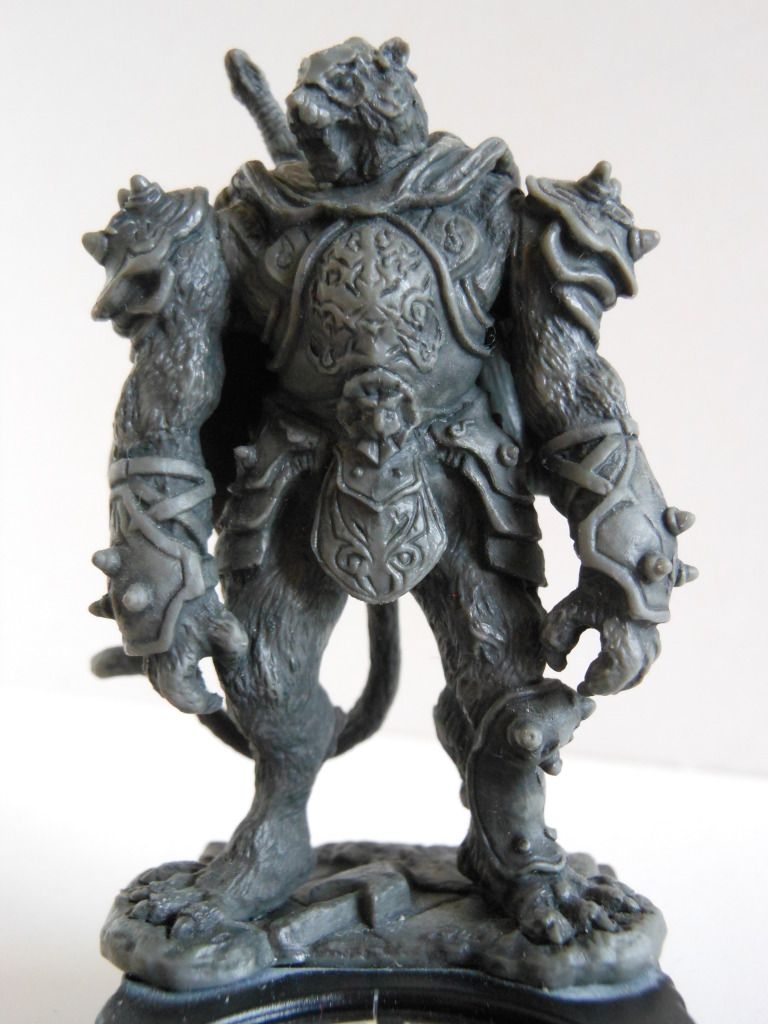
Each player will also have seven beautifully sculpted Maseitai pieces, which begin the game in "The Keep" at the edge of the board. This game was made by Ban-Dai, and their experience in the toy industry shines through in the quality of the Maseitai. They really are some of the finest pieces for a game I have ever seen.

Navia Dratp Maseitai and Navia
Estelle with some of the gang.


If you are using the pieces from a starter set, your selection of Maseitai has already been made for you. Each starter set contains a good mix of characters with good abilities that work well in combination, so this is definitely a good way to play to begin with. Once you are used to the game (and especially if you pick up some extra pieces), you can add a drafting mechanism to the game where you will select seven Maseitai from the pieces available. Unfortunately, I have never been able to do this, as I only managed to pick up a couple of extra pieces and I am therefore stuck with the pieces from the starter sets. (If anybody has spare Maseitai pieces they are looking to part with, get in contact with me, as I may be interested.)

The reason you will want to mix and match the Maseitai is because they all work differently. Every piece has a compass dial on the front of its base which indicates its movement range. Some pieces can move diagonally, some only forwards or sideways. Some can even move backwards. However, to begin with, no Maseitai can move more than two spaces in any one direction. Now, here's the clever bit: Also printed on the compass face is a Dratp value. By spending Gyullas equal to that value, you can Dratp the piece, which involves spinning the compass 180 degrees so the reverse face is showing. This second face will show a new movement grid or a special power, which the Maseitai can now use.

For example, the powerful tiger Maseitai Agunilyos starts out being able to move a single space in any direction. If you pay 16 Gyullas, you can flip his compass to reveal an extended movement grid that allows him to move an unlimited number of spaces in any direction (the same as the Queen piece in Chess).

Navia Dratp Agunilyos Maseitai
Agunilyos... Stupid name, but don't tell him that.


The Maseitai Olip starts the game being able to move one space orthogonally. After paying the Dratp cost of four Gyullas, he can still only move one space orthogonally, but at the point he Dratps he can switch the position of any two allies on the battlefield.

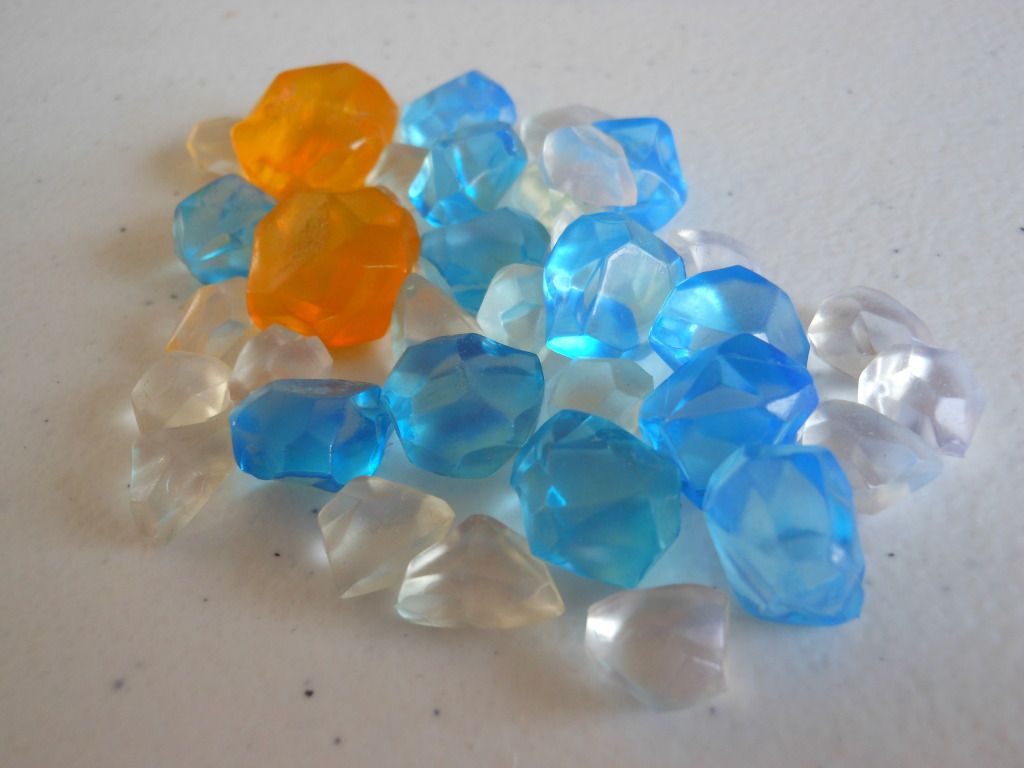
My absolute favourite piece is the Gyullas Turtle (who turned up in my review of Gormiti: The Trading Card Game yesterday). This piece has the same movement pattern as a red Gulled piece, but after Dratping, each time he moves he generates six Gyullas (normally, only Gulled pieces can generate Gyullas from moving). This is massively powerful, as Gyullas not only provide the means to Dratp your characters, they also provide the second route to victory: If you ever obtain 60 Gyullas, you can use them to Dratp your Navia piece, which causes you to instantly win the game.

Navia Dratp Gyullas crystals
Enough Gyullas to Navia Dratp twice!


This Dratping mechanism is the heart and soul of the game. Not only is it wonderfully implemented on the pieces, but it also creates a wealth of exciting possibilities in any game. The Dratping cost of each piece also creates amazing balance. The pieces that have the most powerful Dratp abilities have the highest Dratp cost; this means it takes a long time to save up the Gyullas to activate the power, and activating the power will also mean it will take longer for you to accumulate the 60 Gyullas needed to Dratp your Navia. Furthermore, in an interesting twist, whenever a Maseitai is killed by your opponent, your opponent will gain Gyullas equal to the Dratp value of the killed piece (even if the killed piece had not yet Dratp!).

For example, if you bring Agunilyos into play and foolishly allow him to be killed, your opponent will gain 16 Gyullas! If you had already Dratp him at the cost of 16 Gyullas, that would technically put you 32 Gyullas behind, and probably in a position where it would be unlikely you could win. Bear in mind, Agunilyos is really quite weak until he has Dratp, so if you bring him out too early, your opponent could score an easy 16 Gyullas by picking him off. Put another way, you have to carefully judge if you really should Dratp a Maseitai, or even if you should summon it into play in the first place.

This system means you really have to think about how you balance your forces. If you put all powerful characters in your army, you will only rarely get to Dratp them; but if you only use Maseitai with low Dratp costs, then you will find yourself facing much stronger opponents who will pin down your movements and make it hard for you to win.

The Dratp mechanism is incredibly clever, and incredibly simple, just like the rest of the rules of the game, which boil down to doing one of the following things on your turn:

1. Move a Gulled piece.
2. Summon one of your Maseitai from The Keep to one of the marked summoning spaces on your side of the board.
3. Move a Maseitai or Navia already on the board, and then Dratp one of your Maseitai.

Navia Dratp board details
A close up of some summoning spaces.


Summoning a Maseitai to the board is free, but takes up your whole turn, and this creates even more tension and tactical decisions. The Maseitai are your powerful pieces, and you want them in play; but to begin with you will only have a few spaces to summon them to, and you don't want to bring them out until you really need them or they might be killed, gifting your opponent with Gyullas. Also, if you spend each turn bringing out the Maseitai, you will find you do not have enough Gyullas crystals to perform Dratp actions.

A Navia piece can only move one space at a time, and will quite often remain hidden in your back line. However, there is a third route to victory, and that involves running your Navia off your opponent's side of the board. You will only rarely get a chance to win this way, but its nice to have the option.

I really enjoy Chess, and I even collect Chess sets, so this game appeals to me. However (and I may be burned at the stake here), I actually enjoy Navia Dratp more than Chess. It has simple rules, incredible depth of strategy, and beautiful playing pieces. It's an abstract game with multiple paths to victory that also feels totally thematic. Each Maseitai works completely differently, and tinkering with combinations to see how they work together provides endless replayability. It's just a shame Ban-Dai decided to go down the collectable route, as I would love to be able to have a few more Maseitai to pick from.

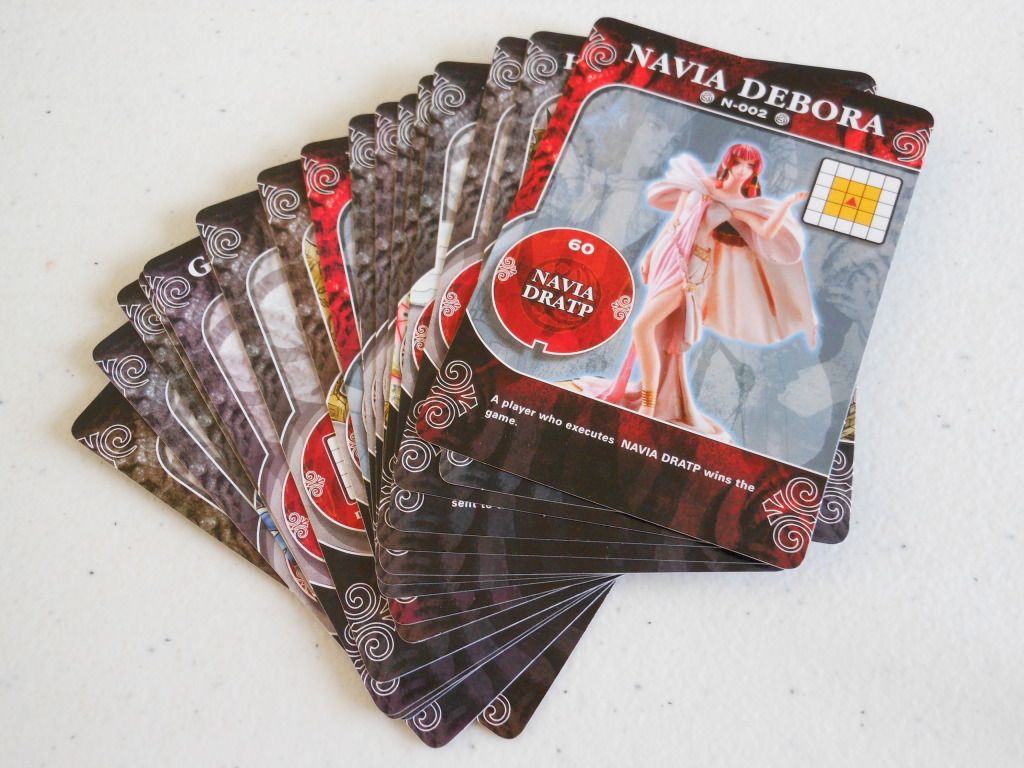
Navia Dratp reference cards
You give reference cards to your opponent, so there are no nasty surprises.


Of course, you will have realised by now that I have no intentions of kicking this game out of The Vault. It remains one of my all-time favourite two-player games, and a shining example of quality game design.

Thursday, 7 June 2012

Review - Gormiti: The Trading Card Game


Gormiti: The Trading Card Game
Published by Giochi Preziosi
Designed by that mysterious fella who designs thousands of games but never admits to it
For 2 players, aged 6 to adult

Recently, I took a leaf out of Stuart Ashen's book. For those of you who don't know Mr Ashen, I highly recommend visiting his website. Not yet - read my blog first. Visit him later. When you're bored of all this board game stuff. Actually, forget it. Just stay here.

He gets enough visitors as it is.

Mr Ashen is a bit of a legend, and regularly posts reviews of complete crap, some of which he purchases in Poundland (the equivalent of a Dollar Store). So, recently I popped into a Poundland to see if they had any fun toys. They didn't. But what I did find were starter sets for Gormiti: The Trading Card Game.

I don't really like trading card games. I like to buy a game and know I won't need to keep buying stuff to make it good; but considering I could pick up two starters for £2, and considering I didn't expect the game to be good enough to bother expanding it, I paid my money.

I am such a sucker.

So here it is, in a special tribute post to Mr Stuart Ashen: A review of Gormiti: The Trading Card Game. An excellent game. He lied.

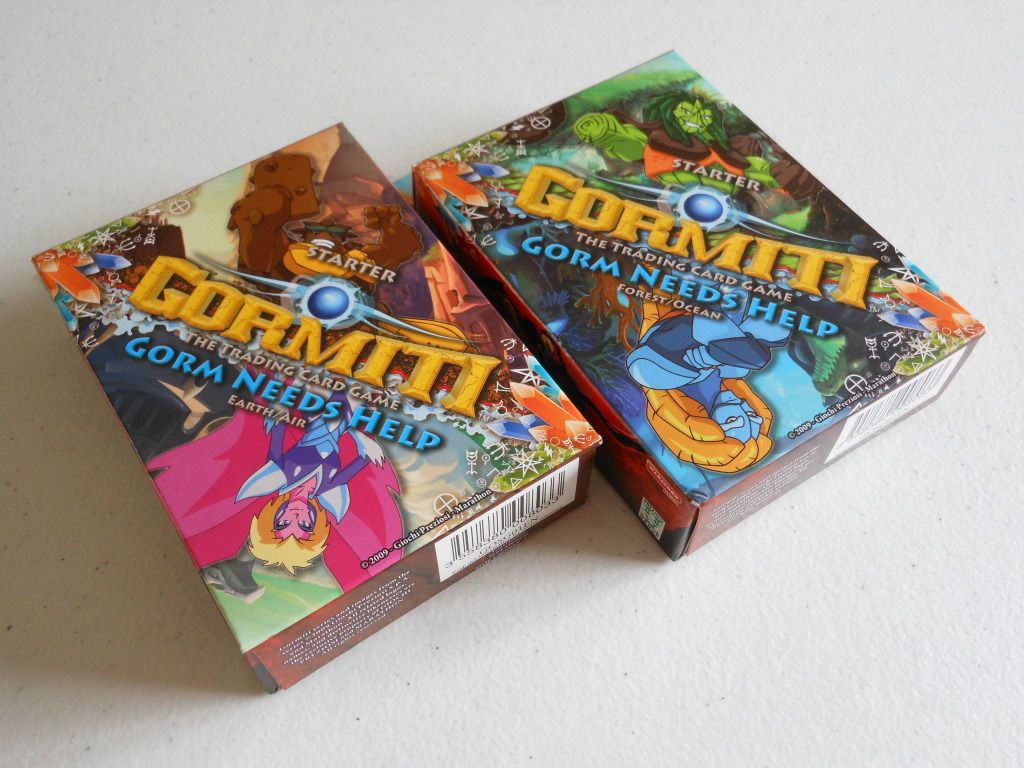
Gormiti: The Trading Card Game starter sets
The two offending items.


This is one of those games based on a cartoon that has also spawned a whole bunch of toys and other paraphernalia. That means the theme will automatically appeal to those people who know the show, and will totally alienate everyone else with lots of stupid words and named characters.

As far as storyline goes, there seems to be four children who can turn into monsters, and they fight other monsters. I'm not really sure how or why they do this, and I don't really care. It's all a bit silly, and it doesn't really matter anyway.

I purchased both of the starter sets, each containing 40 cards and a rule book. One of the starter sets is themed "earth/air" and one is themed "forest/ocean." I guess if I knew more about the show, I might know why fire has been replaced with forest as the fourth element.

Both boxes also claim that "Gorm needs help." I don't know who Gorm is, but I suspect he may be the designer.

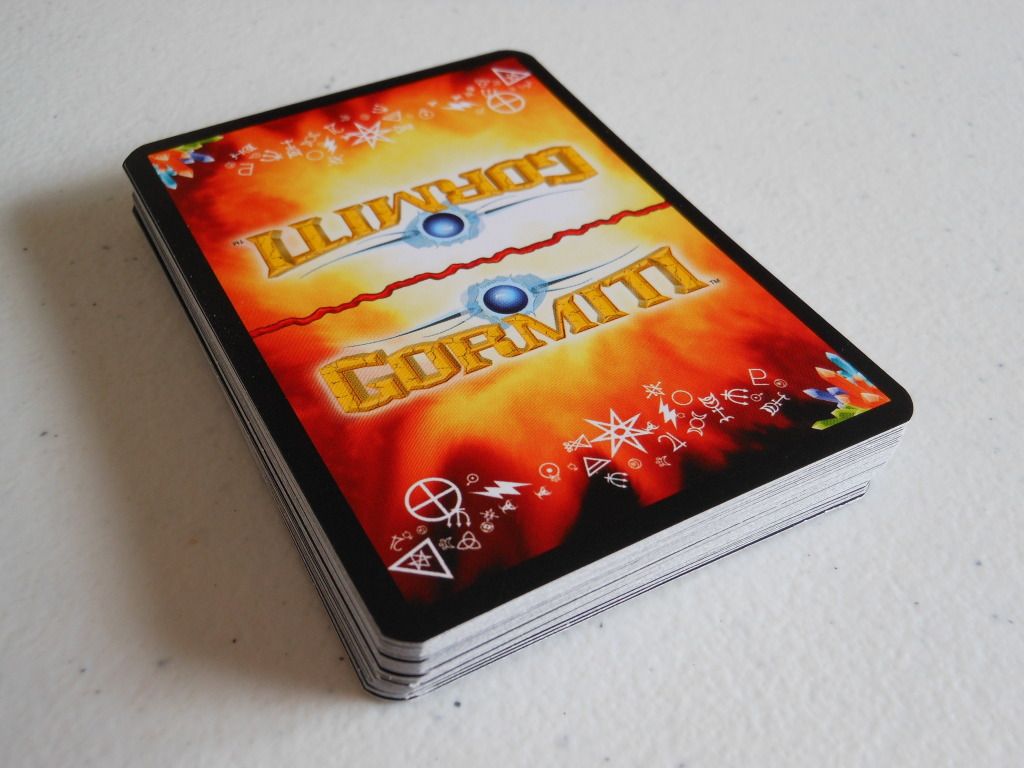
Gormiti: The Trading Card Game deck
40 cards doesn't seem a lot, but you only draw one card per turn.


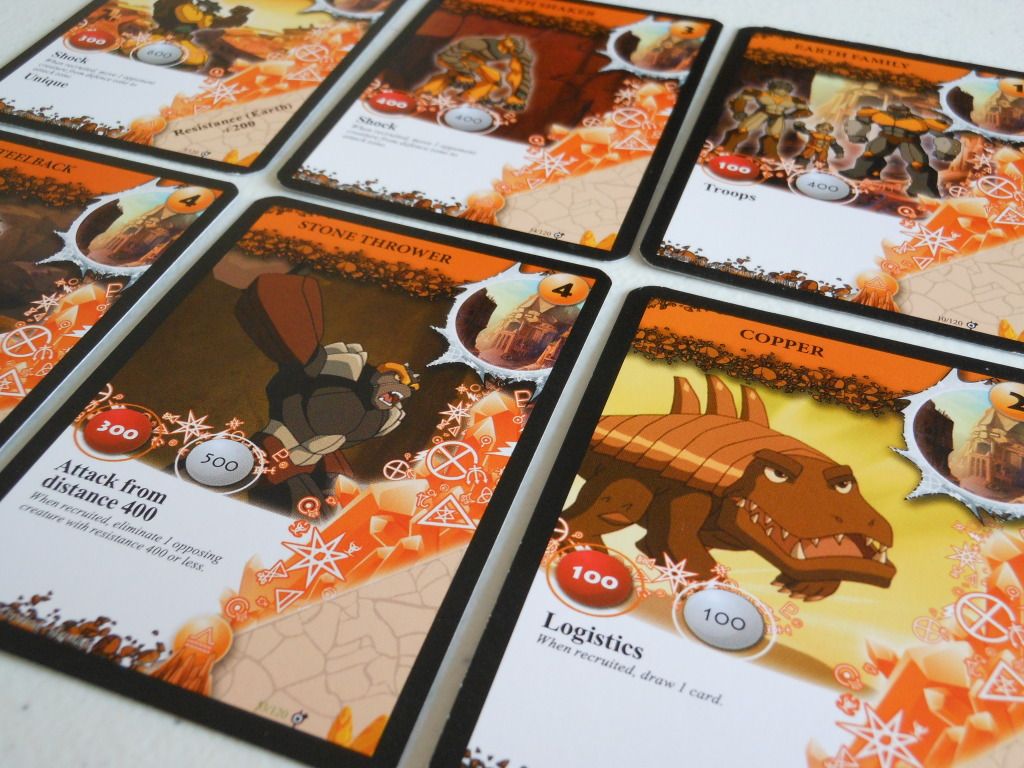
The cards are actually very decent quality, and they are well printed. The downside is they use artwork from the cartoon. It's bold and bright, but it looks bloody awful all the same. This is definitely not one of those collectable games that encourages you to buy more cards simply so you can marvel at the exceptional artwork.

One of the first things you will notice flicking through one of the starter decks is that all of the cards represent characters. There are no items, no events, no spells. Furthermore, if a character has a special ability (only a few of them do), then the details of the special ability are written in full on the card, so you don't need to reference the rule book at all during play. It makes it all very obvious that this is not going to be a particularly deep game. The emphasis is on dropping characters on the table and then letting them fight.

To start a game, each player takes a 40-card deck, gives it a shuffle, and then draws a number of cards that are set aside face down. Player one sets aside five, while player two sets aside six. These cards represent "life orbs" or some such nonsense. When they are all gone, you are dead, and you lose the game.

Players then draw a hand of five cards and play begins.

In each turn, the first thing that happens is a threat level increases. It begins at level one on the first turn, and increases by one point in each round. (Note: The threat chart is printed on the back of the rule book, and you need to track progression with a penny or something. Quite annoying if you should happen to need to look up a rule during a game.)

Gormiti: The Trading Card Game rules
The rule book.


The total threat represents the amount of power each player has available to summon monsters. Yes, you read that right. Each player has the exact same amount of power to summon monsters each turn, and that amount is determined by the game round and not by anything either of the players has done.

This is an utterly bizarre element of the game. I believe it may have been done to simplify the game for younger players, as it removes one of the more difficult elements of deck construction. That is to say, this rule removes the need to create a deck with a balanced mix of creatures and power-producing cards (such as "land" cards in the game Magic: The Gathering), so when you are putting together a deck, you just have to worry about including all your favourite characters.

After the threat level advances, player one draws one card into his hand. He can then summon characters. Each character has a summon cost, and you can summon as many characters as you like as long as their total summon cost does not exceed the threat level. These characters are played to a recruitment zone, which simply means they cannot be used to attack this turn.

The problem is, most of the characters have a summoning cost of four or more, and some are as high as seven or eight; so if you get unlucky with your opening hand, you may not be able to play a character for the first three or four turns. Not only is this boring, but if your opponent is lucky enough to summon a character with a value of one in his first turn, then you could be faced with two or three turns of being attacked with no way to defend, resulting in a very short game indeed. There really is nothing more annoying than playing round after round in which your opponent pecks away at your health because you are unable to bring any characters into play.

Gormiti: The Trading Card Game in play
A sample of the glorious artwork on the cards.


Yes, this is one of those games where bad luck with your initial hand spells instant defeat; and there's nothing you can do about it.

After summoning, you can attack with any characters that are not in your recruitment zone. You can attack with all of your characters, but it is usually a good idea to hold back a few characters to defend with when your opponent attacks.

To attack, you specify which characters are involved. Your opponent then selects defenders. One character can defend against each attacker. For each unopposed attacking character, the defender will lose one "life orb."

If a character's attack is blocked, you compare the attacker's strength to the defender's resistance. If the strength is higher, the defender is killed and the attack gets through anyway. However, you also compare the defender's strength to the attacker's resistance, and it is possible for the attacker to die. It is therefore possible for both an attacker and defender to die at the same time.

Some cards also have a bonus modifier for strength or resistance printed in the bottom right corner. During any combat, players can play any number of cards from their hands as modifiers to try to help win a fight, after which, those cards are discarded. Of course, if you use all your cards to modify a battle, you won't be able to use those cards to summon the characters printed on them, so there is a bit of hand management involved in deciding when to play a card as a modifier and when to hold on to it to play the character instead. This simple choice probably constitutes the only slightly interesting decision a player will be presented with on a turn.

After all the combats are resolved, and dead characters removed from play, the defender must remove one "life orb" from his stack for each hit that got through. The way health is handled is probably the most interesting aspect of the game, as each "life orb" card you lose gets put into your hand; so as you take damage you gain more cards to help you fight back. It's a relatively interesting balancing mechanism to prevent a runaway winner, and feels like it has been half-inched from a much better game.

Once player one has finished attacking, any characters in his recruitment zone become ready for use, and then player two summons characters and attacks. When player two attacks, player one can only defend with characters that did not attack this turn (either because they were kept back on purpose, or because they were waiting in the recruitment zone).

And that's it. Lather, rinse, repeat.

No interrupt cards. No special event cards. No way to draw more cards. No way to summon stronger characters until the required number of game rounds have passed. No way to link together card combos in exciting ways.

No bloody fun.

Navia Dratp Gyullas Turtle
This guy has nothing to do with Gormiti.
He is from a much better collectable game that I will be reviewing next time.
10 points to anyone who can name the game.


If one player can get lots of characters out early on, the game will be over in just a few turns, especially if the other player is unable to summon any characters to defend with. Conversely, if both players are able to get characters out early on, the game can drag on for an age as neither player is able to land a successful attack.

That means, the game will be quick and boring or long and boring. You don't have a choice in the matter, just like you often will not have a choice of which card you can play on a turn. This is just an exercise in drawing and placing cards, with no real thought required.

Although I generally enjoy "heavy" games, I don't actually have a problem with games that involve quite a lot of luck, or which have only limited options available on a turn. However, I do insist that a game should be fun. This game isn't fun. It's oh so dull. The designer tried to take a trading card game and streamline it for simplicity and accessibility for a younger market, but in doing so, all the fun got streamlined out. What's left can hardly be classed as a game at all.

As I already mentioned, I paid £2 to get the two starter sets. Even at that price, I don't think I got value for money. I will certainly not be keeping this game. I mean, it doesn't even have any pretty pictures to look at.

Saturday, 2 June 2012

Continuing a Trend...

I'll keep this brief (mainly because I don't have a lot to say).

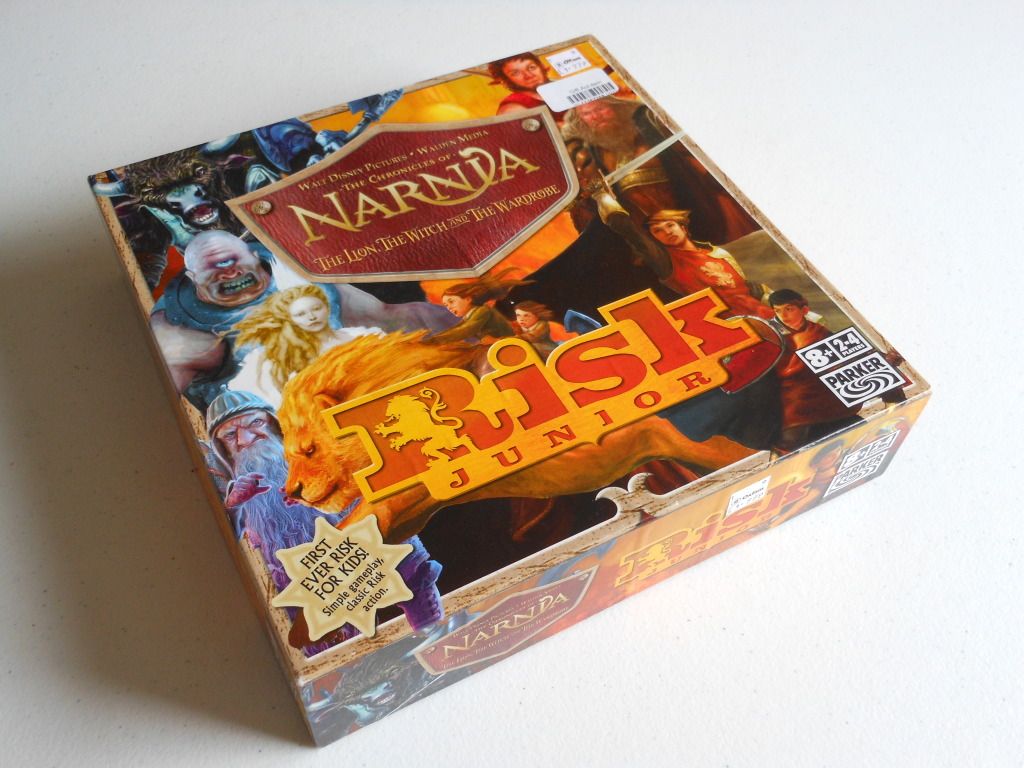
The other day I was doing my regular tour of the local charity shops. I had found nothing of interest (seriously, how many copies of Carol Vorderman's Sudoku get sent to charity on a daily basis?), and I was about to give up. Just then, a small box with an intriguing logo caught my eye. The logo said Risk Junior, and there was a cool lion insignia inside the "R" of the word Risk. A closer examination revealed this to be Risk themed around the movie The Lion, The Witch and The Wardrobe.


Narnia Risk box
Real artwork - not movie stills. Saints be praised!


The box claims that this is the "first ever Risk for kids!" That seems strange to me, as I have always thought of Risk as a family game, and the age specified on this box was 8+. I don't really see children of aged eight having that much difficulty with regular Risk, which does beg the question whether this junior edition is necessary.

Recently, I acquired a copy of Platoon, and I have also been reviewing some other games based on movies, such as Eragon and Indiana Jones Akator Temple Race Game; so I thought I would continue the trend and pick up this copy of Risk Junior too. Besides, I don't own a copy of Risk, and I am a sucker for a good fantasy theme. This game also got extra marks because, even though it is based on the movie, it uses proper artwork instead of movie stills.

I dropped £3.99 for the game, and was pleased to find it was in excellent condition, and 100% complete (it even still had a little rules addendum slip tucked into the rule book).


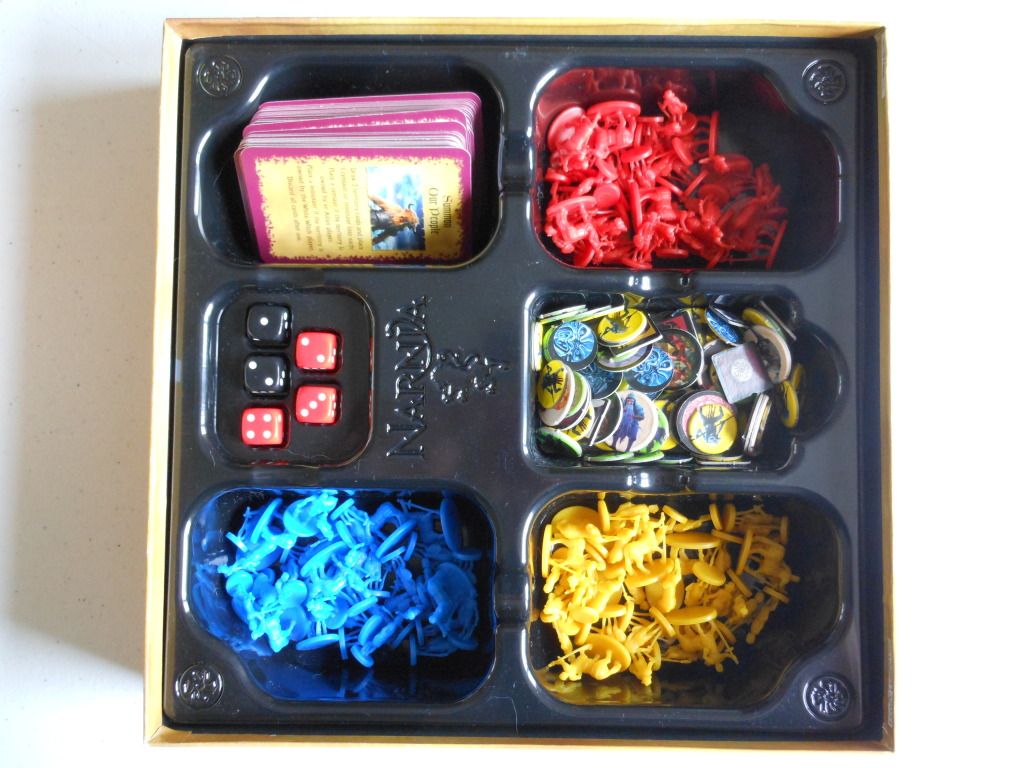
Narnia Risk - inside the box
Inside the box - lots of plastic good guys.


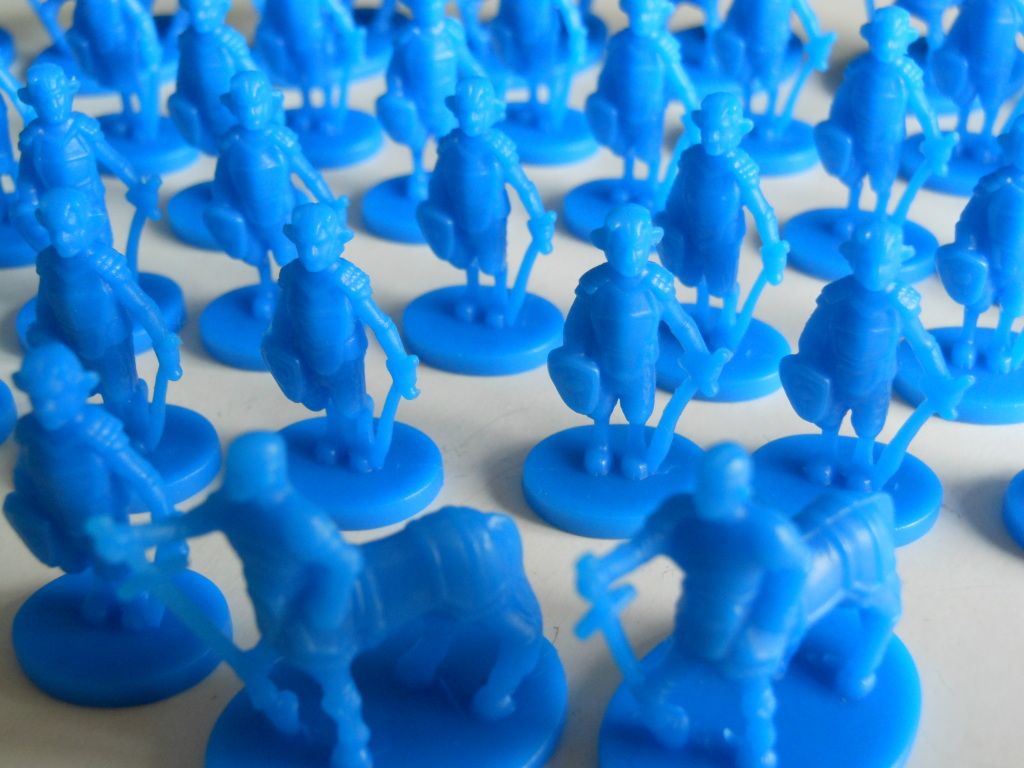
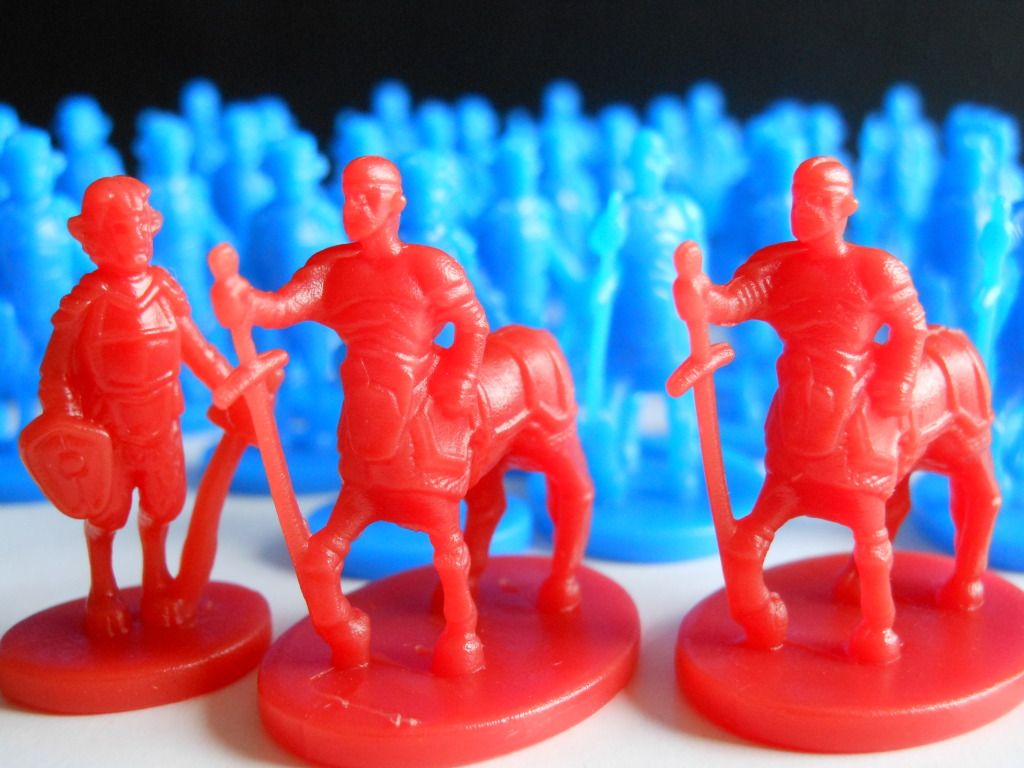
The box is surprisingly small, but it is packed with goodness. The board is nicely illustrated, and best of all, there are hundreds of little plastic fawns and centaurs to represent the armies fighting on Aslan's side. Slightly disappointingly, all of the White Witch's armies are represented by cardboard tokens. I guess the game's budget only extended to two different moulds and three colours of plastic. It's a shame, because I would have loved some little plastic minotaurs... Although thinking about it, I have a copy of Age of Mythology which has loads of plastic figures in it. Maybe I could grab enough minotaurs from there.


Narnia Risk pieces
Big fawns, or tiny centaurs? You decide.


The rules for this edition of Risk have been greatly simplified, and there seems to be a lot more randomness in it; but characters from the movie are nicely implemented with special powers, and it all looks very nice. I will certainly give it a play, and at some point a review will be added here on the blog.


Narnia Risk fawn and centaur miniatures
"I don't wish to alarm you, but I think we're being followed."


Now, where's that copy of Age of Mythology?

Friday, 1 June 2012

Review - Jurassic Dinosaurs


Jurassic Dinosaurs
Published by Legends
Designed by someone who didn't want his or her name on the box
For 2-4 players who hate life and are aged 6 to adult

My wife is a very understanding woman. Not only does she tolerate my hobby, she actively encourages it. She plays games with me, but more importantly, she buys games for me.

My wife also knows me well. She knows I love out of production games, she knows I love dinosaurs, and she knows I love a good bargain. That's why, when she saw a copy of Jurassic Dinosaurs in a charity shop for 50p, she purchased it for me.

The divorce papers are being finalised.

Okay, I'm kidding. We're not really getting divorced. Mainly because I immediately realised how bad this game was, and I never played it.

Yes, you read that right. This is a review for a game I've never played. Sue me. Actually, don't. I can't afford it.

I've never written a review about a game I've never played before, but in this case I've made an exception. You'll see why.

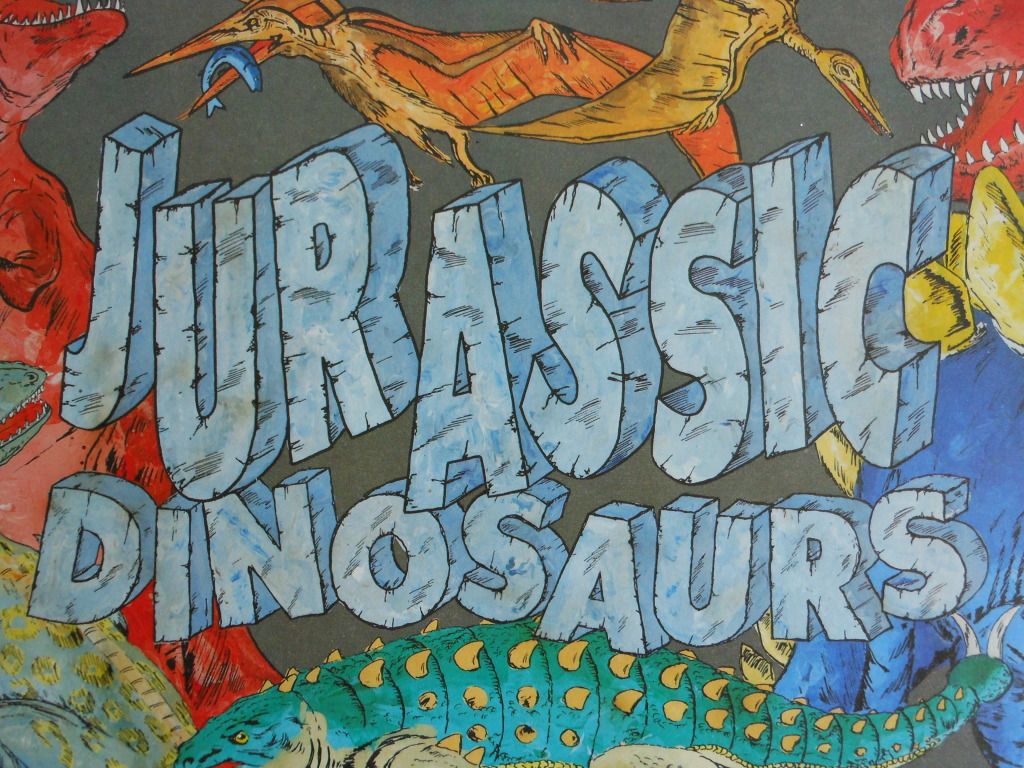
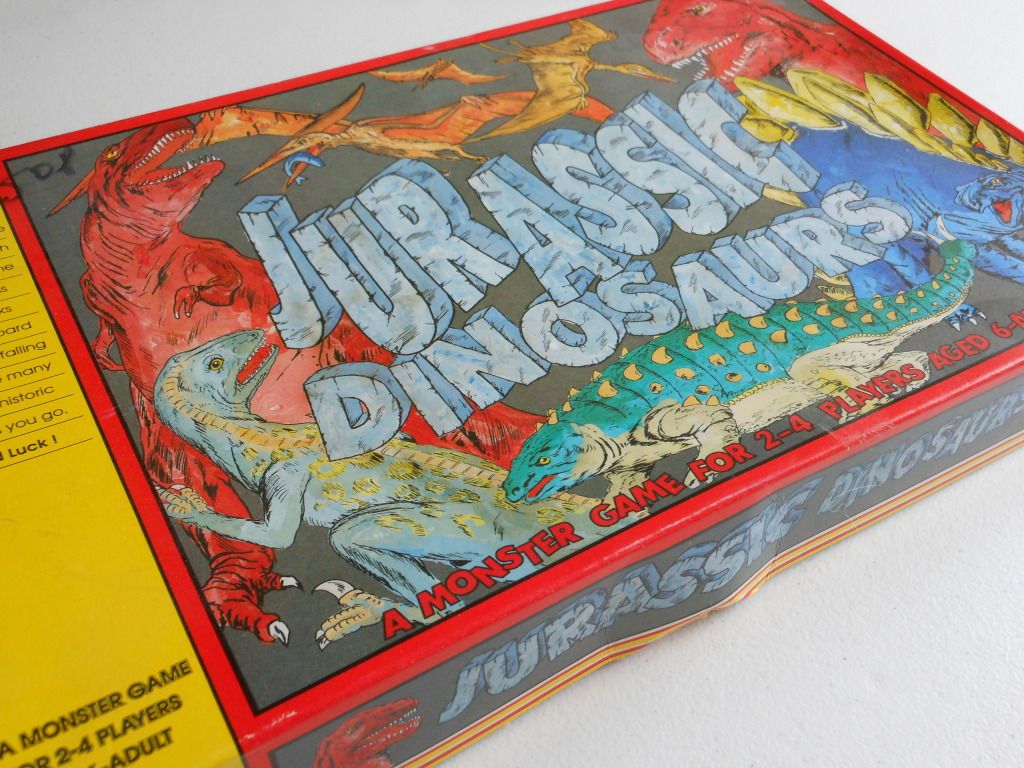
The first thing that struck me about Jurassic Dinosaurs is that it seemed much older than it really is. The art design and component quality looks like something out of the late 70s, and yet, it was made in 1993, that's four years after Heroquest was released!

Jurassic Dinosaurs box
They wrote the price on the box!? THEY WROTE ON THE BOX!


So yes, I was slightly suspicious of this game before I even opened the (slightly crumpled) box. I was also slightly annoyed because the charity shop had written the 50p price on the box lid with a freaking permanent marker. Seriously? I'll never say a bad word about tape monkeys again, because they are no longer my number one enemy.

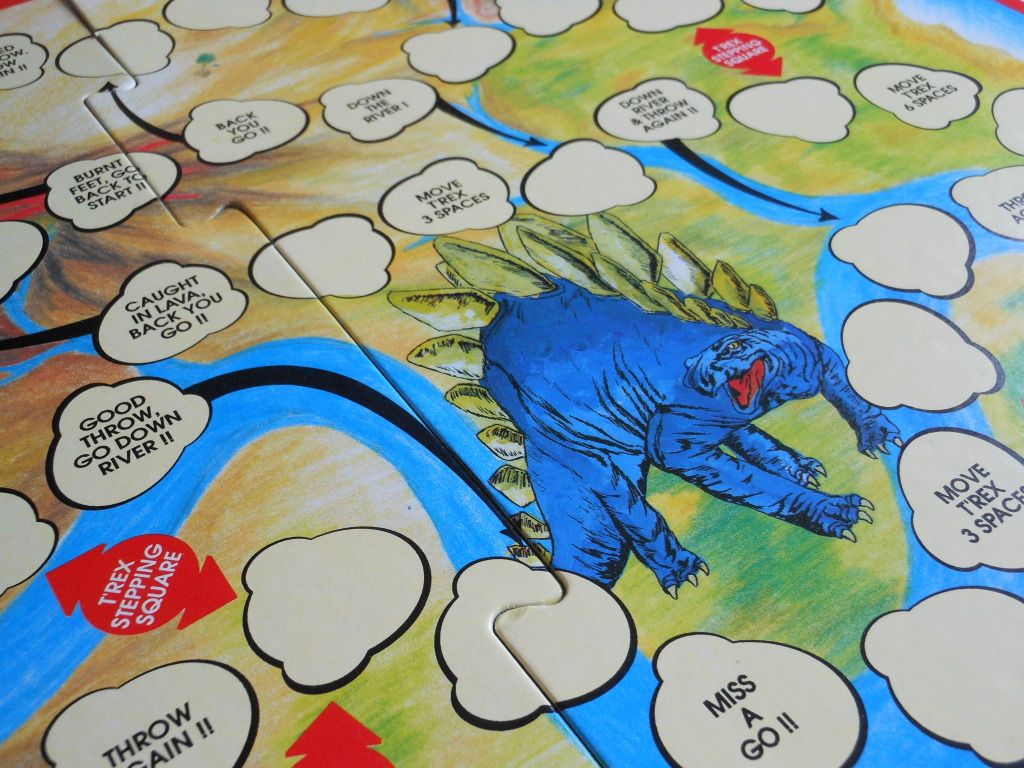
Once I got the box open, my suspicions were confirmed. The board consisted of two pieces that fit together like a jigsaw to reveal a hideous map overlaid with a linear path. Each space on the path is shaped like a footprint, and some of those footprints contain text like "Trapped by lava, miss a go," and "throw again!!" There are also certain spaces linked to other spaces by arrows. Some arrows point up, and some point down.

Jurassic Dinosaurs board
"Miss a go!!" - One of the more exciting spaces to land on, I'm sure.


My heart sank. It's Snakes and Ladders.

Snakes and Ladders!

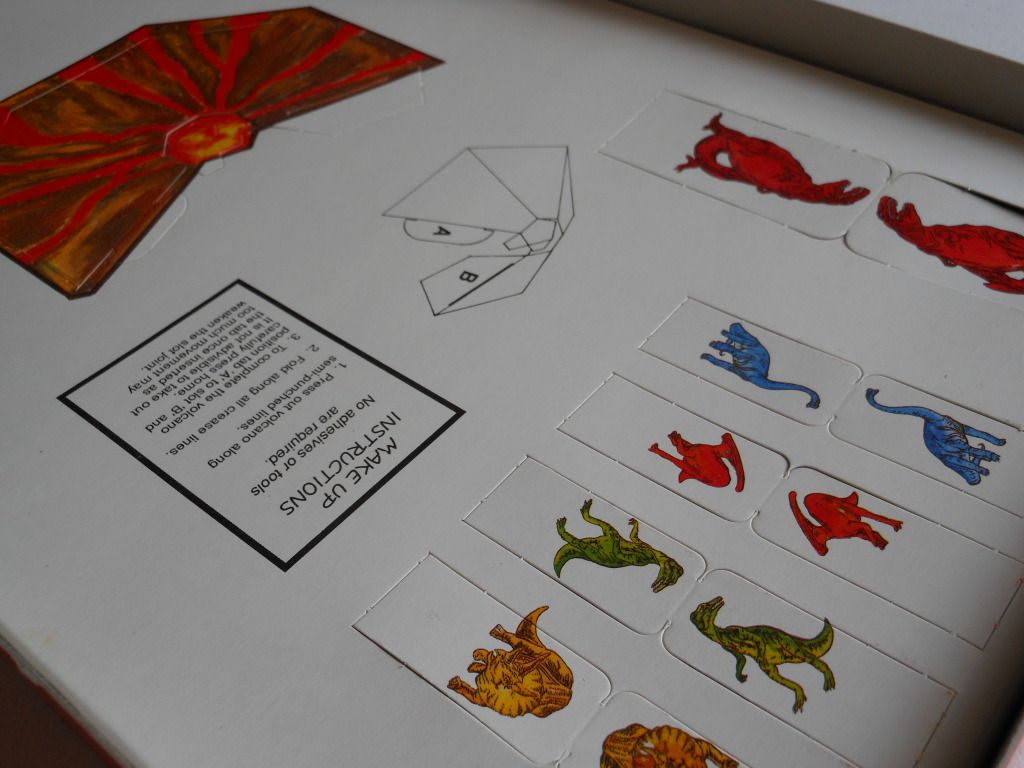
By this point, my interest had pretty much bottomed out; but I thought I would take a look at what the playing pieces were like. Unfortunately they weren't any more interesting: There is a thin card insert in the box, and the dinosaur pieces are printed on that. You punch them out and pop them in little plastic stands.

The pieces for the copy I have are still attached to the card insert, and that means the poor kid who had this game before me didn't bother to play it either.

However, I was intrigued to see two other pieces printed on the insert that needed to be punched out and assembled, and for a moment I was almost interested again. Almost.

The first is a larger t-rex piece. A quick look at the rules (which consist of four paragraphs printed on the bottom of the box!) revealed that when you roll the dice to move, you also move the t-rex. If the t-rex moves over a playing piece, that piece is moved back six spaces; if the t-rex lands on a playing piece, then that piece moves back 12 spaces. Spectacular!

It should also be noted that there are shortcuts printed on the board that only the t-rex can move on. The idea is that you can cleverly use these spaces to use the t-rex to attack your opponents while making sure it doesn't end up in a position to attack you. Of course, I just made that sound much more exciting that it really is.

The other piece printed on the cardboard insert is a 3D volcano that is supposed to be assembled and sat on the start space of the board. The "storyline" behind the game is that the dinosaurs are trying to escape the erupting volcano, and that is the sole reason the three-dimensional volcano piece exists. It doesn't actually do anything. It is just there to look cool and 3D. Unfortunately, it just looks cheap and badly made. Something of a missed opportunity really.

Jurassic Dinosaurs playing pieces (unpunched)
The cardboard insert with playing pieces still attached.


And that's your lot. Roll the dice. Move. Move the t-rex. Stare at the volcano.

The pieces for this game remain unpunched. The board was assembled only so I could take a picture for this review (which you won't have seen if you aren't reading this on my blog). And no, I am not keeping this game.

I think I will burn it.

Okay, okay... I'm being unfair. Snakes and Ladders  has it's place in the world. It is a great first game for kids, and it helps to teach counting, fair play, and social skills. I don't have a problem with Snakes and Ladders as such, and I would rather see a family playing any game rather than watching television. What I have a problem with is a cheaply made knock-off of Snakes and Ladders  with a recommended age of six and up.

Children are not stupid. Children should expect better than this.

They could have at least included some plastic dinosaurs or something to play with...