Showing posts with label collectable games suck. Show all posts

Monday, 18 November 2013

Review - World of Warcraft: Miniatures Game

World of Warcraft: Miniatures Game Horde faction


World of Warcraft: Miniatures Games
Published by Upper Deck Entertainment
Designed by a whole bunch of people
For 2 players, aged 14 to adult


It's about 2:30pm here in Merry Olde England. Time to sit down with a cup of tea and a biscuit and review something. Unfortunately, Mrs Never Boring has eaten the last custard cream in the house. Fear not, I am a warrior, and that sort of minor set back isn't going to stop me.

I'm having a Bourbon biscuit instead.

Anyway...

Collectable games... I've probably mentioned this before, but I'm not a fan. I'm not a fan because such games are a money sink. You are constantly spending money, and the stuff is usually blind-packaged, so you aren't even sure what you are spending your money on.

Call me old fashioned ("you're old fashioned!") but when I buy a game, I want to buy a complete game that has everything I need to play right there in the box. And then, if I like the game, I am happy to buy expansions later on.

One of the biggest problems with collectable games are the starter sets. I don't think I've ever seen a starter set done right. You see, the publishers have to walk a fine line: They want you to have enough bits and pieces to play and like the game, but they also want to make sure you aren't satisfied with just the starter set and want to buy more. These two aims are in direct opposition. If the publisher includes enough stuff for a truly engaging and satisfying game experience, you won't immediately feel the need to buy more bits, and the publisher really wants you to buy more bits. However, if you don't have an engaging and satisfying game experience right out of the box, you aren't going to feel compelled to buy more.

So, what you end up with are boring starter sets, that only give you a sample of what the full game experience has to offer.

And that's why many collectable games don't do well.

I honestly have no idea how well World of Warcraft: Miniatures Game did, but it was first released in 2008, and is no longer in production. I think it got through two waves of releases, which seems to be about the average life expectancy of this sort of thing. It's a bit of a shame really, because the game (while being very simple), is actually okay, and the pre-painted miniatures are large and impressive, and painted relatively well.


World of Warcraft Miniatures Game Alliance faction
The Alliance fellas... Seem friendly enough, don't they?


I only recently acquired this game, because I saw a basic starter set in a clearance store and liked the look of the miniatures. I also liked the fact that the box stated "everything 2 players need to play."

This statement is, of course, a lie.

What the starter set gives you is "some of the bits 2 players need to almost play."

Now, I only have the starter set, so I'm pretty much reviewing that starter set on its own merits. There was a deluxe set which had more figures and a proper board, and that probably was a much better way to get involved in this game, but... I can't find one. If I ever get one, I'll review it.

So, this starter set...

You get four miniatures (not a random allocation): Two evil dudes from the Horde team, and two guys that look just as evil, but actually aren't, from the Alliance team. These guys don't like each other. I don't know why, I've never played the computer games. Could be a dispute over who got the last custard cream for all I know.

Each character has an associated card that lists all stats and special powers, and each character also gets two additional power cards that can be used once per turn.


World of Warcraft Alliance cards
Alliance character cards.


Besides the characters, you get a double-sided paper map, (which only has one side you can use), six very groovy custom dice in two colours (which isn't enough to play), and six "U-bases" (which are crap).

Sigh. Where to start?

Okay, first things first. As I've already said, the miniatures are pretty good. The paint quality is average, but definitely better than something like Dungeon Command, but they are a nice size (too big for using in other games unfortunately), and they are sturdy. The problem is, you only get four, and this game is designed for fights between teams of three or six miniatures. As a result, the paper map (and I really hate paper maps) has two sides: A start side, designed for battles between teams of two, and an advanced side, which you can't use until you have purchased some additional miniatures.


World of Warcraft game map
Paper maps are rubbish.


Fighting on a limited map, with a limited force, can give you a solid idea of how the game mechanisms work; but it sucks out most of the fun. Strategy is limited, turns are repetitive. It's all a bit boring. Like Bourbon biscuits.

You can't even customise the characters you get, because you only get two power cards for each character, and they aren't interchangeable.

The custom dice are quite cool, but you only get three in each colour. A lot of the attacks involve rolling five or six dice, so you technically need 12 dice (six in each colour) to avoid constantly re-rolling.

And then there are the "U-bases." Good grief...

The game is played out in rounds, and each round is divided into 10 measures of undefined time which are marked on a chart printed on the map. Of course, there is no token to use with this tracker, so you need to use a penny or something.

Each character also has a personal clock. These come in the form of the "U-bases" which are attached to the bottom of the miniatures. They are kind of like Heroclix bases, but more complicated. And rubbish.

If you rotate the bottom of the "U-base" it advances the character's personal clock by one point. If you rotate the bottom of the miniature, then it adjusts the character's number of hit points instead. This means everything is tracked right there on the character's base. Sounds neat.

I thought it sounded neat.

It's not neat.

The "U-bases" are utter crap. They don't fit onto the miniatures properly, so they keep falling off. And of course, when you go to put them back on, you have to remember how many hit points you had so you can reset the base properly. Constantly picking up the miniatures and fiddling with the bases is also just... well... fiddly. You have to be careful to twist them the right way, and careful not to knock them off, and careful to put the miniature back where it came from, and... you know... just careful.

This is stupid, over-engineered nonsense. The same thing could have been achieved by including a team tracker sheet in the starter set, and then packaging each character with a little token. Every time you activated a character, you could advance its token on the team tracker. Does the same thing as the stupid bases but without all the hassle. There is no need to over-complicate things.

Anyway, the game round marker starts at "1," and characters whose personal clocks are at "1" take it in turns to activate. You can make a free move, and then do one action (normally an attack or a heal spell). Doing an action costs time, so attacking might make your personal clock advance by three clicks. This is clever see. You do a big attack, advance your clock, and then... You have to wait. You can't move that character again until his personal clock matches the round marker. In the meantime, every other character on the board gets to pummel the stuffing out of him.

It's a very clever system. I really like it. It's just a shame it was implemented through the "U-base" concept.

The dice combat is equally clever, and is implemented well. The custom dice have three shaded faces, and one face with a critical hit symbol. When you attack (physically, or with magic), you roll a number of dice equal to your attack value. Each dice that turns up a shaded face is a miss, and everything else is a hit. The critical symbol may invoke a special power specific to the kind of attack you are doing, such as causing an additional damage. Your opponent then rolls dice equal to his defence (for a physical attack) or resistance (for a magic attack). Anything but a shaded face on the dice successfully blocks one hit. Hits minus blocks is the total damage caused.

Simple.

World of Warcraft custom dice
Custom dice... I love custom dice.


Of course, the point of the game, as with so many other games, is to collect victory points. Oh yes, that nebulous, ephemeral concept that rears its head in so many games. Victory points. Who knows what they really are? An abstract concept? Medals of valour? Custard creams?

You get these victory points by being on or next to a victory point space on the board at the end of the round (when the round marker resets back to step "1"). You also get victory points for killing enemies.

There really is nothing more to the game than that: It's super-streamlined, easy to teach, and hangs off a very clever timing mechanism. But the component issues really hurt the game experience. It makes what should be a very fluid game clunky and cumbersome, and really just not as much fun as it should be. And of course, you absolutely need more than what you get in a starter set to experience the full game.

I think this game really needs a do-over. They need to make a proper base set, with a good board, and two balanced teams, and then release several team factions as expansions, like the new Krosmaster Arena game. They need to replace the "U-bases" with simple tokens and tracker bars. And finally, if they made the miniatures smaller, people could use them in other games including roleplaying games, which could only help to encourage sales.


World of Warcraft: Miniatures Game rules
The rules book.


Man, I should totally be a games designer.

Now, you must excuse me. I have to pop out to the shops. I don't know why, but I have a real craving for custard creams...

Monday, 19 August 2013

Review - Chaotic: Trading Card Game


Chaotic Starter Decks


Chaotic: Trading Card Game
Designed by... A whole bunch of people
Published by 4Kids Entertainment
For 2 players, aged 8 to adult

Sigh.

Here we go again.

Why do I keep doing this to myself?

The other week, I reviewed Huntik, a trading card game that was so slow moving I could feel my beard growing while I played it. I purchased Huntik because I saw a starter set in a store for £1, and I really can't pass up a game (any game) if I can get it for £1.

And that's why I own Chaotic.

I don't like trading card games. I really don't. The starter sets are always weak, giving you crappy cards so you are forced to buy boosters; and then, when you do buy boosters, you just get loads of duplicates of cards you already have. I hate that. I hate that business model.

Hate it.

But I was in my local Poundland, and I saw Chaotic on the shelf. There were two starter sets. One was all shiny and red (the Underworld starter), and one was all shiny and blue (the Overworld starter). And they were £1 each. Of course I bought them.

So what did I get for my £2? I'll tell you... I got two boxes of very nicely illustrated cards with absolutely no game to play with them.

I know how trading card games work. I know that starter sets are designed to give you a taste of the game while still being unsatisfying enough that you are tempted to buy some boosters. But seriously, the starter sets for Chaotic are possibly the worst starter sets I have ever seen for a collectable game. Ever.

Each box technically contains everything you need to play, as long as what you want to play is a strategy-free, painfully slow game of Top Trumps crossed with... with... I don't know... the Devil, I think.

You get a 48 card pre-constructed deck (pre-constructed to be dull as ditch water), 4 "highly collectable" foil cards (kill me now), a rule book (surprisingly large and clearly written), and a paper playing mat (that sound was my soul dying).

Chaotic rule book
The Chaotic rule book


(Have I ever mentioned I hate paper playing mats? Oh yeah, in that Huntik review.)

The playing mat in each box only gives you "your" half of the board, so your opponent has to have a playing mat as well. The two mats are then placed side by side. The reason you need a mat at all is because this is yet another card game where movement and positioning is important.

Chaotic player mat
The Chaotic player mat (from the Underworld starter box)


The premise is simple. You have six monsters, and your opponent has six monsters. Your monsters move from space to space, and try to kill the enemy monsters. If you kill all your opponent's monsters, you win. It couldn't be a simpler concept: Beat up the other guys. But how do you achieve this?

(Caveat: I am now going to talk about the "advanced" game. There is a basic game, but there really is no point playing it. There's no point playing the game at all, but... you know... if you have to, just play the "advanced" game. If you have to. Like, if there's no way you can avoid it.)

As well as six monsters, each player also has in his hand six "mugic" cards. These are basically spells. They are called "mugic" because they are cast by playing music (see, music and magic make "mugic"). You also have six item cards, which are placed face down on the mat (one under each of your monsters). You have a deck of 10 location cards, and a deck of 20 attack cards.

On your turn, you draw a location card. This will be where the fight will happen. A location will usually have a special instruction (like, you can't play "mugic" here). It will also have an initiative symbol. The initiative symbol will match one of four traits that each monster has (courage, power, wisdom, or speed). This is where Top Trumps comes into the equation. You see, the monster that fights first is the monster with the highest value in the trait that matches the initiative symbol on the current location.

So, you and your opponent basically take it in turns to start a fight in a new location. You move one of your monsters onto a space containing an enemy monster, you reveal any item cards the monsters had face down under them, you compare the trait that is keyed to the initiative symbol on the location card, and then the monster who wins initiative attacks first.

You attack by drawing the top card off your attack deck. As you start the game with two cards in hand (plus all your "mugic" cards), you will have three attack cards to choose from.

You play an attack card, and then you and your opponent can take turns playing additional abilities, "mugic" cards (which are cast by taking "mugic" tokens off of monsters in your team, and those tokens are very limited), and stuff like that. At the end of this, the monsters take damage. And this is where the problem with the starter sets becomes evident: damage.

An attack card normally has some base damage, and perhaps a special ability. There might also be additional elemental damage that will be inflicted if the monster you are using has that particularly elemental symbol on his card. For example, if you play "Vine Snare" you do five points of damage. If your monster also has the elemental symbol for earth, you do an additional five points of damage. That's ten points total.

After damage has been taken, damage is marked on a damage track, and then your opponent gets to retaliate by going through the attack process again. This continues until one of the monsters dies.

Most of the monsters have at least 50 hit points.

Chaotic character cards
At least the art is nice


From that description, the problem should be obvious. Fights take ages. And ages. And ages. This is because (a) the attack cards in the starter decks are all very weak (normally doing a base damage of zero or five points), and (b) most of the attack cards key into elemental symbols that are not on the monsters in the pre-constructed decks.

Chaotic character cards
Two characters with no element symbols between them


The argument, of course, is that there will be more powerful attack cards in the booster packs; and once you have a few more monsters and attack cards, you can construct more powerful decks that are full of action cards that work better with the monsters you choose.

My counter-argument is that the starter decks should have been properly constructed so the game is playable right out of those starter boxes. You shouldn't feel like you need to buy more cards right away.

The game designers tried to be clever. They designed a game where the collectable aspect is intrinsic to how well the game plays. You need to buy lots of booster packs, because you need locations that have initiative symbols that play to the traits of your monsters, and you need attack cards that play to the elemental symbols on those same monsters, and you need items that play to the strengths of those same monsters, and you need "mugic" cards that key in to the traits and elements of your monsters. All the cards interlink, and I dread to think how many cards you would need to buy to have a good, functioning, powerful deck. And if you don't have a good deck, you have what the starter boxes provide: a boring deck.

The game is a soulless cash grab, with game mechanics geared around you buying more and more cards. The intention was clearly to encourage people to buy more boosters to get the benefits of deck generation. But all the designers did was encourage me to get rid of this game as quickly as possible.

Monday, 12 August 2013

Review - Huntik: Trading Card Game

Huntik


Huntik: Trading Card Game
Published by Upper Deck Entertainment
Designed by Big Bocca, Brian Hacker, and David Smith
For 1 or 2 players

If there is one particular grouping of words that is guaranteed to set off my Spidey sense, it is "trading card game." I don't have a problem with any of the words on an individual basis, but stick them all together, and in that order, and it's just a recipe for disaster.

You see, the problem with a trading card game is you have to enter into it knowing that any starter set you buy isn't going to give you the full experience. Indeed, if you want to know everything this game has to offer you are going to have to buy lots of blind-packaged cards. That means a serious amount of time and investment. And for a game to demand that level of commitment, it has to be really good.

I used to play Magic: The Gathering. That's a good game. That's a game that went "Yeah, you want more cards. I know you do. You aren't going to be happy unless you spend lots of money." And it was right. I spent an incredible amount of money, and spent countless hours creating themed decks to destroy my best friend in casual magic-flinging frenzies.

But I don't really have time to deck build any more; and frankly, I no longer see the appeal in buying a little foil wrapper that might contain cards I have already paid good money for in the past.


Huntik boosters
Huntik booster packs. Hmm... Shiny.


If that's the case, why the hell did I buy Huntik? After all, it isn't disguising what it is. It says "trading card game" right there on the box.

The truth is, I found this game in a discount store called The Works. They were selling starter boxes for £1. This seemed like a pretty good deal considering the starter pack contained two pre-constructed 30-card decks, a deck of mission cards, a mission map, and a DVD. Of course, I knew it was a trading card game, and therefore no starter set was going to give me the "full" experience, but I thought it might be a mildly diverting entertainment.

I subsequently went into one of the many stores in my area that sell everything for £1, and I happened to spot a very attractive metal tin among the toys. Turns out it was a special booster pack for Huntik, which contained four booster packs and a limited edition rare card. I liked the tin, so I thought I might as well drop another £1 to expand the game. After all, you shouldn't really review a trading card game based only on your experience with starter sets, as you really are only getting a very streamlined version of the game. Everyone knows that most of the fun comes from building your decks.


Huntik booster tin
Huntik booster tin. Hmm... Tinny.


However, having said that, I haven't done any deck-building with this game, and I don't intend to. I was so bored with what I experienced in the starter box, that I have no desire to put myself through any further torture just to be "fair" to the game. So yeah, I'm reviewing just what came in the starter box: two 30-card pre-constructed decks.

I have to be honest, when I first opened the box, I was far from impressed. The game is based on a pretty awful cartoon which just reminded me of Pokémon. That means the card art is lifted straight from the show, and is pretty flat and uninteresting.


Huntik cards
Huntik card art. Hmm... Shitty.


The game is played out on a paper mat, and I really hate paper mats. I realise there is no real way around the use of paper mats without adding a lot of expense to a game, but I really just can't stand them. I have a sheet of Plexiglas (like you might use for framing a poster) and I use it as an overlay for paper mats to stop them moving around and puckering along the creases. It helps, but it's not ideal.

My biggest issue when opening the box was the lack of a proper rulebook. You get a small pamphlet with the basic instructions, and a DVD that is supposed to have the full rules. That is so annoying. But it's not quite as annoying as putting the DVD in a DVD player and then being told you need to run it on a computer. And then running it on a computer and being told you need to go to a website.

Seriously? Really? You need to make learning the game this convoluted? This game has the sub-title Secrets and Seekers, and my efforts to even find the rules made it clear why.

The DVD contains an episode of the show. Hmm... cartoony.


Having finally located the rules and learned how to play, my opinion started to change slightly. I realised there were some interesting things about this game. First of all, its scenario based. The starter box includes a special deck of mission cards. This deck is further broken down into grouped cards that are used for particular missions. A set of mission cards might include an instruction card, a special boss monster to fight, several items to collect, or a location you need to reach.

For example, the training mission "Retrieve the Ring of Arc" uses just two cards. The first card has the instructions for how to play and win. The second card is the "Ring of Arc." You place the ring on the play mat in zone four. During the game, you need to reach zone four, pick up the ring, and bring it back to your starting zone. Your opponent is the defender and needs to stop you.


Huntik mission cards
Mission cards. Er... Missiony.


Even more interesting, some of the missions are for competitive play, some are for solo play, and some are for co-operative play.

Really wasn't expecting that.

I also discovered that the game involves movement. You actually bring your characters into play, and then move them around on the mat. Movement and positioning are quite important, and this lends a nice touch of strategy above and beyond choosing which card to play.

Unfortunately, this movement mechanism is also part of the biggest fault of the game.

You see, the game is divided into rounds, and each round is divided into turns. On your turn, you can do ONE thing. You can play a character from your hand onto your starting zone on the game mat, you can use a special action card (or a special action on a character in play), or you can move one character one or two spaces. That's it. That's all you can do. Then your opponent gets to do one thing. Then you get to do one thing. And so on.

Eventually, you will pass, because you don't have anything you want to do. If your opponent also passes, you both draw TWO cards (not a full hand), and a new round begins. Then it's back to that I-go-u-go system of performing one action at a time.

A good friend of mine who I was playing this with summed it up perfectly in one word: "sedentary."

The game is just so, so, so, so, so, so, so slow.

In our first round, my friend only had major heroes in his hand, and you can only play one major hero in a round. Furthermore, he played a hero who comes into play exhausted (you know, "tapped" like in Magic) and therefore can't do anything. So, the sum total of my friend's actions in the first round was to summon a character who he couldn't then do anything with anyway.

And almost everything exhausts your character. Moving (even just one space), or using a special power, will result in that character being unusable again until the next round. It really does make the game move incredibly slowly.

The first time I played this, everything seemed to take forever. It's hard to explain unless you have played the game, but only being able to do one thing every turn (and then having that one thing exhaust your character) means that even the most basic operations feel like a mammoth effort. Just advancing one character into your opponent's zone will take a minimum of three rounds.

It wouldn't be so bad if the combat part of the game was more interesting, but it isn't. If you trudge into a space containing an enemy character you must stop. Then you can choose to start a fight. Each character has an attack and defence. If your attack is higher than your opponent's defence, then you kill that opponent. However, you might be killed in the process if your opponent's attack is higher than your defence. If more than two characters are involved, then combat values are combined, and it is possible for multiple characters to be knocked out.

Some characters have special powers, and you may be lucky enough to have a combat card that will give you some kind of boost if you play it; but generally speaking, combat is just a case of comparing two values and removing the loser. Its very deterministic, and as you can see your opponent approaching a mile off (as he staggers along, lies down exhausted, gets up again, lies down exhausted, and then finally charges at you) you will have plenty of time to prepare. There really are very few ways to launch surprise attacks in this game.


Huntik tin - open
Another shot of that tin. Hmm... Lovely.


All in all, I think there are some interesting mechanisms in this game. Including movement and positioning could have worked really well, the mission cards are inventive, and including solo and co-op rules was a very good idea. Sadly, the core rules around which the game operates are all designed to create a game that plods along at a snail's pace. You don't get to do enough on your turns, and as you only get two cards each round, you will often find it difficult to put together any kind of meaningful combos or tactics.

There is a lot of missed potential. Which I guess is why you can buy Huntik for £1.

Those booster packs did come in a very nice tin though...

Monday, 10 December 2012

Review - Anima: Shadow of Omega

Here's the thing... Gradually, I am porting across all my reviews from Board Game Geek so they also appear here. Most of the time, this isn't a problem; but from time to time it means I will be publishing a review for a game I no longer have. Such is the case with Anima: Shadow of Omega, a game I really didn't enjoy and sold rather swiftly. Why is it a problem that I no longer have the game? Two words: no pictures.

So, here is a short review that I originally posted on www.boardgamegeek.com back in August 2008, reproduced here for your reading pleasure with absolutely no pictures at all. Enjoy...


Anima: Shadow of Omega
Published by Edge Entertainment
Designed by... ah, no idea. Probably by committee
For 2-5 players, aged 10 to adult

I'm not going to lie, I bought this game because of the artwork, which is unquestionably beautiful. I've been known to do this in the past (Blue Moon, for example), but I have never been quite as disappointed with my purchase as I was with this game, which appears to be a muddled, confusing half-game with too many exceptions that break the rules.

Wow, that's quite negative... I'll start again...

This game has several aspects that make it appealing. First of all, it is not collectable. I hate collectable games. You spend a fortune trying to get enough cards/models in order to have a fair chance of winning a game, only to find your opponent has an "uber-rare-shiny-gold-win-the-game-in-the-first-turn-super-nasty"(tm) and you get completely smashed anyway. Worse still, the game goes out of production before you have a complete set.

Second, Shadow of Omega comes with everything you need to play. I hate opening a game only to find I have to borrow dice from another game, or use pennies to keep track of my health, or buy a special "extras" kit with all the other bits I need (Magic, Dungeoneer - I'm looking at you).

Third, the production value of this game is very good. The graphics are immaculate, and its all very pretty.

Unfortunately, the game is a bit of a mess.

So, what do you get for your money? You get 110 normal-sized cards which are fantastic, two dice (one white, one black), and five wooden counters. By the way, 110 cards is not nearly enough. It sounds a lot, but they all do different things: There are 20 hero cards, 10 mission cards, 3 final mission cards, 14 location cards, 29 event cards, and 34 advantage cards. This basically means you will control between one and four characters from a stock of just 20, on an "epic" adventure in one of 14 locations, trying to complete one of 13 missions (more than enough of these though). The 34 advantage cards, representing spells, skills, and weapons can be used to customise your team based on their class (warrior, spellcaster, etc), but this seems a lot of customisation when you consider there are only 29 unique hazards to be confronted, of which only 21 are actually monsters.

Okay, there are expansions available to increase the variation, and I know this is only a base set that has to cover a lot of ground, and yes, I know it is trying to do the best it can to create the feel of a customisable RPG in a card game format; but the variation just means that after one game you have pretty much seen and done everything there is to see and do.

I actually really enjoyed creating a team of hardened warriors: Gathering my recruits and equipping their skills was my favourite part of the game (but note, team members and skills are drawn randomly from the deck). Each character has a combat value and a speed value, which are used when fighting or performing missions; and they also have one or more classes that allow them to use certain skills. For example, the Dark Paladin can use Kia powers only (basically special combat techniques), but the well-read Freelancer can use Kia powers, magic cards, and trickery cards (cards that allow you to steal things or sneak into locations, etc). Interestingly, characters are also designated as male and female, and this characteristic has been incorporated into the gameplay: if you play a romance card on a male and female character, they fall in love and will fight together with a bonus until one of them dies (I don't see why this card should be limited to a male/female combination of characters, but that is a debate for another time!).

Overall, getting a good combination of characters that can perform all the different skills you have in your hand is very interesting, but having put together an ultimate fighting force, there isn't really that much to do with them. You travel to a location, maybe fight a monster, maybe draw a card, and then move on. It really is a rather bland game, and even though one of my big complaints is the lack of variety, I'm not even sure if more cards would help that much other than having more pretty artwork to look at.

As an aside, while talking about the pretty artwork, I should mention that some people have commented on "inappropriate" art. Basically, this is a high fantasy game, so there is certain archetypal imagery associated with it: There are a few pictures of female characters in very small clothes (one card features a woman waking up in bed in just her underwear), and there is a particularly violent image of an assassin stabbing someone in the back so that the point of his knife bursts out through his unfortunate victim's chest. I don't mind this sort of thing, it goes with the territory; but it is well worth noting if you intend to get this game for very young players. It should also be noted that all the heroes are human (no dwarfs, no elves), and there is an equal mix of male and female characters, so there is a refreshing mix which you don't always get in this sort of game.

Now, back to the game...

It doesn't help that the rules are badly written, and it can be very difficult to know how certain situations are resolved. It is quite common for a card game to have cards that create exceptions to the general rules of the game, but this game is crazy for it: Half the time I didn't know if I was allowed to play a card or not! In this review I haven't gone into the mechanics of the game in great detail, and I don't intend to, but I would advise anyone thinking of buying this game to read the rules beforehand to get a feel for the game. It plays about as dry as it reads, trust me.

By the way, this game has an awful endgame situation: Missions require for you to go to certain places on your turn, but which locations are currently in play is determined by all players, and in every turn, a location can be discarded from play and replaced with something else (and it is not easy to retrieve discarded places). You just try getting to a specific place when everyone else at the table is trying to stop you. You'll be lucky if you ever get there at all.

I really wanted to like this game. I like anything that attempts to create a RPG feel in a board game or card game, I love high fantasy, I enjoy building teams of adventurers and giving them customisable skills; but I just don't seem to be able to get into this game.

Overall: lovely graphics, nice box, interesting concept; but with complicated rules and certain situations that quickly sap the fun out of it.

Thursday, 7 June 2012

Review - Gormiti: The Trading Card Game


Gormiti: The Trading Card Game
Published by Giochi Preziosi
Designed by that mysterious fella who designs thousands of games but never admits to it
For 2 players, aged 6 to adult

Recently, I took a leaf out of Stuart Ashen's book. For those of you who don't know Mr Ashen, I highly recommend visiting his website. Not yet - read my blog first. Visit him later. When you're bored of all this board game stuff. Actually, forget it. Just stay here.

He gets enough visitors as it is.

Mr Ashen is a bit of a legend, and regularly posts reviews of complete crap, some of which he purchases in Poundland (the equivalent of a Dollar Store). So, recently I popped into a Poundland to see if they had any fun toys. They didn't. But what I did find were starter sets for Gormiti: The Trading Card Game.

I don't really like trading card games. I like to buy a game and know I won't need to keep buying stuff to make it good; but considering I could pick up two starters for £2, and considering I didn't expect the game to be good enough to bother expanding it, I paid my money.

I am such a sucker.

So here it is, in a special tribute post to Mr Stuart Ashen: A review of Gormiti: The Trading Card Game. An excellent game. He lied.

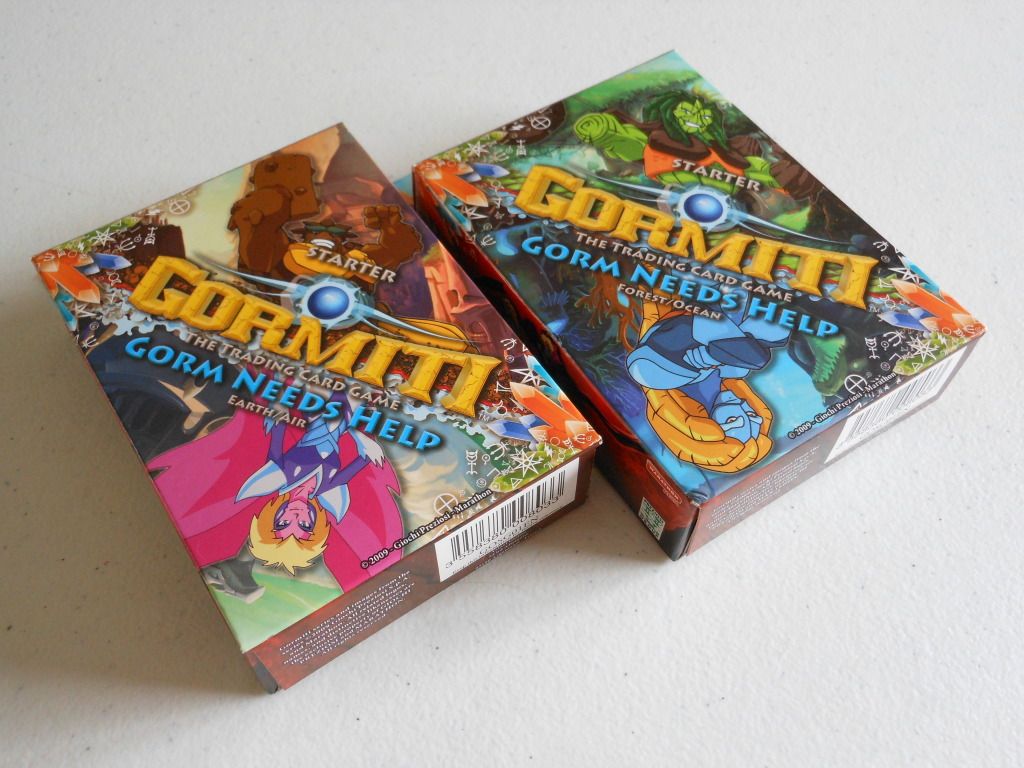
Gormiti: The Trading Card Game starter sets
The two offending items.


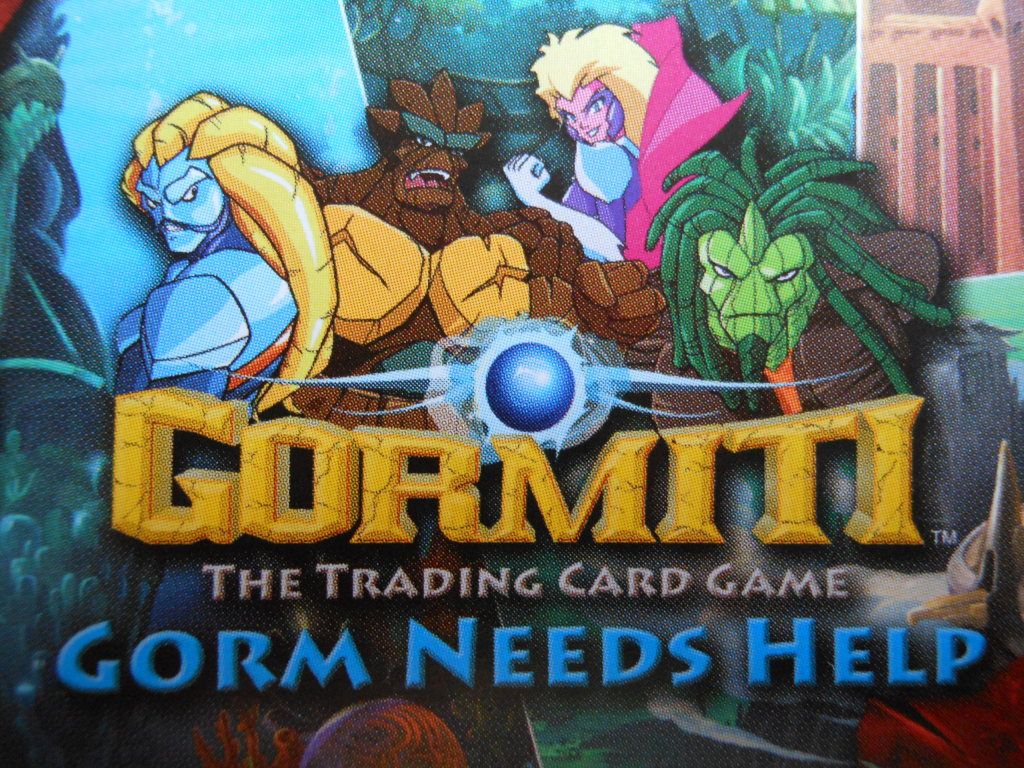
This is one of those games based on a cartoon that has also spawned a whole bunch of toys and other paraphernalia. That means the theme will automatically appeal to those people who know the show, and will totally alienate everyone else with lots of stupid words and named characters.

As far as storyline goes, there seems to be four children who can turn into monsters, and they fight other monsters. I'm not really sure how or why they do this, and I don't really care. It's all a bit silly, and it doesn't really matter anyway.

I purchased both of the starter sets, each containing 40 cards and a rule book. One of the starter sets is themed "earth/air" and one is themed "forest/ocean." I guess if I knew more about the show, I might know why fire has been replaced with forest as the fourth element.

Both boxes also claim that "Gorm needs help." I don't know who Gorm is, but I suspect he may be the designer.

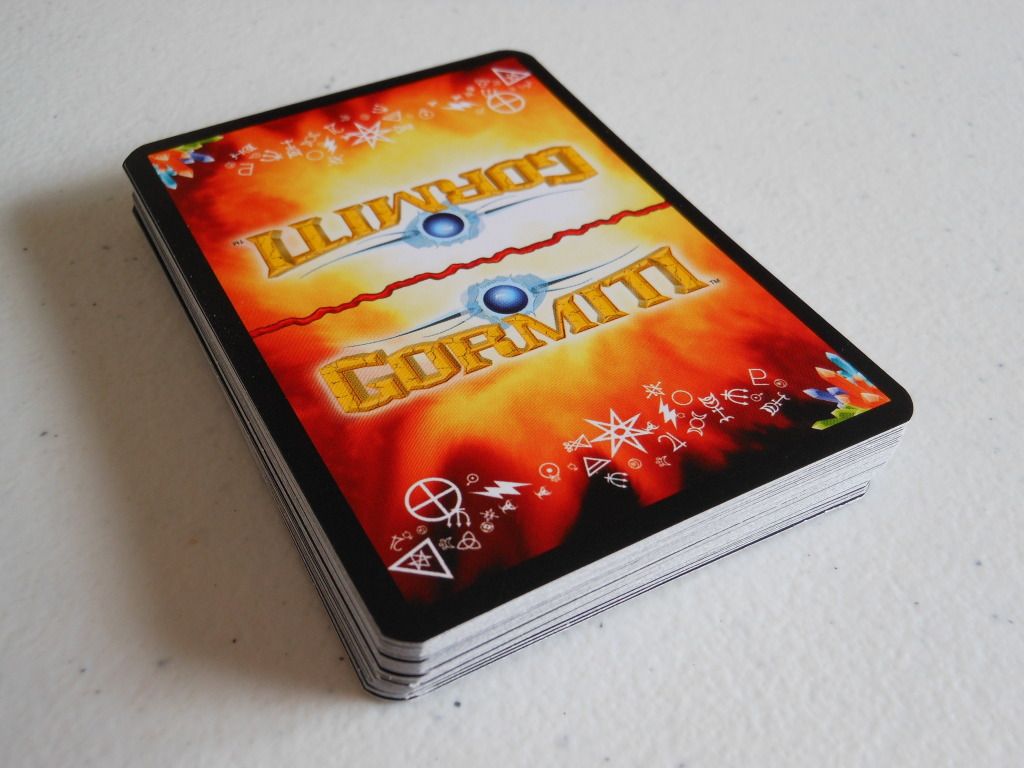
Gormiti: The Trading Card Game deck
40 cards doesn't seem a lot, but you only draw one card per turn.


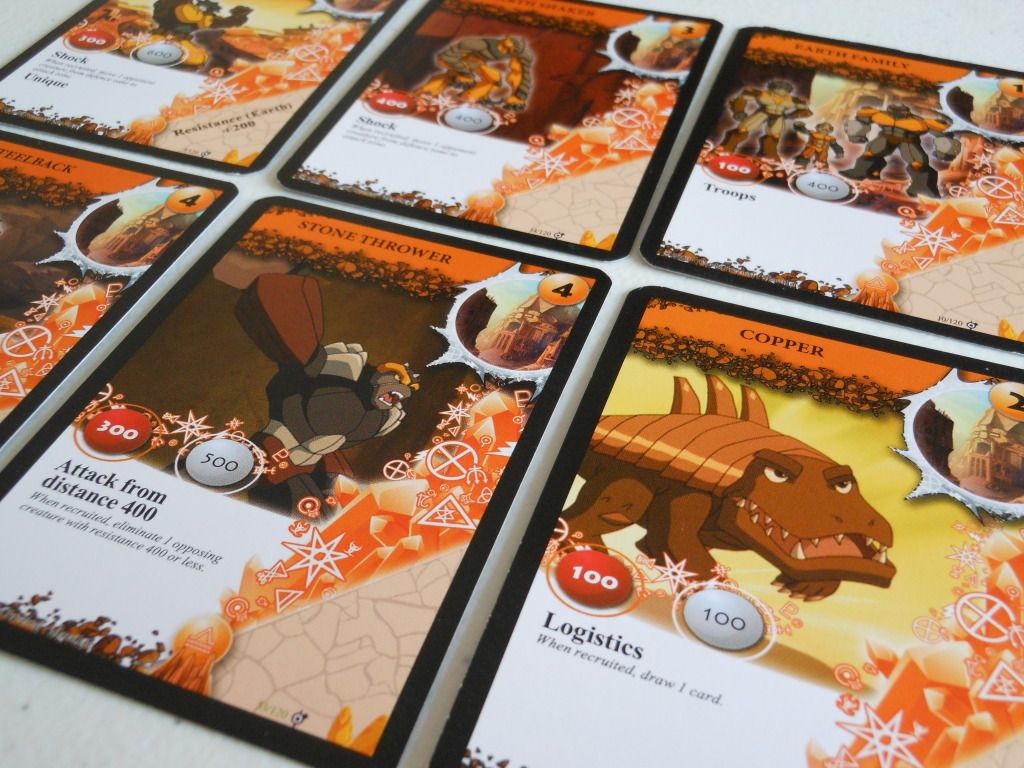
The cards are actually very decent quality, and they are well printed. The downside is they use artwork from the cartoon. It's bold and bright, but it looks bloody awful all the same. This is definitely not one of those collectable games that encourages you to buy more cards simply so you can marvel at the exceptional artwork.

One of the first things you will notice flicking through one of the starter decks is that all of the cards represent characters. There are no items, no events, no spells. Furthermore, if a character has a special ability (only a few of them do), then the details of the special ability are written in full on the card, so you don't need to reference the rule book at all during play. It makes it all very obvious that this is not going to be a particularly deep game. The emphasis is on dropping characters on the table and then letting them fight.

To start a game, each player takes a 40-card deck, gives it a shuffle, and then draws a number of cards that are set aside face down. Player one sets aside five, while player two sets aside six. These cards represent "life orbs" or some such nonsense. When they are all gone, you are dead, and you lose the game.

Players then draw a hand of five cards and play begins.

In each turn, the first thing that happens is a threat level increases. It begins at level one on the first turn, and increases by one point in each round. (Note: The threat chart is printed on the back of the rule book, and you need to track progression with a penny or something. Quite annoying if you should happen to need to look up a rule during a game.)

Gormiti: The Trading Card Game rules
The rule book.


The total threat represents the amount of power each player has available to summon monsters. Yes, you read that right. Each player has the exact same amount of power to summon monsters each turn, and that amount is determined by the game round and not by anything either of the players has done.

This is an utterly bizarre element of the game. I believe it may have been done to simplify the game for younger players, as it removes one of the more difficult elements of deck construction. That is to say, this rule removes the need to create a deck with a balanced mix of creatures and power-producing cards (such as "land" cards in the game Magic: The Gathering), so when you are putting together a deck, you just have to worry about including all your favourite characters.

After the threat level advances, player one draws one card into his hand. He can then summon characters. Each character has a summon cost, and you can summon as many characters as you like as long as their total summon cost does not exceed the threat level. These characters are played to a recruitment zone, which simply means they cannot be used to attack this turn.

The problem is, most of the characters have a summoning cost of four or more, and some are as high as seven or eight; so if you get unlucky with your opening hand, you may not be able to play a character for the first three or four turns. Not only is this boring, but if your opponent is lucky enough to summon a character with a value of one in his first turn, then you could be faced with two or three turns of being attacked with no way to defend, resulting in a very short game indeed. There really is nothing more annoying than playing round after round in which your opponent pecks away at your health because you are unable to bring any characters into play.

Gormiti: The Trading Card Game in play
A sample of the glorious artwork on the cards.


Yes, this is one of those games where bad luck with your initial hand spells instant defeat; and there's nothing you can do about it.

After summoning, you can attack with any characters that are not in your recruitment zone. You can attack with all of your characters, but it is usually a good idea to hold back a few characters to defend with when your opponent attacks.

To attack, you specify which characters are involved. Your opponent then selects defenders. One character can defend against each attacker. For each unopposed attacking character, the defender will lose one "life orb."

If a character's attack is blocked, you compare the attacker's strength to the defender's resistance. If the strength is higher, the defender is killed and the attack gets through anyway. However, you also compare the defender's strength to the attacker's resistance, and it is possible for the attacker to die. It is therefore possible for both an attacker and defender to die at the same time.

Some cards also have a bonus modifier for strength or resistance printed in the bottom right corner. During any combat, players can play any number of cards from their hands as modifiers to try to help win a fight, after which, those cards are discarded. Of course, if you use all your cards to modify a battle, you won't be able to use those cards to summon the characters printed on them, so there is a bit of hand management involved in deciding when to play a card as a modifier and when to hold on to it to play the character instead. This simple choice probably constitutes the only slightly interesting decision a player will be presented with on a turn.

After all the combats are resolved, and dead characters removed from play, the defender must remove one "life orb" from his stack for each hit that got through. The way health is handled is probably the most interesting aspect of the game, as each "life orb" card you lose gets put into your hand; so as you take damage you gain more cards to help you fight back. It's a relatively interesting balancing mechanism to prevent a runaway winner, and feels like it has been half-inched from a much better game.

Once player one has finished attacking, any characters in his recruitment zone become ready for use, and then player two summons characters and attacks. When player two attacks, player one can only defend with characters that did not attack this turn (either because they were kept back on purpose, or because they were waiting in the recruitment zone).

And that's it. Lather, rinse, repeat.

No interrupt cards. No special event cards. No way to draw more cards. No way to summon stronger characters until the required number of game rounds have passed. No way to link together card combos in exciting ways.

No bloody fun.

Navia Dratp Gyullas Turtle
This guy has nothing to do with Gormiti.
He is from a much better collectable game that I will be reviewing next time.
10 points to anyone who can name the game.


If one player can get lots of characters out early on, the game will be over in just a few turns, especially if the other player is unable to summon any characters to defend with. Conversely, if both players are able to get characters out early on, the game can drag on for an age as neither player is able to land a successful attack.

That means, the game will be quick and boring or long and boring. You don't have a choice in the matter, just like you often will not have a choice of which card you can play on a turn. This is just an exercise in drawing and placing cards, with no real thought required.

Although I generally enjoy "heavy" games, I don't actually have a problem with games that involve quite a lot of luck, or which have only limited options available on a turn. However, I do insist that a game should be fun. This game isn't fun. It's oh so dull. The designer tried to take a trading card game and streamline it for simplicity and accessibility for a younger market, but in doing so, all the fun got streamlined out. What's left can hardly be classed as a game at all.

As I already mentioned, I paid £2 to get the two starter sets. Even at that price, I don't think I got value for money. I will certainly not be keeping this game. I mean, it doesn't even have any pretty pictures to look at.