
Anyway, I'm back now, and this time I thought I'd do something a bit different. Not an out of production board game... Not even a board game... It is (to paraphrase Monty Python) time for something completely different.
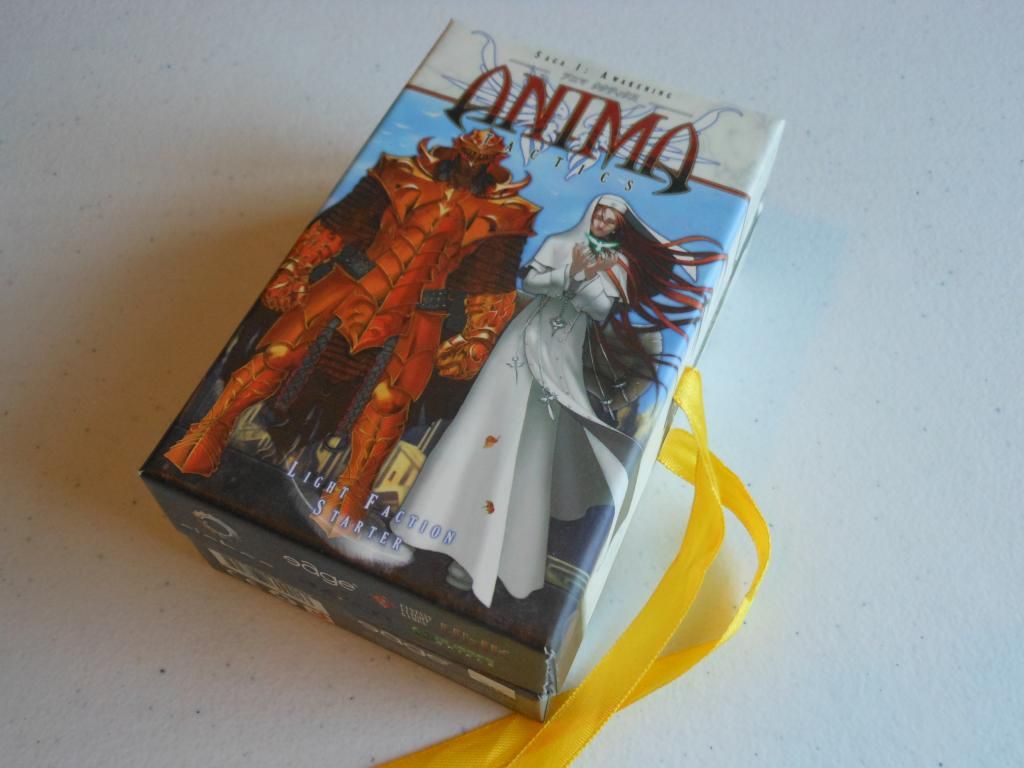
Anima Tactics
Published by Cipher Studios
Deisgned by Carlos B. Garcia Aparicio
For 2 players, aged... Hell, I don't know
My involvement with the game Anima Tactics has been rather unusual, and I'm going to say right from the start that I haven't played the game enough to give a proper review.
You see, I first heard about Anima Tactics shortly after it was released. I saw some photographs of some truly beautiful hand-painted miniatures, and I was immediately interested. Oh yeah, that's a point. I should mention that this is a miniatures game. You know? One of those games where you buy lumps of pewter that you have to stick together and paint yourself. Doesn't sound like your idea of fun? Best move on. Nothing to see here...
Anyway, back to the story.
I saw the miniatures, which had a sort of anime vibe mixed with Western influences, and my interest was piqued. Then I saw some of the artwork, which I really liked as well. It wasn't long before I had bought the two starter boxes that were available for the game at the time.
I was very excited to receive those starters, but by the time they had turned up, my interest had already started to wane (I'm fickle like that). I assembled the models, and tinkered with the game a bit; but I quickly realised that there wasn't enough "game" in the starter sets, and it would involve buying a lot more figures before I could get a real feel for whether I liked it. It started to seem like too much effort and money, so the starter sets got chucked in the back of the cupboard. Eventually, I forgot about them.
Recently, I was going through some stuff, and I found the two starter boxes. They looked so good, and I was reminded of what initially drew my interest to this game. I was compelled to do what I had never got around to the first time: paint the models.
Since then, I have bought another box of miniatures, and a few extras, and I am gradually painting them up. The starter boxes only come with a stripped down version of the rules, and that is what I have been playing with at the moment. The full rules are available as a gorgeous hardback book, but this game doesn't seem to have done too well in the UK and those rules are not easy to find. Luckily, my wife managed to source a copy of the rules for me; but she's doing that annoying thing where she says I'm not allowed it until Christmas. I mean, seriously? It's July! Don't you just hate it when they do stuff like that?
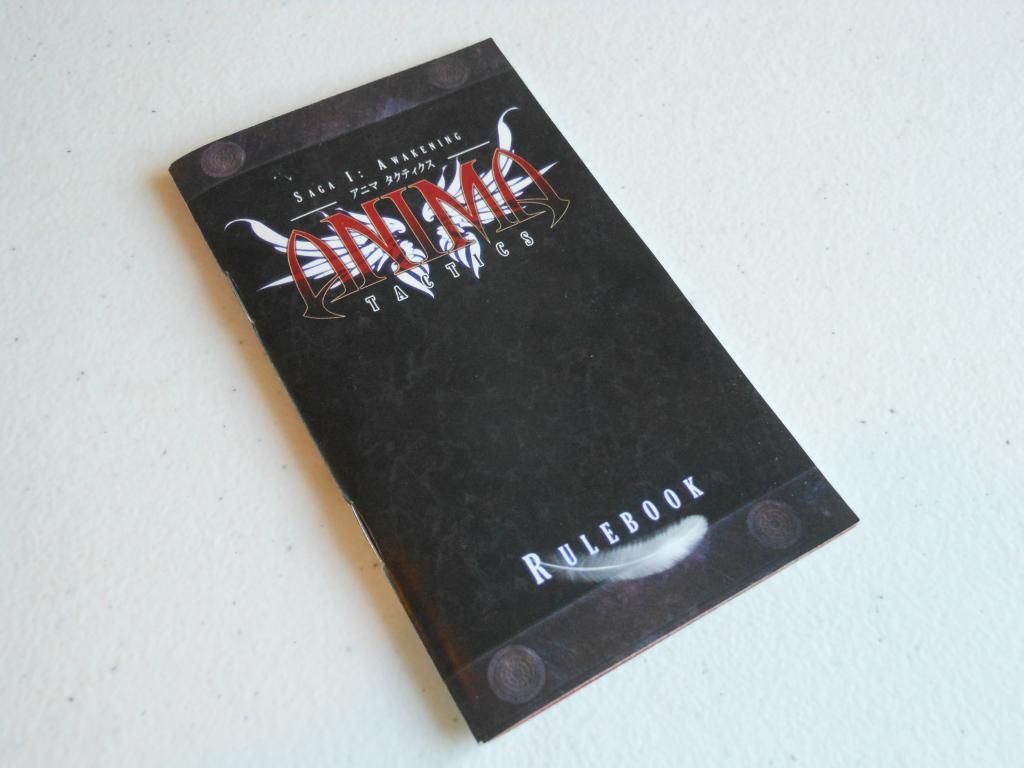 |
| The starter rules - short, but functional |
So, with that preamble out of the way, what is this review actually about?
As it stands at the moment, I have only played with the starter sets. That means I have only had battles with two characters on each side, using the basic starter rule set. That's what I'm going to be reviewing here.
It may seem odd to write a review based on such limited exposure to the game, but as far as I am concerned, if a company releases starters for a game, then the game should be playable (and reviewable) based only on the contents of those starters. However, I do intend this to be an ongoing project. As I paint and add characters to my games, I will post reviews of those new characters, and hopefully, over time, a bigger picture of what this game has to offer will be built.
Now, about that review...
First things first. You should know that Anima Tactics is a skirmish-based game. This was one of the things that appealed to me. I don't have time to paint massive armies, so a game in which most battles are fought between teams of just six to eight characters seemed ideal. Unfortunately, the starter sets don't give you six to eight characters. They give you two.
But let's start with the positives: The boxes that each starter set comes in are little works of art. Now, I love attractively designed boxes. I like to pick them up, look at them, stack them, put them on shelves based on their size. That probably makes me sound like some kind of window-licking weirdo, but there you go. I like boxes, and these are really nice ones. They have great cover art, and little ribbons on the side for tying them shut.
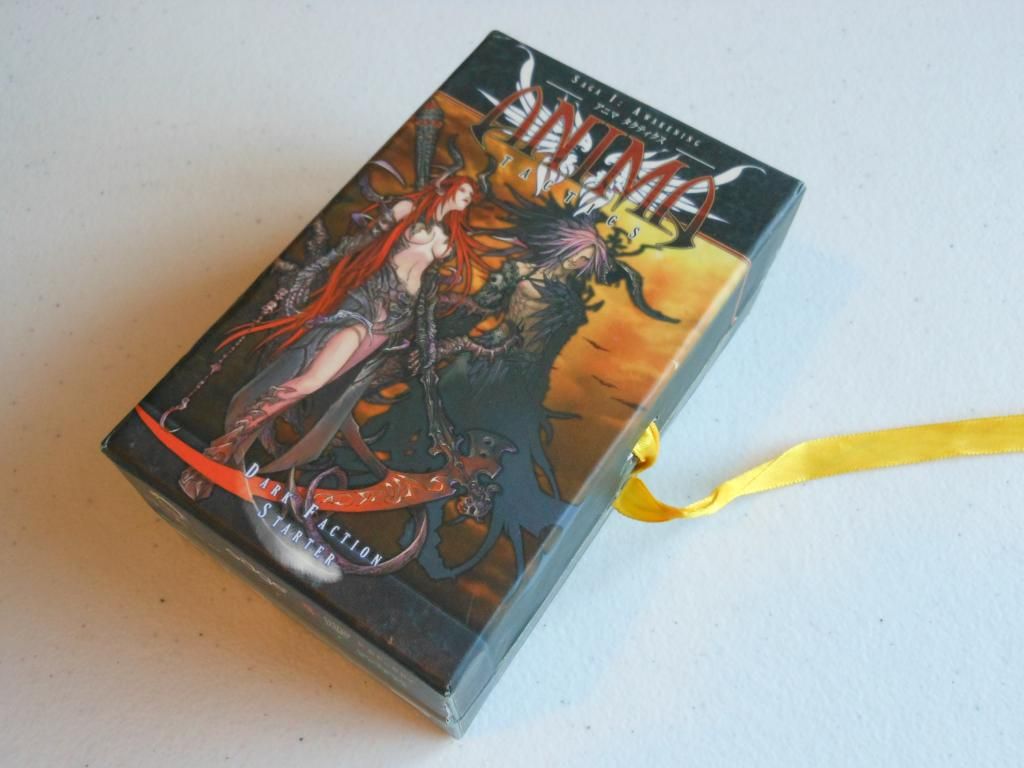 |
| The dark starter box... So pretty |
Each of the two sets has the same contents: A condensed rulebook, some plastic counters, one dice, two pewter miniatures, one character card for each miniature, and two advantage cards (which represent equipment and tactics you can use during a fight). One set features "light" characters, and one set features "dark" characters.
The components are generally a mixed back. The miniatures are lovely, but of course, you have to paint them yourself. It should also be noted that I got the original dark starter set which included the characters Dark Chesire and Shinigami Ayl. Ayl was quickly switched out by the manufacturers, and the dark starter now features a different character called Bael. I believe the switch was made because Ayl was an absolute pain in the proverbial to put together. In fact, she was such a pain that I ended up modding her, so mine doesn't look like the one you will get if you buy her.
 |
| Dark Chesire and Shinigami Ayl |
The character and advantage cards are also nice. They are a good thickness, and are well illustrated. They do have black borders and square corners, but as you don't ever shuffle the cards, this shouldn't be a problem.
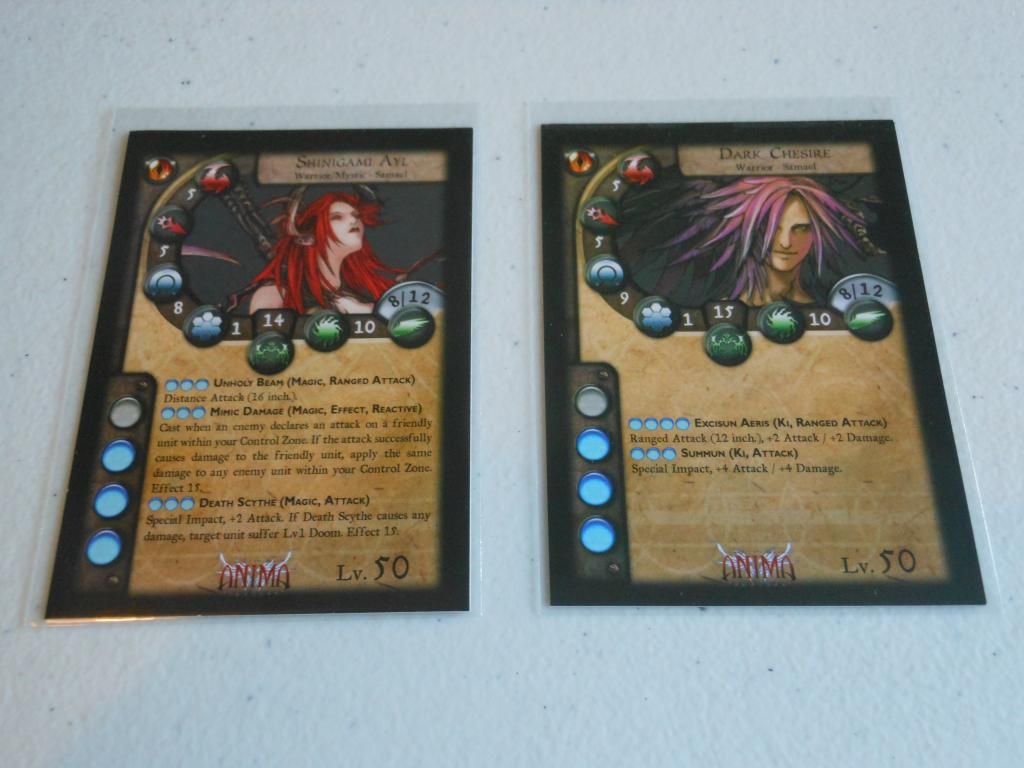 |
| Dark starter character cards |
The plastic tokens that you will use throughout the game are very thin, and a bit like tiddlywinks. They are functional, but cheap.
The worst component in each box is the sheet of tokens. These tokens monitor states during the game, such as poison and wounds. The token sheet is the size of a standard playing card, and you are supposed to cut them out. This obviously means they are very small, thin, and fiddly. I didn't even bother cutting them. I had a nice set of Games Workshop tokens made out of plastic, so I use those instead.
 |
| The token sheet... My advice: Don't bother |
Overall, the contents of the starters are fine, but it is their limited nature that causes the problem (and led to me shelving this game for so long). There just isn't enough stuff in each box. For a start, you only get two characters. That isn't even enough for a single warband, let alone enough to have a fight. I realised two characters wouldn't be enough, so I bought both starters at the same time, and then realised even that isn't good enough. Having only two characters limits your options each turn, and reduces what could be a tactical fight into a basic dice-rolling exercise.
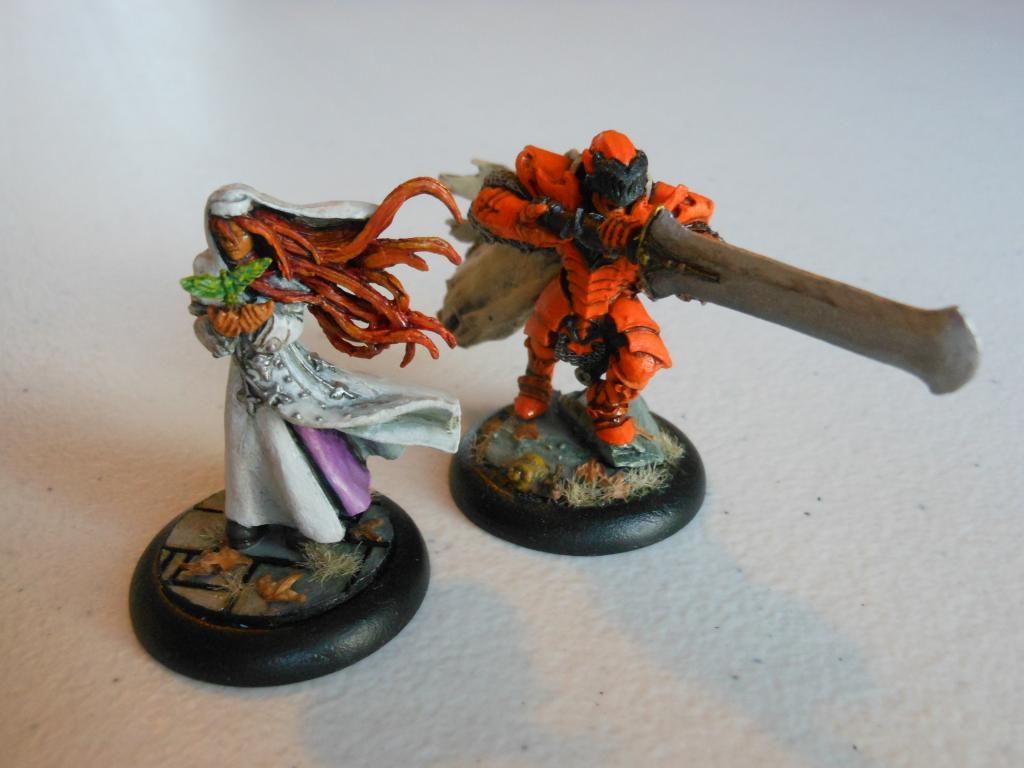
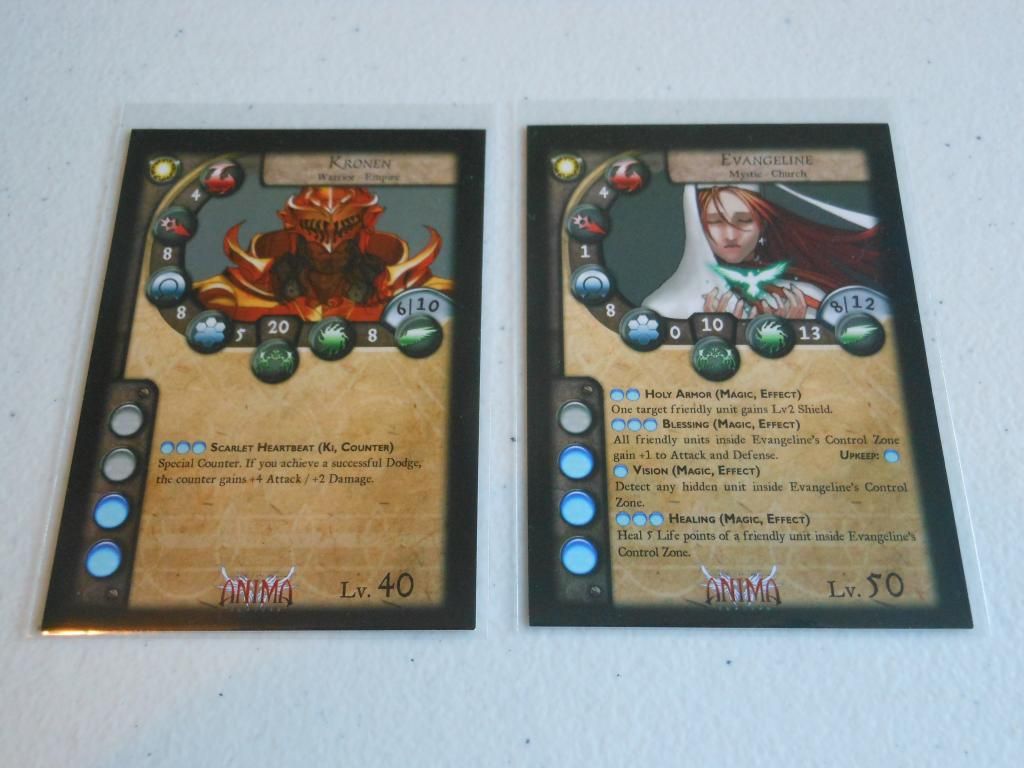
This problem is compounded by terrible balancing between the two sets. In the dark set, Chesire and Ayl are strong fighters with ranged combat abilities. In the light starter, you get a meat shield called Kronen, who can soak up damage but couldn't hit the broad side of a barn, and Evangeline, who is your standard mystic-type who provides buffs for other people on the team, but who can be killed with one hit. The dark team have a serious edge right out of the box, and you will definitely want to buy some extra characters straight away.
The other major problem, is the streamlined rules book. It is written well enough, but it is missing a lot of the rules that add tactical depth. Furthermore, you don't get any fluff about the world or the characters, which makes it difficult to feel invested in what you are doing. Getting that hardback rule book really seems like a must.
It's actually a real shame that the starters give such a poor first impression of the game, because the rules seem pretty good. I don't want to go into a lot of detail about them, but you basically put together a warband of certain size based on character levels. Most characters have a level between 40 and 60, so a game with warbands totalling 200 levels will usually have about four characters per side.
When you build your warband, you can either build a dark force, a light force, or a force based on a specific faction. This is quite an interesting concept. Basically, each character has an affiliation and a faction. If you build a team based on affiliation, then you can pick characters from any faction, but they must all share the same affiliation (there are also characters with neutral affiliation, who can team with anyone). If you build a team based on faction, you ignore affiliation completely, but every character must be from the same faction.
The starters demonstrate this in action. In the light starter, you get two light characters, but one is from the Empire faction and one is from the Church faction. This means you can field the light starter as a light team, but not as a faction-specific team. Meanwhile, the dark starter contains two dark characters who are both from the Samael faction, meaning these two characters can work together regardless of how you decide to build your team.
 |
| Evangeline and Kronen |
When building a team, you can add advantage cards, which you must also buy with levels.
Once you are in the thick of the fight, the most interesting mechanic is the energy system. Each character has an energy bar, which is usually four or five space long. Every turn, each character recovers a certain amount of that energy. The energy is used to power all of your actions and special attacks, so there is a kind of resource management going on. If you use all your energy to attack, you won't have any left to defend yourself or do anything else for the rest of the turn. It might then also take you a couple of turns to recover enough energy to be able to do anything else useful. It's a very cool system, and I really like it.
The combat is also pretty neat, as it allows your opponent to dodge, counterattack, and do special reactive actions. It is quite "mathy" though. The general concept is you declare an attack. Your opponent decides if he will dodge or counter. If he does, he expels some energy and gets to add the roll of a D10 to his defence (and, if he selected counter, he can attack you if you miss). You then roll a D10, and add your attack value plus any other modifiers. If your total is greater than the target's defence, you have hit. The difference between your attack roll and the target's defence is added to your damage value. You then deduct the target's armour value. The final result is the amount of wounds sustained. It sounds a bit complicated, but it is actually very straight forward, and combines "to hit" rolls with opposed dice rolls in an interesting way. You can also use characters to intercept charges from enemies in order to protect weaker characters.
It's all very fluid, and very exciting.
So, after all that, am I glad I dusted off those starter sets? The short answer is yes.
I am trying to paint up my other models as quickly as possible, and I am also putting together some terrain to play on (yeah, it's one of those sorts of games). However, the rules also provide instructions for playing on boards, for those people who don't like using tape measures, and I have tried this as well. I have also used hex-based grids from The Lord of the Rings: The Tradeable Miniatures Game and that works really well too.
I have 11 characters in total, and I am excited to get all of them to the table. If only I could find a bit more time to paint them...
Now, I suppose I should do some kind of summary. It's tricky, because this is really a review of the two starter sets, but it is also a review of the game system.
I really like the game system. I don't think it is doing anything dramatically new or exciting, but it is a really solid system for having short skirmish games between eight or ten characters. Every character feels unique, and brings exciting new tactical options. In this game, you are not just fielding a bunch of generic soldiers. Every character has a history, an affiliation, and a team. Every character has unique special powers. It's almost like what would happen if a miniatures game and a roleplaying game had a baby.
I love a lot of the miniatures in the product line, and I think all four characters from the starter sets look very good indeed. There are definitely some ugly miniatures in the range, but the great thing is, I can just ignore them and build my unique fighting force with the dozens of other cool-looking characters I want to rush out and buy.
I also like the fact that each character comes with its own character card, so you don't need to keep buying army faction books or anything like that. If you see a character you like, you can buy it, knowing that you will be able to build it, paint it, and use it straight away. In fact, every miniature also comes with plastic tokens for marking energy depletion, and most also come with a new advantage card to give you even more army-building options.
 |
| Kronen and Evangeline character cards |
But there you go, I'm talking about other characters and the game in general again. It's hard not to, when the system offers so much potential. It's just such a shame that the starters are a poor introduction. If you want to get into this game (and there are plenty of reasons to do so), the best plan is to get both starter sets, for the cool characters and the basic rules, and then also cherry-pick a few other characters you like the look of. If you enjoy the game, you can then buy a few more characters. Maybe you could invest in that hardback rulebook too...
Is it Christmas yet?


