Showing posts with label Reiner Knizia. Show all posts

Friday, 12 September 2014

Review - Ingenious: Travel Edition

Ingenious: Travel Edition


Ingenious: Travel Edition
Published by The Green Board Game Co.
Designed by Reiner Knizia
For 2 players, aged 8 to adult
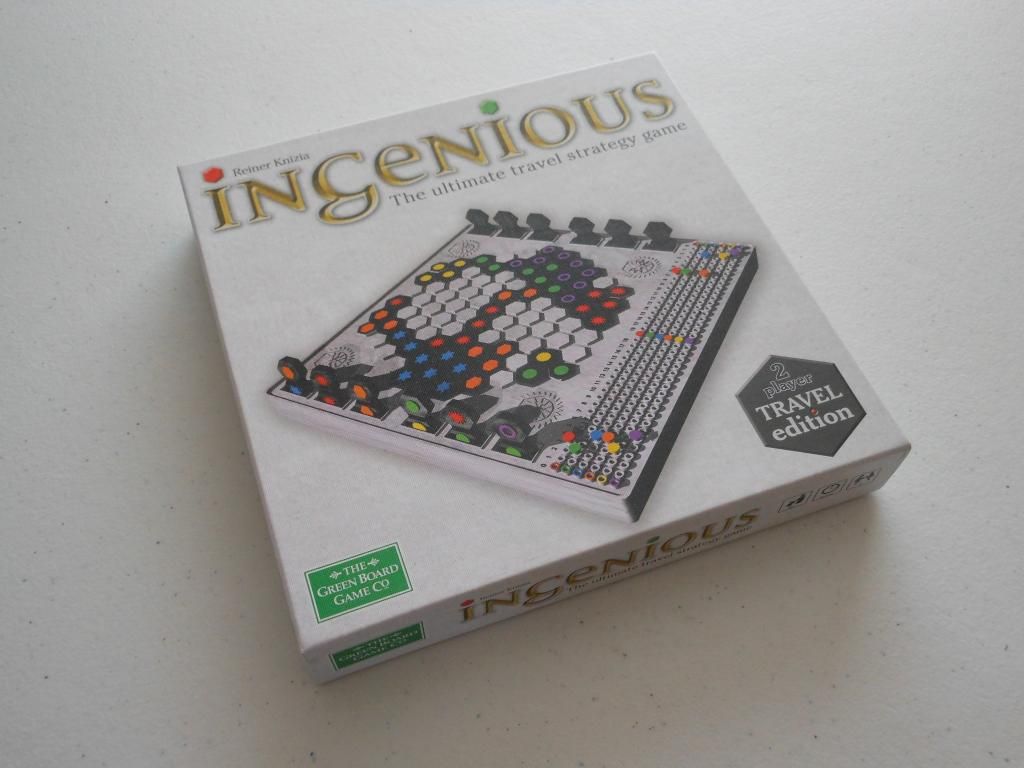
Ingenious: Travel Edition box
It isn't much to look at, I admit...


I've heard about this thing called a vacation, and recently I've been thinking it might be nice to try one.

As a novelist, freelance editor and writer, blogger, dad, and husband, free time isn't something I tend to have in huge quantities.

Now, don't get me wrong; I've done that thing where you go to another country. For example, for Christmas 2013, I took my daughter to Disneyland Paris. It was the most magical experience, and the look of sheer delight on my daughter's face as we passed through the main gates into a world of larger-than-life Disney characters and artificial snow is something I hope I never forget.

It even made going to France tolerable.

(I'm joking. I'm joking.)

(Nothing would make that tolerable.*)

However, going to Disneyland wasn't exactly a vacation. It was a week of running to get to different rides, running to beat other people to the queue to see the princesses, running to find somewhere to eat that wasn't booked solid, running to get a good spot before the parades started, and just running to fit as much as possible into each day.

Endless running.

I still have this recurring nightmare where Mickey Mouse chases me down a long corridor that goes on forever.

But that's besides the point.

The point is, when I was packing for my trip to Disneyland, I optimistically slotted a few games into my luggage, hoping that I would have some time to play games with my wife in the evening while my daughter slept.

What was I thinking? My daughter didn't sleep.

The games never even made it out of the luggage.

But one of the games I packed was Ingenious: Travel Edition. A cute, portable edition of the classic abstract game by Reiner Knizia.

Ingenious is a simple game in which players use tiles shaped like two hexagons fused together with a symbol on each hexagon. At any one time, a player has six pieces in hand, and on a turn, players simply place one piece on the board.
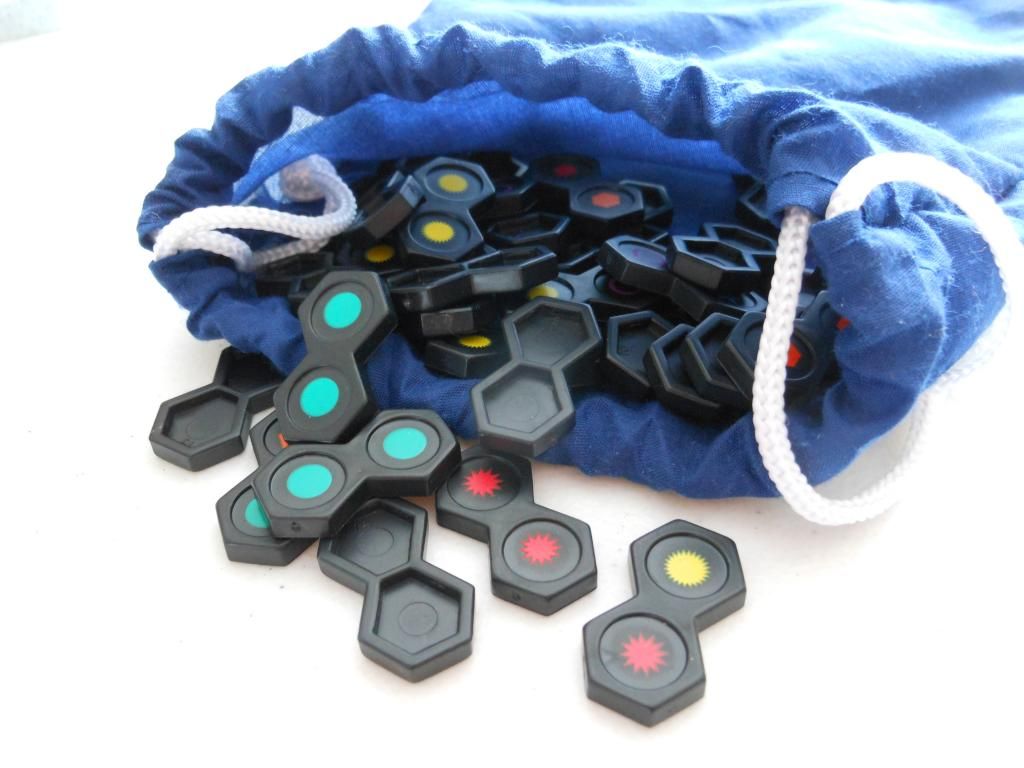
Ingenious: Travel Edition pieces
The cute playing pieces.


Scoring is just as straightforward. When you place a piece, each symbol has up to five adjacent spaces, and these represent the directions in which it is possible to score. You add up all the symbols in a continuous line, in each of the five directions, that match the symbol on the piece played. You score that many points in that colour.
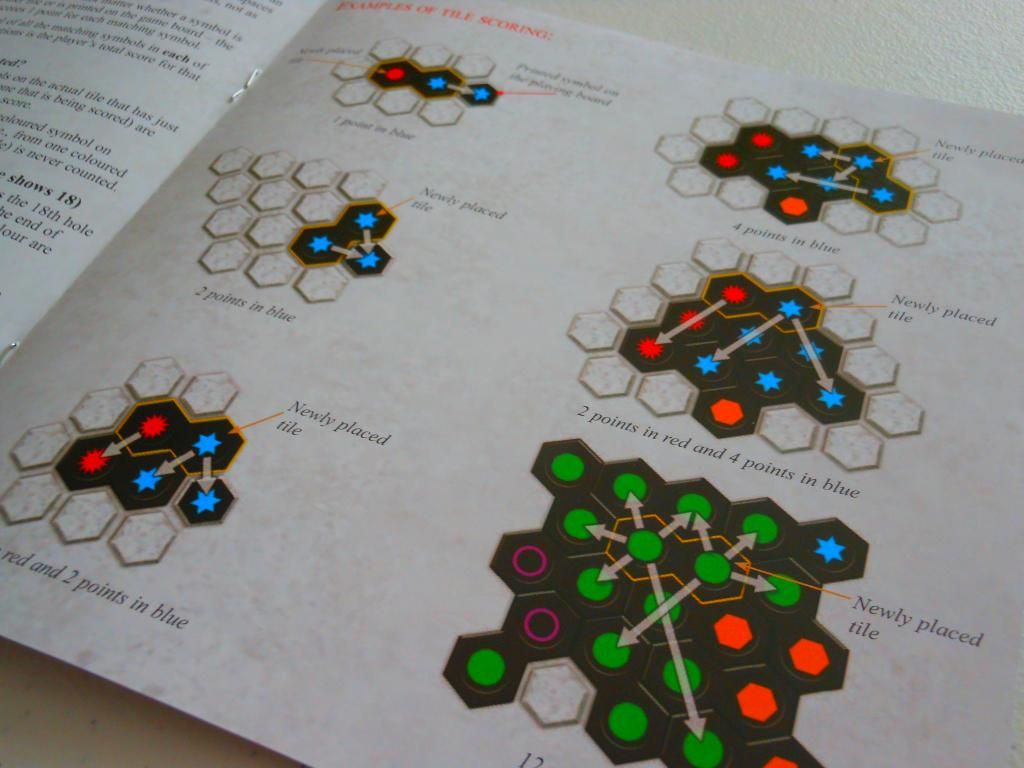

Ingenious: Travel Edition rules
A diagram for scoring, because my description isn't very good.


But here's where it gets really fun: At the end of the game, your final score is your lowest score out of the six different symbols. That means you need to constantly balance what you are doing. Sure, you could score 18 points in blue stars over the course of the game, but if you only score 10 purple rings, then your final score is 10.

Ingenious: Travel Edition playing pieces
More of those cute playing pieces.


The only other rule of note is that, if you score 18 points in any symbol, you get to shout "Ingenious" and place another piece, creating the opportunity to string together combos and really get ahead of your opponent.

And that's basically the whole game. Super streamlined, easy to teach, and about as clever as it gets.

Considering the game boils down to the simple act of placing a single tile, there is an incredible amount of strategy and tactics. Do you play a tile to block your opponent from scoring? Do you race to score lots of points in a single symbol in order to get bonus turns? Do you try to keep all your scores level so you can string together an epic turn where you hit 18 points with multiple symbols one after another?

And when it is your opponent's turn... Oh, the agony. That moment where you know the piece you want to play. You know where you want to play it.

And then your opponent reaches for a tile...

Not there. Don't place it there. Not there. No.

No...

AAARRRRGGGGHHHH!

Infuriating, hilarious, and yes... ingenious.

I have had my copy of Ingenious: Travel Edition for some time now. It was bought for me by a good friend, and I have played it a lot. It has a lovely moulded plastic board, with cute moulded pieces that lock into place so nothing moves around while you are travelling; and it has sweet scoring pegs that remind me of that old game Mastermind.

Ingenious: Travel Edition board
The board, moulded in plastic to prevent pieces sliding around.


Unfortunately, being a travel edition, everything is very small. The pegs are difficult to manipulate, and the playing pieces aren't big enough to feel substantial as you drop them onto the board.

Worst of all, the travel edition is restricted to just two players.

That is why I didn't hesitate to buy the "full-scale" version of Ingenious when I found it in one of my local charity shops (still sealed, and priced at just £3, which is silly). Since then, the travel edition hasn't had a look in, and to be fair, I cannot see myself fumbling around with those little pegs anymore.

As such, despite being a superb game, Ingenious: Travel Edition is not staying in my collection.

I mean, sure, I could keep it for when I go on a vacation sometime. But really, when is it likely I'm ever going to do that?


* Honestly, I am joking. My time in Disneyland Paris was an absolute joy, and the people there were amazing.

I'm going to ramble now... You don't need to read this; it has nothing to do with games.

Every day I queued with my daughter to see a princess. For anybody who has never done this, it involves waiting for around two to three hours in a long corridor with no seats. At the end of the corridor, there are two different screens, and behind each screen is a princess. You get to see one of them, and you do not get to pick.

My daughter had been pestering me to see Rapunzel every day.

Every day we saw Not-Rapunzel.

On the very last day, we got up to the screens, and the woman working the gate smiled and told us we would be going through the screen on the left. While we waited, I took the chance to talk to her, and explained that we really wanted to see Rapunzel, and so far we had not been able to. She smiled kindly at my daughter, and them motioned me towards the screen on the right. Not the one on the left.

We rounded the corner, and there was Rapunzel. My daughter nearly died on the spot. I almost burst into tears. And as Rapunzel chatted to my daughter (and my daughter explained how her favourite princess was Aerial!), the woman who had guided us to this screen popped her head around to see how much happiness her small act of kindness had generated.

I never got to thank that woman. I don't even know her name, and I doubt she will ever read this. And she has probably done the same thing for thousands of families, and for her it might not have been a big deal. But that woman made my daughter's holiday complete, and she enabled me to do something that every dad wants to do for his kids... Make a dream come true.

Sunday, 1 September 2013

Review - Head-to-Head Poker

Head-to-Head Poker
Published by Parker Brothers
Designed by Reiner Knizia
For 2 players


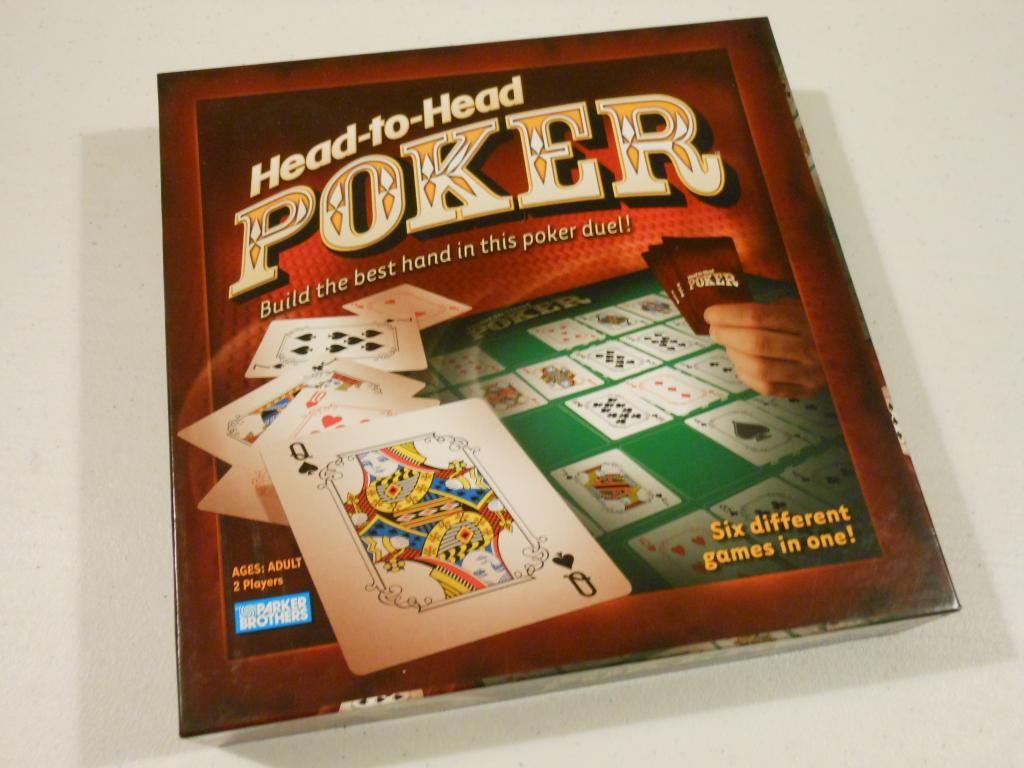
Head-to-Head Poker
Looks exciting, right?


Knizia is a bit of a genius when it comes to game design. I really like a lot of what he does, and a "flagship" Knizia title from a big publisher is usually something you will want to keep an eye on. However, the good doctor also (in my opinion, at least), tends to phone in some designs for a quick pay cheque. This means that his name is by no means a guarantee of quality. If you get him on a good day, you end up with Lost Cities; but get him on a bad day, and you end up with Battleship Express,  or Head-to-Head Poker.

Actually, that's being a little unfair to this game; because it's not like this game is bad. It's just... not really much of anything.

Now, I should say up front that this game isn't really designed for people like me: I don't play a lot of poker, I prefer board games to card games, and I like a bit of theme (even if it is pasted on). But, bearing that in mind, here's the review...

The game ships in a decent box (it's the same size as Castle Panic and Red Dragon Inn) and comprises a completely pointless board, a deck of flimsy, undersized playing cards, a dice, and several bags of chunky (and rather nice) poker chips.


Head-to-Head Poker cards
Rubbish cards.


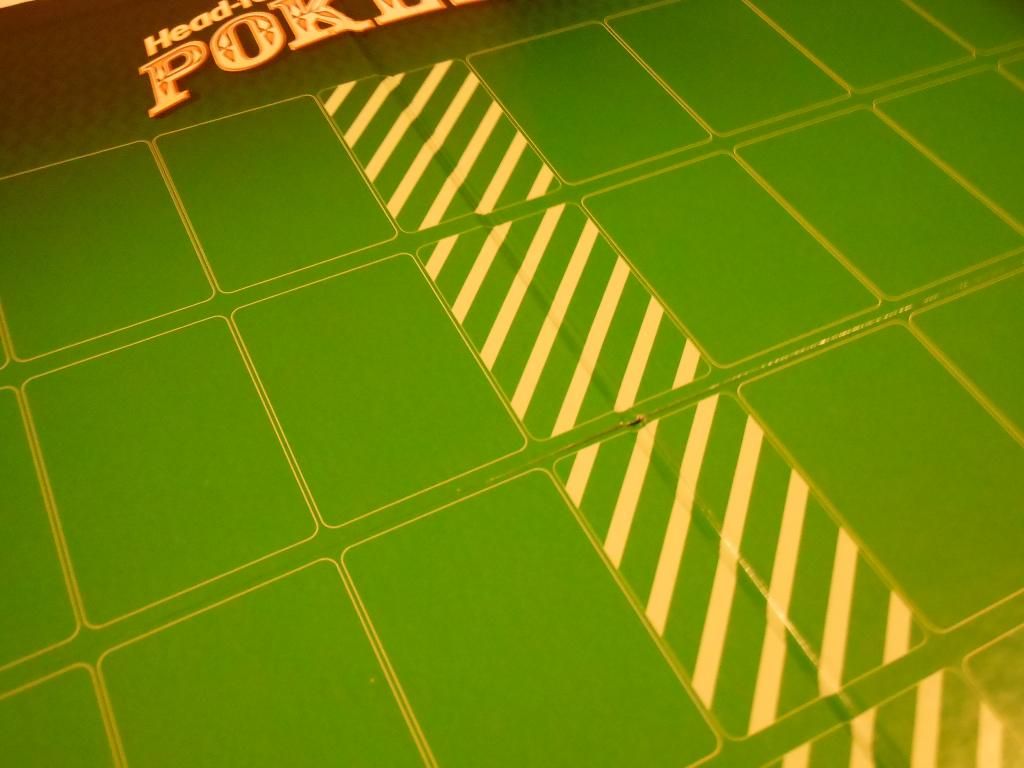
The game board is nothing more than a grid of spaces (five rows of nine spaces), and its only purpose is to show where you should lay a card. I suspect this is why the deck of cards is undersized: It keeps the board a reasonable size. Of course, a better idea would have been to sell the game without a board, with proper sized cards, and in an even smaller box. But hey, I'm not a publisher. What do I know?

The fifth (central) column on the board contains "common" spaces, and cards placed on these spaces can be used by both players. The four columns on either side of the common spaces are for the players (each player controls one half of the board).


Head-to-Head Poker board
The pointless board (note the shaded common spaces).


To begin the game (which lasts three rounds), you place three randomly drawn cards on the first three common spaces, and put some poker chips on each one.

The aim of the game is simple: Play cards (one at a time) to your half of the board to create winning poker hands. When a row on the board is full, you look at the four cards you played on that row, and compare it to what your opponent played for that row (remembering that the common card is added to each player's "hand"). The person with the best hand wins that row, and takes the poker chips that were placed on the common card. It's that simple.

Almost.

You see, at the start of each round, you have to decide what kind of game you are playing. To do this, you roll a dice.

If you roll a one, you are playing "Draw One." In this game, on your turn you draw one card and then play it onto one of the spaces on your half of the board.

If you roll a two, you are playing "Split Two." In this game, you draw two cards, play one, and give the other one to your opponent to play. Then your opponent does the same.

If you roll a three, you are playing "Hold Three." In this game, each player is dealt three cards. On your turn, play one card, and then draw back up to three.

If you roll a four, you are playing "Play Four." In this game, you are dealt four cards, and you play one each turn until you have used them all. Then you are dealt four new cards.

If you roll a five, you are playing "Share Five." In this game, reveal five cards from the deck. On your turn, you pick one of the revealed cards to play. Once all the cards are gone, draw five new cards.

If you roll a six, you are playing "Crazy." This means you roll the dice again to get a different game, and then play a version of that game in which you can place cards on either side of the board.

Okay. I nearly dozed off writing that rules summary. I apologise for quite how dull it was, and I promise I'll never do it again.

Probably.

Oh...

Almost forgot, there's some stuff about gambling in the rules as well. Optional stuff.

Stuff that isn't in this review.

Anyway, after you have played the first round, you play the second round (seems obvious); but in the second round you use four rows on the board instead of three. In the third round, all five rows of the board are used.

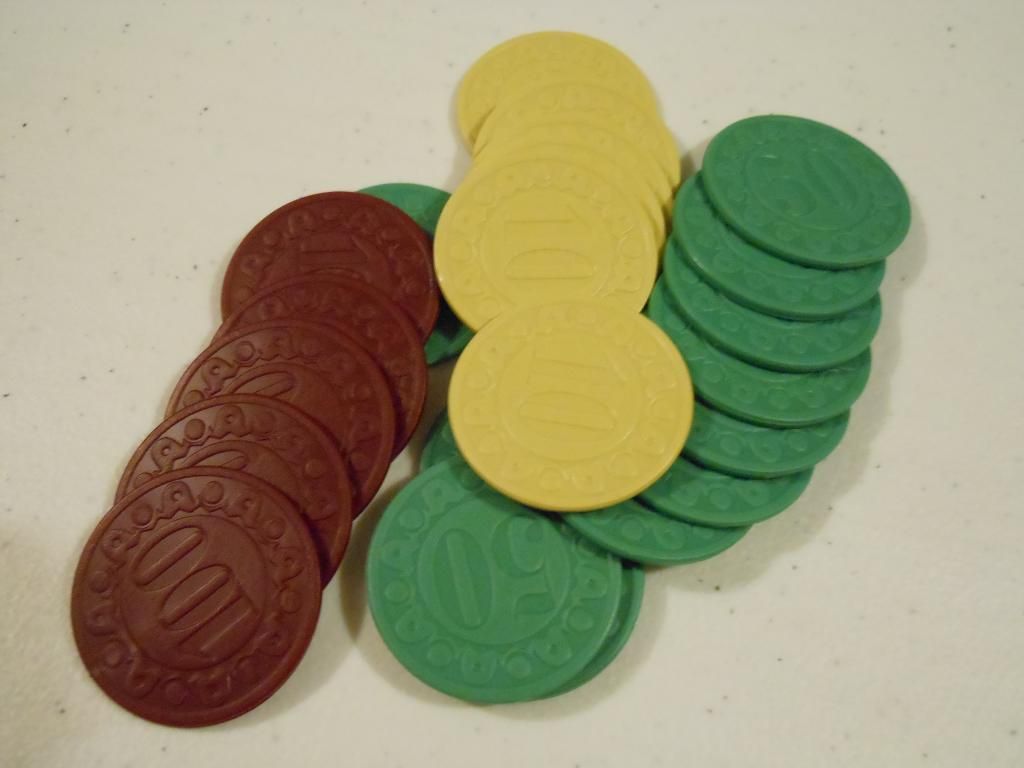
Then, you add up all your poker chips to find out who won.


Head-to-Head Poker chips
Did I win?


As you can see, it isn't a particularly complicated game. It doesn't seem to be particularly clever or original either. In fact, it seems like a rush job. It feels a little bit like Knizia was playing around with a deck of cards and a dice while he was on the phone to someone from Parker Brothers, and thought up the game on the spot.

It certainly isn't a bad game. It's just exceptionally ordinary. In fact, it's a game that can be played with any deck of cards and a dice (and believe me, any deck of cards you have in your home is likely to be better quality than the cards this game ships with). You don't need the board, and poker chips could be swapped for pennies (or just left out, as the gambling rules are optional).


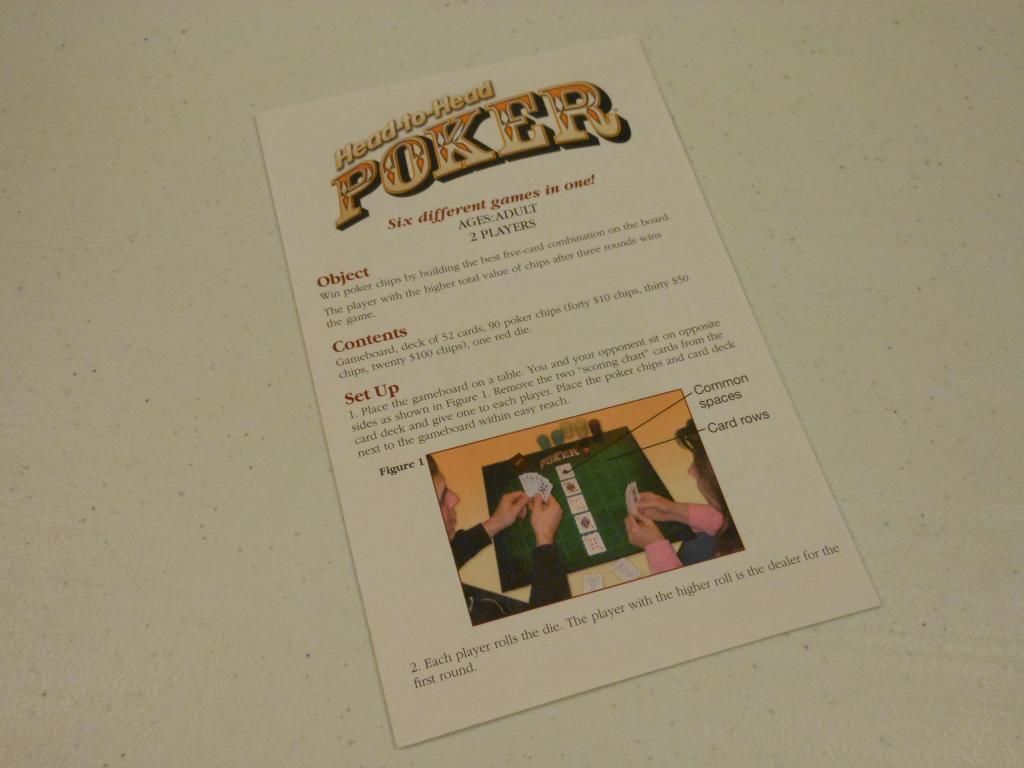
Head-to-Head Poker rules
The rules - probably the only thing worth keeping.


I am intending to photocopy the rule sheet, and then get rid of the game. That way I get the best of both worlds: I reclaim some space on my game shelf, but I still have the rules. It means I can play the game using a poker set I own that has proper, full-sized poker cards.

Although, having said that, if I went to the effort to get out my Poker set, I would probably just end up playing poker...

Wednesday, 11 July 2012

Review - Battleship Express

Recently, work commitments have meant I have not been able to keep my blog as up to date as I would like, so while I try to find the time to do some new reviews I thought I would quickly recycle this old one that first appeared on www.BoardGameGeek.com back in February 2011.

Battleship Express


Battleship Express
Published by Hasbro
Designed by Reiner Knizia
For 2-4 players, aged 7 to adult

So, I'm walking through my local supermarket toy aisle and I see Battleship Express sitting on the shelf. I've heard of the game before, but never really paid it any attention, but there it is... sitting there... and it's only £4. Any game that sits in the same price bracket as a drink at the bar is going to get my interest, but when that game also has a little note on the back cover saying "designed by Reiner Knizia" then how can I refuse? Add to that, the game can play from two to four players in 20 minutes or less, and I'm sold.

Having made the purchase, sneaking it into the shopping trolley between the bread and milk in hope of hiding it from the wife, what are my initial impressions? Basically, I think Knizia may have phoned this one in...

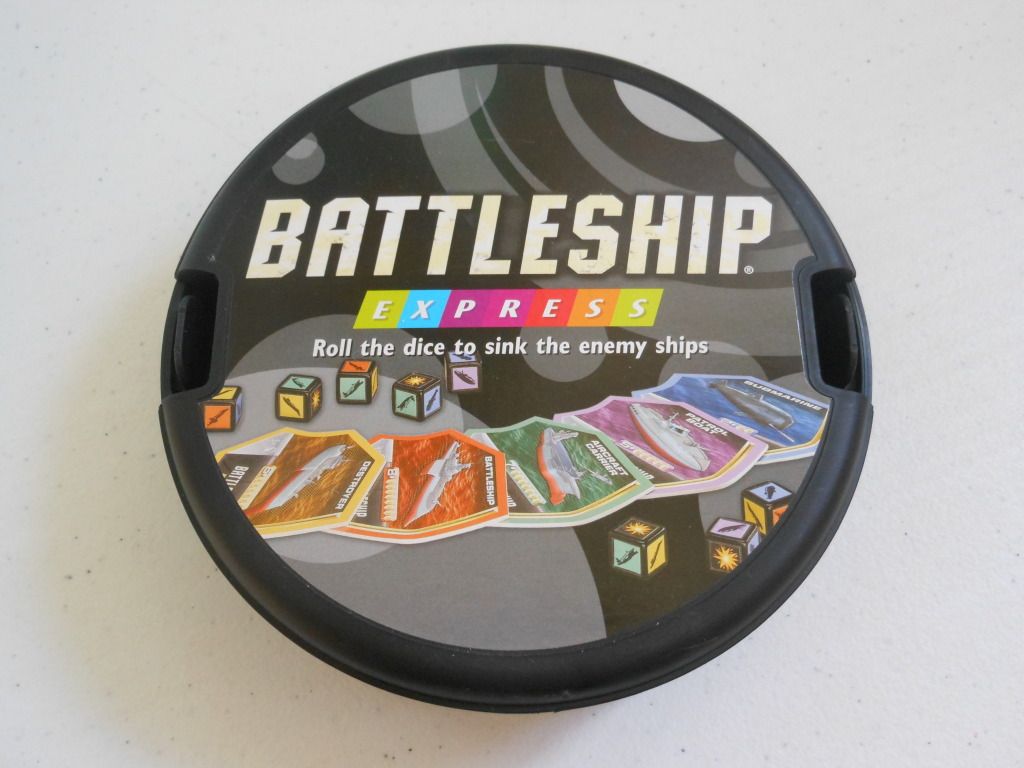
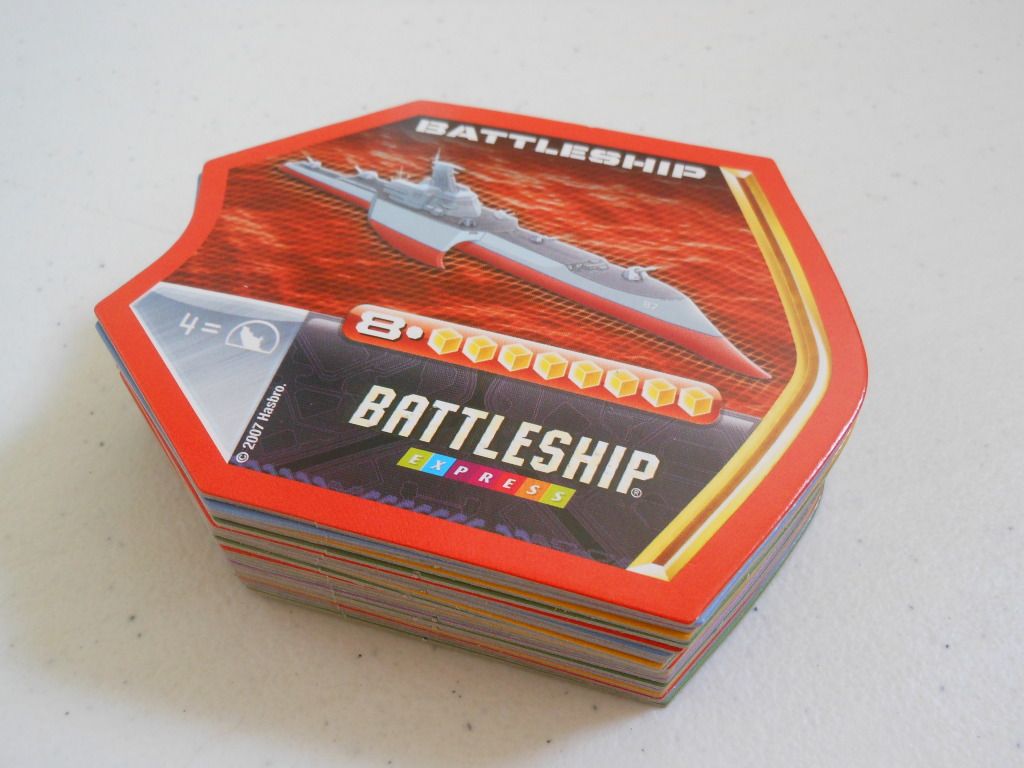
The game is nicely presented in a plastic case which also doubles as the pod for rolling the dice in. Inside this case you will find a deck of 20 ship cards; these are thick, good quality cards die-cut in an unusual shape with one convex side and one concave side. This shape is completely unnecessary, but makes the cards look like the epaulets on a captain's jacket, so it's a neat touch. The shape also makes it easy to remember which card is at the front of your line of battleships and which card is at the back of the line.

Battleship Express - the cards
The cards are shaped like little epaulets - cute!


The rest of the game comprises eight special attack dice. These are simple black plastic with stickers affixed to each face. Five sides of the dice show a picture of one of the types of vessel in the game as a silhouette while the sixth side shows an explosion symbol.

Battleship Express dice
Typical Hasbro dice - chunky, with stickers affixed.


Instructions for a basic game and an advanced game are printed on a small leaflet. Clean and easy to read. Why there are basic rules is beyond me, because the advanced rules are still incredibly simple and I can imagine even very young children grasping them without any real difficulty.


Battleship Express rules
The rules are clear enough - you can skip the basic ones.


Overall, I was happy with the presentation and feel I got a good deal for my £4.

To play, each player takes five cards: one submarine, one battleship, one patrol boat, one destroyer, and one aircraft carrier. These cards are colour coded and show a pretty uninspiring image of the vessel, the number of hits required to sink it, the number of dice to roll when attacking with it, and any special rules. Special rules are only used in the advanced game, so the backs of the cards show a simplified version of the same vessel, without special instructions, and with some modified stats.

Each player lays out the cards in a row, in any order desired, and then the game can start.

You need to choose a start player, and I would suggest dicing off for it in the first game and then moving around the table, as the first player tends to have a big advantage over players that follow, particularly in two player games.

On a turn, you can pick any of your vessels to make an attack. You select the card for the ship and move it to the FRONT of your line of ships. Then you pick a target: any opponent vessel that is either FIRST or SECOND place in their line of ships. So, as you can see, when you pick a ship to attack with, it is in turn moved to a position in your line of vessels where it can be attacked by an opponent on their turn.

You then roll to attack. Look on your card to see how many dice to roll, and then read the special instructions to see how many TIMES you roll, and then get rolling...

When you roll, any dice showing the silhouette that matches your TARGET is a hit. I thought this would be a bit tricky to see quickly at first, but the silhouettes perfectly match the outline of the ship drawings on the cards, and the background for the silhouettes are colour coded to match the ship cards, so it's really easy to work out hits. Also, any explosion symbol is also a hit.

Any dice that are hits are set aside; any dice that are not hits can be rerolled. You get the number of rerolls specified on your ship card.

If you are playing the advanced game, each ship gets a special power:

The aircraft carrier rolls six dice once before selecting a target, and then rolls again. Also, it does not move to the front of the line when attacking, which is a good thing because the aircraft carrier is one of the easiest ships to sink.


Battleship Express ship card
Comparing the basic and advanced version of the Aircraft Carrier.


The destroyer gets six attack dice and two rolls, and explosions count as two hits.

The patrol boat gets five dice and three rolls, but no special powers.

The battleship gets eight attack dice and can roll four times, but explosions do not count as a hit.

Finally, the submarine only rolls three dice and gets no rerolls, but any explosion symbols count as an instant kill. Furthermore, the submarine can attack ANY enemy target, regardless of where they are in the line.

That's all there is to it. In a two-player game, play until one player has no ships left; in a three-player game, play until one player has sunk four ships; in a four-player game, play until one player has sunk three ships.

The game is incredibly quick to learn, set up, and play; as you would expect from an "express" game. It is also incredibly light. Even lighter than I was expecting. Considering it is a Knizia design, I was expecting something that would create a few interesting choices, or which would have an interesting scoring system, but really this is very simple. However, the theme is surprisingly strong, and the special ability of each ship really seems to match up with how you would expect that ship to work - the aircraft carrier can attack from the back by launching its planes, the submarine can attack any enemy ship from underwater, the battleship is inaccurate but can soak up lots of hits, and so on...

I actually quite enjoy the game. As a 20-minute filler it is perfect, and I can see me cracking this out when my parents are visiting for tea. Unfortunately, after even a few plays I think the available strategies are quite obvious and you never really feel like you are torn between making interesting choices. You are always going to try to sink the patrol ships and aircraft carriers first in games with more players, as these ships are the easiest to sink (only three hits required) and you only need to sink three or four ships to win. In a two player game, you are always going to try to take out the hard hitters: the destroyer and the submarine. Only the destroyer and submarine have a good chance of destroying a battleship, so if you can destroy them both then you have a good chance of winning. This is why the first player tends to have an advantage. If the starting player can sink a ship on the first turn, an opponent is always going to be on the back foot.

For £4, I would recommend it as a light filler; just don't expect Knizia at his best. In fact, don't really expect to feel like you are playing a Knizia game at all.