Showing posts with label winging games out the window. Show all posts

Saturday, 7 September 2013

The Purge

Well, it had to happen sooner or later...

I've had a clear out.

I know, I know. What am I thinking?

Well, I'm thinking I have too many games. Not including expansions, individual decks of cards, or multiples of existing games, I have (had!) about 150 games spread across three book shelves, and a large part of my study floor.

I decided enough was enough (when actually enough is never really enough, if I'm being honest).

I have a lot of games I don't enjoy, and a lot of games I am never going to play again. I even have some games I have never, ever played and probably never will. And at some point, you have to draw a line in the sand.

So I got rid of some.

I got rid of quite a few actually.

First out of the door was Platoon. I purchased this game on eBay in 2012, and I was pretty excited about it. I made the purchase at a time when I was trying to expand my collection to include some different styles of games. The only other chit-based war game I have is the rather lovely Valley of the Four Winds (which I haven't reviewed yet), so I thought this was a niche I needed to fill. What better way to fill it than with a game based on a film I love?


Platoon
Platoon.


Platoon was released in 1986, and allows you to recreate four of the fire fights in the film. It looks great, it really does. You get a lovely mounted board (in two pieces), and lots of chits to represent your characters, many of which are those from the movie. While in many war games a chit will represent a large number of troops, in Platoon a chit is just a single person, and that lends the game a nice, claustrophobic, skirmish feel, which is perfectly suited to the theme of sweaty, brutal, jungle fighting.


Platoon unit chit
Look out behind you!


What I liked even more about the chits is that they are designed to stand up on little plastic stands, which means (a) they are easier to move around, and (b) your opponent can't see what each chit represents because they can't see what's on the side facing you. This allows for an exciting "fog of war" element, enabling you to use "fake soldiers" to lure out troops and create ambushes.

It all looks fabulous.

But, there's a reason I don't have war games in my collection. I don't really like war games. I don't really ever feel the urge to play them. Furthermore, I normally game with at least two other people, so two-player games just don't get as much of a look in these days. If I am going to play a two-player game, I will usually be playing against my wife, who has about as much desire to play a game about Vietnam as she has desire to listen to one of my renditions of Lady in Red while pushing a trolley around Tesco.

Of course, there is a very real risk that I have just got rid of a really good game; but as I would probably never get to play it, I might as well sell it to someone who will get more enjoyment out of it.

Close on the heels of Platoon was Incursion. I reviewed Incursion only a few days ago, and frankly, I wasn't impressed. I felt that it took the muscular, beating heart of Space Hulk, and then added a load of extra mechanisms that just didn't work: Card play that lacked any strategy, command point manipulation that created ridiculous situations, and overwatch rules that were horrifically overpowered in every way you care to imagine. I might have been tempted to keep the game if I didn't have Space Hulk, but I do, so I didn't. So there.


Incursion
Incursion - a beautiful turd of a game.


Another game that I recently reviewed before winging out the window was Conquest. This is actually an exceptionally good game. I mean a really good game.

I mean a really clever, elegant, well thought out, beautifully simple, deeply strategic game.

By which, I mean, a game that just wasn't fun.

If you could dedicate the time to getting good at the game, then I think you could have a lot of fun with it. But in my limited experience, I found it too difficult to get my head around.

Another good two-player abstract game that I got rid of was Quantum. This might be surprising to anyone who read my review, because I was very positive about the game. However, I eventually realised the game just wasn't getting played. And it was so incredibly beige it was making my other games look drab.


Quantum
Quantum - remake it in better colours and I'll probably buy it again.


Still, I wonder if getting rid of Quantum is something I will eventually come to regret, because... Well... It is a damned clever game.

For very different reasons, I also got rid of Reiner Knizia's Head-to-Head Poker. This isn't a very good or interesting game at all. Furthermore, you can play it with just a deck of cards, so why have a big box taking up space on my games shelf?
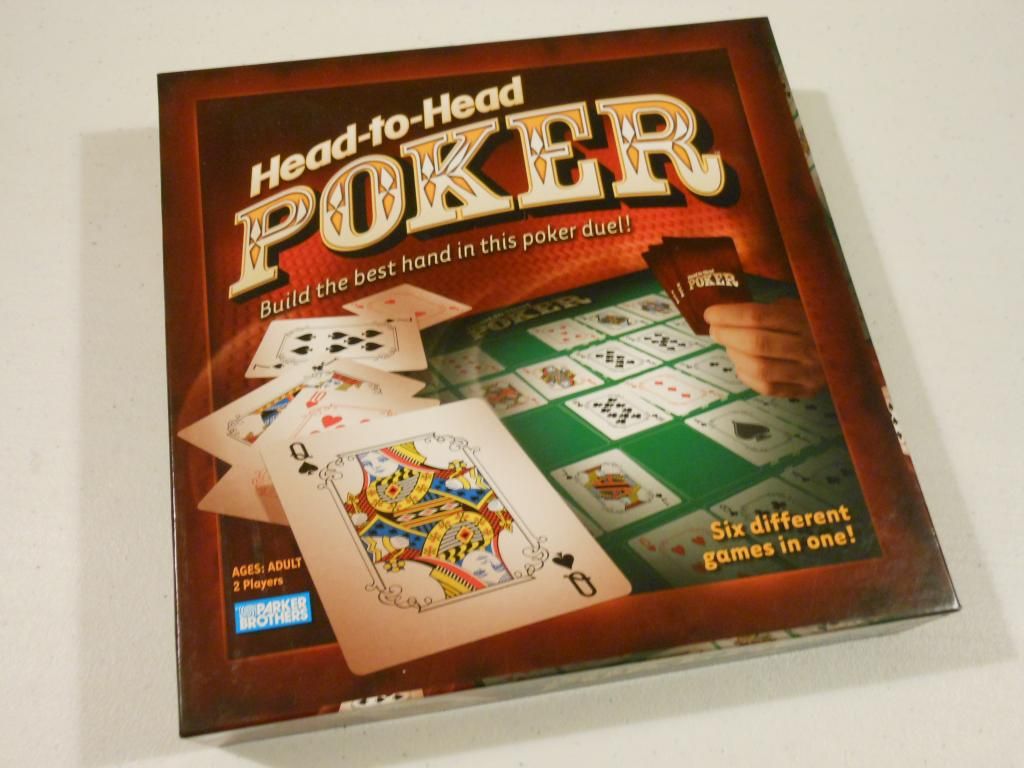

Head-to-head poker
Head-to-Head Poker.


Speaking of games that aren't very good or interesting, I also got rid of Summonaria, Chaotic, and Huntik. I reviewed all three games in recent weeks, and I really have nothing more to say about them. Three bad games that were eating up space that an equal number of good games could be filling.


Chaotic
Chaotic decks.


Finally, I got rid of Trivial Pursuit, simply because I have no bloody clue why I had the game in my collection in the first place. I hate trivia games.

So there we have it. My games collection has been thinned out (a bit). And it's going to get thinner still. I have at least three or four more games that I intend to get rid of (once I have reviewed them).

The question is, what am I going to do with all this new space?

Where did I put my credit card...?

Tuesday, 11 December 2012

Review - Switch 16

Switch 16
Published by Tomy
Designed by Anthony Vadasz
For 2-4 players, aged 7 to adult


Switch 16
Switch 16: the cunning dice-rolling card swapping family wrecking game


I don't have a very big gaming group, it's basically my wife and two of my best friends; however, on special occasions like Christmas, the family gathers around for "quality time" and I get to play some games with them as well. Now, once upon a time, those games would have been Scrabble, Trivial Pursuit, or Monopoly. I can't stand Scrabble, I loathe Trivial Pursuit, and Monopoly should not be played at Christmas (it is supposed to be the season of goodwill, after all). That being the case, I always try to roll out something different. I know I'm not going to be able to get my "non-gaming" family to play Arkham Horror or Marvel Heroes, and that's why my collection of board games also contains a bunch of "family-friendly" stuff that I normally wouldn't look twice at.

One such game is Switch 16, a game so completely and utterly random and chaotic that it makes me feel queasy to think about it for too long. This is a game that I would have been happy to wing out the window after the first game, but my parents really liked it, so I have kept it (it's still better than bloody Trivial Pursuit, after all).

Now, Switch 16 really isn't my sort of game. It has no theme for a start (where are all the dragons?), and as already mentioned, no real strategy or skill. Each player has a deck of 16 cards (numbered 1 through 16), and the aim of the game is to be the first person to discard the card numbered 16. This is achieved by rolling dice into the rather nifty dice tray.

Actually, before I go on, I should spend a moment to talk about the dice tray... The game doesn't have a board in the usual sense, it just has a plastic tray with four indents (one on each edge) for holding the decks of cards for each player, and a central well with a foam lining into which dice are rolled. Even though the game isn't great, this tray is quite cool; and if you can find this game really cheap in a charity shop you might want to get it just so you can use the tray elsewhere.


Switch 16 dice tray
The rather nifty dice tray - almost makes it worthwhile... almost


Enough about that, back to the game:

Each player puts a deck of 16 cards in the allotted space on the perimeter of the dice tray, with card one at the top and card 16 at the bottom. As well as a number, each card has a picture of some dice, and this indicates the number of dice you are allowed to roll, along with a special "switch" dice that has special instructions on it instead of numbers. For example, card one has a picture of three dice, meaning you roll three dice plus the "switch" dice.


Switch 16 cards
Switch 16 cards


Why are you rolling dice? Quite simply, to try to match the number on the card. If any single dice matches the number on the card, or you can combine two or more dice to equal the number on the card, then you are allowed to remove that card from the top of your deck and discard it. If you are then able to use the same dice results to remove the next card you may also do that, and you can continue through your deck until you reach a number you are unable to match.

That sounds a bit confusing, but it really isn't. Here's an example:

On my first turn of the game I roll three dice and get 1, 2, and 4. I can match card one, so I discard it. I can also match card two, so I discard it. I can match card three by combining 1 and 2, so I discard it. I can match card four with the dice that rolled 4, so I discard it. I can discard card five by combining 1 and 4, and so on... Sounds exciting, right?

Wait, it gets better!

Once you can't make any more combinations, you can pass, or you can take a risk. If you take the risk, you roll again; but if you can't match the card at the top of your deck after doing so, then a whole bunch of cards get returned to your deck (either taking you back to card one or card eight, depending on how far down the deck you have got).

Play continues round in this fashion until someone has discarded all of their cards, or someone drinks too much eggnog and suggests playing charades instead.

Matching dice rolls to cards isn't that bad, and it's pretty good for young children to help with maths; but what really annoys me about this game is the damned "switch" dice. You see, this special dice has a number of blank faces, and a number of faces with special instructions:

If you roll a green "switch" then you can swap decks with any other player (and will obviously swap with the person who has discarded the most cards). If you roll a red "switch" then you MUST swap with the person who has the most cards left to discard. Finally, if you roll "block" then you take a special "block" poker chip. This chip can be placed on any player's stack and will stop that player from discarding any more cards until he or she rolls a "block" (and therefore takes control of the "block" chip). Alternatively, the "block" chip can be used to stop another player switching decks with you.

And that's all there is, folks.


Switch 16 dice
"Switch"


Basically, it's a dice-rolling number matching game with heaps of added luck in the form of the "switch" dice. I can't describe quite how annoying it is to be on your last card, only to watch as an opponent (who hasn't discarded any cards yet), rolls a "switch" result, meaning you have to watch totally helplessly as your deck is swapped and you are basically set back to the beginning. It's one of those games where you honestly feel like it really doesn't matter what you do. If you discard loads of cards, it doesn't matter, because invariably someone will swap with you. Similarly, you shouldn't feel bad if you haven't got rid of any cards yet, because a single dice roll can put you in a winning position by allowing you to swap with the leader. Pointless!

The game rules suggest you can make "clever use" of the "block" chip; but as ownership of the chip is determined by random dice roll, there really isn't anything clever about it. There are no tactics to employ. You just roll the dice, and hope you match the numbers on your cards or get to swap with someone who is doing better than you.

There really isn't much to recommend Switch 16, beyond the fact that it isn't Trivial Pursuit. Nice dice tray, shame about the game...