Showing posts with label the worst starter sets in the world. Show all posts

Monday, 19 August 2013

Review - Chaotic: Trading Card Game


Chaotic Starter Decks


Chaotic: Trading Card Game
Designed by... A whole bunch of people
Published by 4Kids Entertainment
For 2 players, aged 8 to adult

Sigh.

Here we go again.

Why do I keep doing this to myself?

The other week, I reviewed Huntik, a trading card game that was so slow moving I could feel my beard growing while I played it. I purchased Huntik because I saw a starter set in a store for £1, and I really can't pass up a game (any game) if I can get it for £1.

And that's why I own Chaotic.

I don't like trading card games. I really don't. The starter sets are always weak, giving you crappy cards so you are forced to buy boosters; and then, when you do buy boosters, you just get loads of duplicates of cards you already have. I hate that. I hate that business model.

Hate it.

But I was in my local Poundland, and I saw Chaotic on the shelf. There were two starter sets. One was all shiny and red (the Underworld starter), and one was all shiny and blue (the Overworld starter). And they were £1 each. Of course I bought them.

So what did I get for my £2? I'll tell you... I got two boxes of very nicely illustrated cards with absolutely no game to play with them.

I know how trading card games work. I know that starter sets are designed to give you a taste of the game while still being unsatisfying enough that you are tempted to buy some boosters. But seriously, the starter sets for Chaotic are possibly the worst starter sets I have ever seen for a collectable game. Ever.

Each box technically contains everything you need to play, as long as what you want to play is a strategy-free, painfully slow game of Top Trumps crossed with... with... I don't know... the Devil, I think.

You get a 48 card pre-constructed deck (pre-constructed to be dull as ditch water), 4 "highly collectable" foil cards (kill me now), a rule book (surprisingly large and clearly written), and a paper playing mat (that sound was my soul dying).

Chaotic rule book
The Chaotic rule book


(Have I ever mentioned I hate paper playing mats? Oh yeah, in that Huntik review.)

The playing mat in each box only gives you "your" half of the board, so your opponent has to have a playing mat as well. The two mats are then placed side by side. The reason you need a mat at all is because this is yet another card game where movement and positioning is important.

Chaotic player mat
The Chaotic player mat (from the Underworld starter box)


The premise is simple. You have six monsters, and your opponent has six monsters. Your monsters move from space to space, and try to kill the enemy monsters. If you kill all your opponent's monsters, you win. It couldn't be a simpler concept: Beat up the other guys. But how do you achieve this?

(Caveat: I am now going to talk about the "advanced" game. There is a basic game, but there really is no point playing it. There's no point playing the game at all, but... you know... if you have to, just play the "advanced" game. If you have to. Like, if there's no way you can avoid it.)

As well as six monsters, each player also has in his hand six "mugic" cards. These are basically spells. They are called "mugic" because they are cast by playing music (see, music and magic make "mugic"). You also have six item cards, which are placed face down on the mat (one under each of your monsters). You have a deck of 10 location cards, and a deck of 20 attack cards.

On your turn, you draw a location card. This will be where the fight will happen. A location will usually have a special instruction (like, you can't play "mugic" here). It will also have an initiative symbol. The initiative symbol will match one of four traits that each monster has (courage, power, wisdom, or speed). This is where Top Trumps comes into the equation. You see, the monster that fights first is the monster with the highest value in the trait that matches the initiative symbol on the current location.

So, you and your opponent basically take it in turns to start a fight in a new location. You move one of your monsters onto a space containing an enemy monster, you reveal any item cards the monsters had face down under them, you compare the trait that is keyed to the initiative symbol on the location card, and then the monster who wins initiative attacks first.

You attack by drawing the top card off your attack deck. As you start the game with two cards in hand (plus all your "mugic" cards), you will have three attack cards to choose from.

You play an attack card, and then you and your opponent can take turns playing additional abilities, "mugic" cards (which are cast by taking "mugic" tokens off of monsters in your team, and those tokens are very limited), and stuff like that. At the end of this, the monsters take damage. And this is where the problem with the starter sets becomes evident: damage.

An attack card normally has some base damage, and perhaps a special ability. There might also be additional elemental damage that will be inflicted if the monster you are using has that particularly elemental symbol on his card. For example, if you play "Vine Snare" you do five points of damage. If your monster also has the elemental symbol for earth, you do an additional five points of damage. That's ten points total.

After damage has been taken, damage is marked on a damage track, and then your opponent gets to retaliate by going through the attack process again. This continues until one of the monsters dies.

Most of the monsters have at least 50 hit points.

Chaotic character cards
At least the art is nice


From that description, the problem should be obvious. Fights take ages. And ages. And ages. This is because (a) the attack cards in the starter decks are all very weak (normally doing a base damage of zero or five points), and (b) most of the attack cards key into elemental symbols that are not on the monsters in the pre-constructed decks.

Chaotic character cards
Two characters with no element symbols between them


The argument, of course, is that there will be more powerful attack cards in the booster packs; and once you have a few more monsters and attack cards, you can construct more powerful decks that are full of action cards that work better with the monsters you choose.

My counter-argument is that the starter decks should have been properly constructed so the game is playable right out of those starter boxes. You shouldn't feel like you need to buy more cards right away.

The game designers tried to be clever. They designed a game where the collectable aspect is intrinsic to how well the game plays. You need to buy lots of booster packs, because you need locations that have initiative symbols that play to the traits of your monsters, and you need attack cards that play to the elemental symbols on those same monsters, and you need items that play to the strengths of those same monsters, and you need "mugic" cards that key in to the traits and elements of your monsters. All the cards interlink, and I dread to think how many cards you would need to buy to have a good, functioning, powerful deck. And if you don't have a good deck, you have what the starter boxes provide: a boring deck.

The game is a soulless cash grab, with game mechanics geared around you buying more and more cards. The intention was clearly to encourage people to buy more boosters to get the benefits of deck generation. But all the designers did was encourage me to get rid of this game as quickly as possible.

Friday, 26 July 2013

Review - Anima Tactics

It's been quite a while since I updated the blog. I've had a lot going on, and every time I thought I would be able to sit down to write something... Well... You know how it goes.

Anyway, I'm back now, and this time I thought I'd do something a bit different. Not an out of production board game... Not even a board game... It is (to paraphrase Monty Python) time for something completely different.


Anima Tactics
Published by Cipher Studios
Deisgned by Carlos B. Garcia Aparicio
For 2 players, aged... Hell, I don't know

My involvement with the game Anima Tactics  has been rather unusual, and I'm going to say right from the start that I haven't played the game enough to give a proper review.

You see, I first heard about Anima Tactics shortly after it was released. I saw some photographs of some truly beautiful hand-painted miniatures, and I was immediately interested. Oh yeah, that's a point. I should mention that this is a miniatures game. You know? One of those games where you buy lumps of pewter that you have to stick together and paint yourself. Doesn't sound like your idea of fun? Best move on. Nothing to see here...

Anyway, back to the story.

I saw the miniatures, which had a sort of anime vibe mixed with Western influences, and my interest was piqued. Then I saw some of the artwork, which I really liked as well. It wasn't long before I had bought the two starter boxes that were available for the game at the time.

I was very excited to receive those starters, but by the time they had turned up, my interest had already started to wane (I'm fickle like that). I assembled the models, and tinkered with the game a bit; but I quickly realised that there wasn't enough "game" in the starter sets, and it would involve buying a lot more figures before I could get a real feel for whether I liked it. It started to seem like too much effort and money, so the starter sets got chucked in the back of the cupboard. Eventually, I forgot about them.

Recently, I was going through some stuff, and I found the two starter boxes. They looked so good, and I was reminded of what initially drew my interest to this game. I was compelled to do what I had never got around to the first time: paint the models.

Since then, I have bought another box of miniatures, and a few extras, and I am gradually painting them up. The starter boxes only come with a stripped down version of the rules, and that is what I have been playing with at the moment. The full rules are available as a gorgeous hardback book, but this game doesn't seem to have done too well in the UK and those rules are not easy to find. Luckily, my wife managed to source a copy of the rules for me; but she's doing that annoying thing where she says I'm not allowed it until Christmas. I mean, seriously? It's July! Don't you just hate it when they do stuff like that?


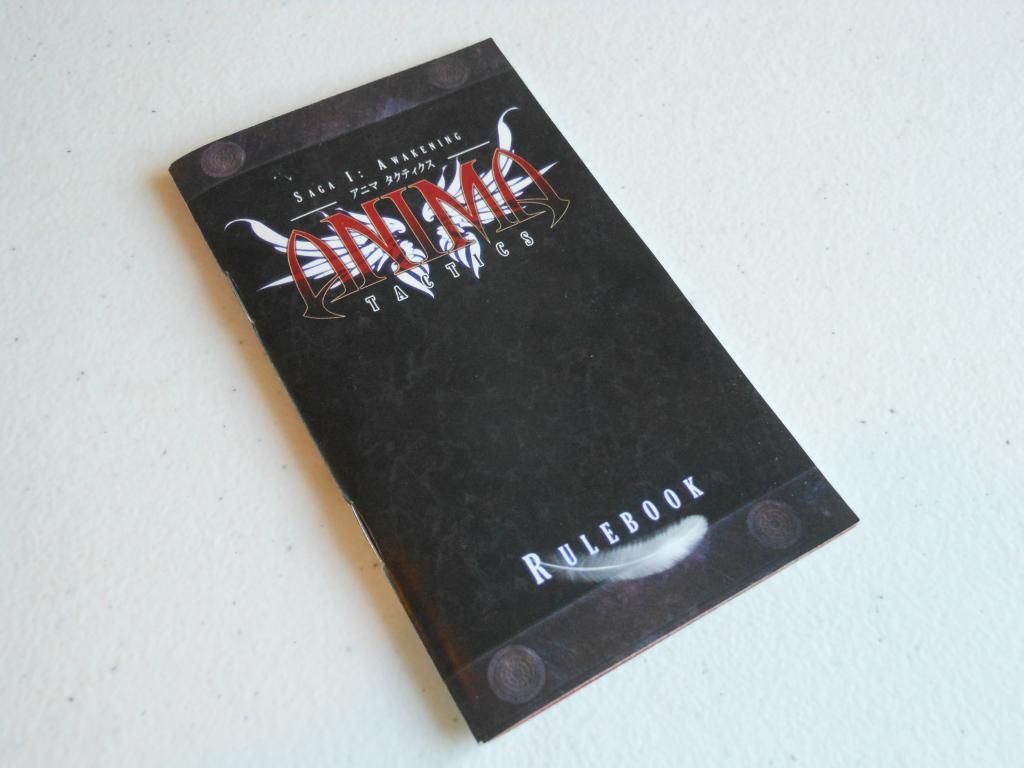
Anima Tactics rules
The starter rules - short, but functional


So, with that preamble out of the way, what is this review actually about?

As it stands at the moment, I have only played with the starter sets. That means I have only had battles with two characters on each side, using the basic starter rule set. That's what I'm going to be reviewing here.

It may seem odd to write a review based on such limited exposure to the game, but as far as I am concerned, if a company releases starters for a game, then the game should be playable (and reviewable) based only on the contents of those starters. However, I do intend this to be an ongoing project. As I paint and add characters to my games, I will post reviews of those new characters, and hopefully, over time, a bigger picture of what this game has to offer will be built.

Now, about that review...

First things first. You should know that Anima Tactics is a skirmish-based game. This was one of the things that appealed to me. I don't have time to paint massive armies, so a game in which most battles are fought between teams of just six to eight characters seemed ideal. Unfortunately, the starter sets don't give you six to eight characters. They give you two.

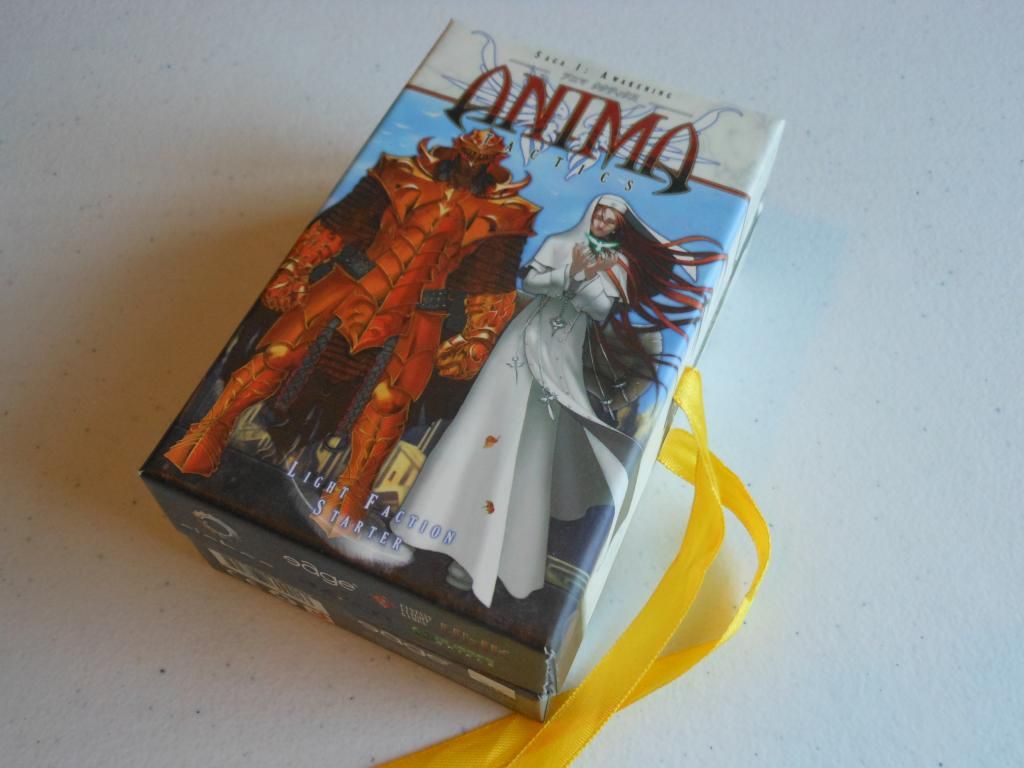
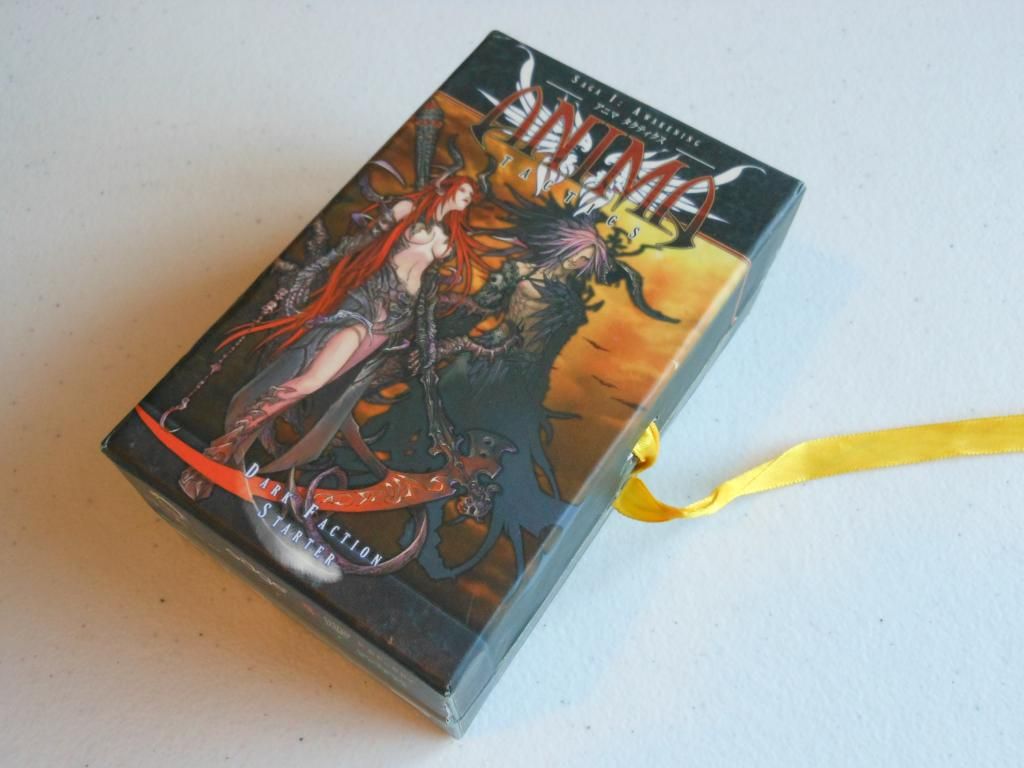
But let's start with the positives: The boxes that each starter set comes in are little works of art. Now, I love attractively designed boxes. I like to pick them up, look at them, stack them, put them on shelves based on their size. That probably makes me sound like some kind of window-licking weirdo, but there you go. I like boxes, and these are really nice ones. They have great cover art, and little ribbons on the side for tying them shut.


Anima Tactics dark starter set
The dark starter box... So pretty


Each of the two sets has the same contents: A condensed rulebook, some plastic counters, one dice, two pewter miniatures, one character card for each miniature, and two advantage cards (which represent equipment and tactics you can use during a fight). One set features "light" characters, and one set features "dark" characters.

The components are generally a mixed back. The miniatures are lovely, but of course, you have to paint them yourself. It should also be noted that I got the original dark starter set which included the characters Dark Chesire and Shinigami Ayl. Ayl was quickly switched out by the manufacturers, and the dark starter now features a different character called Bael. I believe the switch was made because Ayl was an absolute pain in the proverbial to put together. In fact, she was such a pain that I ended up modding her, so mine doesn't look like the one you will get if you buy her.


Dark Chesire and Shinigami Ayl


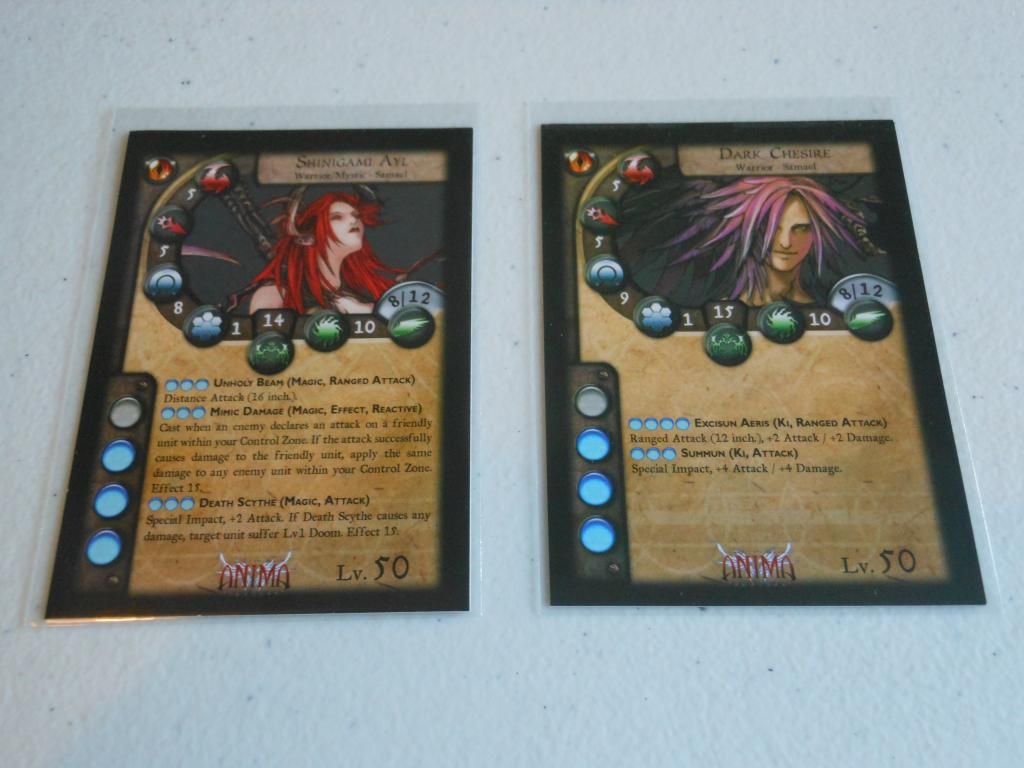
The character and advantage cards are also nice. They are a good thickness, and are well illustrated. They do have black borders and square corners, but as you don't ever shuffle the cards, this shouldn't be a problem.


Character cards for Anima Tactics dark starter
Dark starter character cards


The plastic tokens that you will use throughout the game are very thin, and a bit like tiddlywinks. They are functional, but cheap.

The worst component in each box is the sheet of tokens. These tokens monitor states during the game, such as poison and wounds. The token sheet is the size of a standard playing card, and you are supposed to cut them out. This obviously means they are very small, thin, and fiddly. I didn't even bother cutting them. I had a nice set of Games Workshop tokens made out of plastic, so I use those instead.


Anima Tactics tokens
The token sheet... My advice: Don't bother


Overall, the contents of the starters are fine, but it is their limited nature that causes the problem (and led to me shelving this game for so long). There just isn't enough stuff in each box. For a start, you only get two characters. That isn't even enough for a single warband, let alone enough to have a fight. I realised two characters wouldn't be enough, so I bought both starters at the same time, and then realised even that isn't good enough. Having only two characters limits your options each turn, and reduces what could be a tactical fight into a basic dice-rolling exercise.

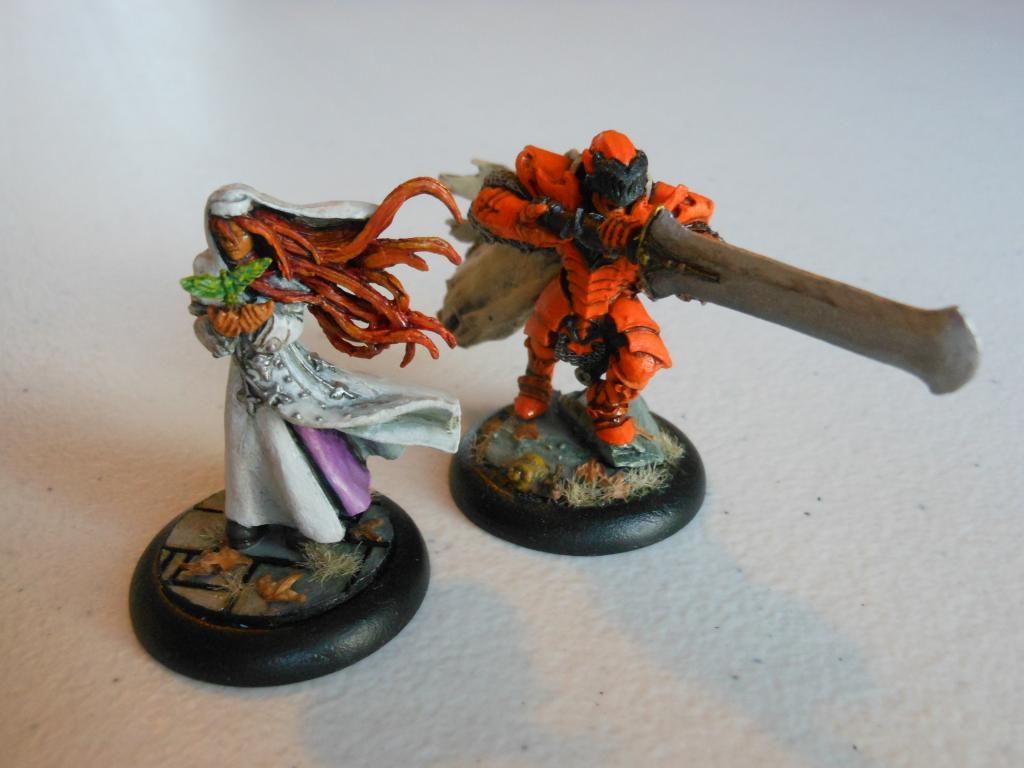
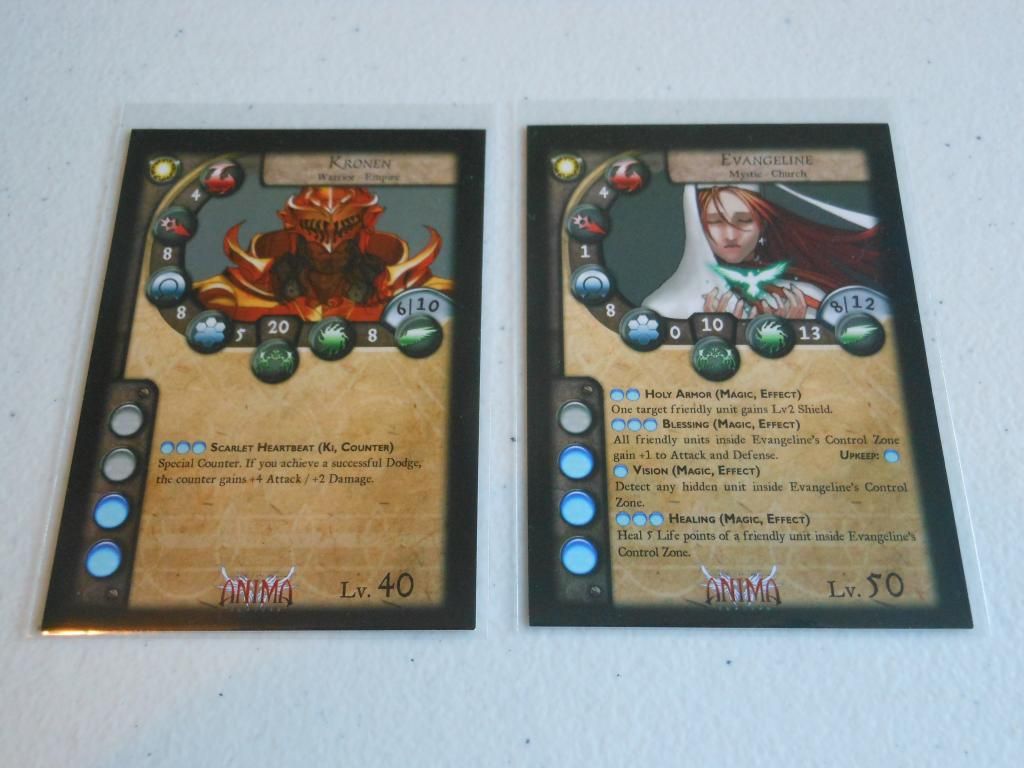
This problem is compounded by terrible balancing between the two sets. In the dark set, Chesire and Ayl are strong fighters with ranged combat abilities. In the light starter, you get a meat shield called Kronen, who can soak up damage but couldn't hit the broad side of a barn, and Evangeline, who is your standard mystic-type who provides buffs for other people on the team, but who can be killed with one hit. The dark team have a serious edge right out of the box, and you will definitely want to buy some extra characters straight away.

The other major problem, is the streamlined rules book. It is written well enough, but it is missing a lot of the rules that add tactical depth. Furthermore, you don't get any fluff about the world or the characters, which makes it difficult to feel invested in what you are doing. Getting that hardback rule book really seems like a must.

It's actually a real shame that the starters give such a poor first impression of the game, because the rules seem pretty good. I don't want to go into a lot of detail about them, but you basically put together a warband of certain size based on character levels. Most characters have a level between 40 and 60, so a  game with warbands totalling 200 levels will usually have about four characters per side.

When you build your warband, you can either build a dark force, a light force, or a force based on a specific faction. This is quite an interesting concept. Basically, each character has an affiliation and a faction. If you build a team based on affiliation, then you can pick characters from any faction, but they must all share the same affiliation (there are also characters with neutral affiliation, who can team with anyone). If you build a team based on faction, you ignore affiliation completely, but every character must be from the same faction.

The starters demonstrate this in action. In the light starter, you get two light characters, but one is from the Empire faction and one is from the Church faction. This means you can field the light starter as a light team, but not as a faction-specific team. Meanwhile, the dark starter contains two dark characters who are both from the Samael faction, meaning these two characters can work together regardless of how you decide to build your team.


Evangeline and Kronen


When building a team, you can add advantage cards, which you must also buy with levels.

Once you are in the thick of the fight, the most interesting mechanic is the energy system. Each character has an energy bar, which is usually four or five space long. Every turn, each character recovers a certain amount of that energy. The energy is used to power all of your actions and special attacks, so there is a kind of resource management going on. If you use all your energy to attack, you won't have any left to defend yourself or do anything else for the rest of the turn. It might then also take you a couple of turns to recover enough energy to be able to do anything else useful. It's a very cool system, and I really like it.

The combat is also pretty neat, as it allows your opponent to dodge, counterattack, and do special reactive actions. It is quite "mathy" though. The general concept is you declare an attack. Your opponent decides if he will dodge or counter. If he does, he expels some energy and gets to add the roll of a D10 to his defence (and, if he selected counter, he can attack you if you miss). You then roll a D10, and add your attack value plus any other modifiers. If your total is greater than the target's defence, you have hit. The difference between your attack roll and the target's defence is added to your damage value. You then deduct the target's armour value. The final result is the amount of wounds sustained. It sounds a bit complicated, but it is actually very straight forward, and combines "to hit" rolls with opposed dice rolls in an interesting way. You can also use characters to intercept charges from enemies in order to protect weaker characters.

It's all very fluid, and very exciting.

So, after all that, am I glad I dusted off those starter sets? The short answer is yes.

I am trying to paint up my other models as quickly as possible, and I am also putting together some terrain to play on (yeah, it's one of those sorts of games). However, the rules also provide instructions for playing on boards, for those people who don't like using tape measures, and I have tried this as well. I have also used hex-based grids from The Lord of the Rings: The Tradeable Miniatures Game and that works really well too.

I have 11 characters in total, and I am excited to get all of them to the table. If only I could find a bit more time to paint them...

Now, I suppose I should do some kind of summary. It's tricky, because this is really a review of the two starter sets, but it is also a review of the game system.

I really like the game system. I don't think it is doing anything dramatically new or exciting, but it is a really solid system for having short skirmish games between eight or ten characters. Every character feels unique, and brings exciting new tactical options. In this game, you are not just fielding a bunch of generic soldiers. Every character has a history, an affiliation, and a team. Every character has unique special powers. It's almost like what would happen if a miniatures game and a roleplaying game had a baby.

I love a lot of the miniatures in the product line, and I think all four characters from the starter sets look very good indeed. There are definitely some ugly miniatures in the range, but the great thing is, I can just ignore them and build my unique fighting force with the dozens of other cool-looking characters I want to rush out and buy.

I also like the fact that each character comes with its own character card, so you don't need to keep buying army faction books or anything like that. If you see a character you like, you can buy it, knowing that you will be able to build it, paint it, and use it straight away. In fact, every miniature also comes with plastic tokens for marking energy depletion, and most also come with a new advantage card to give you even more army-building options.


Kronen and Evangeline character cards


But there you go, I'm talking about other characters and the game in general again. It's hard not to, when the system offers so much potential. It's just such a shame that the starters are a poor introduction. If you want to get into this game (and there are plenty of reasons to do so), the best plan is to get both starter sets, for the cool characters and the basic rules, and then also cherry-pick a few other characters you like the look of. If you enjoy the game, you can then buy a few more characters. Maybe you could invest in that hardback rulebook too...

Is it Christmas yet?