
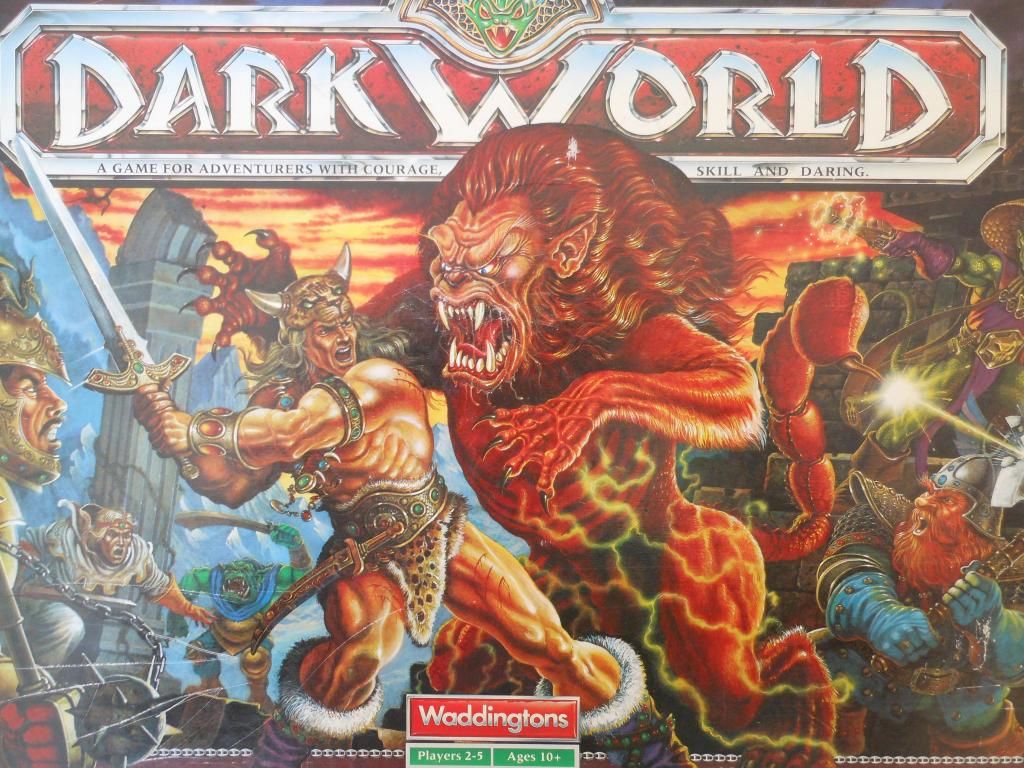
Dark World
Designed by Eamon Bloomfield
Published by Waddingtons
For 2 to 5 players, aged 10 to adult
The other day I was talking about stories. I explained how, when I play a game, I'm not playing to beat someone. I'm not playing to prove my intellect. I am playing so that I can sit down with people I love (or at least tolerate) and create stories. That's why I'm such a big fan of games with a strong theme. And frankly, there aren't many games that look more thematic than Dark World. A game with components that are so dripping with theme you expect them to play a tune when you open the box (a dark ominous tune, played on a pipe organ by a guy in a mask).
Dark World was very much a product of its time. It was released in 1992, when board game designers were doing everything they could to keep people interested in dice and cards. That meant lots of games were being released with a ridiculous amount of chrome (read "toys"). Unfortunately for Dark World, it missed the boat a bit. The incredible HeroQuest had been released three years earlier, setting a benchmark that few games could hope to match. Not that they weren't trying. Dark World was released into a market that was soon to be stuffed to the gills with dragon-slaying goodness, including the obscenely fun Legend of Zagor, and the much-maligned but surprisingly awesome Dragon Strike.
Dark World put up a brave fight in the face of better games, and even had two expansions (which are actually good games in their own right). Those expansions were Dark World: Village of Fear and Dark World: Dragon's Gate (I'll talk about those another time).
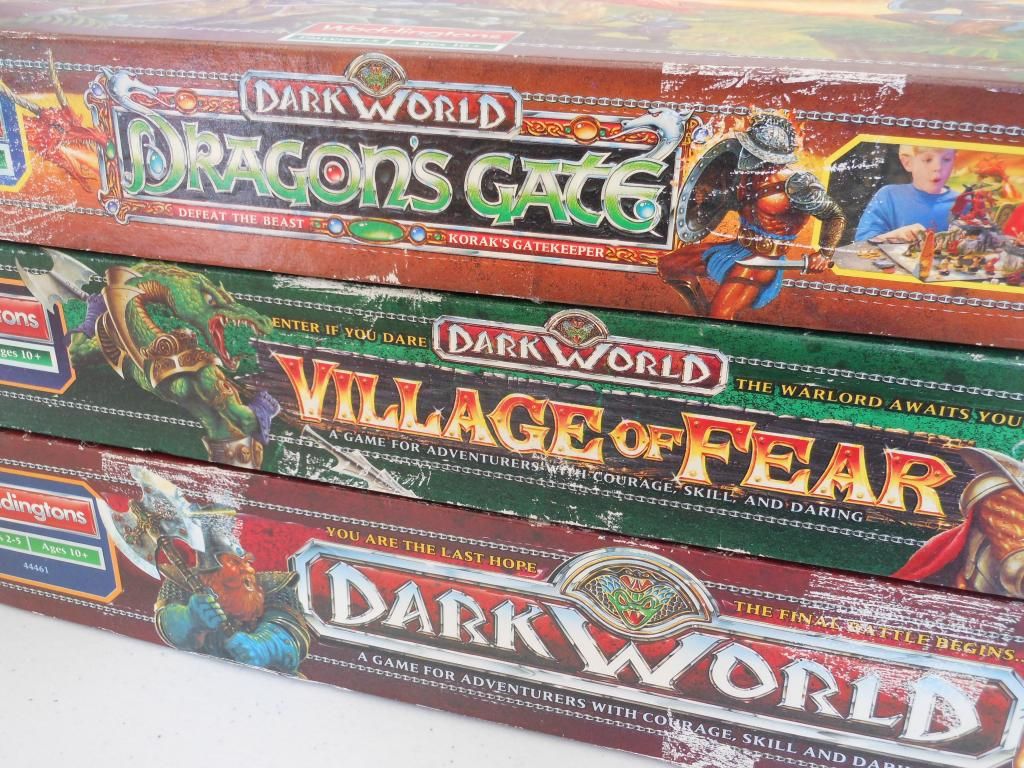 |
| The full set. Awesome. |
Put simply, Dark World was good, and it tried really hard to be great; but the competition was fierce. Most people never got to hear that theme tune, which is a shame, because it wasn't a bad little ditty.
But enough rambling, let's talk about what Dark World has to offer.
Well... What it offers is adventure. What it offers is a clutch of nicely moulded miniatures representing heroes and monsters (the heroes even have interchangeable weapons). What it offers is an entire three-dimensional dungeon.
What it offers, is stories.
And actually, a slightly more interesting rule set than you might suspect...
 |
| Rules - showing the board set up. |
You and up to four friends each select a hero, give him a basic grey weapon, a hand of three cards from the "hit/miss" deck, and then you set off into the dungeon. You're all working towards the same goal: Killing another one of your friends, who will be playing the awesomely named Korak the Cobran Nemesis (dum dum DUM), who is ruler of the dungeon, and master of its evil inhabitants. But here's the thing, while the heroes are all trying to kill the bad guy, they are not necessarily working together. They keep track of their own points (for killing monsters and gathering loot), and there will only be one overall winner. That's right, this is an early example of a comperative (?) game. It's all for one, and one for himself. After all, if you are going to overthrow an evil tyrant, you want to make sure you get the most credit for doing it.
But how do the heroes go about winning the day?
Each turn, a hero can take three actions, and each action is a movement of one space or a single attack.
Wait. Hold on.
No roll and move?
Sweet.
Anyway...
Heroes move through the oh-so-cool three-dimensional rooms until they reach an oh-so-cool plastic door that is on real hinges and really opens in such an oh-so-cool kind of way. And once the door is open, the proverbial really hits the fan.
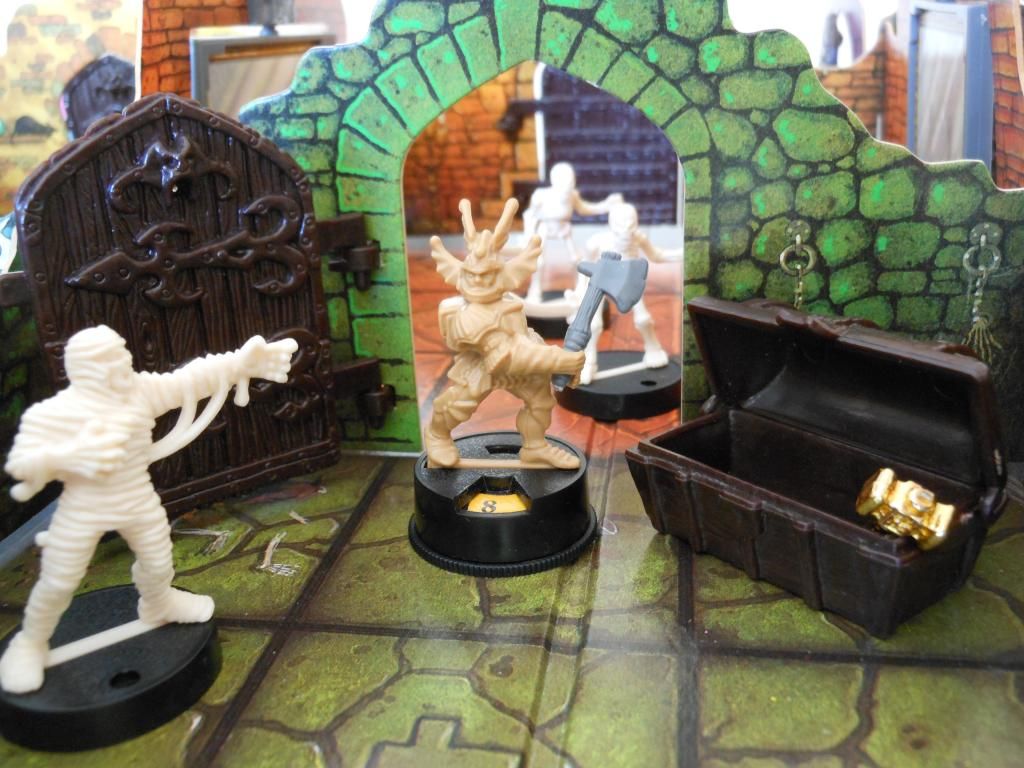 |
| The knight finds a magic hammer... and some new friends. |
Each room has a number printed on it. This number represents the total strength of the monsters that the bad guy can spawn in that room. Each monster has a value printed under the base, which is kept secret from the heroes. The bad guy selects up to two monsters to place in the room, with total strength less than the printed value on the room. The bad guy can select weak monsters if he wants, or he can use the strongest possible combo possible. He could even place a single weak monster to make the heroes think that the monster is stronger than it really is.
Wait. Hold on.
Bluffing? Genuine decisions for the bad guy?
Sweet.
Anyway...
Monsters spring out of the shadows, your heroes prepare for battle. If a hero has a basic grey weapon, he rolls two dice when fighting, but if he has found a golden magical weapon he rolls three. These are really nice custom dice, with sides showing blanks, one sword, or two swords. Each sword represents a hit.
After rolling, a hero adds up his hits. He can now play hit cards if he has them. Each card played adds one hit.
So, you're in a room with a single orc and you have rolled four swords. The room has a printed strength of five, so the orc could have a strength of five (meaning you need five hits). But maybe the bad guy was bluffing? Maybe this orc is just a sentry with no real combat experience. Maybe he's a runt who got left behind because he was too weak to keep up with the rest. You have one valuable hit card in your hand... What do you do?
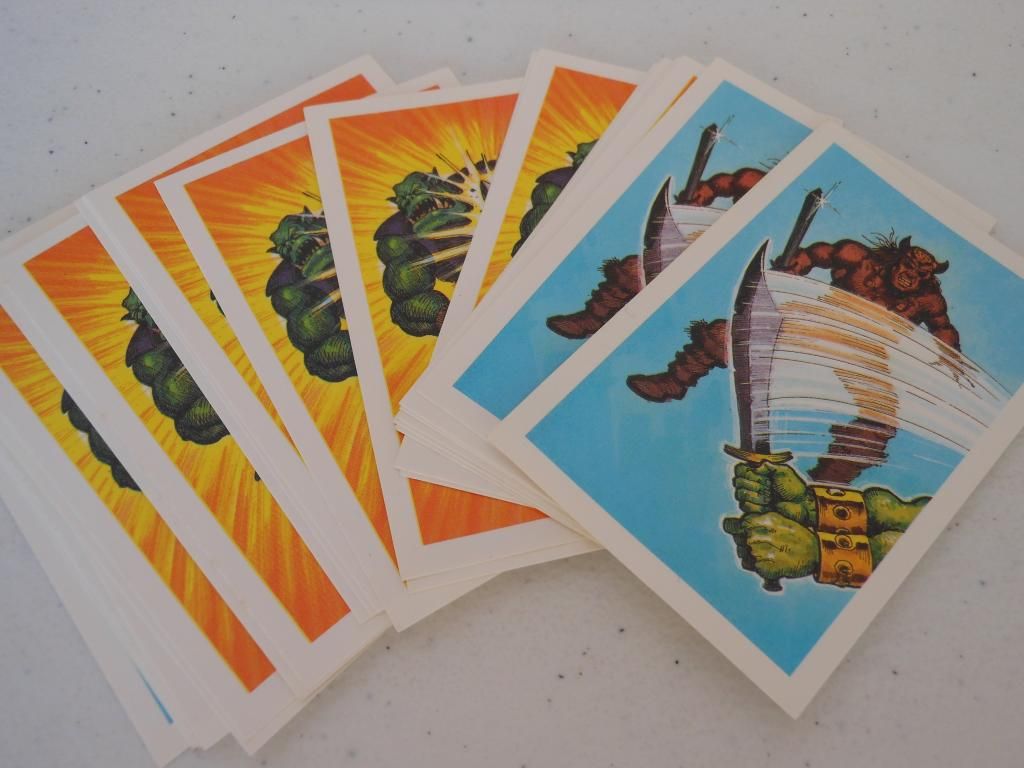 |
| Hit and miss cards. |
Shouting your battle cry (which in my group is something like "Tea, no sugar, please!") you throw down your hit card, and then you secretly check the base of the monster (because you don't want those other heroes to know what you know). The base strength of the orc is a one. You wasted your card, the bad guy laughs.
But as you casually slide the orc off the end of your sword, a small glass bottle slips from its hand and rolls across the cobbles. What's this? A healing potion.
Yes, like all good dungeon-crawling games, looting the dead is a prerequisite for victory. Each monster will drop a healing potion, some magic boots, or a grenade (!). All one-use items, and all incredibly useful. The best thing: They are represented with cute little plastic miniatures that clip into the bases of the monsters, so you can see in advance what loot you will get when you kill something.
So, wait. Hold on.
Dice rolling, push-your-luck, bluffing based combat? The ability to target the monster that gives you the loot you need? Grenades!
Sweet.
Anyway...
After you have finished an attack, the monster gets to fight back in the same way (if it's not dead, of course). The bad guy rolls two dice and adds up hits. The hero can then play miss cards to reduce the number of hits. The remainder i deducted from the hero's hit points, and are recorded by rotating the hero's clicky base.
Wait. What? Clicky base?
Yeah. Hit points for heroes are recorded with a Heroclix style click base.
 |
| Clicky bases are cool. |
Sweet.
Anyway...
Once all the heroes have activated, the bad guy gets a go. Korak gets three actions with each visible monster, and if there are more than a couple of monsters, the heroes are in a world of pain.
 |
| Korak the Cobran Nemesis. |
And then, the echoing clash of steel on steel dies down. The barbarian and the dwarf exchange a nervous glance. They've faced tougher monsters before, but there is something else... Something wrong with this place. The hairs on the back of their necks stand up, and the haunter silently glides through the chamber, stealing the life force of any hero or monster unlucky enough to get in its path.
Yeah. There are spooky goings on in this dungeon, and I don't just mean all the skeletons and mummies shambling around the place. The haunter is a very cool Grim Reaper type character. At the end of each of the bad guy's turns, a dice is rolled, and the haunter will fly along the board following a path dictated by that dice roll. Anything it touches dies instantly. Luckily, heroes regenerate, and the worst that happens is they lose a bit of ground by being sent back to the starting space (where there also happens to be a handy teleporter to get them back into the thick of the action quickly).
After the haunter has done his thing, a new turn begins. The awesomely named and oh-so-cool "Mace of Chaos" (a big, plastic rattle) is given a good shake, and the order of the coloured balls inside it dictate the order in which the heroes will move in the new round. Then it's back into the fray for more of the same...
I guess that's basically how the game plays out. The heroes advance, they fight some monsters, they find treasure chests that contain magical weapons that make them better at fighting monsters, they occasionally die and get respawned, and then, eventually, they make it to the awesome three-dimensional tower at the end of the board, where there is an epic showdown with Korak and his pet manticore. It's all quite simple really.
 |
| The final showdown. |
And that's the major problem with the game. It's quite simple.
Too simple.
There are some really interesting game mechanisms in the design, but they just aren't layered enough.
Take, for example, the four heroes you can pick from. They look different, but in the game they all work in exactly the same way. Same hit points, same number of actions, same number of attack dice. No special powers.
Take, for example, the starting grey weapons you can pick from and slot into the hands of your totally generic hero. They look different, but in the game they all work in exactly the same way.
Take, for example, the magic golden weapons you can find in oh-so-cool plastic chests that open on real hinges in an oh-so-cool kind of way. Those weapons look different, but guess what? They all work in exactly the same way. It isn't even necessary for each hero to find a specific golden weapon to use. Any weapon will do.
And then there are the monsters. Skeletons, mummies, orcs, and ogres. A beautiful, horrible wave of merciless dungeon denizens that want to rip your throat out... by rolling two combat dice at a time. Yeah. It doesn't matter what kind of monster you are facing. An orc works the same way as every other creature. There are no special powers, no variable attack strengths. Nothing.
NOTHING.
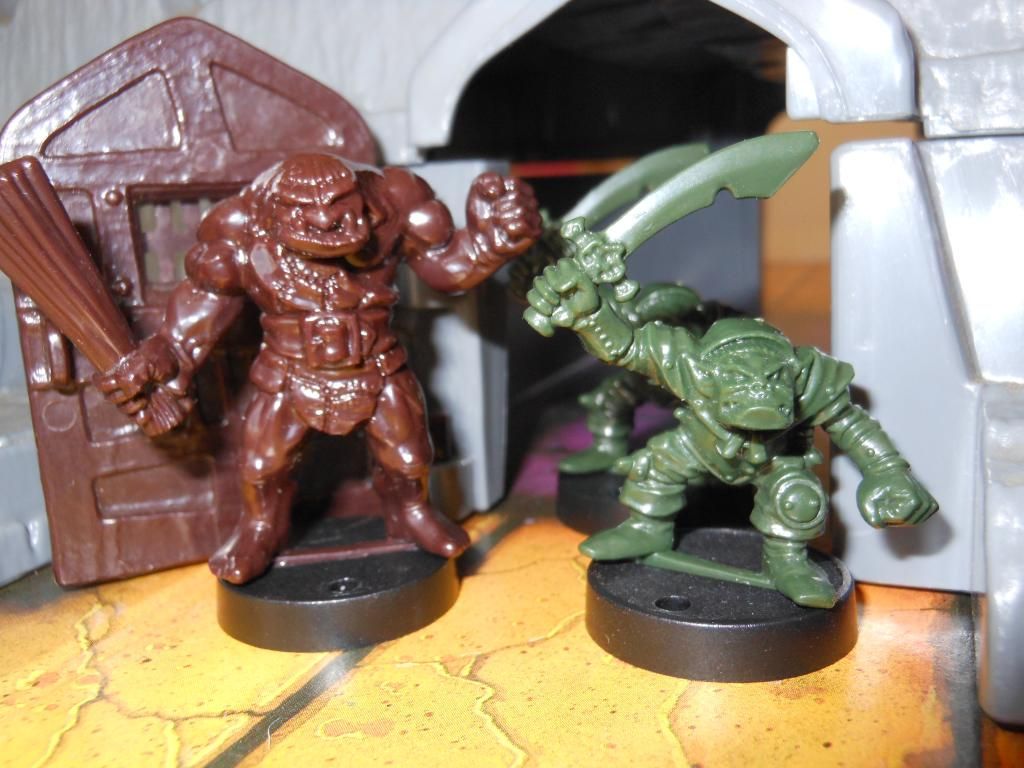 |
| Beasties! |
And that's a real shame. The game has so much chrome you might go blind when you open the box, but none of that chrome got applied to the rules. It's almost like half a job. The rules are good. They actually solve a lot of problems that rules for these sorts of games often have (roll and move, limited combat choices, nothing for the bad guy to do). The game isn't even scenario based, so is technically more replayable than something like Heroquest.
But you won't replay it.
Not as much as you should. Not as much as you want to.
Because this is a game that does tell stories. Stories of adventure. Stories of heroes fighting impossible odds. Stories of monsters and ghosts and evil tyrants.
But almost all of those stories will be exactly the same.
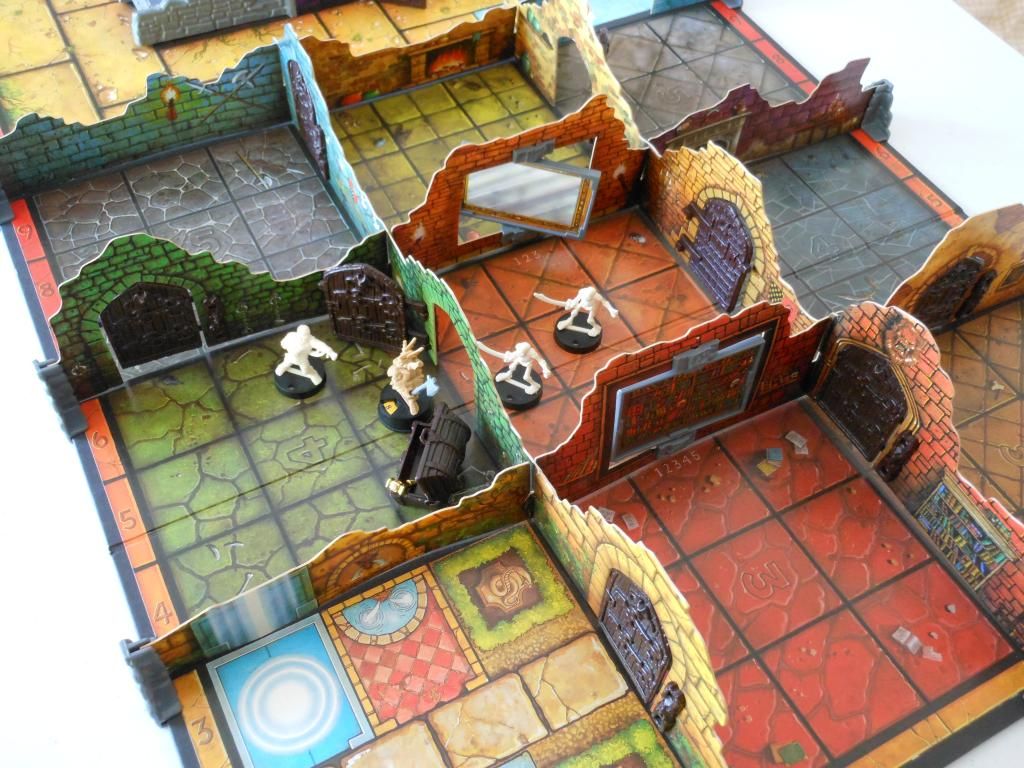 |
| That knight's in trouble... |
Before you go, I also wanted to mention a little curio I've heard about but never seen. It turns out that, a few years ago, this game got rereleased. It was completely reskinned with the Chaotic brand, looked completely different; but most of the mechanisms and board design from the original game were preserved. I would love to get a copy of this retheme so I can do a good comparison. If anyone in the UK has a complete copy they might be interested in passing on, do let me know.
